Your JitoSOL cheat sheet




At 21shares we say that JitoSOL is one token, providing two yields.
Issued by the Jito Network, JitoSOL came onto the market in November 2022 and has established itself as the dominant liquid staking asset within the Solana (SOL) ecosystem.
It is known for being the first to provide a two-way yield structure. And the result is full SOL price exposure with a built-in yield component and no operational complexity.
But what does this actually mean? And how does this actually work?
Our JitoSOL cheat sheet breaks it down into eight essential points.
1) JitoSOL in a nutshell
JitoSOL is a liquid token that represents staked SOL plus the rewards it has earned.
In terms of process: you deposit SOL into Jito’s staking setup; you receive JitoSOL in return; and, over time, JitoSOL increases in value relative to SOL as rewards accrue.
In terms of rewards: By swapping SOL for JitoSOL, the Jito Network keeps full exposure to the price of SOL while automatically earning two types of rewards: standard staking interest plus a "bonus" share of the network’s transaction tips.
In terms of flexibility: Unlike directly staked SOL, JitoSOL remains transferable and can be used across Solana’s DeFi ecosystem, including as collateral for lending or to provide liquidity.
A useful way to think about it: Staked SOL is similar to a bond held to maturity; it earns yield, but isn’t easily exited. JitoSOL is the tradable claim on that position, preserving both income and price exposure while remaining transferable.
2) Jito as an online tipping concierge
Think of Solana like a highway. When traffic is heavy, drivers will pay for the fast lane. On Solana, that fast-lane payment shows up as tips. This is where Jito comes into play: It doesn’t create the fast lane, nor does it create the tipping system; but it provides a clearer way to collect tips from users and distribute them to stakers.
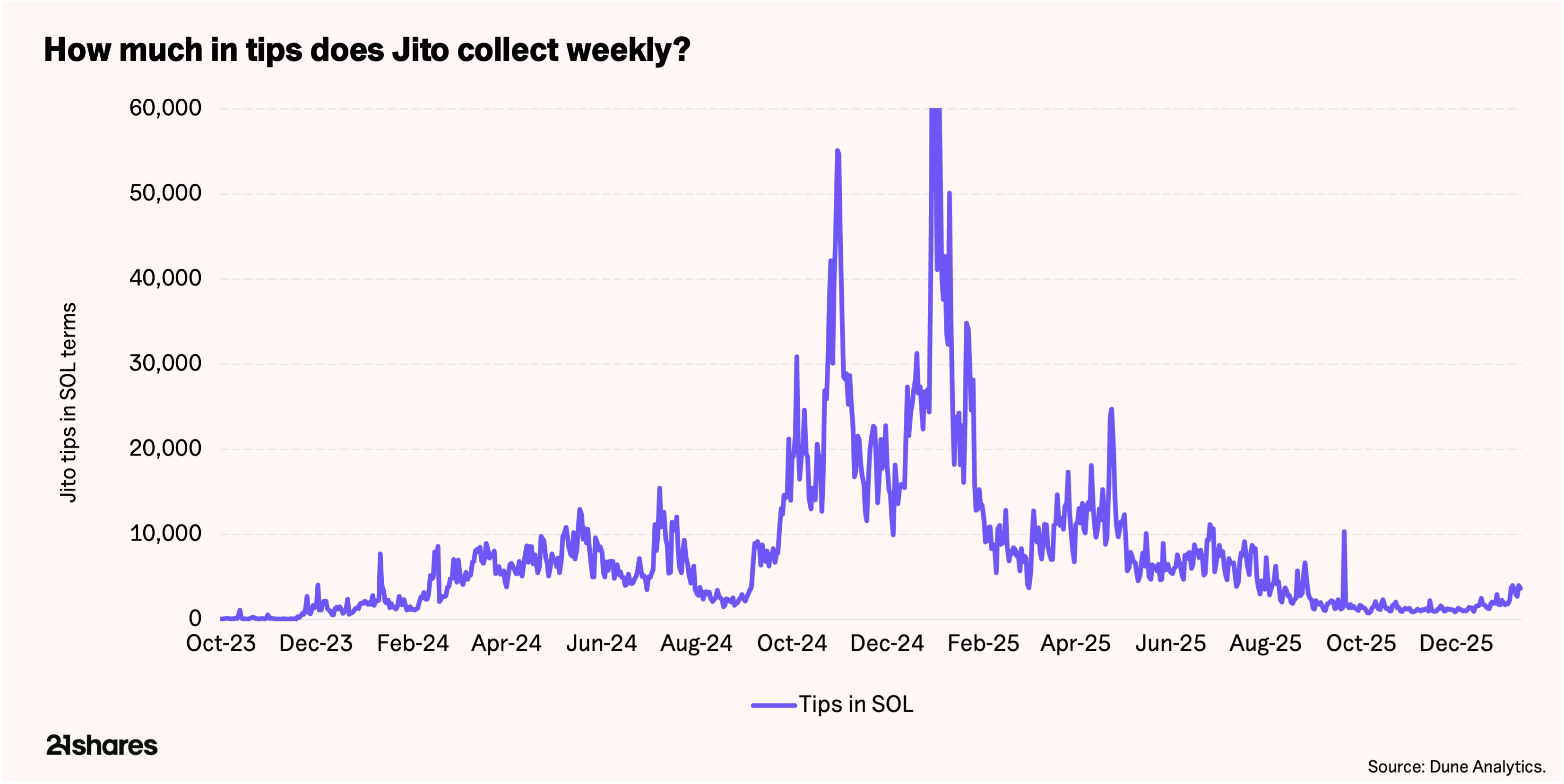
This means that on Solana, stakers can earn the usual staking rewards, plus an additional yield that comes from tips. The extra stream isn’t guaranteed, rather it rises and falls with respect to the network’s congestion.
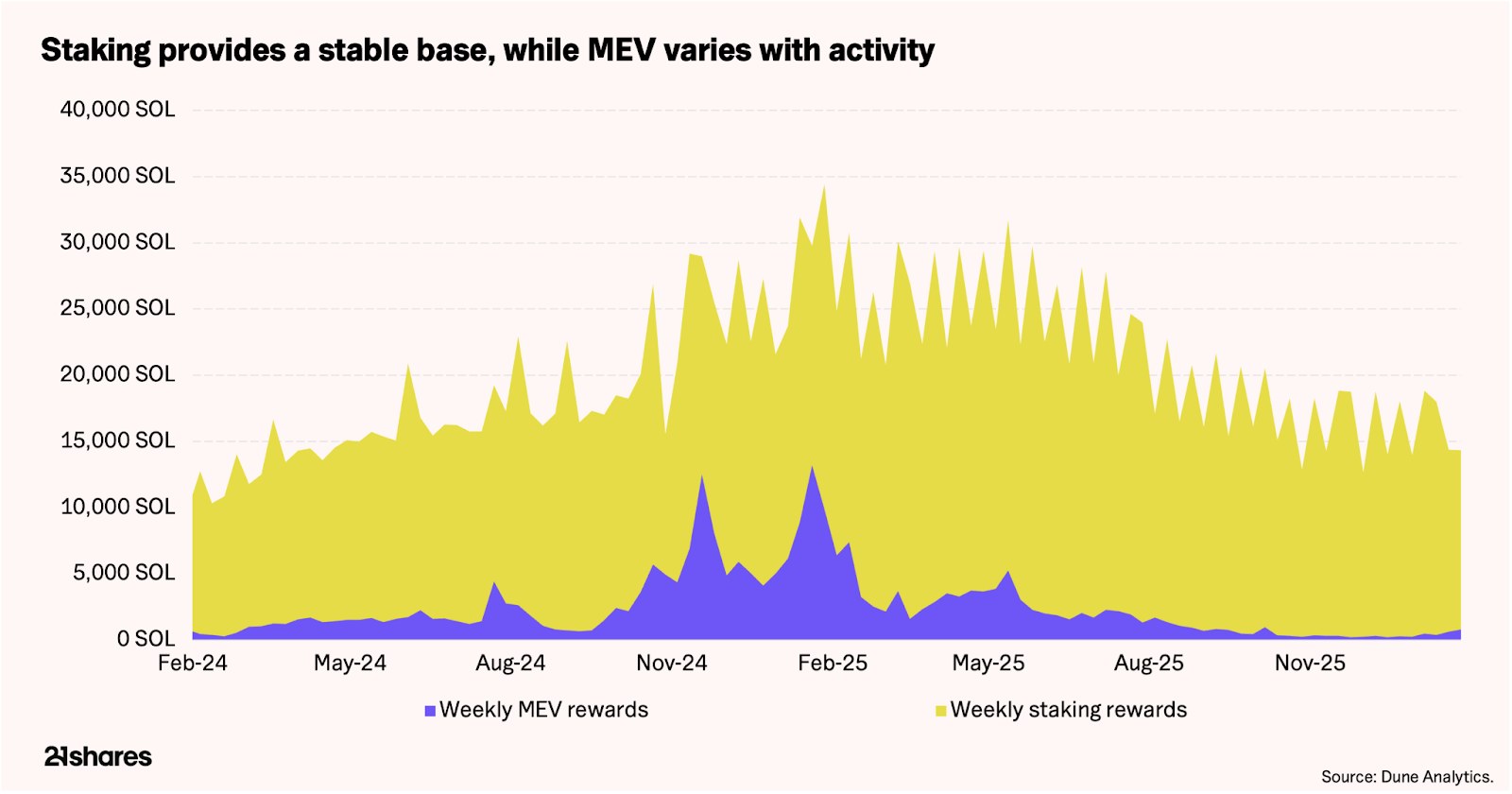
Think of Jito as the tipping concierge: it does such a good job of distributing the tips that it’s become central to the Solana system. Thus, JitoSOL lets its investors – also referred to as stakers – benefit from this extra income while keeping their stake liquid.
3) How Jito helps stakers access more value from transactions
MEV (Maximal Extractable Value) is a technical term for a simple concept: the profit generated by deciding the order of transactions.
On a busy network, transaction sequencing matters – and that sequence has value. In other words: Whoever controls the ordering can earn extra income.
Crucially, MEV is inherent to Solana; it exists with or without Jito. Rather than inventing MEV, Jito democratizes it. By moving transaction ordering into an open, competitive auction, Jito ensures this value is shared transparently with stakers rather than being captured by private actors. Thus, JitoSOL is the vehicle that lets investors share in fast-lane fees, alongside regular staking rewards.
4) Jito has become core to Solana’s staking market
Jito’s offering isn’t a niche product anymore. At this point, it functions as core infrastructure within Solana’s staking market.
As of 26 January:
- 71% of Solana validator clients use Jito’s software.1
- ~14.07m SOL staked through Jito-enabled validators (~2.5% of all staked SOL)2.
- JitoSOL accounts for almost 39% of Solana’s liquid staking tokens.3
This level of adoption matters because it improves: liquidity and market depth, operational credibility (more validators choosing to run it), and the likelihood that the “extra yield” mechanism stays structurally relevant.
Put simply, this scale is what makes JitoSOL work. More validators using Jito means more liquidity, stronger market depth, and a more reliable flow of extra income to JitoSOL holders.
5) Yield: what to expect, and what not to assume
Historically, JitoSOL has delivered a modest premium over baseline Solana staking, averaging around 30-60 basis points over longer periods. However, this premium is not fixed.
The incremental yield comes from execution-related income generated during periods of elevated network activity. It can therefore contract when network usage is lower, as fewer users pay for transaction priority or execution-related income declines.
In practice, JitoSOL’s yield advantage is cyclical: it tends to be more visible during busy periods on Solana and less pronounced during quieter market conditions.
6) JitoSOL adds additional risk beyond pure SOL exposure
JitoSOL replaces simplicity with flexibility. In exchange for liquidity and the potential for higher returns, investors accept additional risks. These include reliance on smart contracts, separate liquidity and pricing dynamics from SOL, and a yield profile that rises and falls with network activity more than traditional staking. Whether this trade-off makes sense depends on an investor’s comfort with variability and added complexity.
7) Liquidity: Why JitoSOL exists in the first place
Direct staking involves lock-ups and withdrawal delay periods, which limit flexibility. JitoSOL is designed to preserve liquidity while maintaining staking exposure.
JitoSOL can be redeemed into SOL, though redemption may not be immediate and can be subject to staking mechanics and prevailing liquidity conditions, particularly for extremely large redemptions.
For investors accessing JitoSOL through an exchange-traded product (ETP; or exchange-traded fund, ETF, depending on location), day-to-day liquidity is typically provided via exchange trading rather than onchain redemption.
8) Investor fit: flexibility versus simplicity
JitoSOL is designed for investors who want to earn staking returns while keeping their capital usable. The trade-off is straightforward: more flexibility and an additional yield stream, but also more moving parts, such as smart contracts, market-driven liquidity, and yields that change with network activity. Investors who prioritize simplicity may prefer holding SOL or staking directly, while those comfortable with variability may find JitoSOL more attractive.
______
Footnotes:
- Blockworks Research. (n.d.). Solana: Validator Clients — Analytics Dashboard. Blockworks. Retrieved February 2, 2026, from https://blockworks.com/analytics/solana/solana-supply-staking-and-validators/solana-validator-clients
- Dune. (n.d.). LST Staked Sol | Dune. Dune Analytics. Retrieved February 2, 2026, from https://dune.com/queries/5013486/8290960/
- Dune. (n.d.). Solana Staking, Validators, and Liquid Staking Tokens (LSTs) | Dune. Dune Analytics. Retrieved February 2, 2026, from https://dune.com/ilemi/solana-staking
This report has been prepared and issued by 21Shares AG for publication globally. All information used in the publication of this report has been compiled from publicly available sources that are believed to be reliable, however, we do not guarantee the accuracy or completeness of this report. Crypto asset trading involves a high degree of risk. The crypto asset market is new to many and unproven and may have the potential not to grow as expected.Currently, there is relatively small use of crypto assets in the retail and commercial marketplace in comparison to relatively large use by speculators, thus contributing to price volatility that could adversely affect an investment in crypto assets. In order to participate in the trading of crypto assets, you should be capable of evaluating the merits and risks of the investment and be able to bear the economic risk of losing your entire investment.Nothing herein does or should be considered as an offer to buy or sell or solicitation to buy or invest in crypto assets or derivatives. This report is provided for information and research purposes only and should not be construed or presented as an offer or solicitation for any investment. The information provided does not constitute a prospectus or any offering and does not contain or constitute an offer to sell or solicit an offer to invest in any jurisdiction. The crypto assets or derivatives and/or any services contained or referred to herein may not be suitable for you and it is recommended that you consult an independent advisor. Nothing herein constitutes investment, legal, accounting or tax advice, or a representation that any investment or strategy is suitable or appropriate to your individual circumstances or otherwise constitutes a personal recommendation. Neither 21Shares AG nor any of its affiliates accept liability for loss arising from the use of the material presented or discussed herein.Readers are cautioned that any forward-looking statements are not guarantees of future performance and involve risks and uncertainties and that actual results may differ materially from those in the forward-looking statements as a result of various factors.This report may contain or refer to material that is not directed to, or intended for distribution to or use by, any person or entity who is a citizen or resident of or located in any locality, state, country or other jurisdiction where such distribution, publication, availability or use would be contrary to law or regulation or which would subject 21Shares AG or any of its affiliates to any registration, affiliation, approval or licensing requirement within such jurisdiction.









_logo.svg)

.svg.png)