

President Donald Trump’s pro-crypto pick, Paul Atkins, has been confirmed as Chair of the Securities and Exchange Commission (SEC), marking a pivotal moment for the U.S. crypto industry. Atkins, who served as an SEC Commissioner from 2002 to 2008, is a well-known champion of market innovation with deep expertise in regulatory policy and digital assets.
He previously served as a board advisor to Ripple, the company behind XRP, currently the third-largest cryptocurrency by market cap. Ripple fought a long battle with the SEC during Biden’s administration, which has now been settled.
Atkins is now the CEO of Patomak Global Partners, a consulting firm that helps both crypto startups and traditional finance companies with risk management, regulations, and digital asset strategies.
Crypto industry welcomes Atkins with optimism
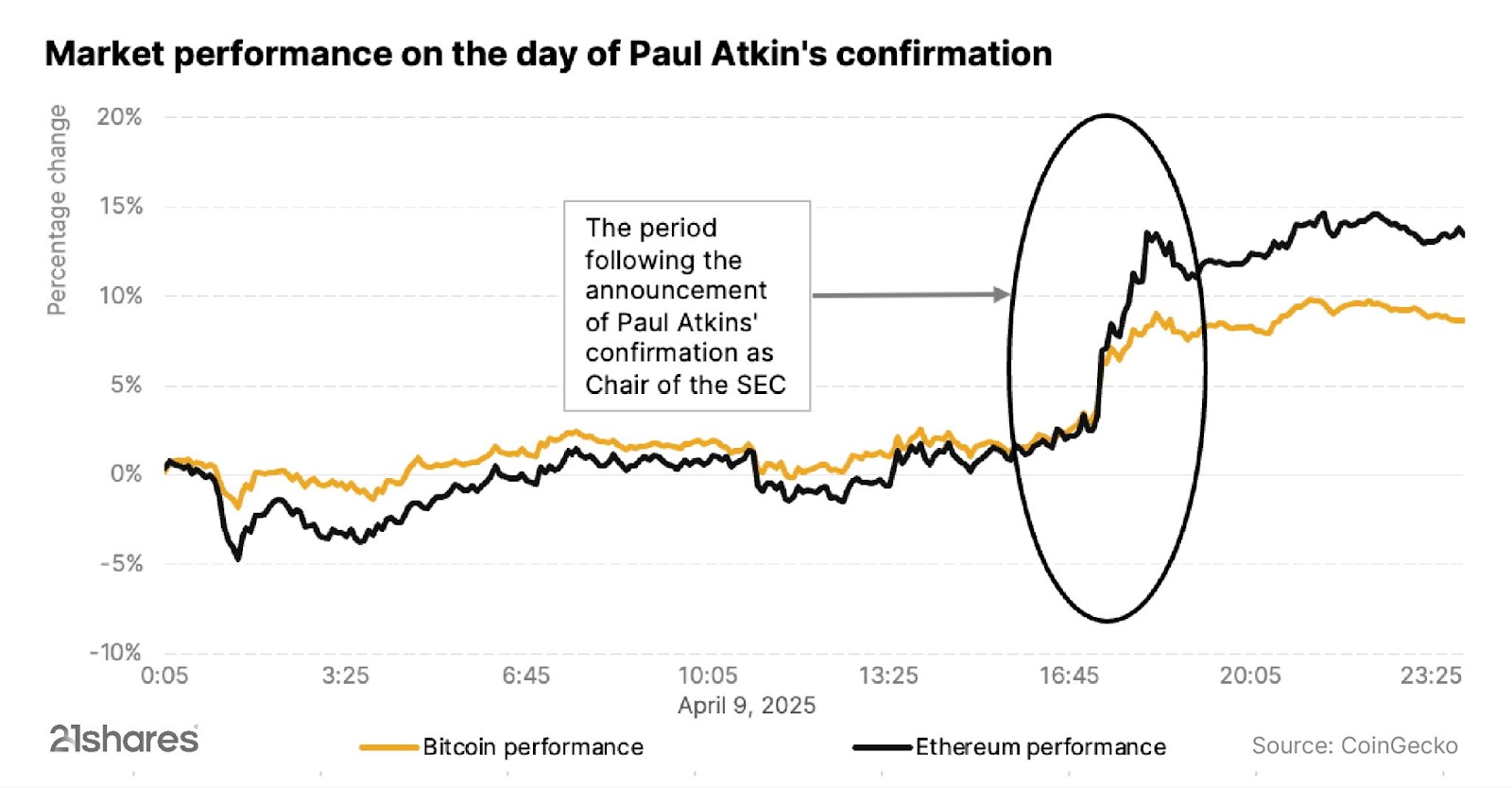
The crypto market seemed to celebrate Paul Atkins’ confirmation as SEC Chair. On April 9, Bitcoin surged from $78,700 to over $82,300 between 5:00 and 8:00 PM EST, while Ethereum climbed from $1,516 to $1,643—an 8.4% rally during the same window Atkins was confirmed—before pushing past $83,000 shortly after. The rally reflects growing investor confidence that the SEC, under Atkins’ leadership, may embrace a more innovation-forward approach, aligning with the crypto industry’s long-standing hopes for regulatory clarity and support.
Crypto’s wishlist: Clearer rules, more rails
This change in leadership is widely expected to accelerate the SEC’s review and approval process for exchange-traded funds (ETFs) that track the longer tail of crypto assets, such as Solana and XRP. With the SEC having delayed several key decisions on these products pending Atkins’ confirmation, market participants are hopeful that approvals could now move forward.
Atkins’ appointment could also unlock long-awaited features such as staking in Ethereum ETFs and in-kind redemptions in both Bitcoin and Ethereum ETFs, capabilities that are critical for keeping U.S.-based products competitive with their international counterparts. These enhancements are especially important for Ethereum products. Without the ability to earn yield through staking, institutional investors have been hesitant to allocate capital to ETH ETFs.
More broadly, Atkins’ arrival is seen as the beginning of the end for regulatory paralysis. His support for innovation and past efforts to bring clear rules suggest the SEC may finally shift away from scattered crackdowns toward real, thoughtful regulation. For the first time in years, there's real hope that U.S. regulators are ready to work with the crypto industry, paving the way for responsible growth and long-term adoption.
Early signs of change are already visible
Just after Atkins was confirmed, the SEC's Division of Corporation Finance issued new guidance for crypto projects. While not a formal rule, the guidance brings much-needed clarity for projects operating in the gray area of U.S. securities laws. The SEC now encourages issuers to clearly explain how their projects make money, validate transactions, and manage governance.
This guidance is temporary while the SEC's new Crypto Task Force works on creating formal regulations. Commissioner Hester Peirce emphasized that the goal isn’t to classify all crypto assets as securities but to give a clearer path for those that might be.
The SEC has also made it clear in recent weeks that dollar-backed stablecoins used for payments are not securities, and neither are proof-of-workmining or memecoins. These steps show the SEC is moving toward more rational regulation, which is expected to continue under Atkins.









_logo.svg)

.svg.png)