

Bitcoin began “Uptober” pumping through to $126K, setting a new all-time high. However, trade tensions between the US and China sparked a sharp drawdown, leaving some investors with a degree of hesitation. After all, allocating near highs can stir concern of “buying the top”.
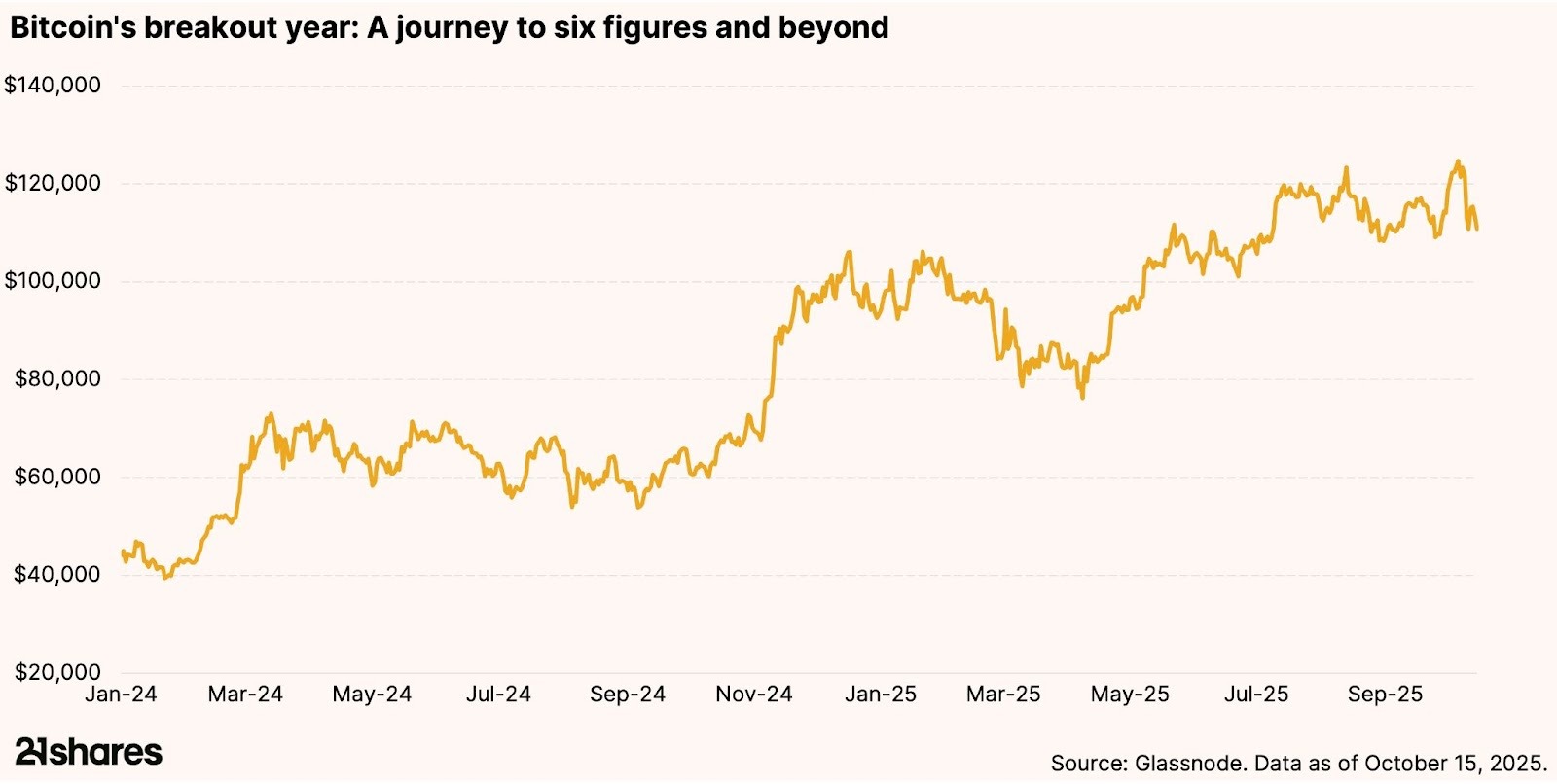
But as we illustrated earlier, time in the market trumps timing the market. That analysis showed that even if you had bought Bitcoin at the worst possible moment each year since 2020, your investment would still have more than doubled.
This concept shouldn't be foreign to equity investors either. The S&P 500 has historically traded within 10% of its all-time high nearly 75% of the time.
Does buying near Bitcoin’s peaks imply limited upside?
No, rather it reflects the steady climb of quality assets that consistently outpace the rate of persistent monetary debasement. In a world of structurally looser policy and increasing fiscal pressure, owning durable assets is more important than ever. So instead of focusing on whether we're too “high,” the more meaningful question is: Will Bitcoin be more or less important in one, five, or 10 years? Your answer to that will likely tell you whether a long-term allocation makes sense.
With Bitcoin trading near all-time highs and despite last week’s drawdowns, (currently around $1-7K, within 15% off its recent peak), the vast majority of investors, around 91% of entities, are sitting on unrealized gains, as shown in the chart below. What’s more remarkable is how consistently they’ve held onto them.
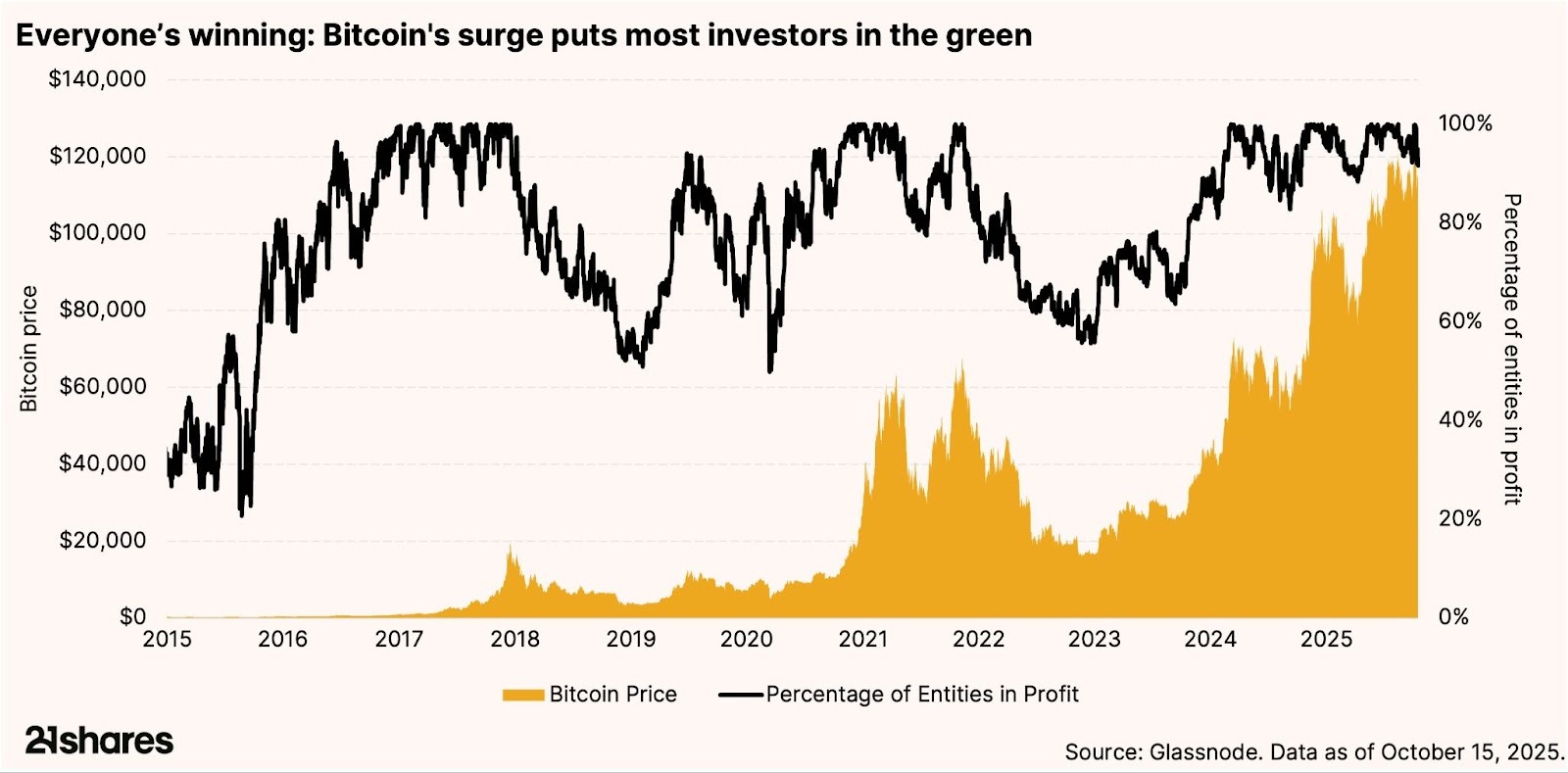
Since the launch of spot Bitcoin ETFs in the US in January 2024, the percentage of profitable entities has never dropped below 80%, even through macro stress like the yen unwind in Q3 2024, this year’s tariff-fueled volatility, or last week's geopolitical shock. And yet, we haven’t seen industry-wide selling pressure.
People are holding on to their Bitcoin. What changed?
During prior bull markets, elevated prices often triggered sharp changes in ownership, as weaker hands exited and new investors entered the Bitcoin race in fear of missing out.
This time, turnover at local highs has been far more muted, suggesting a calmer, more conviction-led investor base. Investors appear increasingly comfortable sitting on unrealized gains, showing a level of stickiness that’s new to this cycle; even if selling pressure emerges amid shocks, we've seen far more hands willing to purchase Bitcoin at what is considered discounted prices, resulting in corrections that hit with less depth and resolve more quickly.
Naturally, some profit-taking is still expected at these levels, but the data tells a different story: most are staying in, likely reflecting a growing shift in how Bitcoin is being perceived, less as a short-term trade, more as a strategic allocation.
But what happens if the market turns?
In prior cycles, Bitcoin routinely suffered drawdowns of over 50%, even while the broader trend remained bullish, often with major waves of profit-taking and no bidding hands to absorb supply, leading to prolonged consolidations. But in this current cycle? The most significant drawdown remains under 30% (with last week's fall a more modest 15%).
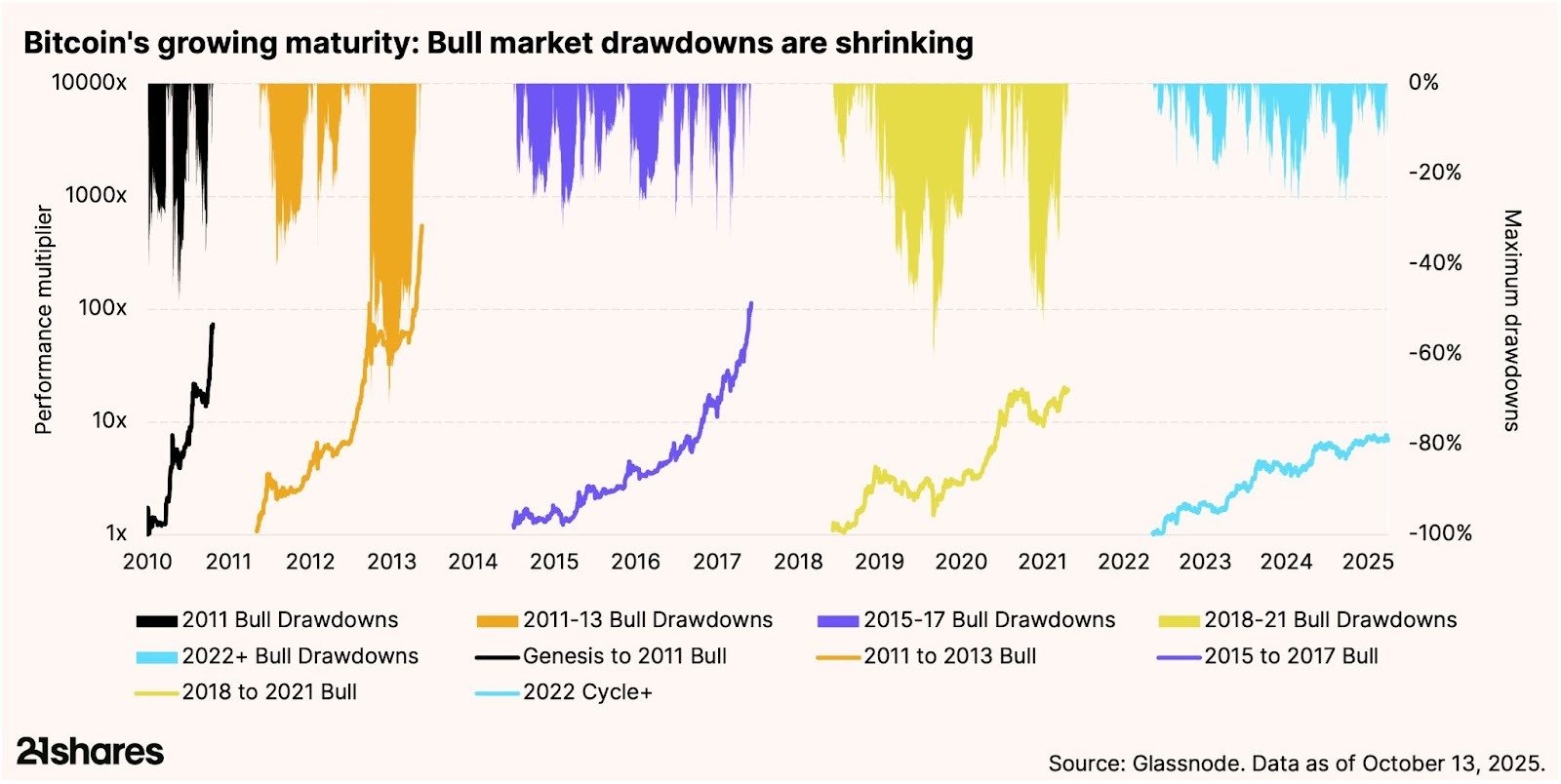
What’s different? Institutionalization. As Bitcoin cements itself within multi-asset portfolios and treasury reserves, its mechanics have shifted. With over $25 billion flowing into Bitcoin exchange-traded products this year, and corporate and sovereign entities acquiring over 6x the Bitcoin mined, the buy-side continues to absorb pressure, making any future drawdowns more likely to be modest and short-lived, not structural resets.
As a result, price action is beginning to reflect strategic asset allocation, institutional accumulation, and broader macro integration. This brings about a more “natural” price structure, with less explosive upside but also shallower downside. For allocators, that’s a trade-off worth embracing: the asset may be maturing, but so is its return profile, and downside risks are clearly compressing.
Bitcoin’s volatility profile isn’t just declining, it’s changing shape. We're seeing a shift in skewness: more persistent upside movements and fewer abrupt, downside movements.
A 5% portfolio allocation to Bitcoin
Now that we’ve laid out why Bitcoin remains a strategic long-term asset, even despite trading near all-time highs, the natural next step is how to practically incorporate it into a portfolio.
In the table below, we compare a traditional 60/40 portfolio with a more modern portfolio with a crypto allocation. This serves as an illustration based on historical data from the last three years. Interestingly, the time it took each portfolio to recover from its largest fall over the past three years, which happened in response to the US tariffs in April 2025, was less for the two portfolios with crypto (both 17 days) than for the traditional portfolio (22 days).
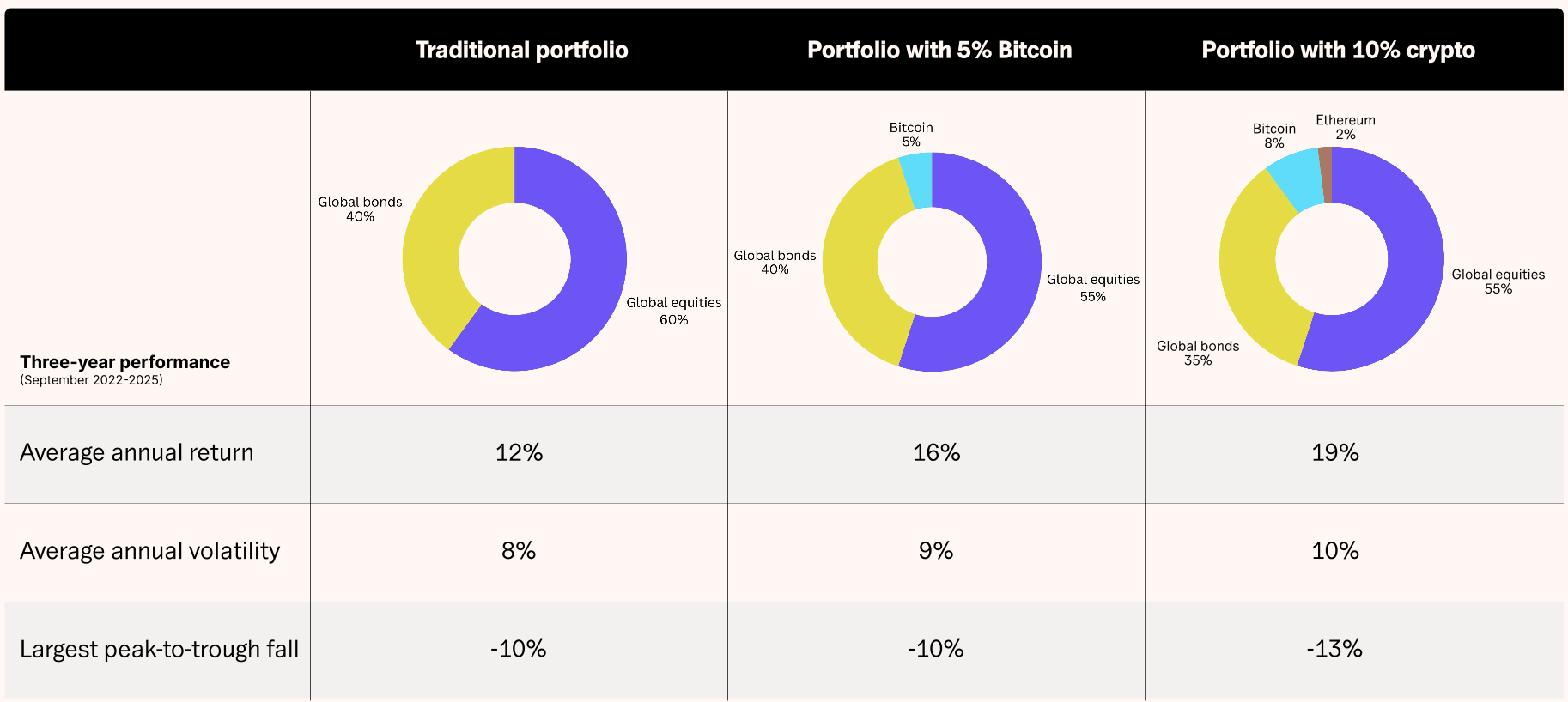
Returns and risk-adjusted metrics improved across all rebalancing strategies, while volatility and drawdowns remained manageable. Even without rebalancing, risk stayed in line, highlighting Bitcoin’s ability to deliver asymmetric upside without disproportionately increasing downside.
This supports a clear conclusion: when sized appropriately, Bitcoin can enhance portfolio efficiency across market cycles.
Conclusion: The case for Bitcoin allocation remains strong
Bitcoin has entered a new phase, defined by institutional adoption, deeper liquidity, and tighter integration into the global financial system. Even the worst-case historical investor would still be up more than 2x over the past five years, and drawdowns in this cycle remain the shallowest on record. Volatility isn’t just lower, it’s evolving. With upside skew increasingly driven by structural demand, Bitcoin is now behaving more like a growth-enhancing, risk-moderating addition to traditional portfolios.
A modest allocation, even just 5%, has proven capable of materially boosting risk-adjusted returns, while keeping downside risk in check.









_logo.svg)

.svg.png)