

XRP occupies an unusual position heading into the second half of 2026. The XRP Ledger (XRPL) settled $159.9 billion in the first half of the year, which counts as real, large-scale transaction volume, yet the fees generated from that activity fell 81.6% year-on-year, from $6.43 million to $1.18 million. Meanwhile, the stablecoin base sitting on the network grew 1,131% over the same period. The network is simultaneously contracting on revenue and expanding on the metric that matters most for its next chapter.
Understanding what that means for XRP holders requires separating what has already happened from what the infrastructure is being built to support.
Revenue fell sharply, but most of the decline was not from ordinary use
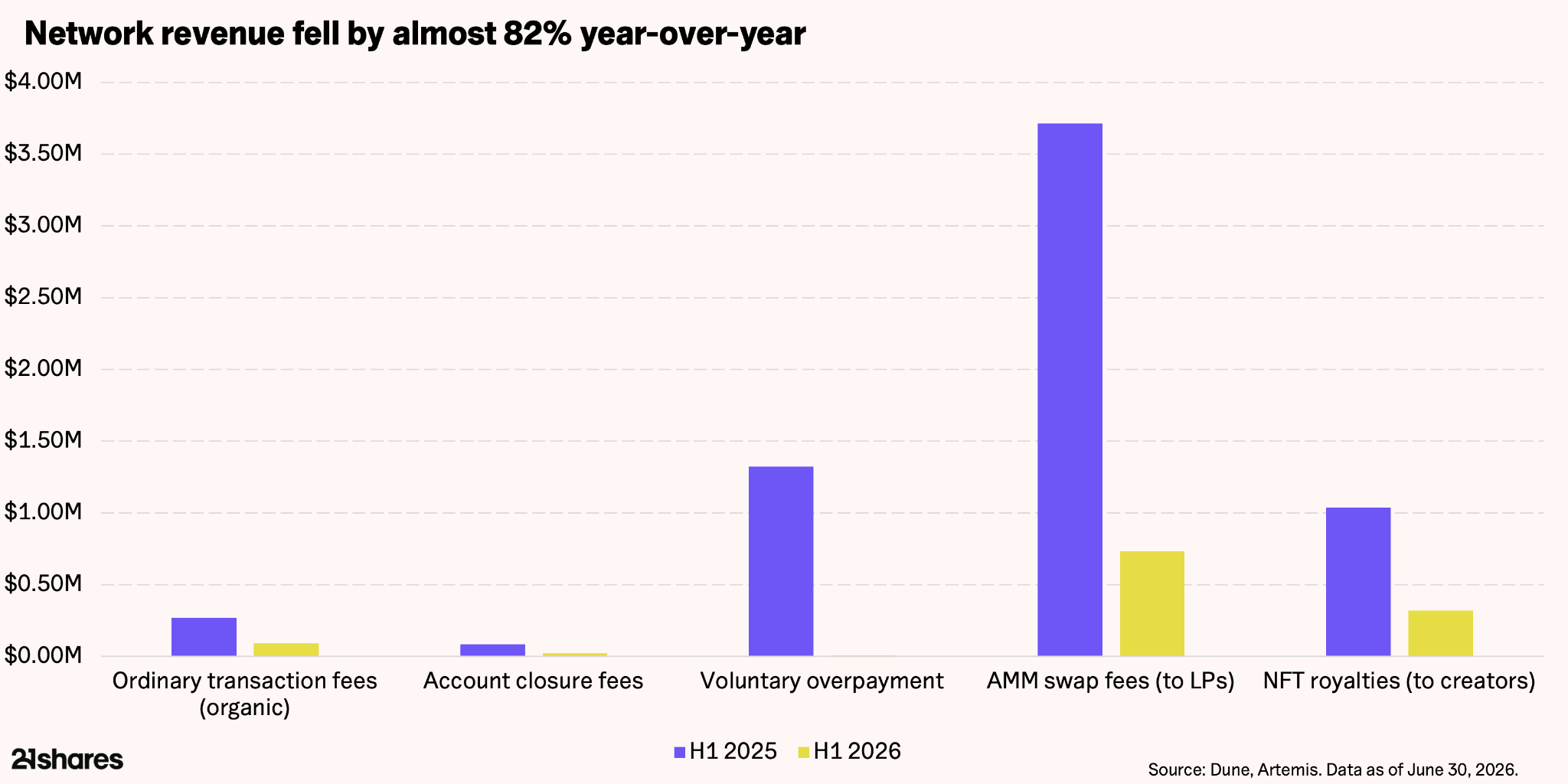
The 81.6% revenue drop looks severe. In context, it is more specific. Two revenue lines drove most of the decline: trading fees paid to liquidity providers on the XRPL network; XRPL's automated market maker fell 80.3% year-on-year, and NFT royalties fell 69%. Together, those two categories account for roughly 89% of total revenue. Ordinary transaction fees, the fees paid by everyday users sending XRP, fell a more modest 66.3%, from $269,600 to $90,800.
Another structural point is worth understanding: on the XRPL, fees are burned rather than paid to validators. Only three burn components (traditional transaction fees, account closure fees, and voluntary overpayments) reach XRP holders indirectly by reducing supply. The other categories, swap fees and NFT royalties, are paid to liquidity providers and creators, respectively. Of the $1.18 million in H1 2026 revenue, just 10.6% actually reached XRP holders via that burn mechanism.
The stablecoin base grew 1,131%, and that changes XRP’s investment case
Set against the revenue contraction, one number stands apart. Ripple's regulated dollar stablecoin, RLUSD, reached $1.56 billion in total supply by 30 June 2026, with 52% of that supply held on the XRPL, up from roughly 10% a year earlier. The company has made XRPL the primary issuance venue for its regulated dollar, a deliberate signal of institutional intent.
A deeper stablecoin base on the ledger matters because it creates the liquidity foundation that decentralized finance (DeFi) and tokenized real-world assets require. Those are the two demand sources for XRP that its payment rails alone have not reliably generated. In July 2026, Aviva Investors placed a share class of its USD Liquidity Fund on XRPL, with the Central Bank of Ireland's approval — joining abrdn, Ondo, and Société Générale, which had already brought a money-market fund, tokenized Treasuries, and a euro stablecoin onto the ledger. The institutional pipeline is forming.
The compliance infrastructure to support it is now live on mainnet. Credentials, Multi-Purpose Tokens, Permissioned Domains, and a Permissioned DEX (decentralized exchange) are operational on the XRP Ledger, giving institutions the controls they need over who can issue, hold, and trade assets. Lending, batch transfers, and confidential transfers are still missing, but the directional movement is clear.

XRP imposes the lowest dilution among its crypto payment peers
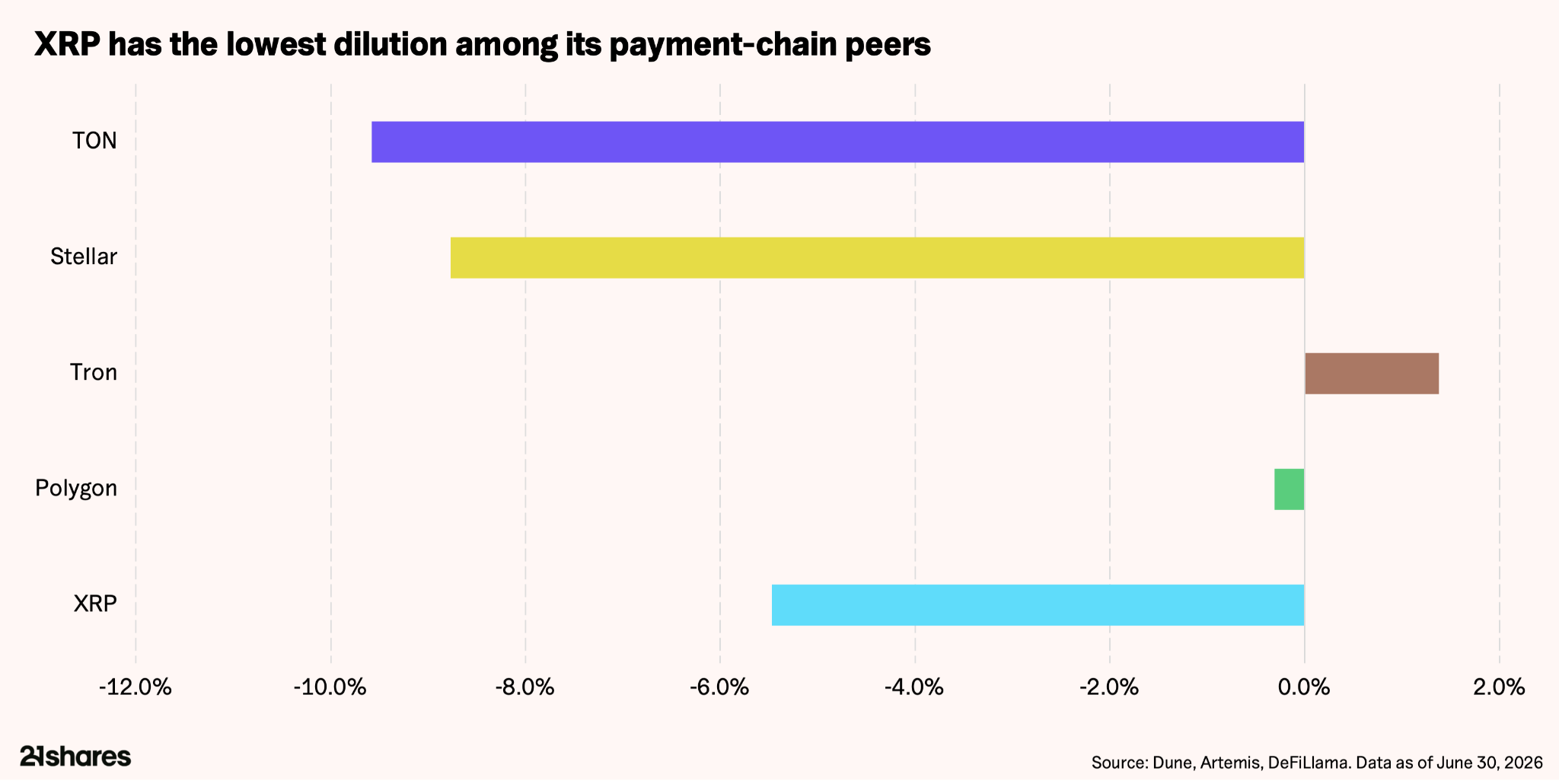
One metric where XRP compares favorably is supply dilution. Circulating supply grew 5.5% year-on-year through escrow releases and re-locks, driven by approximately 272 million XRP added monthly. Among its crypto payment network peers, that is the lowest annual dilution rate: Stellar dilutes holders at 8.8% per year and TON at 9.6%. Only Tron generates sufficient fee revenue to offset its supply growth, giving holders a net positive return of 1.4% per year. XRP holders face a net annual drag of 5.5% at current fee levels.
Fees alone cannot close that gap. Revenue would need to grow roughly 12,700 times to offset one year of new supply at current market values, which means any path to holder value creation runs through adoption-driven demand, not incremental fee growth.
The missing piece is XRP as collateral
Infrastructure readiness and regulatory clarity are moving in the right direction, but neither directly drives XRP demand. The upcoming XLS-65/66 proposal could enable tokenized assets to serve as loan collateral on the ledger, but loans can be denominated in RLUSD or tokenized Treasuries rather than XRP. The catalyst that would directly amplify XRP demand is regulated institutions accepting XRP itself as collateral or margin. That has not yet happened.
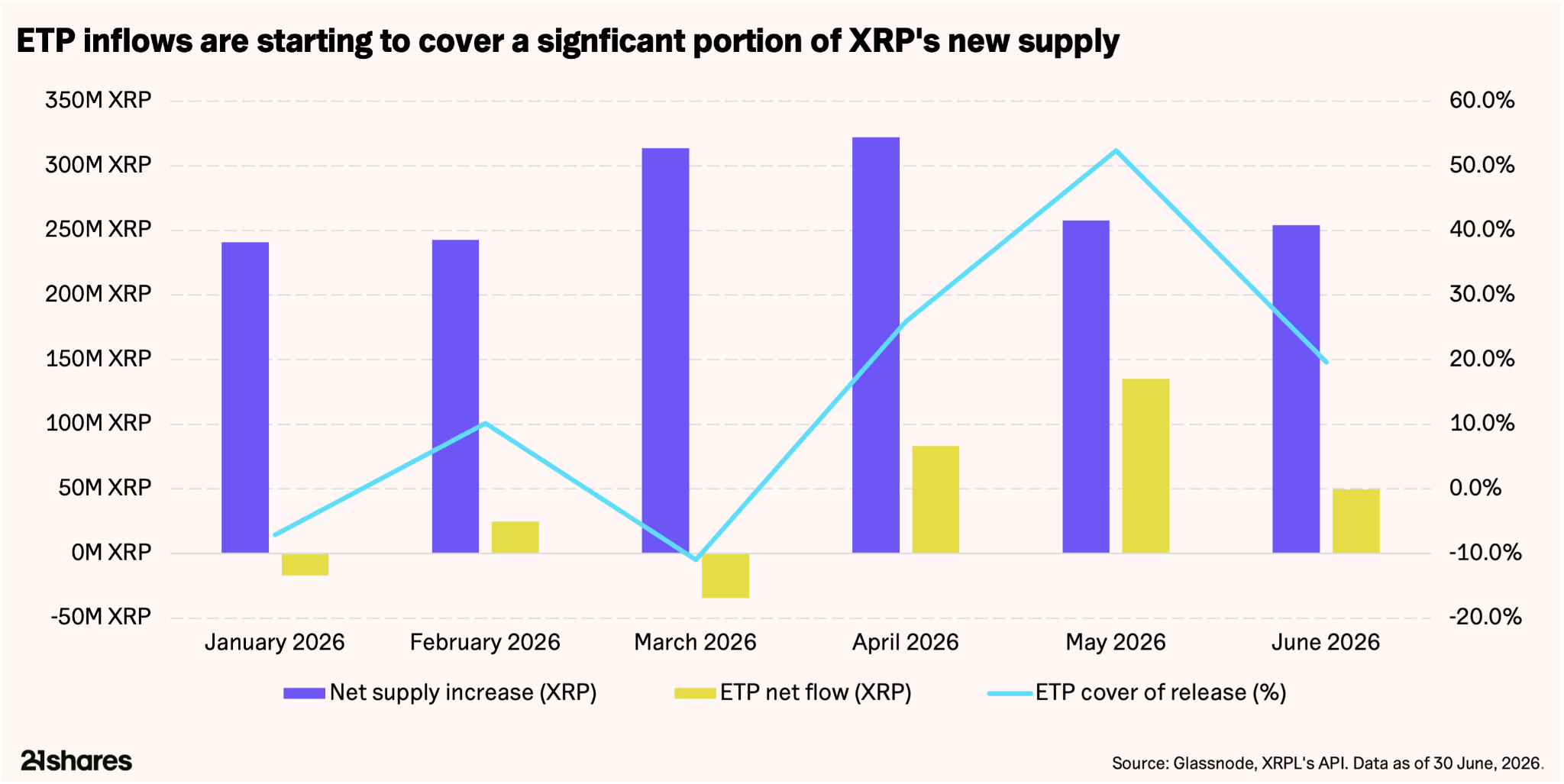
On the supply side, US spot XRP exchange-traded products (ETPs) absorbed just 14.8% of the increase in circulating supply in H1 2026, and were net sellers in two of six months. What matters here is that ETF absorption covered more than half of new supply in May, the strongest month on record. That said, at the current annual run rate of $588 million, ETPs absorb roughly one-seventh of annual net XRP supply.
XRP sits at a genuine transition point. The ledger is settling real volume, the stablecoin base is growing at pace, and institutions are beginning to use it as a venue for regulated products, none of which was true at the same scale a year ago. Similarly, the two demand signals that are easy to observe, stablecoin balances and ETP absorption, are both inflected upward in the second quarter, which is also reassuring. Fee revenue and user activity tell a different story for now. The question is whether the infrastructure being assembled will generate the collateral demand and DeFi activity needed to close that gap.
For investors who already hold bitcoin and are considering where XRP fits in a broader crypto allocation, the XRP ETP offers regulated access to that thesis without requiring direct custody of the asset.
XRP remains highly volatile, and its investment case depends on adoption outcomes that are not yet in the data. Past performance is not a reliable indicator of future results.
FAQ
Why did XRP's revenue fall so sharply in H1 2026?
H1 2026 revenue fell 81.6% year-on-year, from $6.43 million to $1.18 million. The bulk of the decline came from two sources: swap pool fees on the XRPL's automated market maker, which fell 80.3%, and NFT royalties, which fell 69%. Ordinary transaction fees, paid by everyday users, fell a more modest 66.3%. The network's fee structure means most revenue is burned rather than distributed to holders — of the total H1 2026 revenue, only 10.6% reached XRP holders (21shares Research, source: Dune, data as of 30/6/2026).
What is RLUSD and why does its growth matter for XRP?
RLUSD is Ripple's regulated US dollar stablecoin. By 30 June 2026, 52% of RLUSD's $1.56 billion supply was held on the XRP Ledger, up from roughly 10% a year earlier — a growth rate of 1,131% year-on-year. A larger stablecoin base on the ledger creates the liquidity foundation that decentralized finance activity and tokenized real-world assets require, both of which are potential sources of fresh demand for XRP that its payment rails alone have not consistently generated (21shares Research, source: DeFiLlama, data as of 30/6/2026).
How does XRP's supply dilution compare to other crypto payment networks?
XRP's circulating supply grew 5.5% year-on-year in H1 2026, the lowest dilution rate among its crypto payment peers. Stellar dilutes holders at 8.8% per year and TON at 9.6%. Only Tron earns enough in fees to fully offset its supply growth. For XRP holders, the net effect is a 5.5% annual drag at current fee levels — meaning the price would need to rise at least 5.5% per year for holders simply to break even on a purchasing-power basis (21shares Research, source: Artemis, DeFiLlama, Dune, data as of 30/6/2026).
Is the institutional adoption of XRPL translating into demand for XRP?
Not yet in a direct, measurable way. Institutions including Aviva Investors, abrdn, Ondo, and Société Générale have placed tokenized products on XRPL, and the compliance infrastructure for permissioned issuance is now live. However, these activities do not automatically create demand for XRP itself — loans and settlements can be denominated in RLUSD or tokenized Treasuries rather than XRP. The missing catalyst is regulated institutions accepting XRP as collateral or margin, which has not yet occurred at scale (21shares Research, H1 2026).









_logo.svg)

.svg.png)