

Solana generated $2.85B in annual revenue across DeFi, trading tools, meme coins, DePIN, and AI apps, proving its diverse ecosystem and rapid growth as a leading blockchain economy.
Solana has emerged as one of the most dynamic revenue-generating ecosystems in crypto, pulling in hundreds of millions of dollars each month from a wide range of activities. Solana’s revenue profile is strikingly diverse, with contributions coming from decentralized exchanges (DEXs), trading tools, meme coins, launchpads, borrowing and lending protocols, wallets, and even emerging verticals like DePIN and AI-driven applications.
This broad mix of activity reflects both Solana’s technical capacity and its vibrant user community. While trading-related activity remains the single largest contributor, the breadth of revenue sources signals that Solana is not just a one-dimensional chain. Instead, it is steadily transforming into a multi-sector economy capable of sustaining growth even as market cycles shift.
Revenue momentum and meme coin peaks
From October 2024 through September 2025, Solana averaged nearly $240 million in monthly revenue, with peaks well above $600 million during periods of intense trading activity, totaling roughly $2.85 billion in this one year. The most notable surge came during the meme coin mania of late 2024 and early 2025, when coins like President Trump’s Trump Coin drove unprecedented trading volumes. January 2025 marked the absolute high point, with revenue surpassing $616 million in a single month.
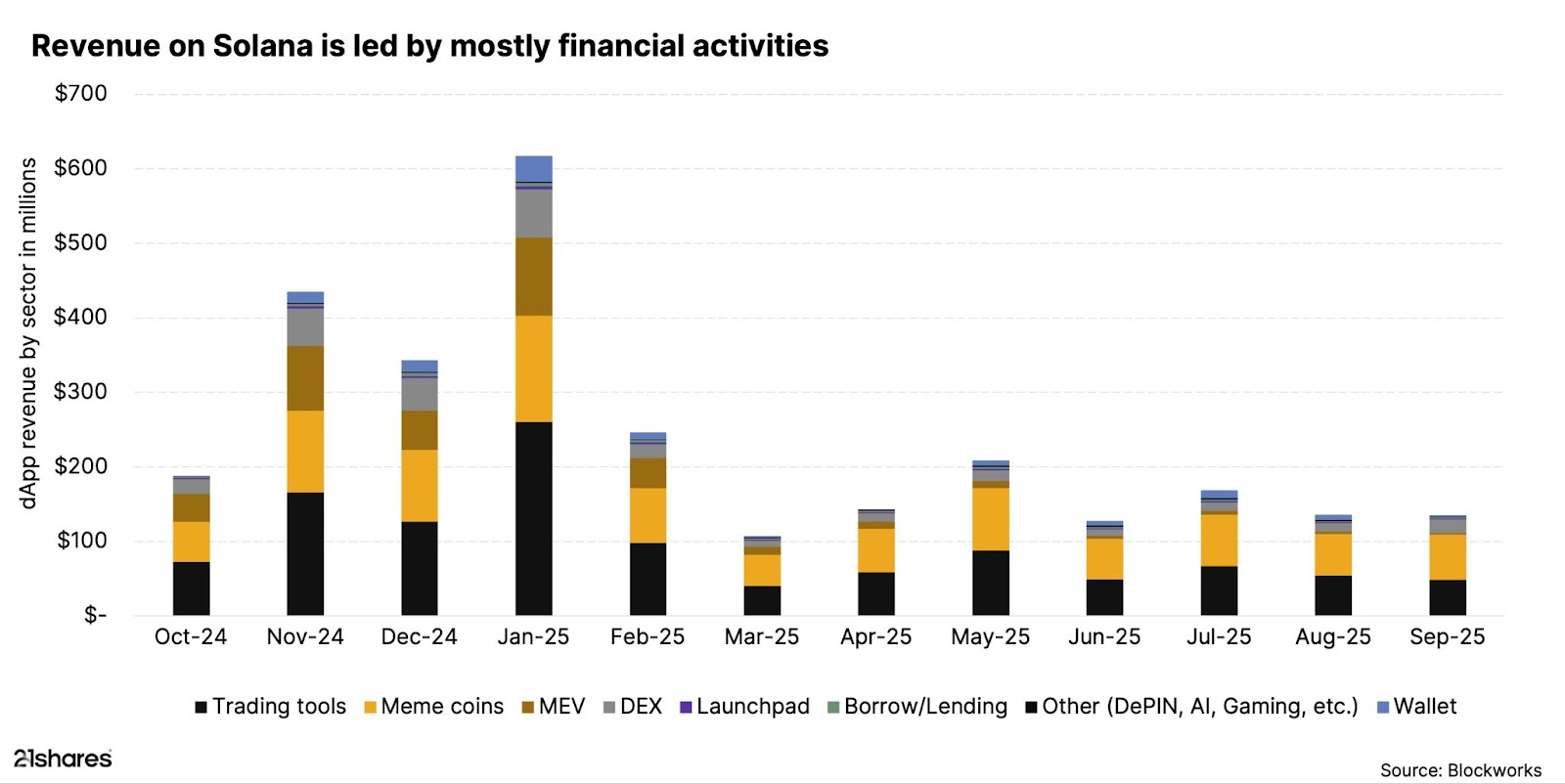
While meme coin activity has cooled since then, Solana’s revenue remains remarkably strong. Even in the post-mania environment, monthly revenues sit comfortably in the $150 million-$250 million range, demonstrating that the chain’s success is not merely a speculative flash in the pan. Instead, the underlying demand for Solana’s blockspace has proven resilient, with activity continuing across DeFi, AI, DePin, and trading applications.
Solana generated roughly $2.85 billion in revenue over the past year, with trading tools as the single largest driver - contributing about $1.12 billion, or 39% of the total. These apps - like Photon and Axiom - make trading easier with faster swaps and advanced execution features, and at the height of the meme coin craze in January 2025, they generated as much as $260 million in a single month.
Solana’s architecture, capable of handling thousands of transactions per second at costs below $0.01, makes it the natural hub for onchain trading. To put its scale into perspective, the Solana network brought in nearly as much revenue as well known companies that have been around for decades, such as Web 2 AI powerhouse Palantir ($2.8 billion in 2024) or leading Web 2 financial services everything app Robinhood ($2.95 billion) - living up to its goal as the 24/7, global “onchain Nasdaq” where the world’s most active markets are being rebuilt in real time.
Perspective: Where Ethereum was at this stage
Between 2019 and 2020, roughly four to five years after its launch (similar to where Solana is now in its lifecycle), Ethereum’s monthly revenue averaged less than $10 million. By comparison, Solana in its equivalent stage is producing 20-30x more average revenue on a monthly basis, with some months outpacing Ethereum’s early revenue by more than 50x.
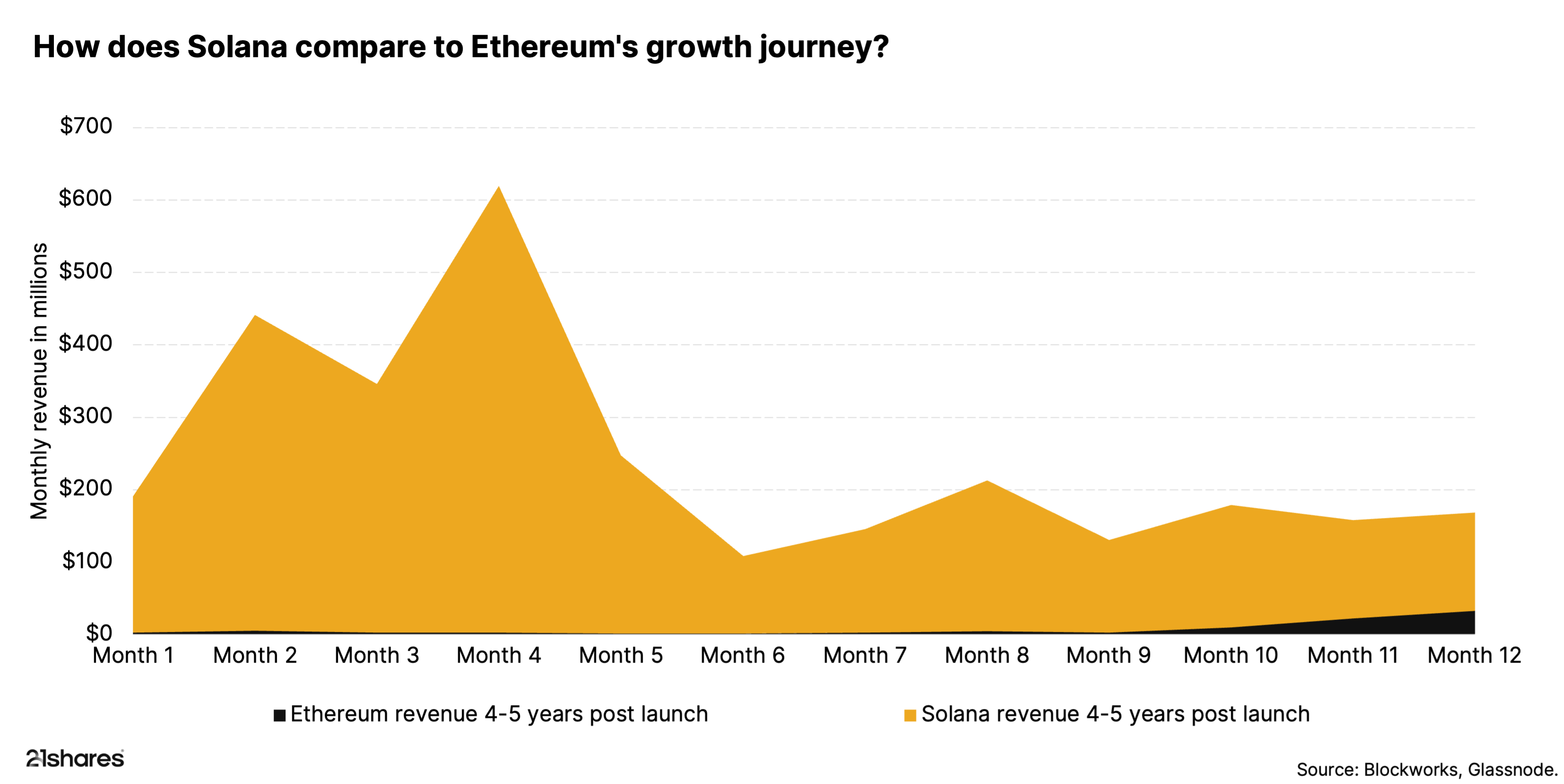
This comparison underscores just how rapidly Solana has monetized usage at scale. While Ethereum laid the groundwork for smart contracts and decentralized finance, Solana has leveraged its high throughput and low fees to capture a far wider range of activity earlier in its lifecycle. Ethereum trading from $150-500 from late 2019 to late 2020, meaning gas fees and revenues were naturally constrained relative to what they would have been at higher price levels. Ethereum was also heavily congested, which spiked gas fees and limited adoption - yet despite this, it still flourished during DeFi Summer of 2020, having no competition and being the only DeFi chain in town. Despite the smaller market, Ethereum was effectively the only serious smart contract blockchain at that time, while Solana today competes in a far more crowded landscape. Wallet activity helps illustrate this: Ethereum averaged roughly 400,000–500,000 daily active addresses in 2019–2020, whereas Solana now consistently averages 1.2–1.5 million daily active addresses. In other words, the market itself has scaled up dramatically, but Solana’s ability to capture such an outsized share of that activity amid stiff competition underscores the depth of its adoption.
What do the last two years tell us about what’s to come?
Just two years ago, Solana’s revenue was a fraction of what it is today. Between October 2022 and September 2023, total network revenues stood at just $13 million, a modest figure that reflected its early-stage ecosystem and market skepticism in the wake of outages, regulatory scrutiny, and the collapse of FTX. Fast forward to today, and that number has exploded to $2.85 billion over the following 12 months, a 220x increase that signals a fundamental shift in the network’s maturity and value capture. What was once a highly experimental blockchain is now one of the most commercially successful ecosystems in crypto.
This shift has reframed Solana’s role in the eyes of institutional capital. Over $3 billion in SOL is now held on public company balance sheets, with other treasury initiatives underway from firms like Forward Industries, Pantera Capital, and Brera Holdings. A potential U.S. spot Solana ETF, expected to receive an SEC decision this month, could further unlock access, solidifying Solana’s place in regulated portfolios.
But the case for Solana is also rooted in activity. Total value locked in Solana DeFi is approaching $13 billion, stablecoin volume has grown 6x year-over-year, and over $500 million in tokenized real-world assets (RWAs) now operate on its rails. These use cases, from high-frequency DeFi to institutional-grade stablecoin flows, point to a network with real product-market fit and growing demand from both crypto-native and traditional players.
Solana’s evolution is also being driven by key technical upgrades aimed at meeting future scale. The Firedancer validator client is targeting 1 million transactions per second by 2025. Alpenglow, already approved, will reduce finality to below 200 milliseconds. Meanwhile, a planned doubling of blockspace is unlocking capacity for real-time apps, AI-native microtransactions, and on-chain capital markets infrastructure.
In short, Solana’s story is no longer one of resilience, but of readiness. Its ecosystem has moved from potential to execution, with real-world use cases now fully operational. Together, these developments are cementing Solana’s role as a scalable and commercially viable digital economy.









_logo.svg)

.svg.png)