

Every digital asset needs a reason to exist, and a reason to appreciate. For XRP, both come down to the same idea: if global finance moves onto blockchain rails, the networks that settle that activity become valuable, and XRP is the native asset of one of the most institutionally established of those networks.
The investment case rests on four pillars.
Regulatory clarity, finally
For nearly five years, XRP traded under the cloud of the Securities and Exchange Commission's (SEC) case against Ripple, filed in December 2020. That case concluded definitively in August 2025, and with it went the compliance barrier that had kept US institutions, regulated funds, and banks on the sidelines. XRP is one of the few large digital assets with this question fully behind it, and that matters more for XRP than for most assets, because its target users are precisely the institutions that could not touch it before.
Institutional access is built
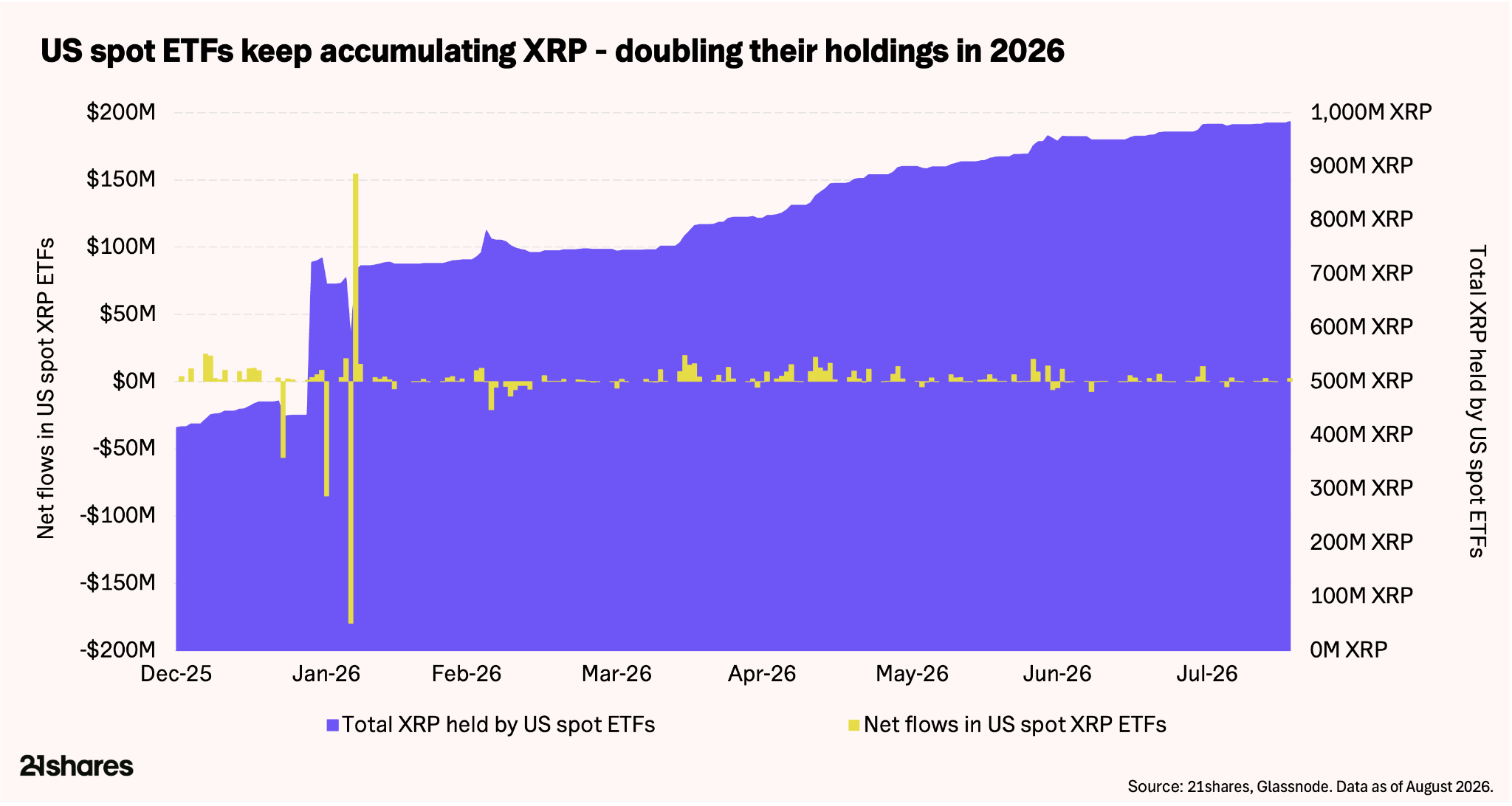
Seven US spot XRP exchange-traded funds (ETFs) launched from November 2025, gathering $1.3 billion in their first month, including a record 55-day streak of consecutive net inflows, and despite market weakness, cumulative net flows have remained positive through the first half of 2026. Institutional interest is real but two-sided: Goldman Sachs was the largest disclosed holder at $153.8 million in its Q4 2025 filing, then exited the entire position by its Q1 2026 filing, while retail and other funds absorbed the sale. Investors can now hold XRP through regulated wrappers on the same rails as any equity or bond, removing the operational friction that historically limited allocation.
A utility thesis you can measure
The XRPL is positioning itself as settlement infrastructure for stablecoins and tokenized real-world assets, and the activity is already material: the ledger moved close to half a trillion dollars in on-chain value over the past 12 months. Ripple's RLUSD stablecoin grew from $72 million to around $1.6 billion in less than two years since launch, one of the stronger stablecoin launches to date, and tokenized assets on the ledger have grown to around $4 billion, making it one of the largest networks for real-world assets. Ledger upgrades such as the Multi-Purpose Token standard let institutions issue assets like bonds with compliance rules embedded at the protocol level. These are early numbers, but they are numbers, which is more than many altcoin theses can offer.
Scarce and predictable supply
XRP's supply is fixed at 100 billion, fully created at launch, with a small amount burned with every transaction, more than 14 million XRP destroyed to date. There is no inflation schedule to dilute holders, and escrow releases follow a public, predictable cadence.
However, network adoption does not mechanically translate into token demand: institutions can use the ledger while holding XRP only briefly, and the link between usage and value accrual is still being proven. XRP is best understood as a technology investment: a position on tokenized settlement reaching scale. The upside depends on adoption reaching scale; the risk is that adoption grows while value capture lags.
For investors who believe payments and asset issuance are moving onchain, XRP offers one of the more direct, regulated, and institutionally connected ways to express that view. That view remains a thesis, not a settled outcome, and digital assets remain highly volatile.









_logo.svg)

.svg.png)