

Bittensor is a blockchain protocol that decentralizes artificial intelligence, turning machine learning into an open, peer-to-peer marketplace.
Founded in 2021 by Jacob Steeves and Ala Shaabana, Bittensor aims to counter the growing centralization of AI under tech giants like OpenAI. Instead of closed, corporate-owned models, Bittensor rewards open-source intelligence, creating a “digital hive mind” where developers contribute AI models that collaborate, compete, and earn rewards based on their usefulness.
As of October 2025, Bittensor hosts over 129 active subnets, each dedicated to different AI tasks. Institutional attention rising, Bittensor is emerging as a cornerstone of the AI-crypto intersection.
How does Bittensor work?
Bittensor runs on Subtensor, a proof-of-stake blockchain that coordinates decentralized AI development.
The network is divided into subnets, which are like specialized workspaces for different types of AI or compute tasks, like text generation, code writing, or even drug discovery.
- Miners deploy and train models that provide these services.
- Validators stake Bittensor’s native token TAO and evaluate these models using Yuma Consensus, an algorithm that scores the relative value of each model’s output.
- Subnet owners burn TAO to register new subnets and set the rules for participation.
Each subnet functions as a self-contained economy: high-performing models earn more TAO rewards, while validators ensure quality and integrity. Examples include Sportstensor for sports predictions integrated with Polymarket, Ridges AI for code generation, and Nova for molecular modeling.
Recent upgrades like EVM compatibility now allow smart contracts to run directly on subnets, connecting AI applications with decentralized finance (DeFi).
Tokenomics: Scarcity meets intelligence
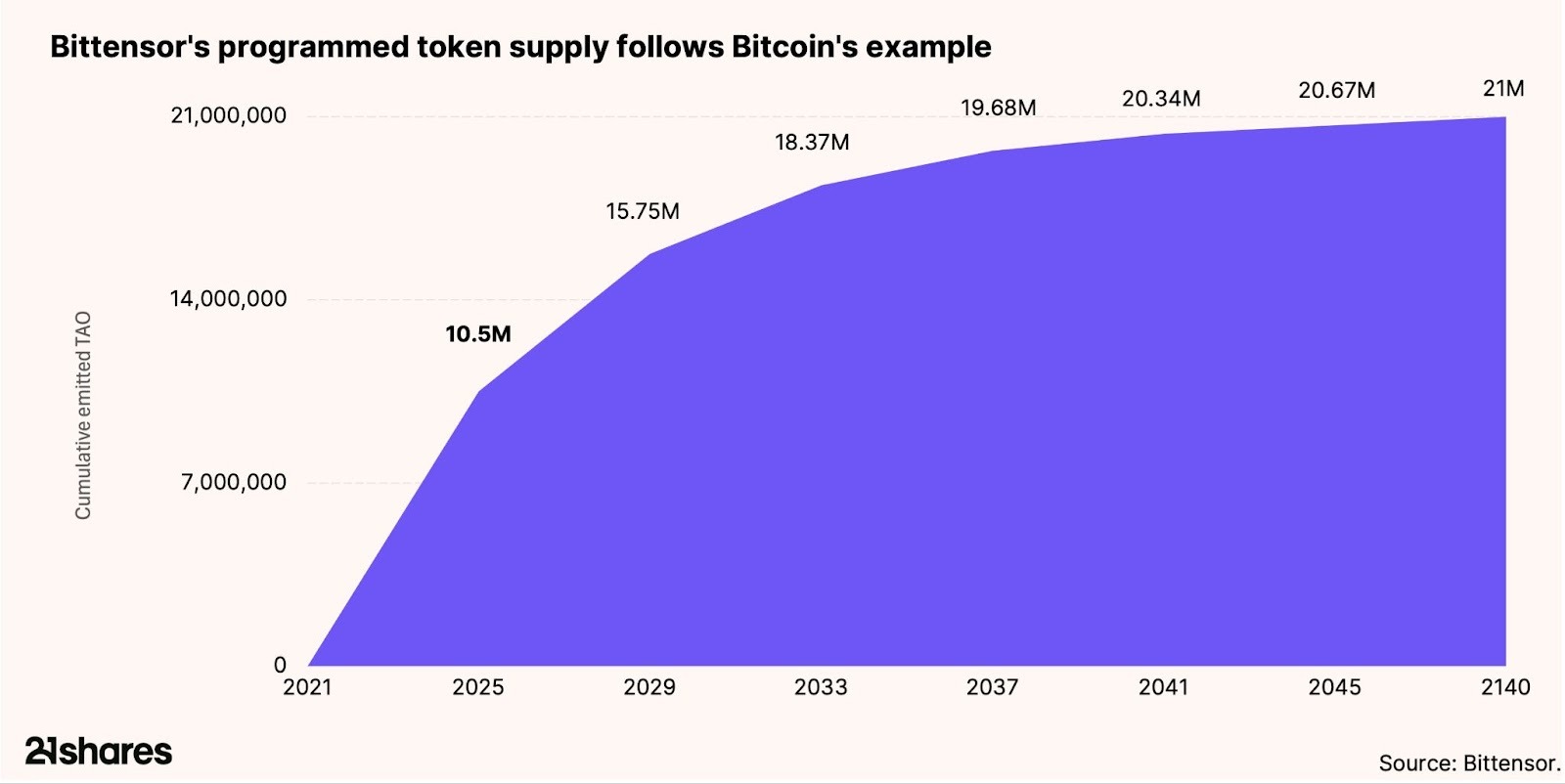
TAO combines Bitcoin-style scarcity with a utility layer built for AI. Its total supply is also capped at 21 million, with daily emissions of 7,200 TAO that halve every four years. The first halving on December 12, 2025 will cut emissions to 3,600 TAO per day, reducing supply as demand rises. This fixed, disinflationary structure introduces predictable scarcity while rewarding participation.
TAO serves three main functions:
- Staking: Validators and delegators secure the network and earn new TAO.
- Governance: Stakers vote on proposals through a bicameral governance model (Senate-Triumvirate) that becomes more decentralized over time.
- Utility: TAO powers for subnet creation, transaction fees, and collateral for subnet-specific alpha tokens (α) that control emission rights and yield opportunities.
No TAO was pre-mined or sold through an initial coin offering (ICO). All tokens are earned through mining or staking. Currently, around 73% of supply is staked, reflecting strong long-term conviction. Although large holders like DCG and Polychain hold significant stakes, the Dynamic TAO upgrade redistributes rewards through market-based mechanisms to enhance decentralization.
The investment case of Bittensor
Bittensor represents a new frontier where intelligence becomes a tradeable asset. As AI continues to reshape productivity and value creation, TAO captures that growth by combining Bitcoin’s scarcity with decentralized coordination of AI models.
Its upcoming halving, EVM integration, and growing institutional interest make TAO one of the most asymmetric opportunities in the emerging AI-crypto economy. Just as Bitcoin monetized energy, Bittensor monetizes intelligence, rewarding open, collaborative innovation over corporate control.
In a world dominated by closed AI systems, Bittensor offers an open alternative - a permissionless network where intelligence is built, valued, and owned by its own users.