

On October 10, Ethena’s synthetic dollar USDe experienced a sudden and dramatic price dislocation on Binance’s spot market, briefly plunging to $0.65. The anomaly occurred during intense market turbulence, with Bitcoin dropping 13% and Ethereum more than 16% in a single day, creating confusion among traders.
This was not a failure of the USDe protocol or a flaw in its underlying design. The depeg was confined to Binance’s internal order books and was not reflected onchain or across major decentralized finance platforms, where USDe continued to trade close to its intended one-dollar value.
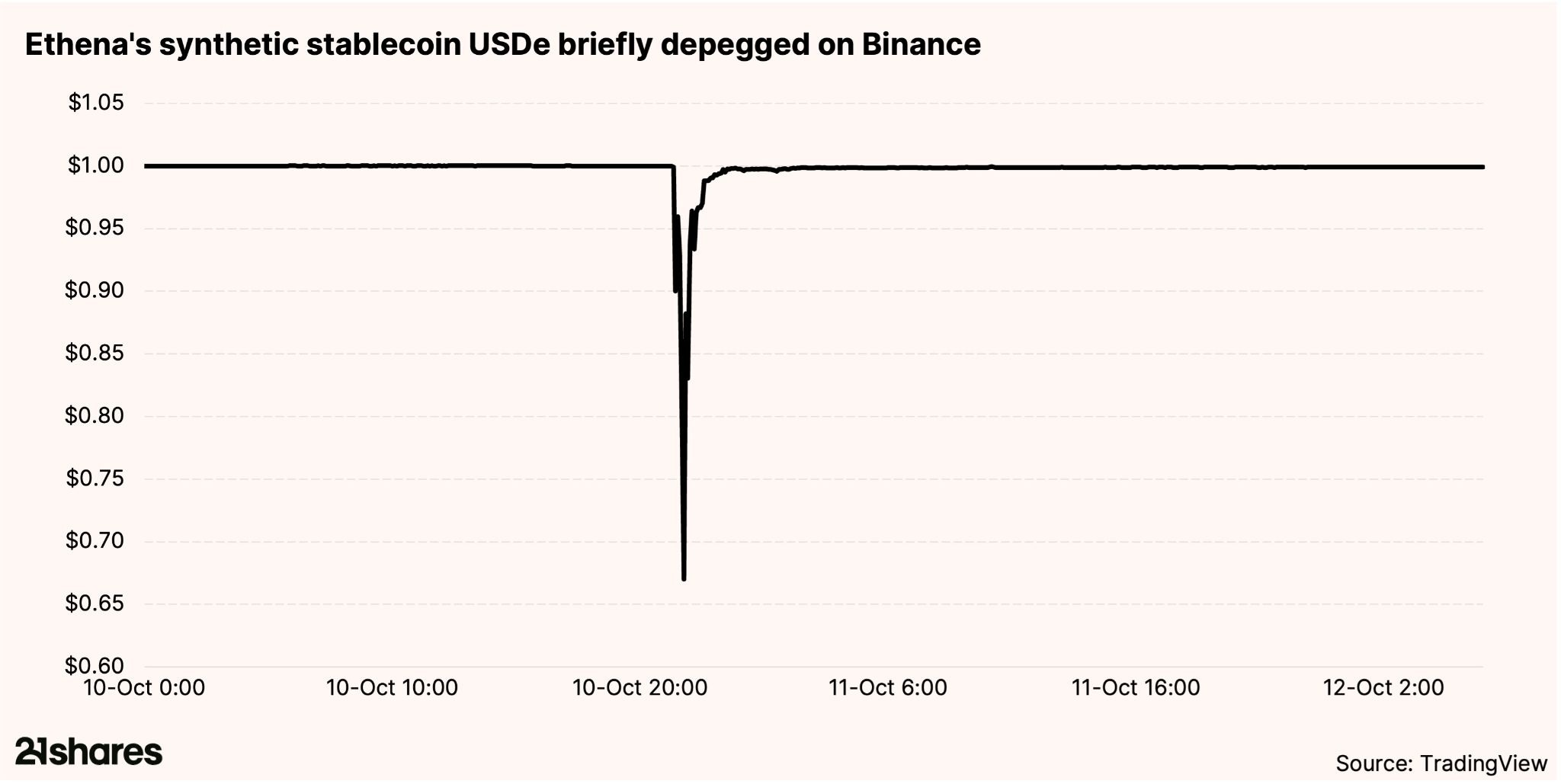
At the peak of the disruption, USDe’s market capitalization declined by roughly $2.2 billion, from $14.8 billion on October 10 to $12.6 billion by October 12, as traders reacted to the price swings. The event also triggered forced liquidations on Binance due to margin systems marking against the distressed spot price. Yet, across decentralized markets like Curve and within Ethena’s own mint and redeem mechanics, USDe held far closer to its one-dollar target. This divergence underscored a crucial point: the problem was not USDe itself; it was Binance’s infrastructure under stress.
The root cause of the dislocation lies in how centralized exchanges handle liquidity and risk during periods of extreme volatility. Binance, like most centralized exchanges, operates an order book model where liquidity depends on the willingness of market makers to post bids and offers. In chaotic conditions, liquidity providers often pull back to protect their positions, causing the order book to thin dramatically. This can lead to sharp price gaps as even small orders move the market. That is exactly what happened with USDe: liquidity dried up, prices collapsed, and automated liquidation engines amplified the sell pressure.

Why was USDe more stable in decentralized finance?
By contrast, decentralized finance markets rely on automated market makers and time-weighted, multi-source oracles.
- Automated market makers use liquidity curves rather than discrete order books, which means slippage increases under stress, but prices rarely collapse suddenly unless faced with enormous volume.
- Oracles aggregate prices from multiple venues over time, so a transient mispricing on one exchange carries little weight.
This design meant that onchain pools and protocol accounting systems continued to value USDe near one dollar even as Binance’s internal mark briefly plunged. Arbitrageurs were also able to step in more easily on chain, minting and redeeming USDe at near net asset value to exploit any small dislocations.

Another key difference lies in how liquidation and collateral systems are structured. Binance and other centralized exchanges rely on venue-specific mark prices and internal risk engines, which can cascade into forced liquidations if those marks deviate. In this case, a localized mispricing of USDe caused liquidations that might not have been justified based on the protocol’s actual net asset value. DeFi protocols, on the other hand, tend to use more conservative oracles and liquidation parameters precisely to avoid these feedback loops. Aave, for instance, treats USDe conservatively as collateral, ensuring that short-term exchange volatility does not trigger a chain reaction of liquidations onchain.
Health check: USDe’s mechanics throughout the depeg on Binance
Despite the dramatic price movement, USDe’s core design worked as intended. Ethena’s delta-neutral strategy, which hedges crypto collateral such as Ethereum and Bitcoin with short perpetual futures, continued functioning throughout the episode. Collateral remained overcollateralized, mint and redeem operations stayed open, and off-exchange settlement structures insulated the treasury from counterparty risk. This is why most decentralized finance venues saw no significant deviation and why the dislocation resolved itself within about 40 minutes on Binance as liquidity returned and arbitrage normalized prices.

While disruptive, the episode is best understood as a pain that comes with integrating synthetic dollars into exchange infrastructure. It revealed a gap between how synthetic assets are designed to function and how centralized platforms manage them during periods of stress. Binance has acknowledged the anomaly, launched an internal review, compensated affected users, and stated that it is updating its pricing and risk management frameworks for assets like USDe.
Moral of the story?
The broader lesson is that events like this can ultimately strengthen the ecosystem. They underscore the need for more resilient oracle design, using time-weighted, multi-venue price feeds that resist manipulation and local distortions. They also push both centralized and decentralized platforms to tighten risk controls by adjusting liquidation thresholds and borrow limits to account for sudden dislocations. The incident highlights the value of onchain settlement and transparent backing, which maintain a continuous, auditable redemption path — something Binance users lacked during the volatility window.
Finally, this unfortunate event can encourage centralized exchanges to use cross-venue reference prices instead of relying solely on internal order books, adding brief trading pauses when prices swing more than 20 to 30% in a minute, and applying dynamic price bands to block trades far outside global averages. Together, these measures would prevent extreme price prints from cascading into mass liquidations and improve the resilience of synthetic assets like USDe
In short, USDe did not fail; Binance’s market structure did, albeit briefly. That distinction matters. The episode revealed vulnerabilities in centralized exchange design that decentralized finance systems, by virtue of their architecture, are better positioned to withstand. As synthetic dollars like USDe become more systemically important, this divergence will shape how exchanges evolve and how protocols integrate with them. If there is one clear lesson from October’s volatility, it is that DeFi’s composable, transparent infrastructure provides resilience that centralized systems still need to catch up to.
______
Footnotes:
“Binance to Compensate Users Affected by Crash in wBETH, BNSOL, and Ethena’s USDe.” CoinDesk, 12 Oct. 2025, https://www.coindesk.com/markets/2025/10/12/binance-to-compensate-users-affected-by-crash-in-wbeth-bnsol-and-ethena-s-usde.