Bitcoin saw explosive growth in 2024, fueled by the landmark launch of U.S. spot Bitcoin exchange-traded funds (ETFs). These ETFs shattered records, amassing over $100 billion in assets under management and becoming the most successful ETF launch in history. Since their inception in January 2024, they’ve drawn more than $40 billion in net inflows.
Now, 2025 is building on that momentum. After a slow start to the year, April alone brought in nearly $3.5 billion in net inflows, putting U.S. Bitcoin ETFs ahead of some of the world’s biggest and most actively traded ETFs.
21Shares anticipates that Bitcoin ETFs will attract 50% more inflows this year compared to last year. This would result in net inflows of approximately $55 billion in 2025, representing an increase of around $20 billion year-over-year. If this trend continues, the total assets under management could nearly double from the current $110 billion to over $200 billion by the end of the year.
Bitcoin ETFs surpassing traditional ETFs
U.S. spot Bitcoin ETFs have now outpaced SPY (SPDR S&P 500 ETF Trust), the former heavyweight among global ETFs, which has seen over $19 billion in outflows year-to-date. They’ve more than doubled the net inflows of QQQ, Invesco’s flagship Nasdaq-100 ETF, and surpassed Vanguard’s Information Technology ETF (VGT), the world’s largest pure-play tech fund, by over $1 billion in new assets. This signals a powerful shift in investor appetite, with Bitcoin rapidly claiming a larger share of the traditional ETF landscape.
This increase indicates a movement towards safety and high-quality investments during uncertain times. While most major exchange-traded products (ETFs) have seen limited inflows, and in the case of SPY, significant outflows, the U.S. spot Bitcoin ETFs have distinctly separated themselves from the overall market trends.
Bitcoin once again outshines gold
The difference is most evident when comparing Bitcoin ETFs' performance to that of traditional safe-haven assets. AGG, the world’s largest fixed income ETF, has brought in just $1.6 billion year-to-date, less than half the flows into Bitcoin ETFs.
Even GLD, the world’s largest gold ETF and long regarded as the quintessential crisis hedge, has underperformed Bitcoin with respect to flows. During the April selloff surrounding Liberation Day, GLD experienced five consecutive days of outflows, including a $1.2 billion decrease on April 22, while Bitcoin ETFs recorded $400 million in net inflows on the same day.
The resilience under pressure demonstrates that Bitcoin is increasingly viewed as a macro hedge, comparable to, and often surpassing, gold and bonds.
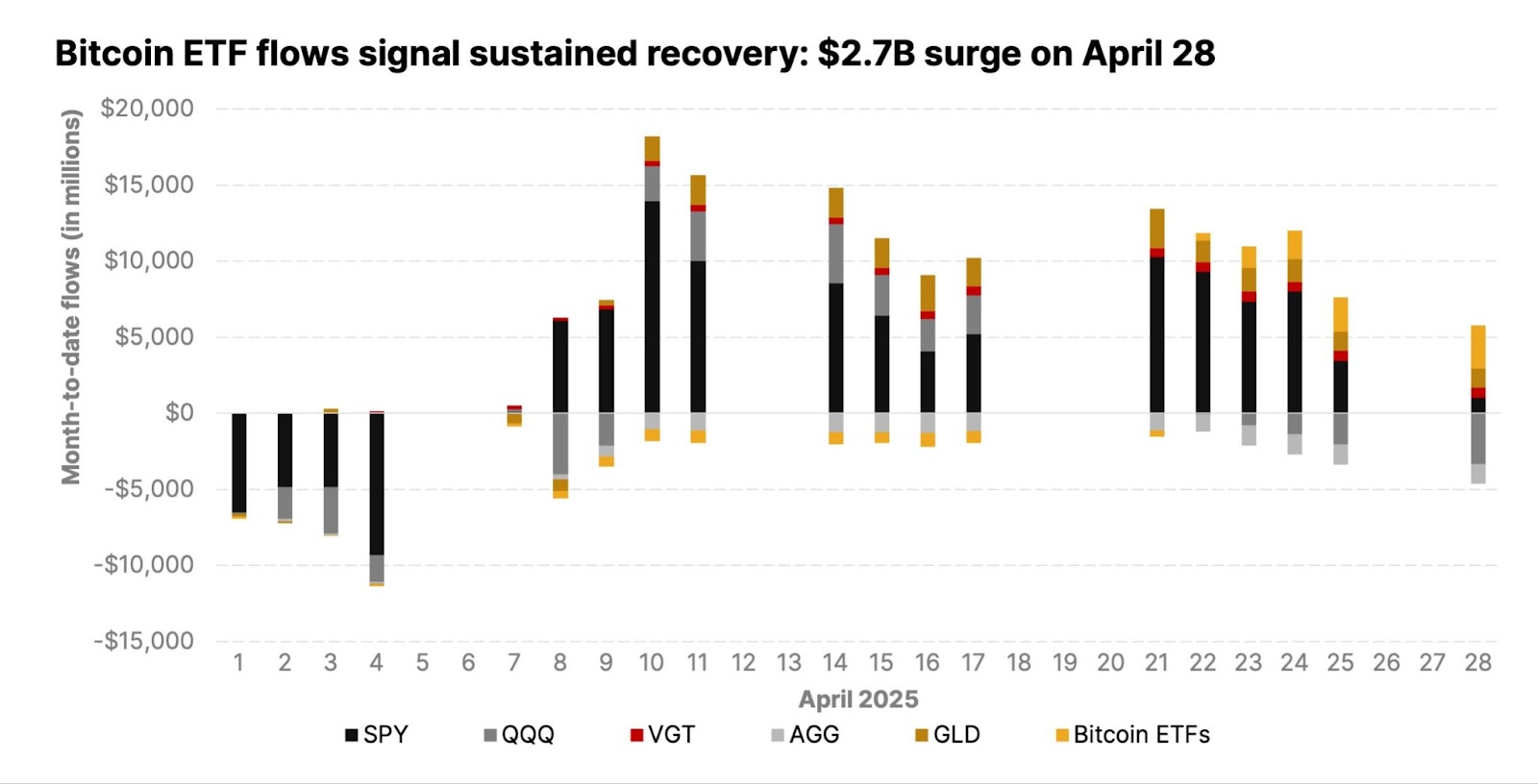
Bitcoin emerges as a preferred allocation
Bitcoin ETFs haven’t just outpaced SPY, QQQ, VGT, GLD, and AGG; they’ve also topped the combined inflows of every major sector ETF, cementing their dominance across the board. With $3.7 billion in year-to-date inflows, Bitcoin ETFs have easily outpaced Utilities ETFs ($2.3 billion) and Tech ETFs ($1.0 billion).
At the same time, every other sector, such as Financials, Energy, Health Care, and Industrials, has experienced billions in net outflows. This is not merely a standout performance; it is a clear indication that capital is shifting into Bitcoin, detracting from nearly every traditional asset class.
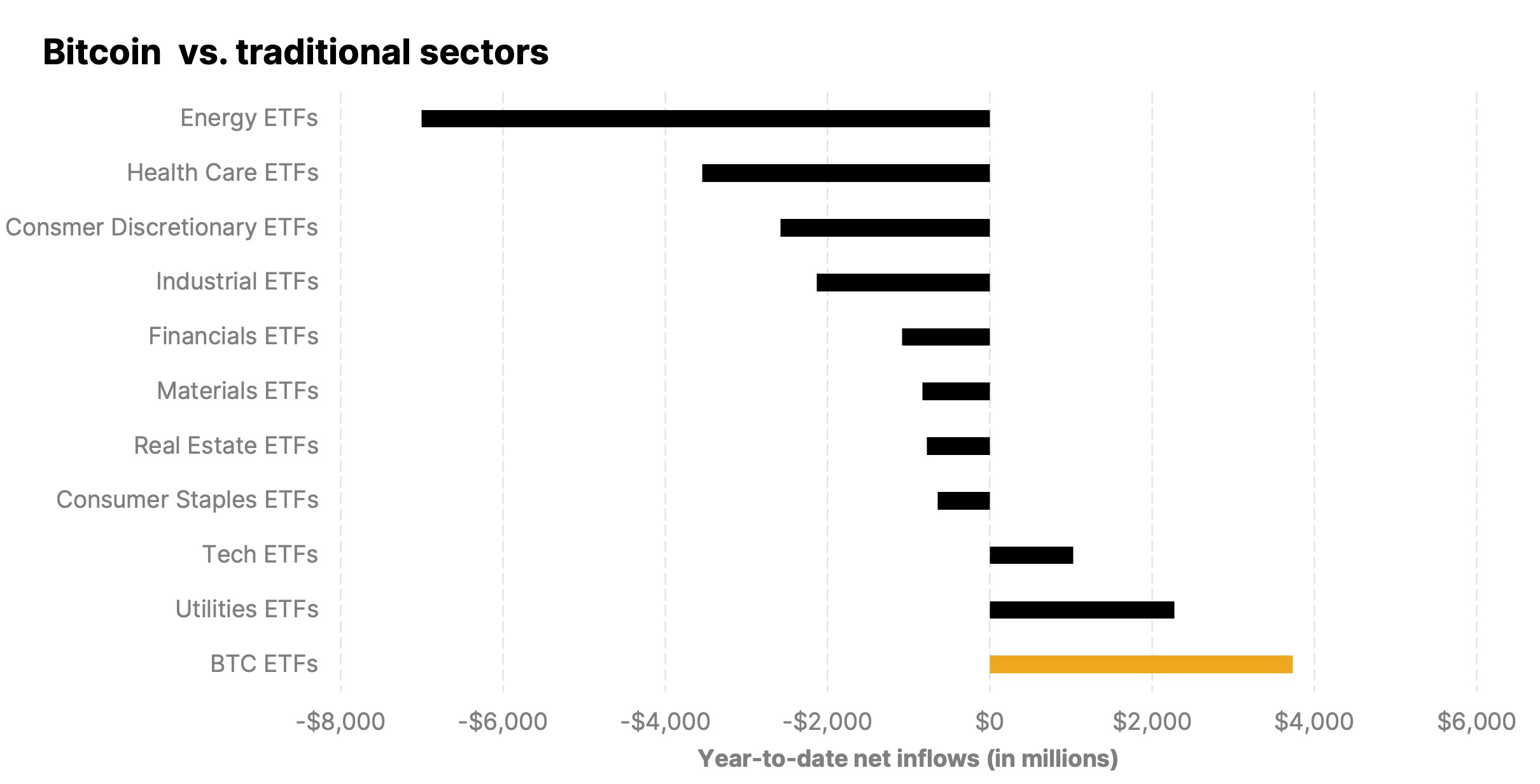
Looking ahead, the success of U.S. spot Bitcoin ETFs in 2025 signals more than just strong investor appetite and marks a turning point in the global investment landscape. With inflows surpassing those of major sectors and traditional asset classes, Bitcoin is moving from the margins to the mainstream. It's being redefined as a core portfolio allocation, indicating a structural shift in capital allocation across the ETF market.