

Key takeaways
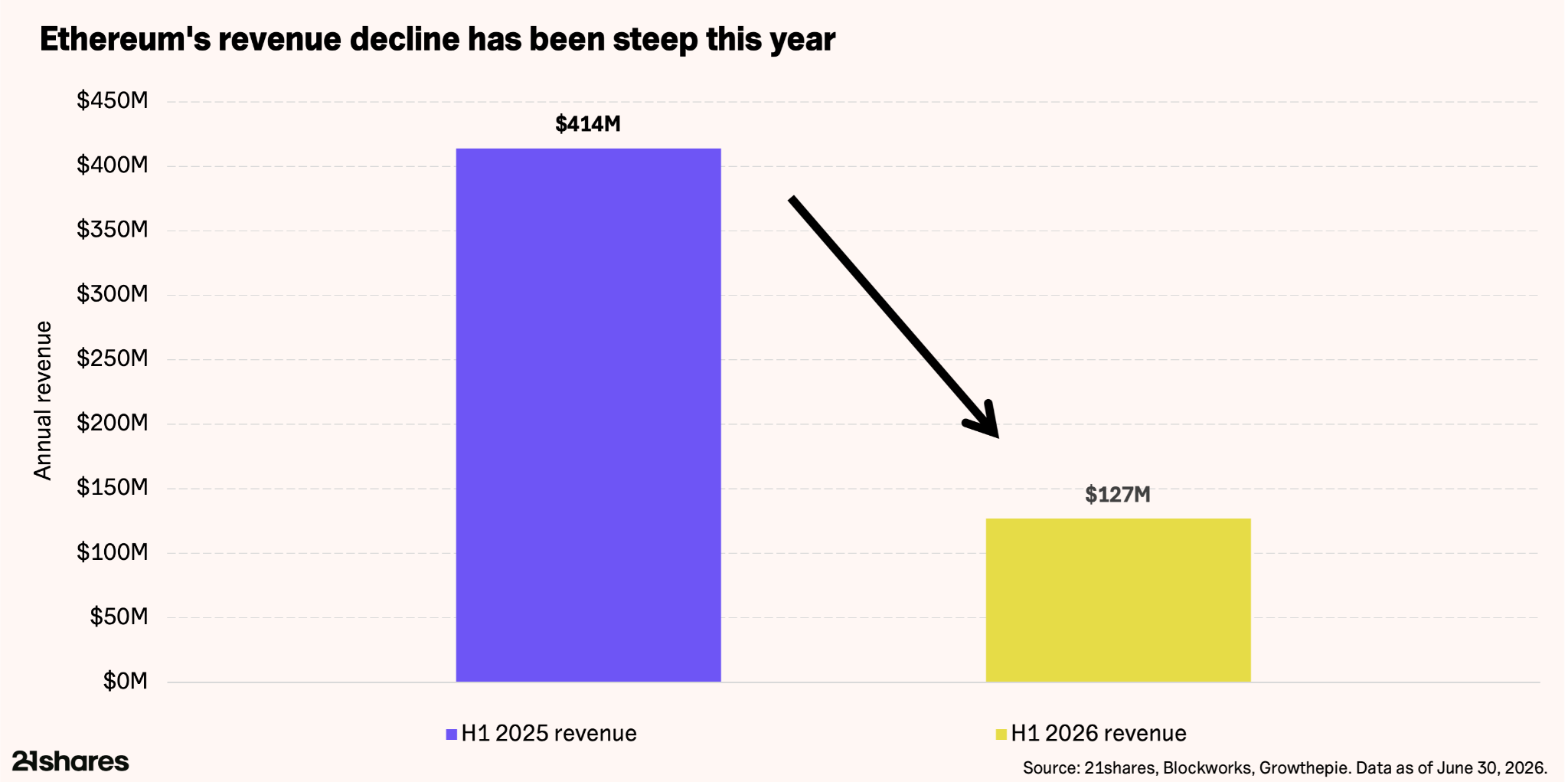
- Ethereum's gross revenue fell 69.3% year-over-year (YoY) from $414 million in H1 2025 to $127 million in H1 2026, consistent with a comparable 64% decline between H1 2022 and H1 2023 (DeFiLlama, Blockworks, TokenTerminal. Data as of 30 June 2026).
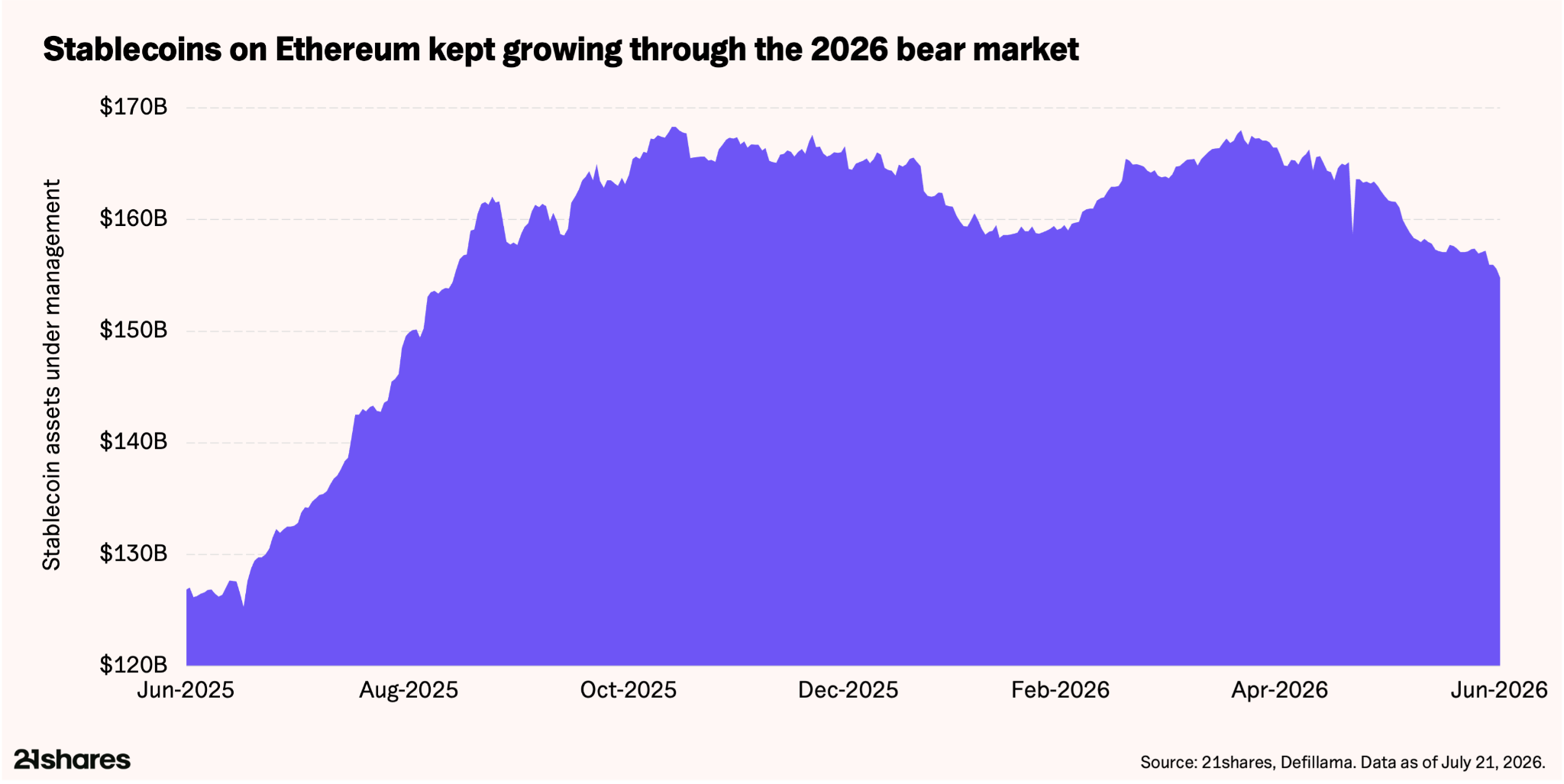
- Despite the revenue decline, stablecoins on Ethereum grew 22% YoY to approximately $156 billion in assets under management (AUM), and Ethereum captures approximately 47% of the $34 billion tokenized real-world asset market (rya.xyz, Blockworks. Data as of 30 June 2026).
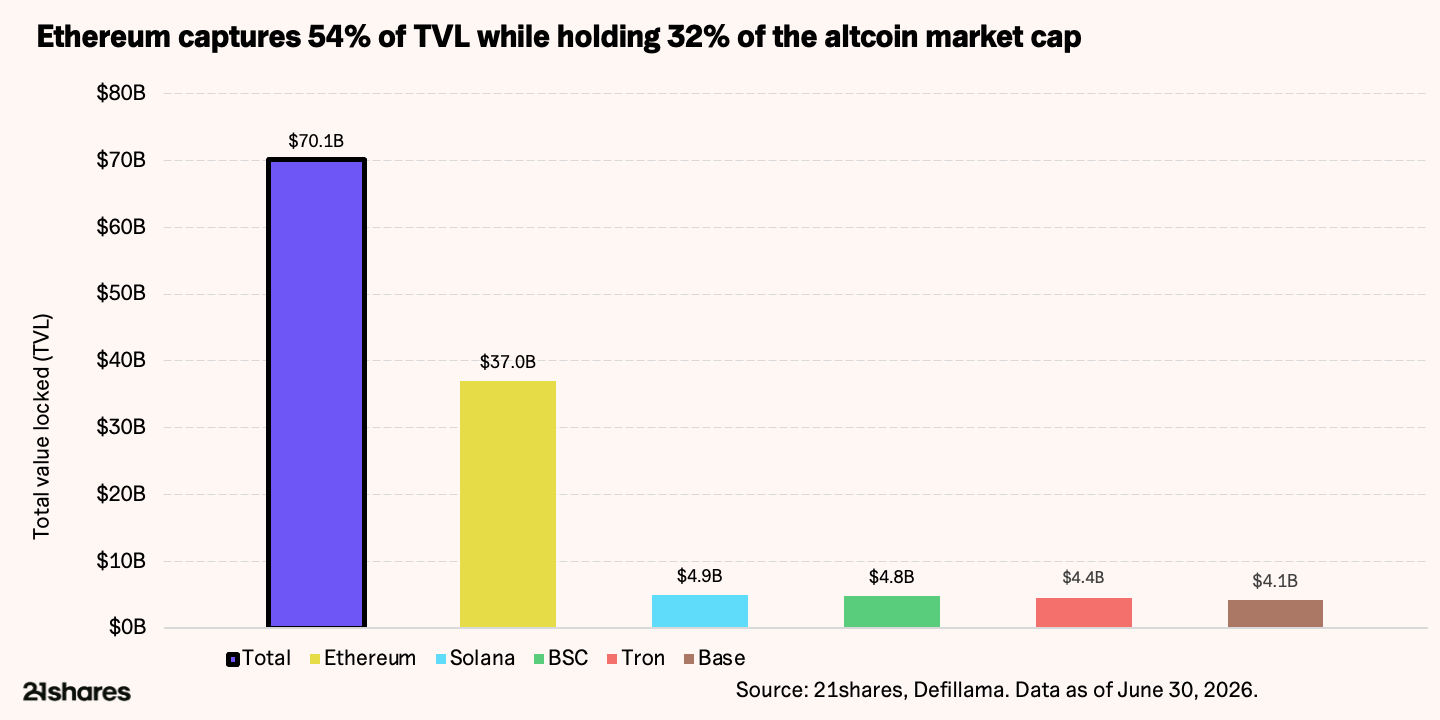
- Ethereum holds 54% of all total value locked (TVL) across crypto networks while representing 32% of the altcoin crypto market cap, and monthly active addresses and smart contract deployments are both growing YoY (DeFiLlama, CoinGecko, TokenTerminal. Data as of 30 June 2026).
Ethereum's revenue fell sharply, and that has happened before
Ethereum's gross revenue fell from $414 million in H1 2025 to $127 million in H1 2026, a 69.3% YoY decline (DeFiLlama, Blockworks, TokenTerminal. Data as of 30 June 2026). Bear market conditions damped demand for block space across trading and decentralized finance (DeFi) activity, pulling transaction fees sharply lower across all four of Ethereum's revenue streams: base fees, Layer 2 (L2) fees, priority fees, and maximum extractable value (MEV).
While significant at face value, this decline should be viewed in context as it is in line with prior bear markets: during the 2022-2023 bear market, Ethereum’s revenue declined by 64% from H1 2022 to H1 2023. Last cycle’s fee decline also predated Ethereum Improvement Proposals (EIPs) 4844 and 7691, which together reduced fees across the ecosystem. With that in mind, the current decline is less alarming than it may first appear.
Fees alone, however, don't tell the whole story: while Ethereum's revenue is down, the network is showing growth in other areas.
Stablecoins and real-world assets kept growing through the downturn
Even as fee revenue fell, stablecoin supply on Ethereum kept climbing through the downturn. Stablecoins on Ethereum grew 22% YoY to approximately $156 billion in AUM by June 2026 despite the broader market decline. Roughly half of all global stablecoin supply sits on Ethereum, making it the primary settlement layer for this category.
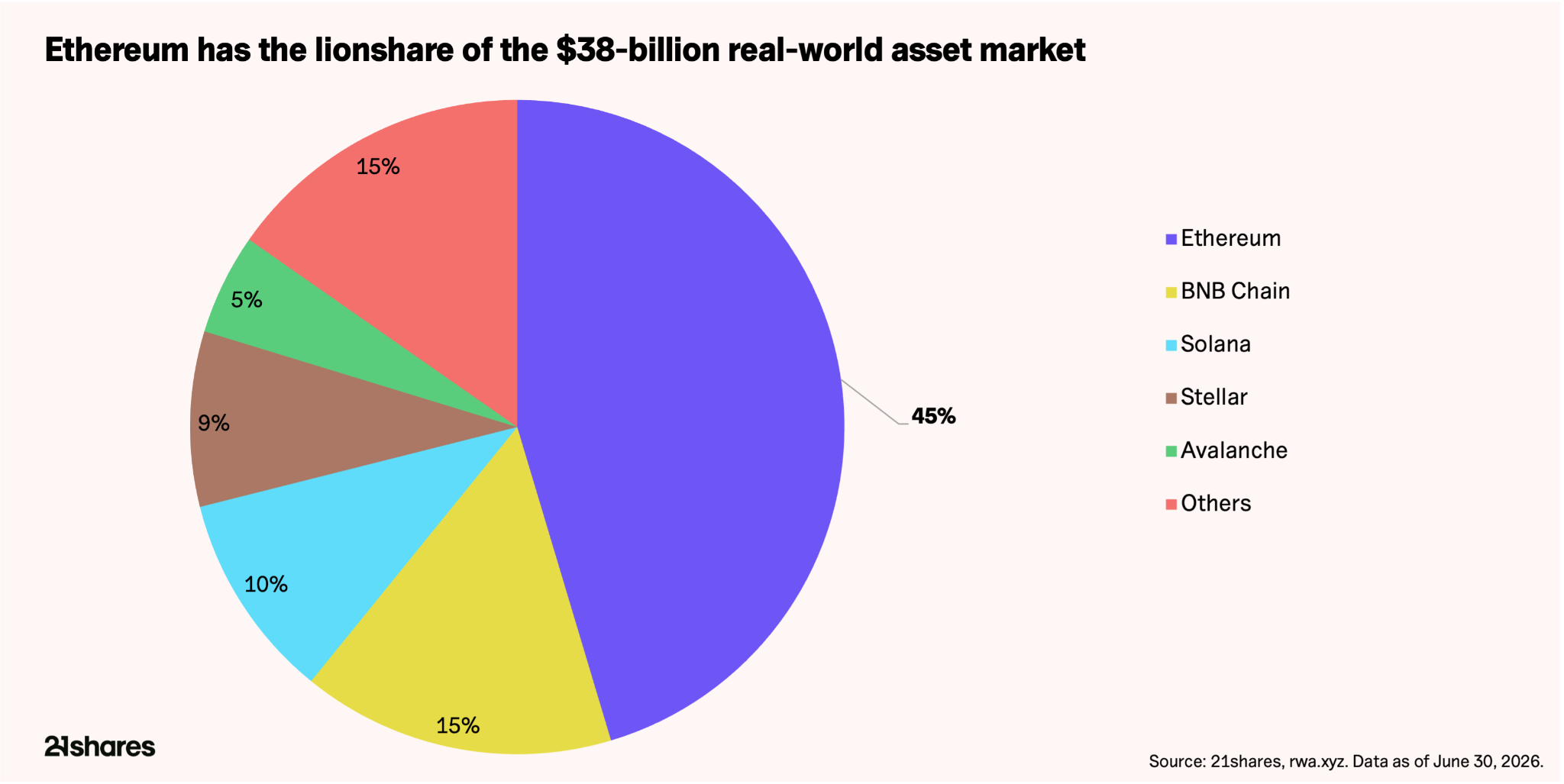
Ethereum also commands approximately $16 billion (47%) of the $34 billion TVL in tokenized real-world assets (RWAs) currently onchain. Tokenized assets such as equities, fixed-income, and commodities are increasingly being issued and traded on Ethereum. As more traditional financial assets migrate onchain, Ethereum's role as the dominant RWA settlement layer is a structural position to monitor. However, it faces real competitive pressure from other chains targeting the same vertical.
Ethereum still dominates where it counts: capital committed to the network
Ethereum represents 32% of the total crypto market cap excluding bitcoin and stablecoins, yet captures 54% of all TVL across crypto applications as of June 2026 (DeFiLlama, CoinGecko. Data as of 30 June 2026). TVL tracks the capital deposited in a blockchain’s applications, a measure of actual economic activity on the network, not just the price of its token. The fact that Ethereum holds a majority of crypto's TVL, approximately $37 billion of the total $70 billion across all blockchains, on just 32% of the market cap points to a durable first-mover advantage. Ethereum has the longest track record of any smart-contract platform; that’s why it benefits from the Lindy Effect: the longer a network operates reliably, the more trust it accrues, and capital stays where it has proven safe.
Users and developers are still building
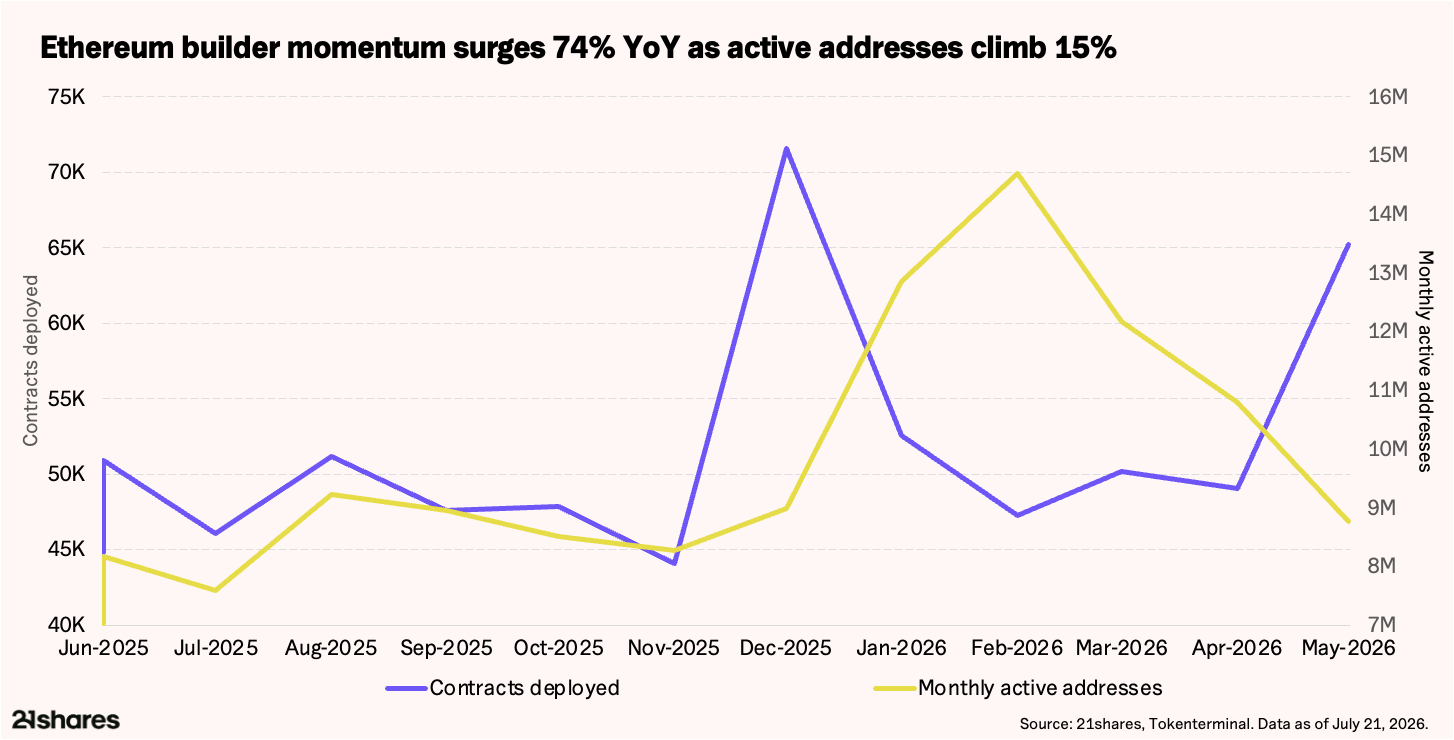
Despite the fall in revenue, both developer and user activity on Ethereum have continued to climb. Monthly active addresses on Ethereum rose 15% YoY to 8.4 million as of June 2026, while smart contracts deployed grew 74% YoY to over 1.3 million (TokenTerminal. Data as of 30 June 2026). It must be noted that spam may account for a portion of the contract deployment figure, but this caveat holds true across all blockchain data. Yet, the underlying signal remains: the network is being used, and the developer activity building on top of it is accelerating through the downturn. In bear markets, speculation tends to fade while the real building continues, laying groundwork for the next generation of decentralized apps to flourish.
The app store lens: a different way to think about Ethereum's value
Think of Ethereum the way you think about an app store. Just as Apple and Google take a cut on every transaction through their platforms, Ethereum charges fees for every application built and run on its network. Any developer, anywhere, can deploy on it permissionlessly. The blended market cap of the Apple App Store and Google Play Store, isolated from their parent companies, is estimated at approximately $723 billion (21shares, CoinGecko, Apple, Google. Data as of 30 June 2026). At even 50% of that figure, Ethereum's implied price per token would be approximately $2,995, a 91% increase from its 30 June 2026 price of $1,570.
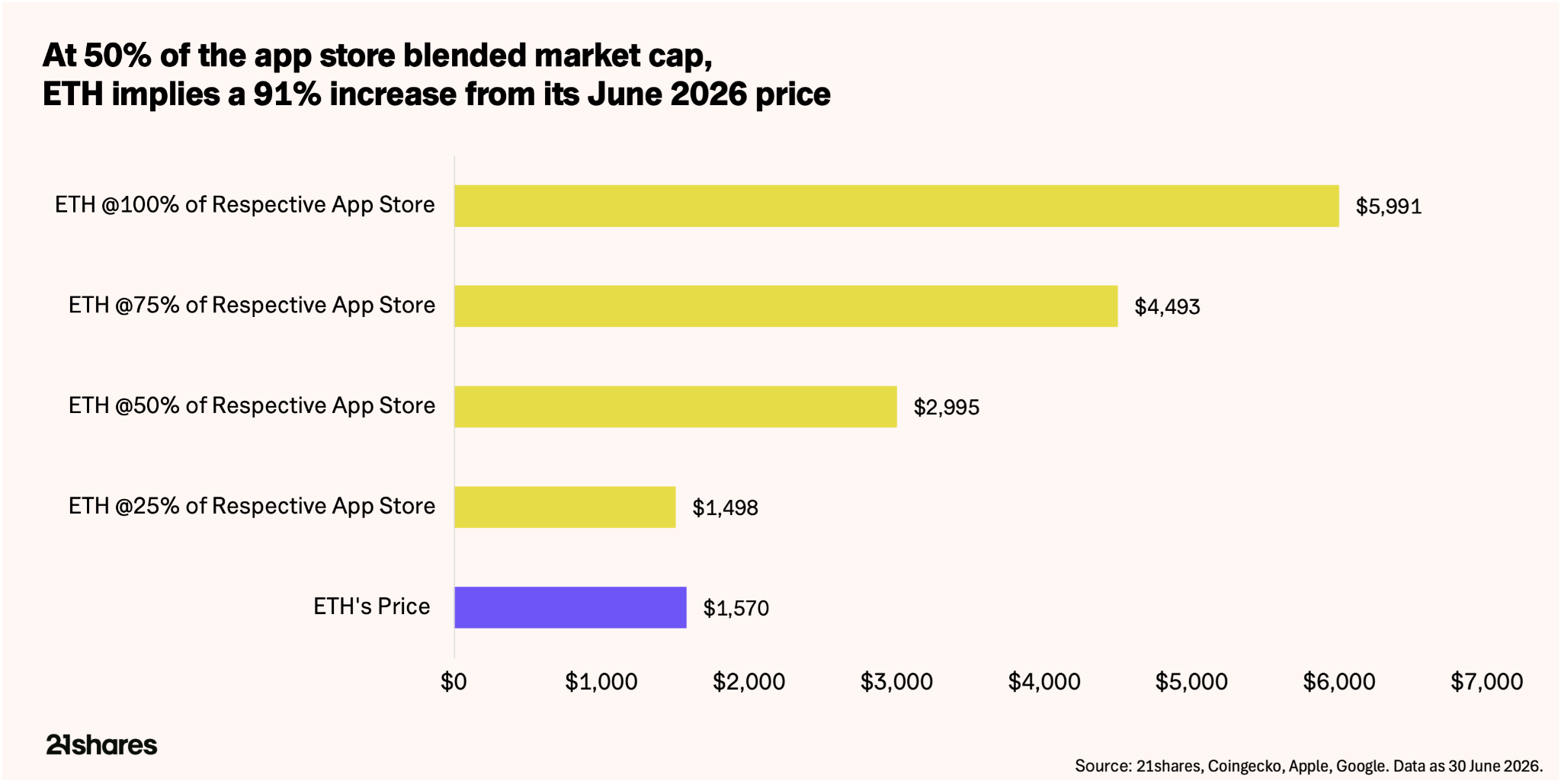
This valuation framework is for assessing Ethereum's long-term growth potential, less so for its price target. Remember, past performance is not a reliable indicator of future performance, and Ethereum's price is volatile and may fall significantly from current levels.
The app store relative-valuation framework may have its limits and should be seen for what it is: a model. Ethereum faces genuine competitive risks from other chains targeting its core fee-generating verticals: Hyperliquid and Solana in trading, and Tron and Solana in stablecoins. The network has also become net inflationary, with token issuance from staking rewards now outpaces the supply burned as activity migrates to L2 networks. However, Ethereum is only 0.86% inflationary, which is far less than gold’s 1.7% annual inflation. Recurring security exploits in DeFi continue to erode TVL, which poses a material risk to Ethereum and should be weighed alongside the structural opportunity.
Ethereum's core infrastructure is growing through the downturn
While Ethereum's revenue decline is real, it follows a pattern that the network has weathered before and recovered from. The bear market is filtering out the noise, and Ethereum’s infrastructure and moat continue to strengthen. The stablecoin settlement layer, the tokenized asset network, and the developer base are all showing double-digit growth YoY. If you are already holding ether and wondering whether the downturn changes its investment thesis, the answer depends on which lens you are examining ether from.
FAQ
What happened to Ethereum's revenue in 2026?
Ethereum's gross revenue fell 69.3% YoY from $414 million in H1 2025 to $127 million in H1 2026 (DeFiLlama, Blockworks, TokenTerminal. Data as of 30 June 2026). Bear market conditions reduced demand for block space, lowering transaction fees across trading and DeFi activity. A comparable decline of 64% occurred between H1 2022 and H1 2023, consistent with prior market cycles.
Is Ethereum losing ground to other blockchains?
Ethereum holds 54% of all value locked across crypto networks as of June 2026, despite representing only 32% of the alt-crypto market cap excluding bitcoin and stablecoins (DeFiLlama, CoinGecko. Data as of 30 June 2026). It also commands approximately $16 billion of the $34 billion in tokenized real-world assets onchain. Ethereum faces growing competition from chains targeting its fee-generating verticals, including Hyperliquid and Solana in trading and newer entrants in stablecoins — a genuine risk to monitor.
How do I invest in Ethereum without buying it directly?
An Ethereum exchange-traded product (ETP) gives you exposure to Ethereum's price through a regulated financial instrument held in a standard brokerage account, without needing to manage wallets or private keys. The 21shares Ethereum Core Staking ETP (ETHC) is listed on major European regulated exchanges.
What are the main risks of investing in Ethereum right now?
The main risks include continued revenue decline if network activity stays low, increased competition from rival blockchains targeting Ethereum's core use cases, Ethereum becoming net inflationary as staking rewards outpace supply burned, and recurring DeFi security exploits that erode total value locked on the network. Ethereum's price is highly volatile and may fall significantly from current levels. Past performance is not a reliable indicator of future results.