

Additional contributions from Krisan Haria
Ethereum's percentage of supply staked has reached a new all-time high at 33.33%.1 For most participants, this reads as a confidence signal; a deepening of network commitment, a collective vote of conviction. What it actually represents is a growing pool of validators locked in a queue-dependent exit mechanism in a network where one entity's financing structure can make that exit more painful than ever for everyone.
Bitmine's position is the story
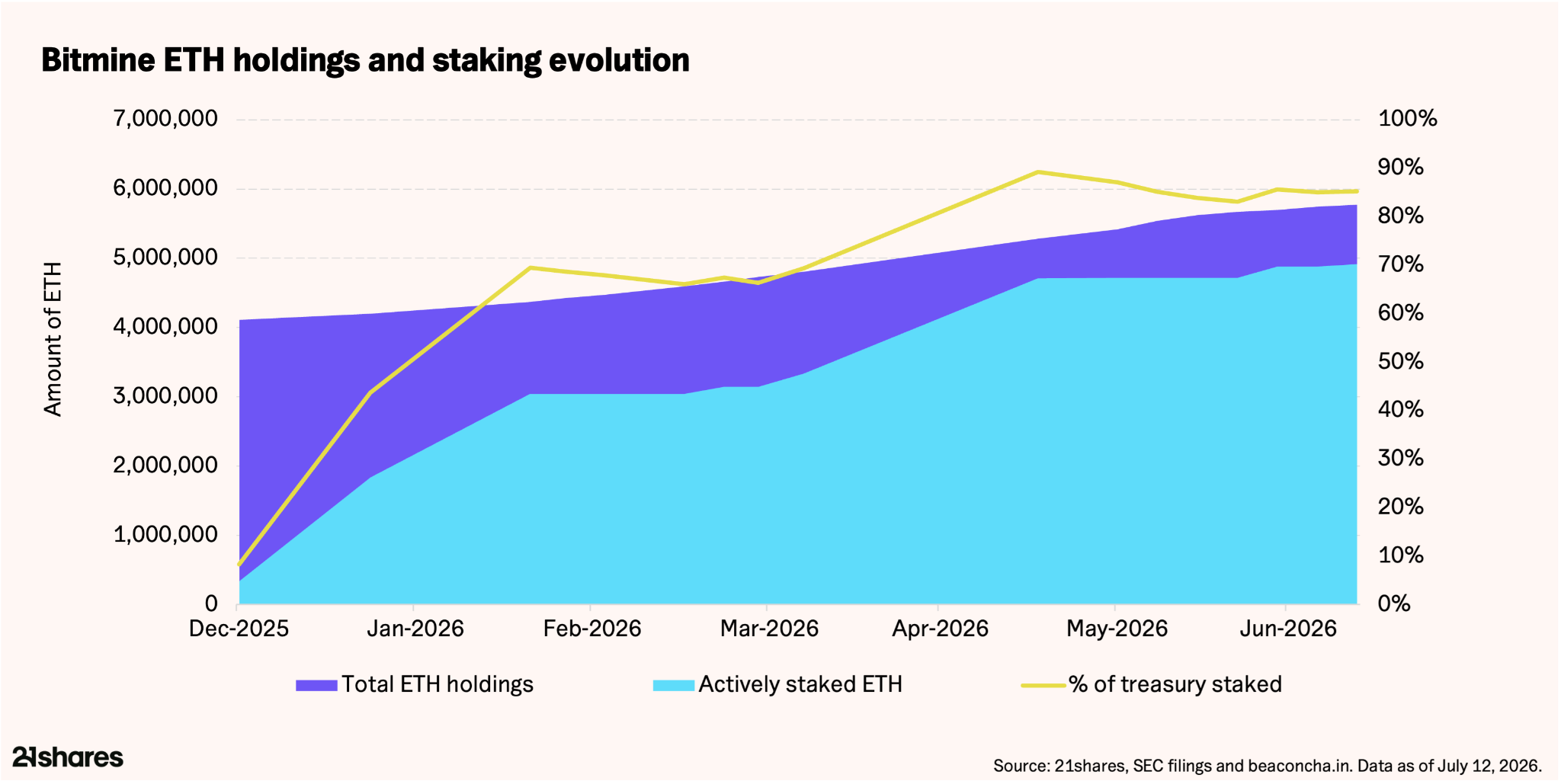
Bitmine has been a primary driver of this concentration, accumulating and staking ETH throughout 2025-26 to the point where it now holds close to 5% of total ETH supply and accounts for approximately 12% of total supply staked,1 operating at an 85% utilization rate.2 The firm has issued preferred stock carrying a 9.5% annual fixed dividend paid out weekly, a materially elevated financing cost that introduces a recurring, non-discretionary cash obligation.
A financing structure that binds every other validator
The structural parallel to Strategy is the correct frame. In a scenario where Bitmine is compelled to liquidate its ETH holdings to meet its obligations to shareholders, the consequences extend beyond price impacts. The validator exit queue would experience a renewed and significant surge in wait times.
For reference, the Kiln incident,3 which drove exit queue times to nearly 50 days, was triggered by the unstaking of approximately 1.6 million ETH. Bitmine currently has approximately 4.9 million ETH staked.2
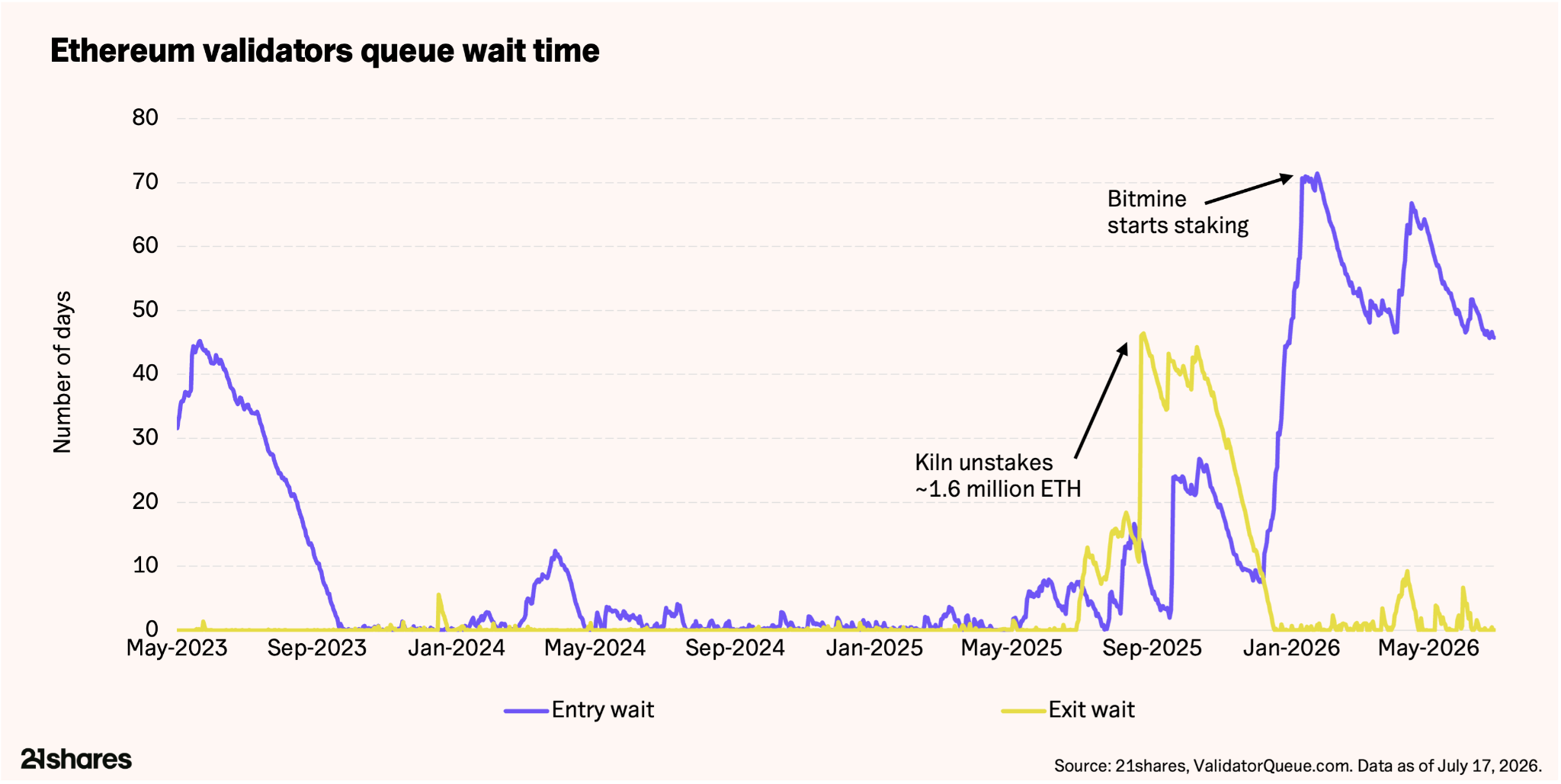
A partial liquidation equivalent to calling the outstanding preferred stock (approximately $367.5 million) would involve approximately 5% of Bitmine's staked ETH. At July 2026 price levels, this alone could potentially add an estimated 5-6 days to the exit queue if recent history is any indicator. Under conditions of deeper financial distress, where ETH price moves adversely and the liquidation requirement scales, the queue impact becomes substantially more severe.
These estimates also do not consider the knock-on effect on other large participants. In the Kiln incident, 1.6 million ETH were forced out of staking, but 400,000 more came from participants trying to front-run the queue and exit first, worsening the situation further.1 That dynamic is likely to repeat in any Bitmine distress scenario, given the scale of its stake in Ethereum.
Glamsterdam addresses the exit side, but not the entry side
The Glamsterdam upgrade, currently scheduled for Q4 2026, has EIP-8061 under consideration for inclusion and is likely to be included, which addresses the exit side of the queue problem.4 The validator exit cap is removed. The exit churn limit increases by approximately four times.
Applied retroactively to the distressed period experienced in late 2025, this would reduce queue times to approximately 12 days.
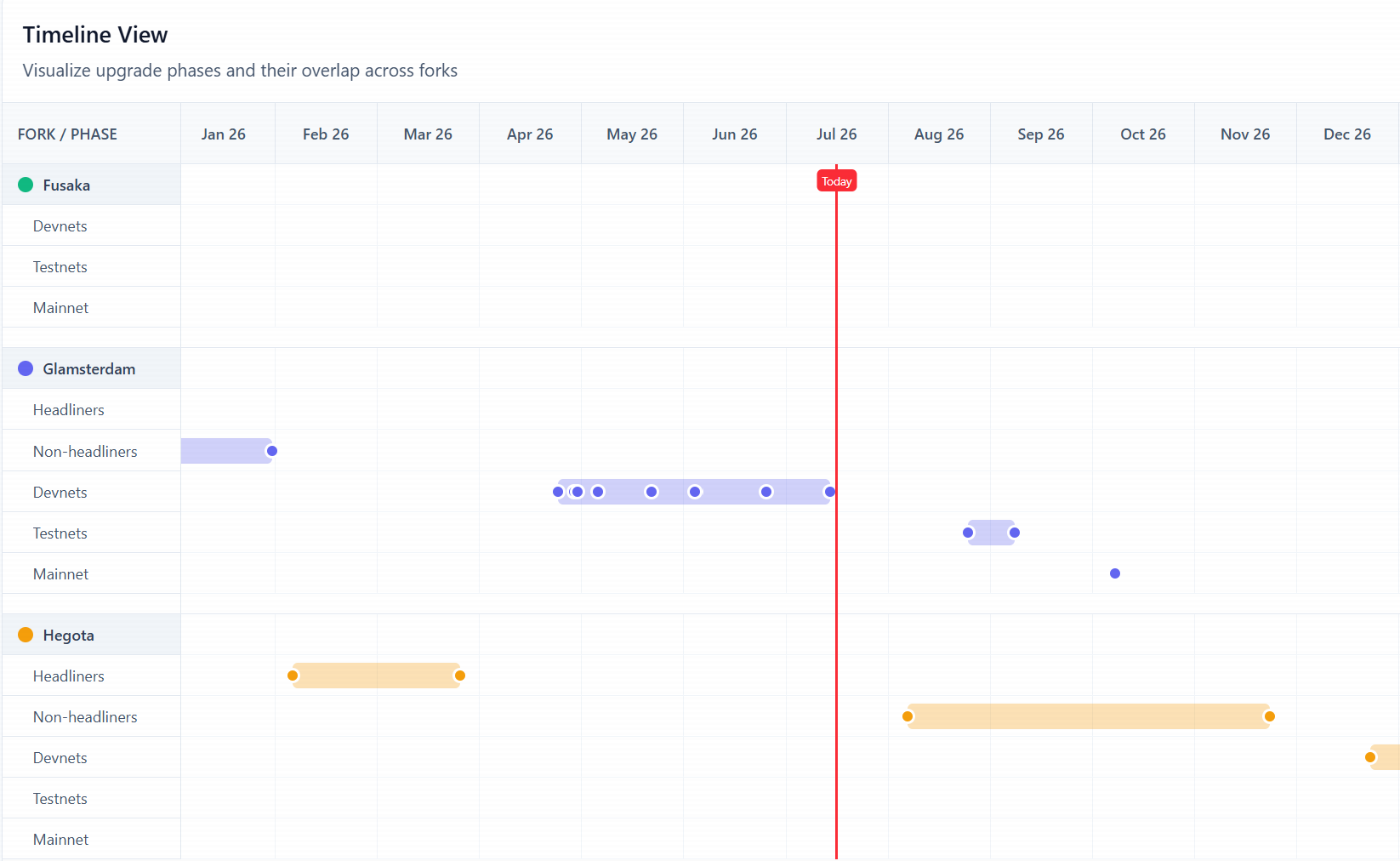
However, no corresponding solution for entry queues is planned. Bitmine plans to continue accumulating until it reaches what it calls the "Alchemy of 5%," and if it maintains its current staking model, entry-side congestion is likely to remain a structural feature of the network, with elevated wait times as the baseline rather than the exception.
Bottom line: the queue is the risk nobody is pricing
The staked supply figure points to more ETH being committed to the network. It does not tell us under what terms, or who bears the cost when those terms cannot be met. Bitmine's shareholders can exit at any moment. Ethereum's validators have to sit in a queue. Those two realities are now structurally linked, and most participants staking ETH today are not pricing that dependency into their target utilization rate.
If EIP-8061 is included in Glamsterdam as currently anticipated, the exit-side vulnerability is addressed. The entry-side risk remains unaddressed. The question for anyone with ETH staked today is whether their risk framework has actually stress-tested a queue disruption at this scale - or whether it is priced on the assumption that one never comes.
FAQ
What is the Ethereum staking exit queue and why does it matter?
The Ethereum staking exit queue is the mechanism that controls how quickly validators can withdraw their staked ETH from the network. Validators must wait in line to exit, and the wait time grows longer as more validators try to leave at the same time. If a large staker is forced to sell, every other validator in the queue behind them faces a longer wait.
What is EIP-8061 and what does the Glamsterdam upgrade change for Ethereum staking?
EIP-8061 is a proposed change to the Ethereum protocol that removes the cap on validator exits and increases the exit churn limit by approximately four times. It is under consideration for inclusion in the Glamsterdam upgrade, currently targeted for Q4 2026. If included, it would significantly reduce exit queue wait times during periods of high unstaking activity.
How much ETH does Bitmine have staked, and why does it matter to other validators?
Bitmine holds approximately 4.9 million ETH staked, roughly three times the amount that triggered the Kiln incident, which pushed exit queue times to nearly 50 days.2 If Bitmine were forced to liquidate even a portion of its position to meet its preferred stock dividend obligations, the resulting surge in the exit queue would affect every other validator waiting to withdraw.
Is the Ethereum staking exit queue problem solved by the Glamsterdam upgrade?
The Glamsterdam upgrade addresses the exit side of the queue problem but does not resolve the entry side. If large-scale staking continues to grow without a corresponding increase in entry capacity, elevated queue wait times on entry are likely to persist as a structural feature of the network.
What is the Kiln incident and why is it used as a reference point for Ethereum staking risk?
The Kiln incident refers to a period when approximately 1.6 million ETH were unstaked in a concentrated period, driving exit queue wait times to nearly 50 days.3 It is used as a benchmark because it represents one of the most severe stress events the Ethereum validator exit queue has experienced, and current staking concentration by single entities now exceeds the scale of that event.
Footnotes
- Beaconcha.in. (n.d.). Ethereum blockchain explorer. https://beaconcha.in
- Bitmine Immersion Technologies, Inc. (2026, July 20). Bitmine Immersion Technologies (BMNR) announces ETH holdings reach 5.78 million tokens, and total crypto and total cash holdings of $11.5 billion [Exhibit 99.1]. U.S. Securities and Exchange Commission. https://www.sec.gov/Archives/edgar/data/1829311/000149315226033855/ex99-1.htm
- Omelchenko, D. (2025, September 11). Ethereum validator exit queue spikes 150% as Kiln unstakes all its ETH. The Defiant. https://thedefiant.io/news/hacks/ethereum-validator-exit-queue-spikes-150-as-kiln-unstakes-all-its-eth
- Forkcast. (n.d.). ACD planning sandbox [Ethereum upgrade schedule]. https://forkcast.org/schedule/




.svg)
