
.jpeg)
Last week, we explored perpetual futures and how decentralized exchanges (DEX) are powering their explosive rise. Among them, a leading DEX, Hyperliquid, is breaking records, leading volumes, and sending its token to new all-time highs.
Before diving into the numbers and what’s driving them, a quick refresher: Hyperliquid runs on its own blockchain, setting it apart from typical trading platforms. Sitting at the intersection of three unstoppable forces: soaring derivatives demand, the shift to decentralized infrastructure, and the rise of next-gen financial architecture, it’s quickly establishing itself as one of DeFi’s most formidable players.
Revenue reaches unprecedented heights
Hyperliquid blew past the $100 million mark in monthly revenue during August, reaching approximately $110 million, a 21% increase from July's $86.6 million. Notably, the platform processed around $357 billion in perpetuals trading volume for the month, a 12% month-over-month rise.
The surge was fueled by heightened market volatility, which drove trading across major assets, and Hyperliquid’s high-performance infrastructure, attracting professional traders seeking centralized exchange-like execution in a decentralized environment. At the same time, structural shifts in the DeFi perpetuals landscape, including declining activity on competing platforms, have concentrated liquidity on Hyperliquid, enabling it to capture the lion’s share of onchain perpetuals trading.

Dominating the DeFi perpetuals market
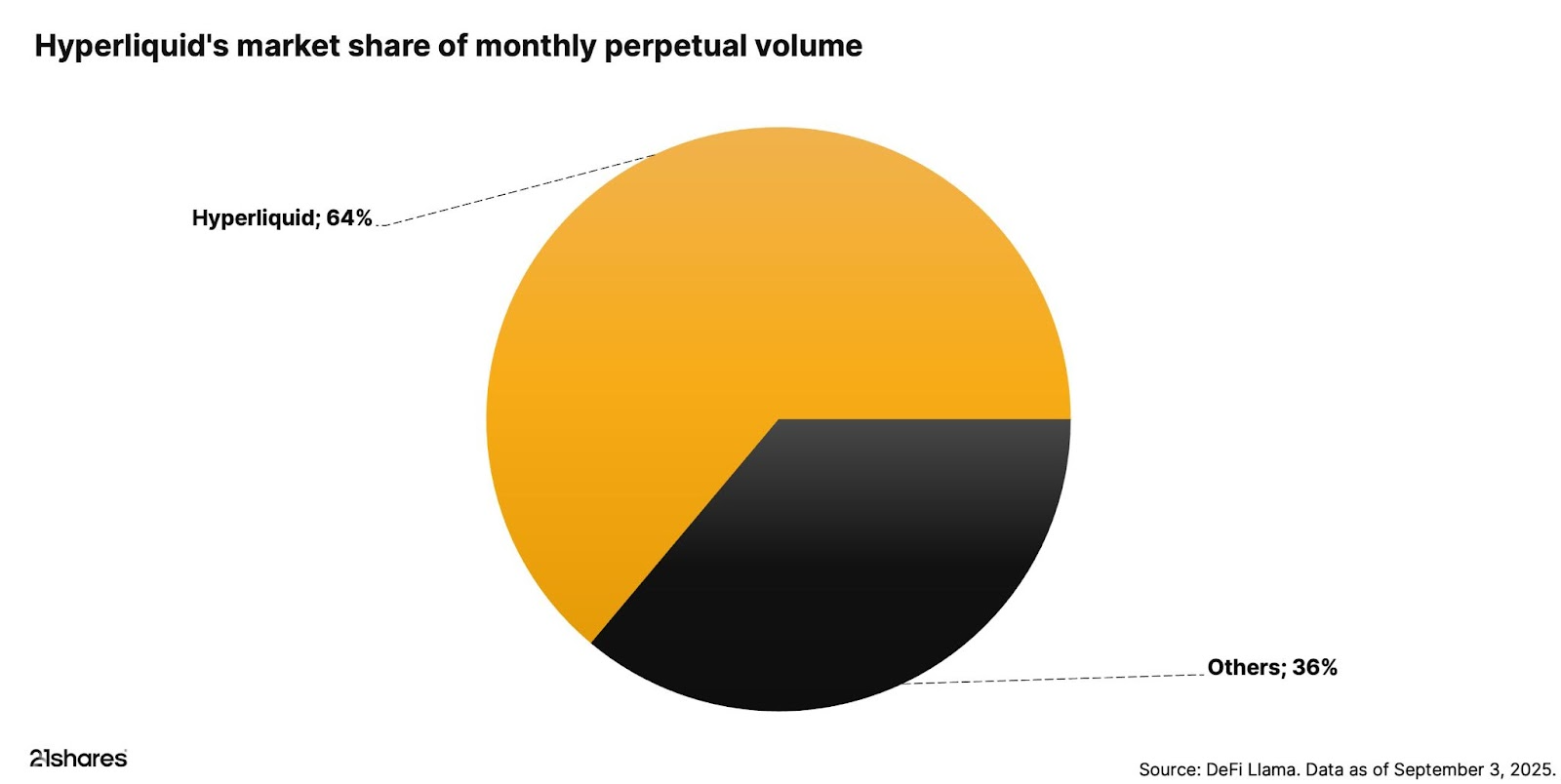
Over the past month, Hyperliquid has dominated decentralized perpetuals, commanding 64% market share. This dominance is a result of its fast on-chain infrastructure, which supports sub-second execution and up to 200,000 orders per second, features that attract both retail and institutional traders.
Token price rockets to an all-time high
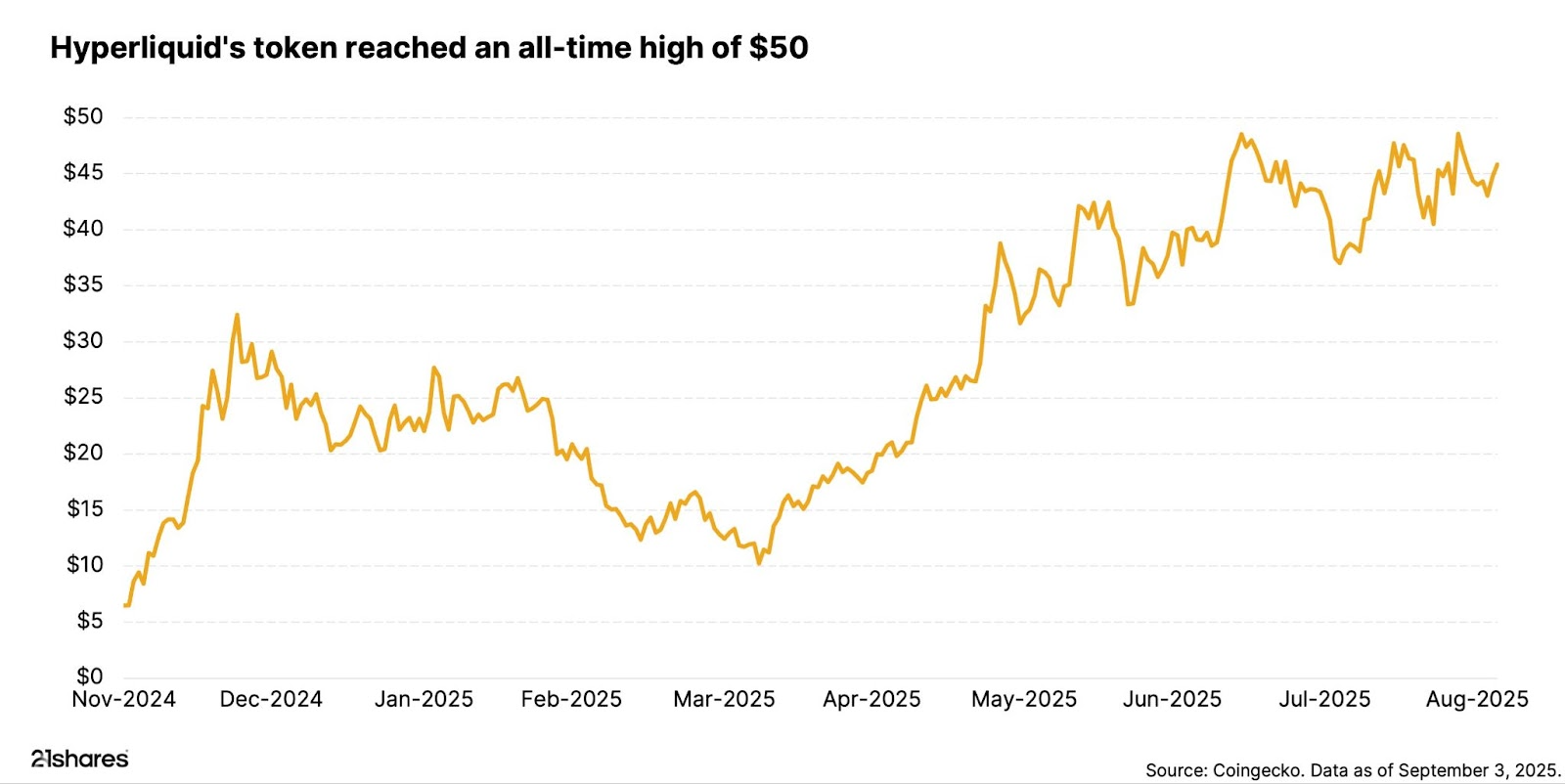
The native token, HYPE, reached a peak of $50.99 in late August. Analysts attribute this increase to record trading activity and the protocol’s automated token buyback mechanism, which directs a significant portion of fees into market purchases, which helps reduce the circulating supply.
What’s driving the momentum?
- Sustained volume surge: With August’s $357 billion in volume, Hyperliquid has emerged as the largest onchain venue for crypto derivatives.
- Innovative infrastructure: The Hyperliquid blockchain provides high throughput and near-instant finality, rivaling centralized exchanges while maintaining decentralization.
- Tokenomics that favor holders: Most revenue flows into token buybacks via the “Assistance Fund,” tightening supply and supporting long-term price discovery.
What's next for Hyperliquid?
Hyperliquid’s rapid ascent shows little sign of slowing. Its planned expansion into new markets, such as spot trading and the tokenization of real-world assets, has the potential to attract fresh user groups and drive even greater volumes.
The launch of its custom operating system, HyperEVM, in early 2025, has transformed Hyperliquid from a derivatives powerhouse into a full-fledged Layer 1 ecosystem, giving developers the tools to build innovative DeFi applications directly on its infrastructure.
For institutions, the appeal is clear: high throughput, transparent settlement, and composable liquidity, all within a blockchain-native environment. Together, these developments could cement Hyperliquid’s place as one of the most influential players in the next phase of decentralized finance.









_logo.svg)

.svg.png)