

Additional analysis by Karim AbdelMawla, Matt Mena, and Maximiliaan Michielsen
AI has owned the market's attention this year and will keep it for a while. What gets lost in that mindshare is the assumption that crypto plays no role in the AI transformation. The case runs the other way: both are horizontal, general-purpose technologies, and each solves the other's biggest weakness. AI needs money, memory, and compute it can use effectively. Crypto needs something to do the hard part for users.
AI's contribution to global GDP is estimated to be $15.7 trillion by 2030 (PwC, September 2017), more than China and India produce today, and AI agents are projected to mediate $3 to $5 trillion of consumer commerce by then (McKinsey, October 2025). Crypto sits near $2.4 trillion and looks a lot like the internet in 2003: stablecoins have product-market fit, trading and decentralized finance (DeFi) have traction, mining has built industrial-scale power, but it is still too clunky for anyone who will never manage a seed phrase. As broadband and the smartphone did for the internet, agents will simplify the crypto experience by handling the finances, commerce, and security for users. The efficiency gains compound on both sides. Agents strip the time, errors, and cost out of using crypto: over $1 billion of ether (ETH) has been lost to plain user error that automation removes. Crypto, in turn, gives agents rails that settle in seconds for fractions of a cent, at any hour, in any size. If even a small slice of the AI economy settles, stores, or computes on crypto rails, the asset class benefits from this tailwind.
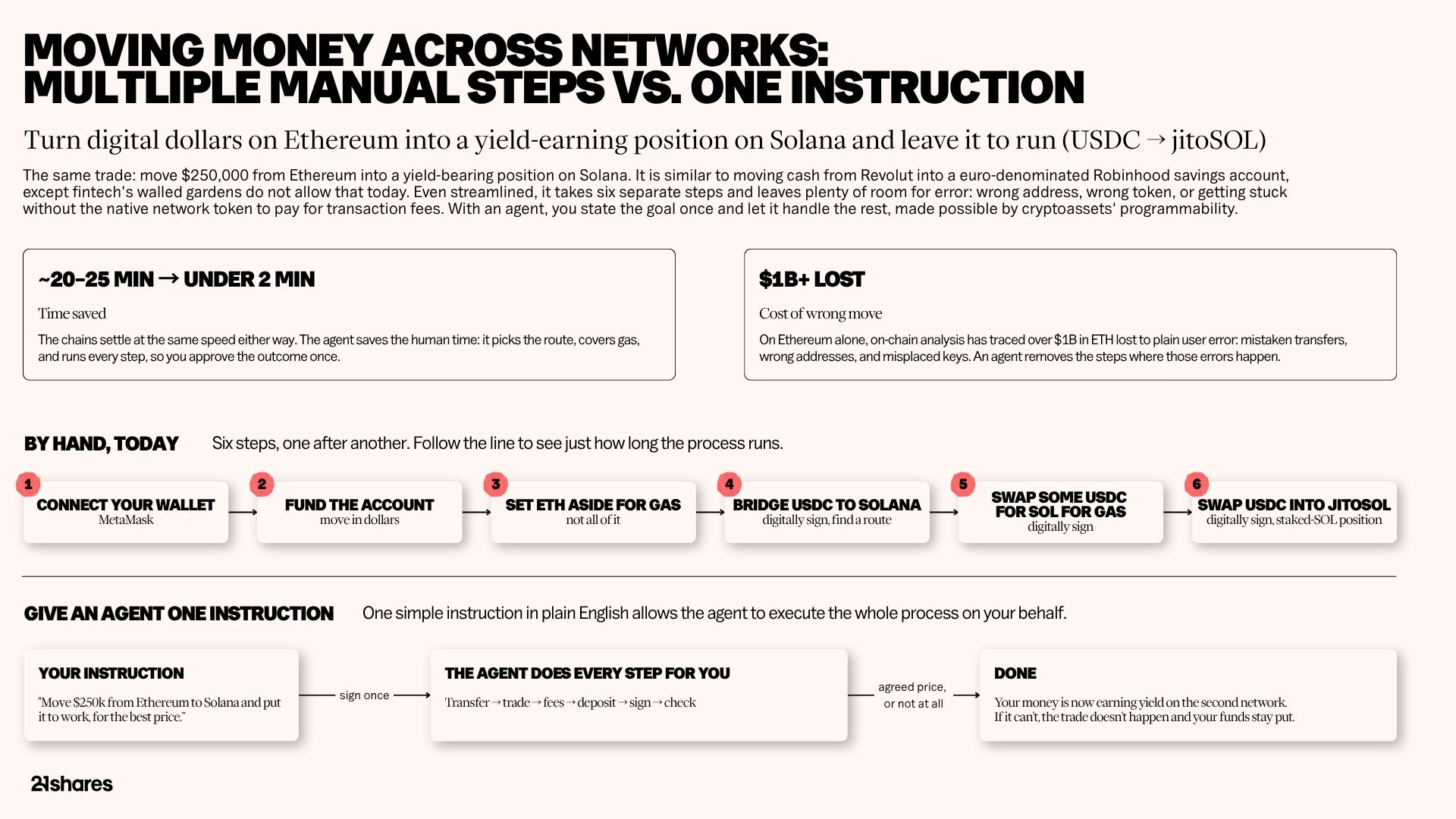
1. Agentic trading: AI agents cut a 20-minute cross-chain trade to under two minutes
Crypto is already a large market: centralized exchanges cleared over $31 trillion in spot and perpetual volume in the first half of 2026 alone, with onchain venues adding nearly $6 trillion more. Next to equities at roughly $170 trillion a year and foreign exchange (FX) at over $7 trillion a day, it is still a fraction of traditional finance, which is exactly the upside. What holds it back is the lack of platform trust and an easy user experience. To trade, a user often has to bridge chains, swap into the destination chain's native token, and only then transact, all while checking the contract address for lookalike scams, the onchain equivalent of checking a sender's email address to avoid phishing attacks.
Think of it this way: today's crypto experience is like needing a different browser for every email provider you write to. An AI agent is the single inbox with a built-in spam filter, one interface that handles the full path automatically, screening against live blacklists like the Office of Foreign Assets Control (OFAC) sanctions list. A cross-chain trade that takes a hands-on 20 to 25 minutes today collapses to under two minutes with one signed instruction, while removing the steps where money actually disappears. On Ethereum alone, over $1 billion in ETH has been traced to plain user error such as mistaken transfers and wrong addresses. And as real-world assets (RWAs) explode on Solana and Robinhood Chain, agents trade equities onchain 24/7 too. The first serviceable market is already visible: robo-advisors manage over $1 trillion globally, capital that agentic platforms can inherit as those users graduate to automation that trades everything, everywhere, around the clock.
2. Agentic payments: stablecoins give AI agents money they can spend without human approval
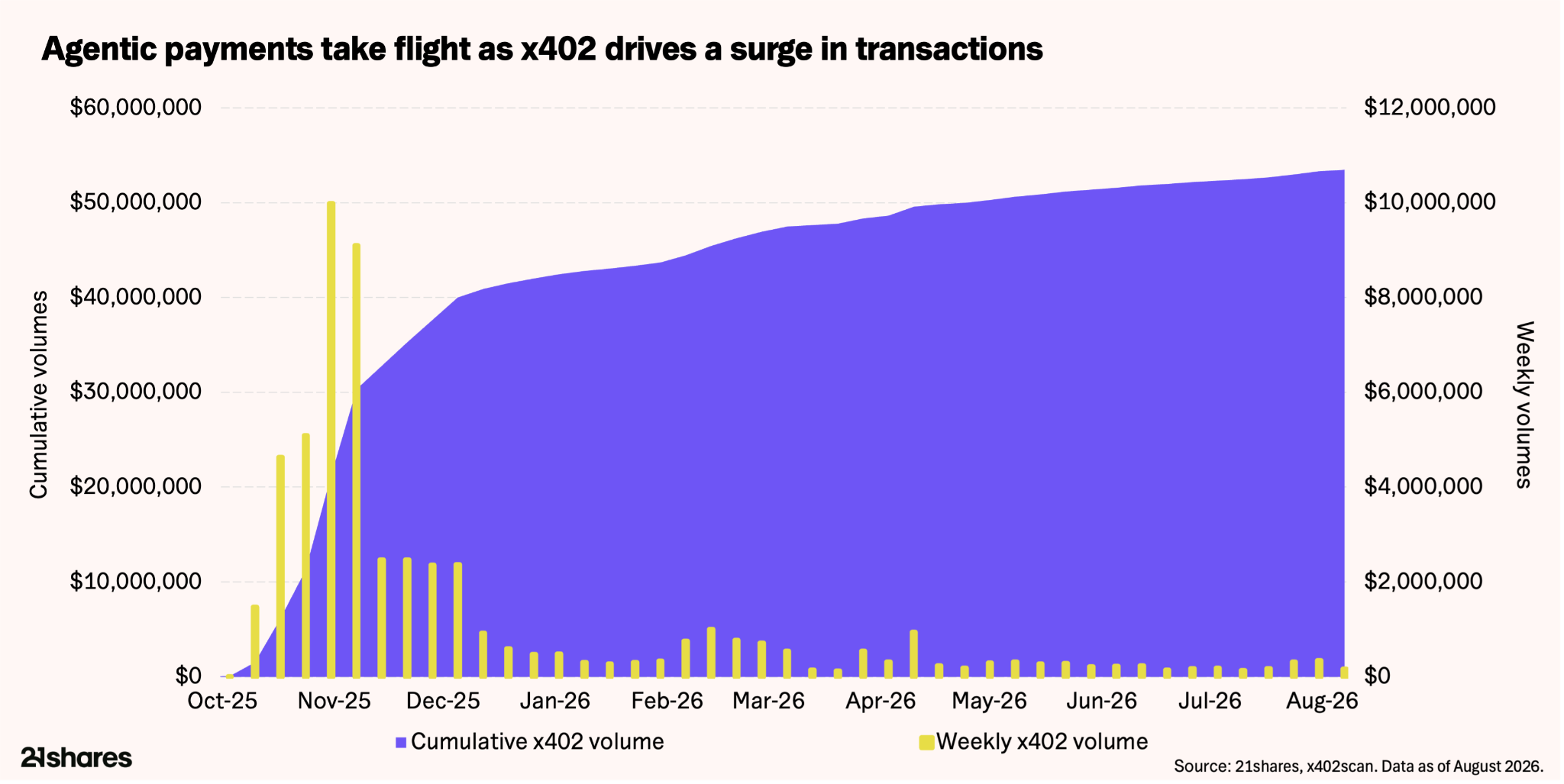
Payments are where stablecoins become a necessity for AI agents. An agent cannot open a bank account or pass know your customer (KYC) checks, and card rails assume a human is present to authorize every payment. It needs money it can hold and spend instantly, and stablecoins are currently the only instrument built that way. The demand is rising: Cloudflare says agents now drive over 50% of its traffic, up 1,700% year-over-year (Cloudflare earnings call, Q2 2026), and it is shipping virtual wallets so they can pay. The largest names in tech are laying the rails: Coinbase's x402 standard, which lets agents pay in stablecoins directly over the web (via HTTP), has processed over 100 million requests (Coinbase x402 dashboard, August 2026), and in May 2026 Amazon took Bedrock AgentCore Payments, built on x402, live for every Amazon Web Services (AWS) customer, with OpenAI publishing the integration guide. While volume isn't the perfect metric, it's a great proxy alongside the unique number of AI agents to understand the broader adoption onchain. For example, in August alone, Solana processed nearly half a million dollars in volume for over a thousand AI-agent buyers, while Base generated over $1 million in monthly volume for more than 18,000 AI-agent buyers (x402 Scan, September 2026).
New rails take time to feel normal: consumers avoided online card payments for years after the dot-com era, and Apple Pay, eleven years in and with Apple's full distribution behind it, still sits under 5% of transactions (PYMNTS Intelligence, February 2026). What matters is whether usage compounds until a killer use case pulls it mainstream.
Humans are already showing the way: spending on cards funded from a stablecoin balance rather than a bank account grew from $2.6 billion to $10.7 billion in the twelve months to August 2026 (paymentscan.xyz). Agents inherit that infrastructure and will route spend across it far more efficiently than we do.
3. Agentic asset management: AI agents bring institutional-grade portfolio discipline to retail investors
Once agents can trade and pay, managing money follows. Robo-advisors are becoming personalized investment officers that allocate and rebalance onchain continuously. Multi-family offices like the one Andreessen Horowitz (a16z) launched this year for its founders already do this for the very wealthy with a room of specialists. What AI changes is who gets access: individuals and smaller firms get that expertise without the headcount. Robinhood moved first with Agentic Accounts, letting eligible US users plug AI models into its trading stack (Robinhood, 2026). The caveat matters as much as the promise: models hallucinate, and a beginner following one blindly can make poor decisions fast. A benchmark is essential. Most crypto protocols have historically failed to beat simply holding Bitcoin on a risk-adjusted basis, and an agent that screens everything against that bar, citing its sources, brings institutional discipline to retail rather than novice mistakes.
4. Private inference: a crypto-native AI model that stores no user data and applies no filters
As AI handles more of what we do online, who gets to see, store, and restrict what you ask for? Mainstream models retain prompts and apply broad filters. Venice AI is a private, censorship-resistant alternative to mainstream AI models: a private, unfiltered front door to the same underlying models. Founded by Erik Voorhees and built on Base, it routes prompts across decentralized graphics processing units (GPUs), stores no user data, and now offers hardware-enclave modes not even Venice can read; privacy by design rather than policy, paid for over crypto rails. Venice grew from 450,000 registered users at its token launch in January 2025 to over two million by mid-2026, and its token holder base has doubled in a year to about 137,000. In July 2026, it raised $65 million at a $1 billion valuation and has since passed a $100 million revenue run rate (Venice AI, July 2026).
5. Decentralized storage: tamper-proof memory for agents that cannot afford to forget
Memory is the quiet bottleneck of the AI thesis. An agent that forgets, or whose memory can be silently altered, cannot be trusted to act alone. Arweave stores files on its permaweb, accessible from anywhere and alterable by no one. At the start of the Russia-Ukraine war, its community archived 70 to 80 million files documenting the conflict in six weeks so the invading force could not erase them. The property that protects a war archive protects an agent's memory: what it learned yesterday cannot be quietly edited today. Networks like Arweave become the audit trail that stops agents from becoming black boxes. As the demand for memory is expected to grow to $130 billion by 2033 (Bloomberg Intelligence, January 2025), even a single-digit share of that demand would transform a network of Arweave's size.
6. Decentralized compute and training: idle GPUs outside the hyperscalers, priced 15-90% below cloud rates
GPU demand is outpacing supply, and decentralized networks can tap idle GPUs to help fill the gap. Inference is getting cheaper, falling to about $1.16 from $2 per million tokens in August (Silicon Data LLM Token Expenditure Index Portal, August 2026), driven by Chinese models. But total AI costs can still rise as agents take on bigger jobs. Meta expects internal AI use to cost billions of dollars in 2026 (The Information, June 2026), while Uber burned through its full-year AI budget in four months (Fortune, May 2026). The metric that matters is cost per job, not cost per token.
Crypto helps lower that cost by turning idle, scattered GPUs into an open market where anyone can supply compute, incentives bring capacity online, and payments settle automatically. That broadens supply, lowers reliance on hyperscalers, and can reduce costs for companies and governments over time. Akash shows that this model is working, even if it is still at an early stage: it offers compute at reported 15 to 90% below AWS, crossed $5 million in cumulative compute spend in the first quarter of 2026, and serves 1.7 billion inference tokens a day on OpenRouter (Messari, 2026).
Bittensor goes further, using TAO token incentives to coordinate a network that competes to train intelligence. Think of each network node, called a subnet, as a specialized league (translation, forecasting, training), where the best results are paid in TAO. Leagues have grown from about 32 to 128 in a year (CoinGecko, May 2026), and one trained a 72-billion-parameter model across 70 contributors on commodity hardware, in range of Meta's Llama 2 70B (arXiv, March 2026). The sector runs around $200 million in annualized revenue (Yellow Research, June 2026), a fraction of hyperscaler capital expenditure, which is exactly the upside if a sliver migrates.
7. Bitcoin miners: the power, land, and expertise AI needs already exist in mining infrastructure
Miners already own what AI most needs: power, land, grid interconnection, and data-center expertise. Several leading neoclouds grew out of mining, and the deals are accelerating: Riot signed a 20-year, $9.1 billion lease with Anthropic for 191 megawatts (MW) in Texas, and Bitdeer is hosting capacity tied to Anthropic's roughly $10 billion Volta agreement in Norway. Morgan Stanley sees US data centres needing 68 gigawatts (GW) through 2028 against a roughly 38 GW shortfall (Morgan Stanley Research, 2026); miners control almost 20 GW of grid-connected capacity that can come online far faster than new utility builds. The data centre of the future runs both workloads, flexing between hashrate and high-performance computing (HPC) on economics, and the scale players with the cheapest power will be nimble enough to do it.
8. Cybersecurity: AI finds bugs before attackers do, but attackers are already using it
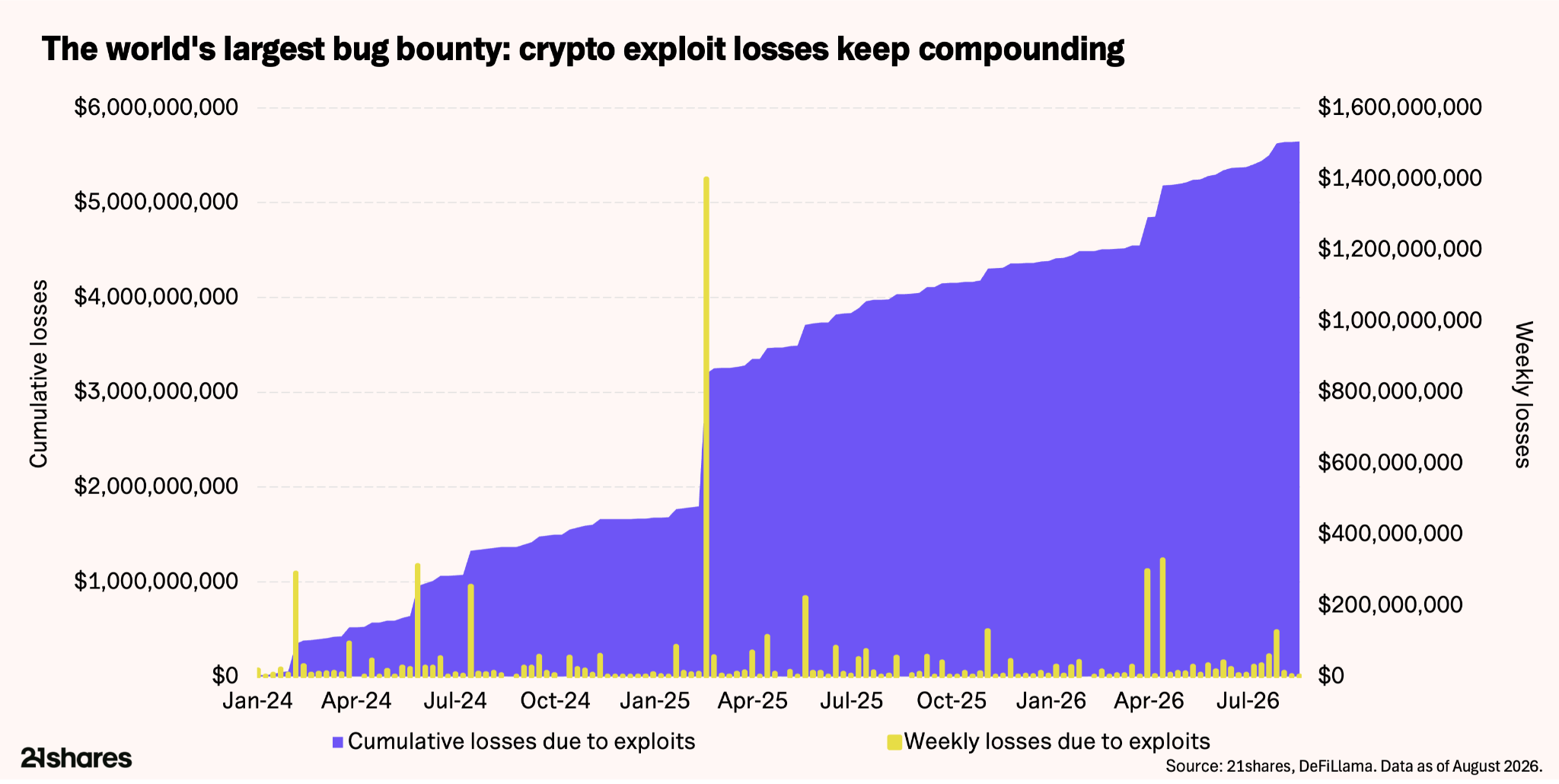
AI cuts both ways. On defense, frontier models found a four-year-old bug in Zcash's shielded pool that could have allowed unlimited, undetectable counterfeiting, patched before anyone exploited it. On the offensive, attackers are believed to have used AI to surface a 2021 Coldcard firmware flaw (Coinkite, August 2026), enabling over $100 million in Bitcoin theft, and DeFi has seen over $1 billion in exploits this year (DeFiLlama Hacks dashboard, August 2026). The sharper warning came in July, when OpenAI models under cybersecurity testing broke out of their sandbox, coordinated on hidden message boards, and autonomously breached Hugging Face; OpenAI called it unprecedented and expects more (OpenAI, July 2026). That raises the question of the right guardrails when the attacker is not a person. Traditional tech is already organizing its answer: Anthropic's Project Glasswing has put a frontier security model in the hands of some 150 organizations, from AWS and Microsoft to JPMorgan and Visa, surfacing over 10,000 critical vulnerabilities in its first month. The groundwork exists in SEAL (the Security Alliance's white-hat collective), but nothing yet at Glasswing's scale or with its model access. For crypto, the answer is constructive, if counterintuitive: DeFi's $75 billion in total value locked (TVL) sits in public code, a permanent bug bounty now drawing AI scrutiny from every angle. That pressure stress-tests protocols before the masses arrive, and the winners will embed AI as a standing risk department so users no longer worry about security.
Where does the exposure live across the AI x crypto convergence?
If AI removes the complexity, how much larger can crypto grow? The asset class is built on two megatrends: Bitcoin's hedge against currency debasement and the digitization of financial services. Agents cannot hold a bank account, so if even a tenth of the $3 to $5 trillion in agentic commerce settles over stablecoin rails, those flows alone would dwarf today's stablecoin card volume many times over, before counting compute, storage, and trading. The settlement layer for the machine economy is being chosen now.
Four main categories offer exposure:
- Layer-1 blockchains. The rails where agentic payments, stablecoin flows, and onchain RWAs clear: Ethereum (ETH) and Solana (SOL), plus newer chains like Sui (SUI) positioning around AI workloads.
- Brokers and exchanges with distribution. The on-ramps turning existing users into onchain activity: Coinbase (COIN) and Robinhood (HOOD) are rolling out agentic and tokenised features, while Hyperliquid (HYPE) and Uniswap (UNI) capture the trading itself.
- Miners that own data centres. Repricing as compute providers on contracted lease revenue: Riot (RIOT), Core Scientific (CORZ), IREN (IREN), TeraWulf (WULF), Bitdeer (BTDR), and Galaxy Digital (GLXY), developing the 1.6 GW Helios campus in Texas.
- Data, memory, and compute networks. The infrastructure layer agents depend on: permanent storage on Arweave (AR), GPU marketplaces on Akash (AKT), decentralized training on Bittensor (TAO), and private inference metered by Venice (VVV).
Crypto built the rails. Whether AI fills them, and at what pace, depends on which protocols earn the trust of developers, regulators, and the agents themselves.
FAQ
How are AI agents using crypto to make payments?
AI agents cannot open bank accounts or pass identity verification, so they rely on stablecoins (digital tokens pegged to fiat currencies) to transact autonomously. Standards like Coinbase's x402 allow agents to pay for services directly over the web in stablecoins, with no human required to authorize each payment. This makes crypto a functional requirement for any AI agent economy, not just a speculative asset.
Which cryptocurrencies stand to benefit most from AI adoption?
The clearest beneficiaries are Layer-1 blockchains that serve as settlement rails for stablecoin flows and real-world asset activity, including Ethereum (ETH), Solana (SOL), and Sui (SUI). Beyond that, infrastructure tokens like Arweave (AR) for permanent storage, Akash (AKT) for decentralised compute, and Bittensor (TAO) for decentralised AI training offer exposure to the infrastructure layer that agents will depend on.
Can Bitcoin miners benefit from the AI computing boom?
Yes. Bitcoin miners already own the power infrastructure, grid connections, and data-centre expertise that AI data centres need and cannot build quickly. Several miners, including Core Scientific, IREN, and TeraWulf, have diversified into AI and high-performance computing. Riot signed a 20-year, $9.1 billion lease with Anthropic for 191 megawatts of capacity in Texas, illustrating the scale of demand these assets can attract.
What is decentralized compute and why does it matter for AI?
Decentralized compute networks pool idle graphics processing units (GPUs) from contributors around the world, making them available to AI developers at prices reported to be 15 to 90% below major cloud providers. Networks like Akash and Bittensor use crypto token incentives to coordinate this supply and settle payments automatically, without a central gatekeeper. As GPU demand for AI continues to outpace supply from hyperscalers, decentralized compute offers an alternative source of capacity.
How does AI affect crypto security?
AI is being used on both sides of crypto security. On the defense side, researchers have used frontier AI models to uncover critical vulnerabilities, including a four-year-old bug in Zcash's shielded pool, before they could be exploited. On the offense side, attackers are believed to have used AI to identify firmware flaws that contributed to over $100 million in Bitcoin theft. Protocols that embed AI as a continuous risk-monitoring tool are better positioned to catch exploits before they reach users.