

As tensions between Israel and Iran escalate, Bitcoin’s price has remained steady, holding strong above $100K. Unlike many assets that often fall during uncertain times, Bitcoin’s resilience is drawing increasing attention from everyday investors as a dependable store of value amid global instability.

Last week, during the clash between Iran and Israel, Bitcoin was gaining momentum toward its all-time highs. Yet even as risk assets wavered, Bitcoin’s volatility remained contained, briefly climbing to 35% (well within historical norms) and far below spikes seen during past market dislocations.
Bitcoin’s resilience in the historical context
As a high-beta asset, Bitcoin has often sold off during geopolitical tensions and risk-off periods, though its reaction has varied depending on market timing and maturity. In 2014, during Russia’s annexation of Crimea, Bitcoin dropped 13% on day one and continued to slide. Even in 2021, amid the Myanmar civil war, Bitcoin saw a slow 90-day decline of nearly 30%.
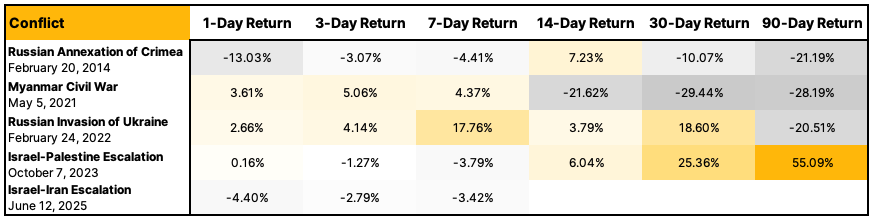
The clear outlier in the dataset is the Israel-Palestine escalation. Bitcoin surged over 55% in the 90 days following the conflict, a dramatic deviation from typical war-linked performance. However, this rally was driven by speculation around the imminent launch of US-based spot Bitcoin ETFs at the start of 2024, not by inherent geopolitical hedging.
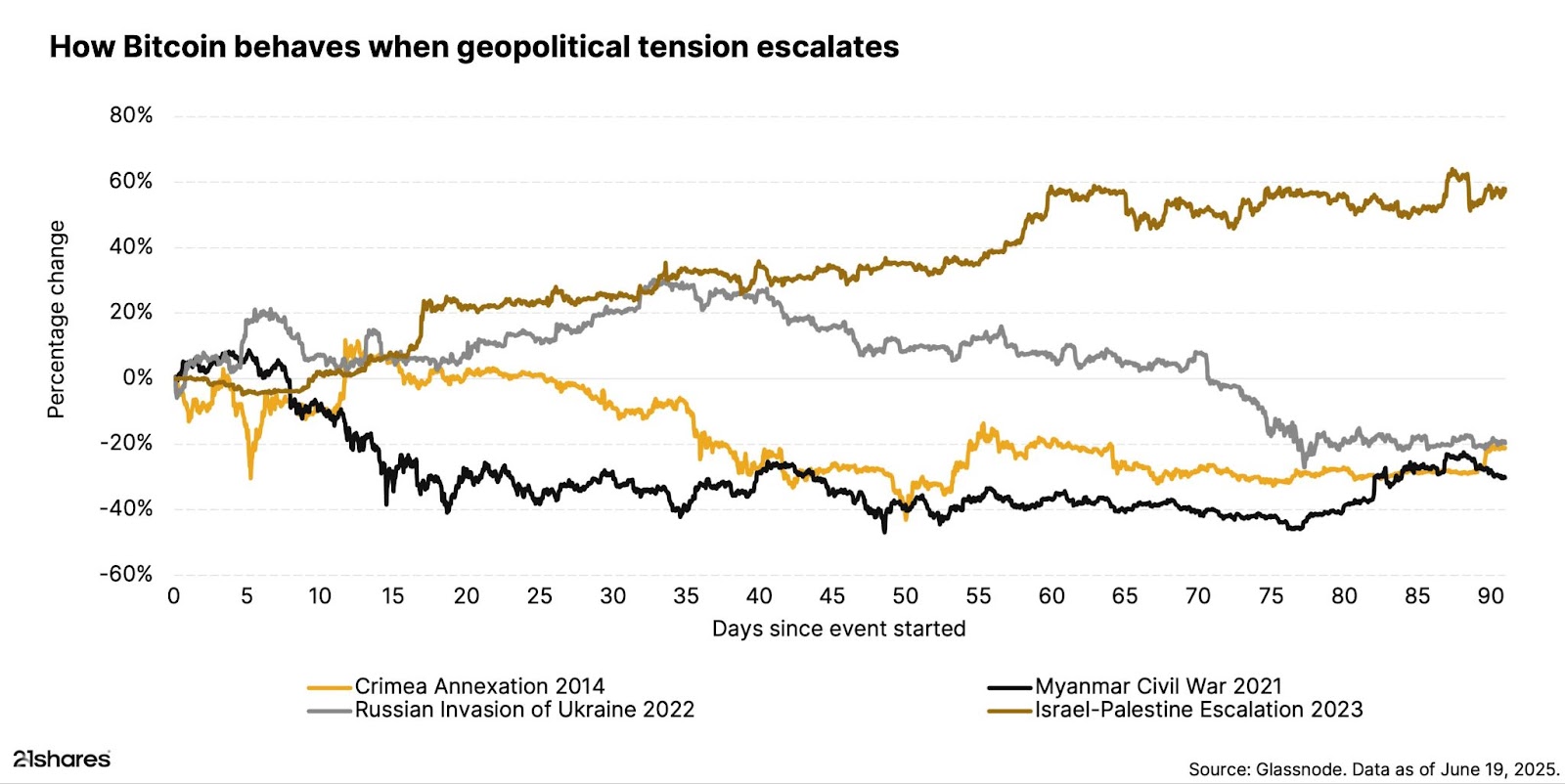
The data shows that Bitcoin’s short- and medium-term returns usually show sharp drawdowns immediately after such events, especially when internal sentiment is weak or tensions remain unresolved. In the recent Israel-Iran escalation, Bitcoin dipped briefly on the day of the strike but quickly stabilized, trading above $100K without sustained selling pressure, a contrast to previous multi-week declines. This underscores Bitcoin’s growing stability, liquidity, and resilience in the face of external uncertainty, bolstered by robust internal fundamentals.
Bitcoin’s foundation grows stronger beneath the surface
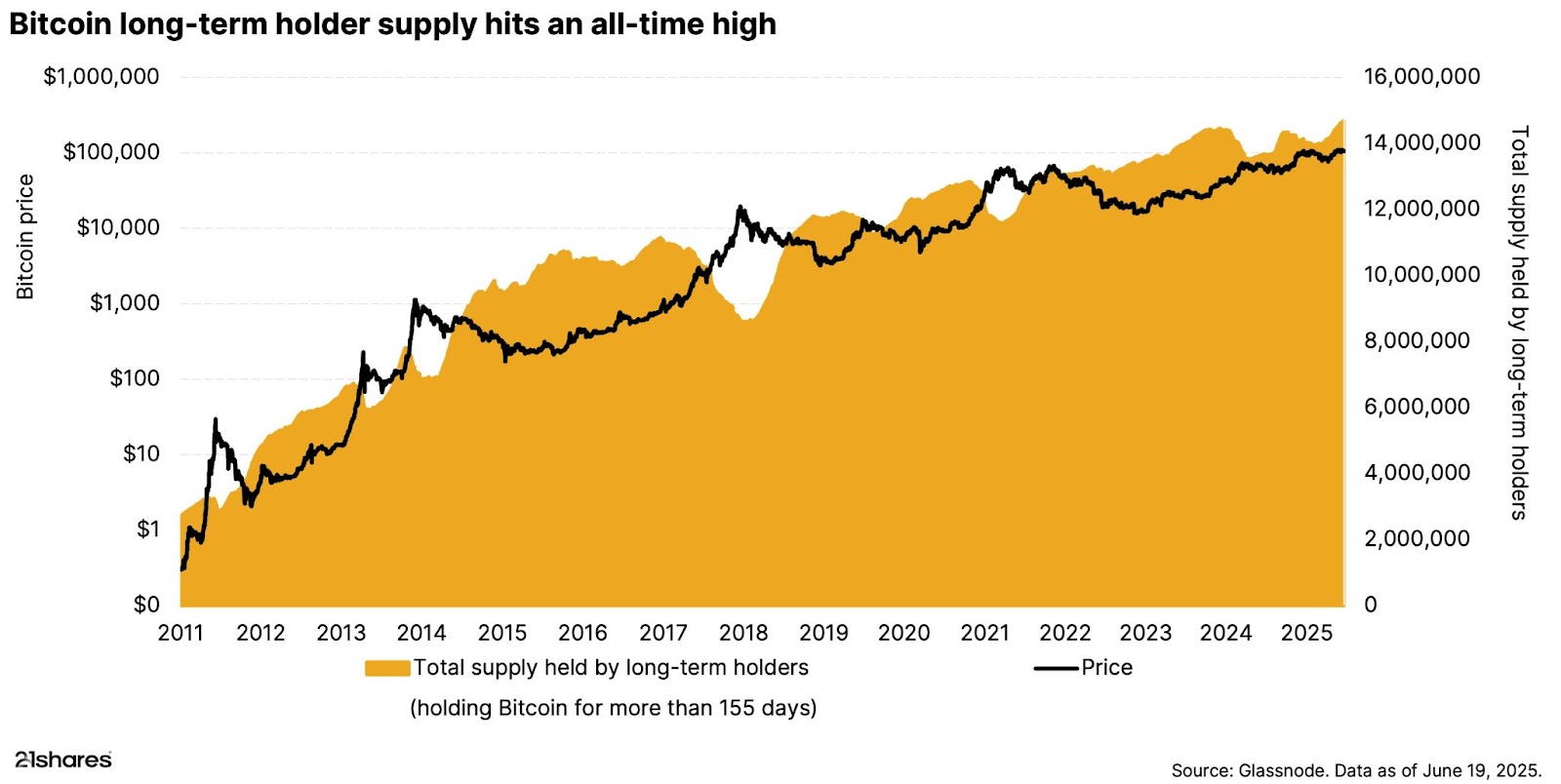
While short-term price action reflects how Bitcoin reacts to external shocks, on-chain data reveals a deeper story. As shown in the chart below, long-term holder supply has hit an all-time high: over 14.5 million BTC, around 70% of the circulating supply, is now held by entities that haven’t moved their coins in six months or more. This shift signals Bitcoin’s maturing market: long-term holders are stabilizing price swings, minimizing losses, and boosting resilience, especially during macro turmoil. The recent calm after the flare-up reflects this growing strength.
Conclusion
While Bitcoin’s current trajectory isn’t without risk, a broader conflict escalation could still trigger a risk-off move across markets, the core thesis holds firm. Historically, geopolitical crises fuel inflation through fiscal expansion, looser monetary policy, and supply shocks. In such environments, Bitcoin’s value proposition as a non-sovereign asset with fixed supply becomes not just relevant, but increasingly compelling.









_logo.svg)
.svg.png)