Was 2025 the year crypto entered adulthood?



Key takeaways:
- Crypto crossed a threshold in 2025: The shift was from excitement-led adoption to infrastructure-led utility and long-term capital alignment.
- Deleveraging without capitulation: Excess speculation unwound sharply, but real usage held. Leverage reset and memecoin volumes collapsed, yet payments, stablecoins, and active users proved resilient, clarifying what demand was transient versus structural.
- Infrastructure and regulation converged to enable scale: Clearer rules and production-ready infrastructure converged, enabling governments, banks, and fintechs to use public blockchains and stablecoins in live payments, settlement, and tokenization.
- The industry’s first durable apps have emerged: As the rails solidified, applications scaled. DeFi lending and prediction markets crossed product-market fit, drew institutional participation, and produced real revenue – marking crypto’s transition from experimentation to durable, economically viable applications.
Crypto cycles have historically been defined by price. In 2025, the defining signal was resilience. As leverage and speculation unwound, core usage continued to compound, revealing a system increasingly driven by function rather than narrative.
Crypto’s relevance no longer hinged on momentum or sentiment. Instead, it began to resemble infrastructure: regulated, embedded, and increasingly responsible for moving real value across financial systems.
This report examines three forces behind that shift: a speculative reset without a usage collapse, alignment of regulation and infrastructure, and applications moving from pilots to scalable production. For investors, this marked crypto’s transition into maturity.
1) Speculative activity declined while core usage remained resilient
Takeaway: This year separated transitory hype from durable adoption.
The year started with a fever of speculation. President Trump’s inauguration and the launch of the TRUMP memecoin reinforced expectations of a more crypto-friendly policy backdrop, triggering a wave of memecoin issuance across celebrities and even nation-states like Argentina1.
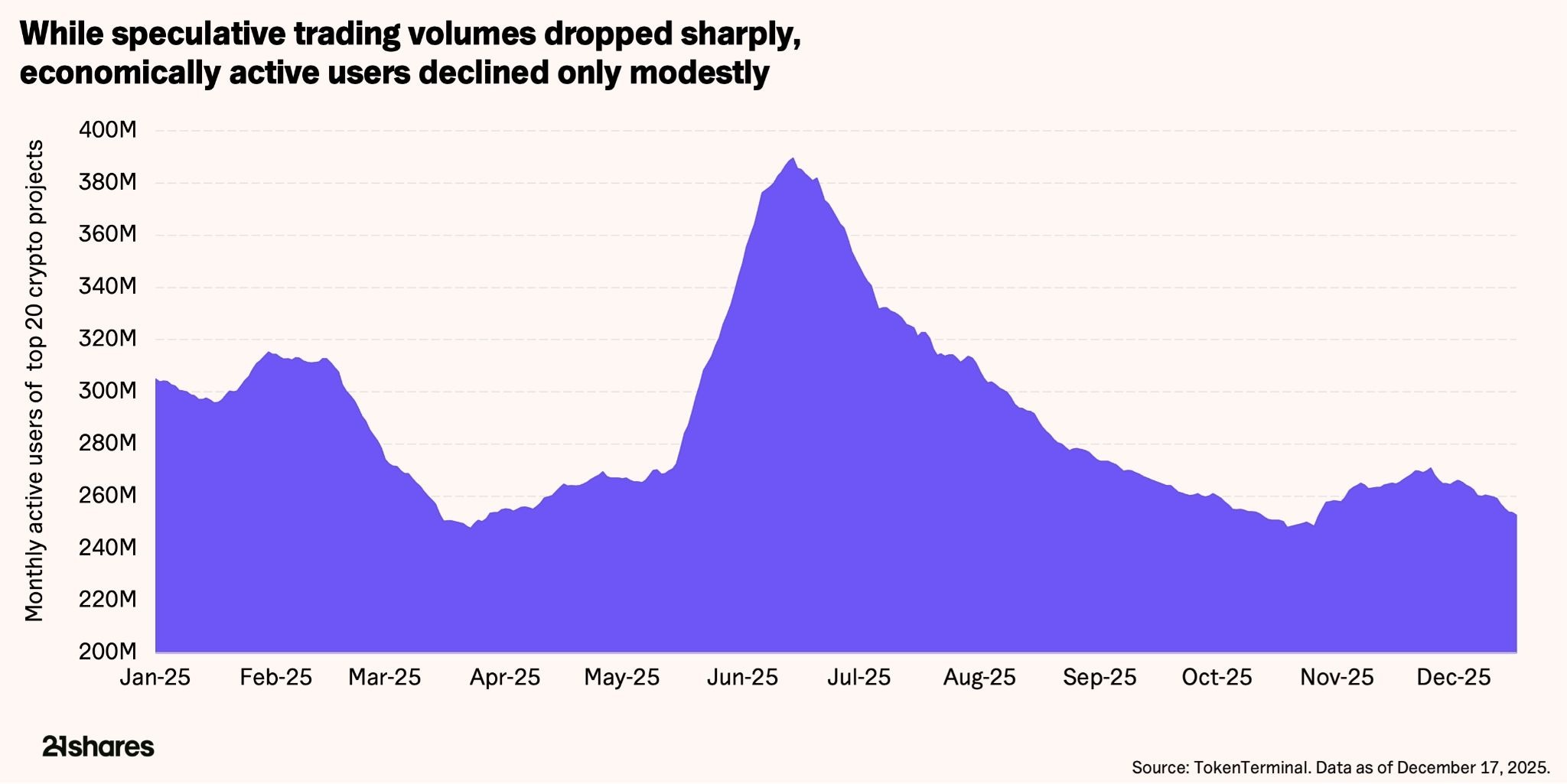
However, this momentum proved short-lived as speculative activity dropped off:
- Memecoin activity collapsed: Trading volumes generally fell 80–90%2 over the year. On Ethereum, memecoin volumes declined by roughly 60% (from ~$13m to ~$5m), while on Solana they dropped over 85%3 (from ~$106m to ~$13m), despite easier token issuance via launchpads such as Pump.fun.
- Leverage reset: Aggregate futures open interest fell by around 30%, from ~$45bn in Q1 to ~$32bn4. The reset was tested in April, when global trade tensions triggered a risk-off move, pushing Bitcoin down more than 20% peak-to-trough and driving tens of billions of dollars in liquidations. A smaller deleveraging followed in October which, despite limited impact on spot prices, produced one of the largest liquidation events on record.
Crucially, adoption proved resilient. While speculative activity and leverage collapsed, active users across the top 25 protocols and apps declined only 22% (from ~250m to ~195m)5, and stablecoin monthly active users grew 25%6 (from ~40m to ~50m) year-to-date. Taken together, the reset clarified what was transitory and what was durable. Speculative activity unwound, but usage tied to payments, settlement, and liquidity continued to grow.
2) Infrastructure scaled as regulation reduced uncertainty
Real-world integrations
Takeaway: Crypto went mainstream by becoming invisible.
Governments expanded real-world deployments of public blockchains in 2025. The focus was not speculation, but recordkeeping, payments, and tokenized liabilities. Some of the standouts were:
- United States: Federal agencies published hashes of official GDP data on public blockchains, using Ethereum for recordkeeping and Chainlink for data verification7.
- Germany: NRW.BANK, the country’s largest state-owned development bank (~€160bn in assets), issued a fully digital bond on Polygon,signaling onchain issuance at an institutional scale8.
- United Arab Emirates: The UAE central bank approved Zand AED, a fully backed dirham-pegged stablecoin issued on AIDA, a government-backed Ethereum scaling solution platform. This placed the national currency onto regulated, programmable payment rails, supported by memoranda of understanding with global institutions, including Mastercard and Franklin Templeton9.
Banks also matured in their use of crypto’s railways, moving beyond pilots to real-world integrations. Large financial institutions increasingly used public blockchains for settlement, reconciliation, and tokenized financial instruments.
- Visa and US banks: Cross River Bank and Lead Bank began settling obligations with Visa in USDC on Solana, using a public blockchain as a treasury and payments rail, with broader US availability planned through 202610.
- JPMorgan: Launched the My OnChain Net Yield Fund (MONY), a tokenized money-market fund with shares represented as tokens on Ethereum and subscriptions available in cash or USDC11.
- Société Générale – FORGE: Deployed its regulated EURCV (and later USD-denominated) bank stablecoins on Ethereum, integrating directly with DeFi protocols such as Uniswap and Morpho for live liquidity and settlement12.
Fintech adoption followed a similarly pragmatic path, with stablecoins integrated as backend infrastructure for payments and settlement. Though largely invisible to end users, standout partnerships included:
- Stripe: Enabled USDC payments and subscriptions by abstracting pricing, checkout, and settlement – positioning stablecoins as a native, instant payments rail for commerce.13
- Revolut: Integrated USDC and USDT as in-app dollar balances for real-world payments, enabling on-chain settlement while maintaining a familiar, foreign-exchange-style user experience14.
- Western Union: The company recently announced its plan to launch a Solana-based USD stablecoin (USDPT) in the first half of 2026 to lower settlement costs and accelerate cross-border transfers, with crypto fully abstracted from the user experience15.
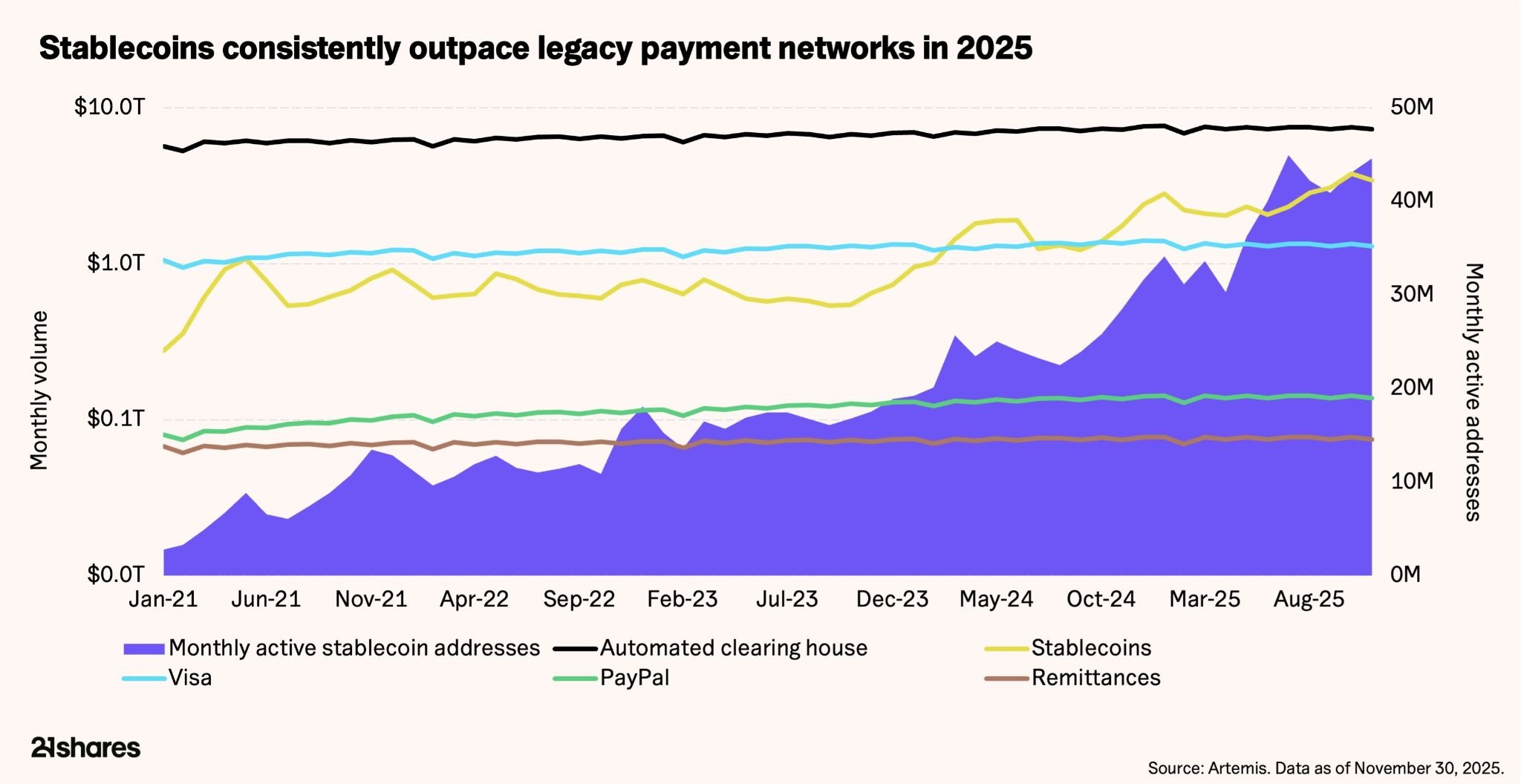
These examples are representative rather than exhaustive, and similar integrations across fintech and payments platforms – such as MasterCard, MoneyGram, Robinhood and Klarna16 – suggest a broader shift toward stablecoins as back-end financial infrastructure. Supporting this view, stablecoins processed more than $50 trillion in transaction volume in 2025 and now handle comparable – or, at times, higher – monthly volumes than networks such as Visa and PayPal. In practice, this points to a form of mainstream adoption where crypto increasingly functions as infrastructure rather than a merely consumer-facing product.
Regulation reduced uncertainty – and unlocked balance sheets
Takeaway: Regulatory clarity changed who could participate.
The regulatory conversation changed in 2025. Instead of policing crypto from the outside, policymakers began defining the rules of engagement: formalizing stablecoins, integrating crypto into existing frameworks, and enabling institutions to participate with confidence.
Key regulatory unlocks in 2025
United States
- GENIUS Act (Stablecoins): Established a federal framework for payment stablecoins, giving banks and fintechs a clear path to issue and use them at scale17.
- OCC trust charters: Brought major crypto and stablecoin issuers under bank-style supervision, materially reducing regulatory and counterparty risk18.
- Market-structure reform momentum (CLARITY Act): US lawmakers are advancing towards pushing legislation in 2026 to clarify SEC and CFTC jurisdiction, signaling a shift toward a rules-based framework19.
- SEC generic listing standards: Simplified approval for spot ETFs, normalizing digital assets within public markets20.
Europe and UK
- EU MiCA implementation: With MiCA going into effect in 2025, the EU replaced national fragmentation with a harmonized framework, giving institutions a clearer path to participate at scale.
- UK crypto perimeter expansion: Confirmed crypto trading, custody, lending, and staking will fall under full financial regulation while reopening the door to retail crypto ETNs21.
Asia and Global
- Hong Kong stablecoin licensing: Introduced one of the clearest “license-to-issue” regimes for fiat-backed stablecoins globally, which has been in effect since August 202522.
- UAE payment-token framework: Finalized a stablecoin licensing regime, establishing the UAE as a regulated onchain-payments hub and provided the legal foundation for the recent launch of a dirham-backed stablecoin licensed by the central bank23.
3) Utility took hold, and markets followed
Tokenization moved onto balance sheets
Takeaway: Real-world assets are moving onchain en masse beyond government securities and experimentation.
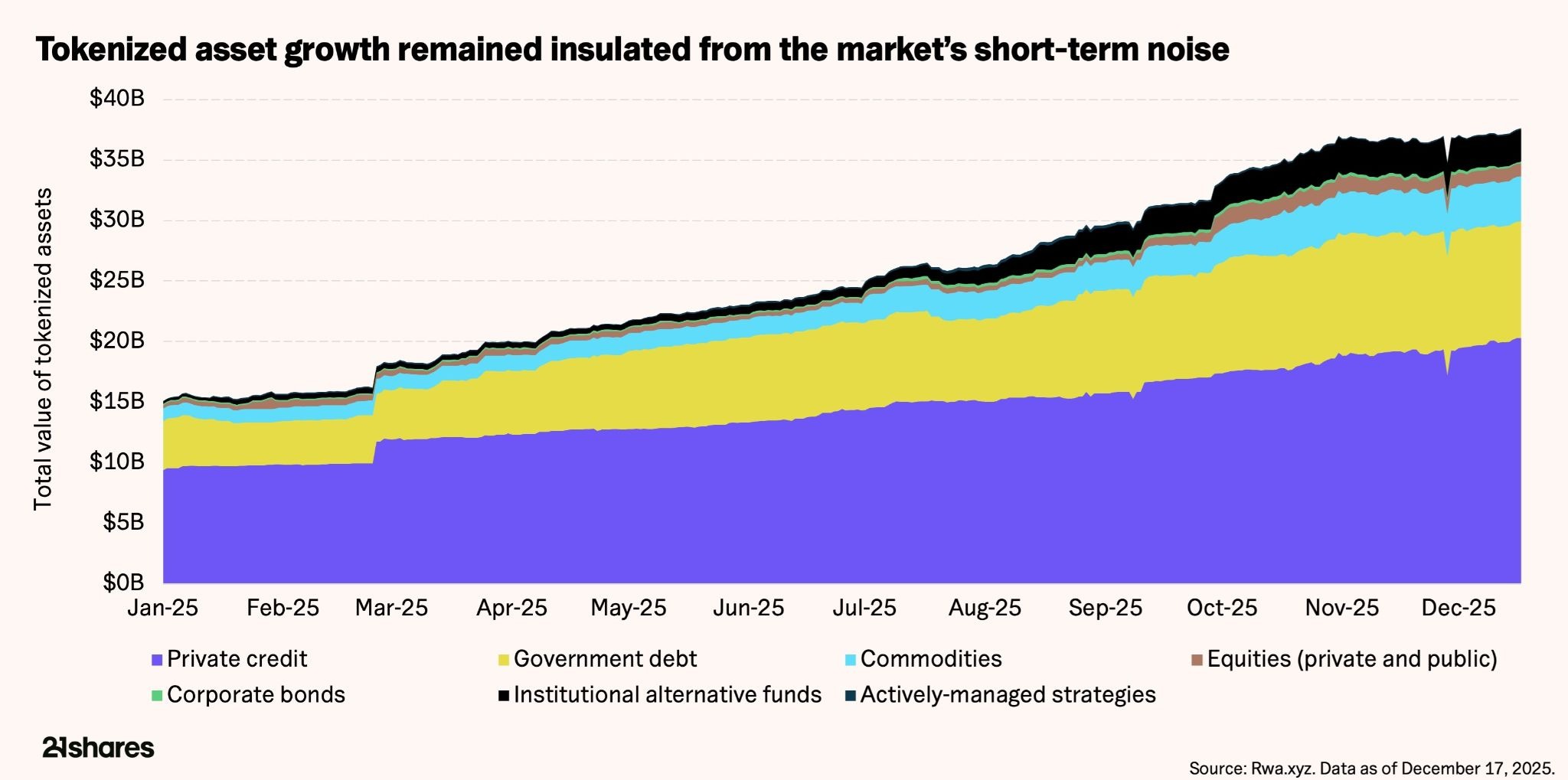
Tokenized real-world assets grew from ~$5.6bn to nearly $19bn24. US Treasuries remained the largest segment at $8.6bn, but the fastest growth came from other categories:
- Private credit expanded nearly 40x from ~$60m to ~$2.4bn, led by platforms such as Maple Finance.
- Institutional alternative funds rose ~1,200% from $189m to ~$2.36bn across institutional strategies including carry trades, venture, and diversified credit funds, with large managers such as Apollo entering the space.
- Non-US sovereign debt increased ~550% from $98m to $662m, driven primarily by European and Chinese issuance.
This expansion was also spurred by a combination of regulatory clarity and maturing infrastructure:
- Project Crypto (US): introduced a formal token taxonomy and improved legal clarity across agencies25.
- The GENIUS Act: established a comprehensive federal framework that clearly distinguishes digital commodities from securities and provides issuers with a defined rulebook.
- Infrastructure networks: Platforms like Canton advanced interoperable, privacy-preserving rails for regulated tokenized assets, while Provenance scaled real-world asset tokenization and on-chain financing workflows (notably in loan origination/securitization).
- Institutional DeFi: Platforms such as Aave Horizon expanded collateral utility for tokenized funds by bridging regulated assets into institution-focused DeFi markets26.
Critically, in December 2025, the SEC issued a no-action letter to the DTCC, enabling tokenized entitlements for eligible DTCC-held securities (including Russell 1000 equities, major ETFs, and US Treasuries) on approved blockchains. This clarification materially lowers structural barriers and is likely to serve as a key catalyst for accelerated RWA adoption in 202627.
ETFs reframed crypto as a legitimate portfolio allocation strategy
Takeaway: ETFs institutionalized crypto, transforming it from a standalone asset class into a macro allocation whose pricing, ownership, and behavior are increasingly shaped by traditional market forces.
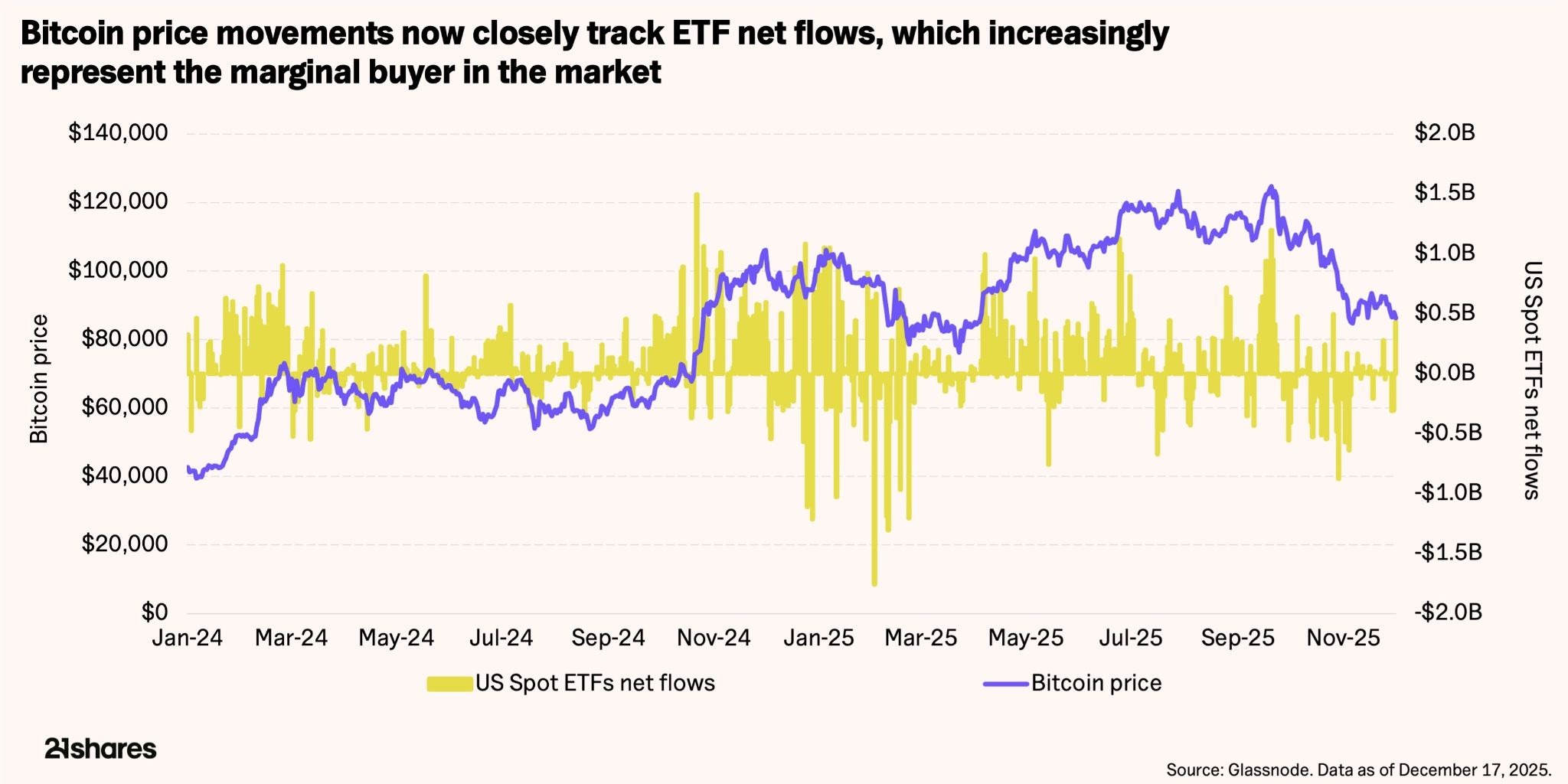
ETFs did not simply expand access to crypto, they changed how macro conditions are reflected in its pricing. Once Bitcoin exposure entered regulated vehicles held by wealth managers and institutional allocators, crypto became more sensitive to the same drivers that shape multi-asset risk: debt yields, liquidity, and policy expectations. This is visible around rate repricing events, where ETF flows are adjusted in line with broader risk appetite, and price action increasingly tracked macro signals rather than crypto-native narratives. In effect, crypto began trading as a macro sleeve rather than an isolated asset.
Under this new regime, institutional validation accelerated:
- Bank of America28 and Morgan Stanley29 referenced ~1-4% allocation ranges for clients with higher volatility tolerance, positioning crypto ETFs as diversification tools within multi-asset portfolios.
- Vanguard, long resistant to crypto exposure, ultimately permitted access to crypto ETFs30.
- JPMorgan went further, approving Bitcoin ETFs – and more recently direct BTC – as eligible collateral, signaling a material shift in institutional risk acceptance31.
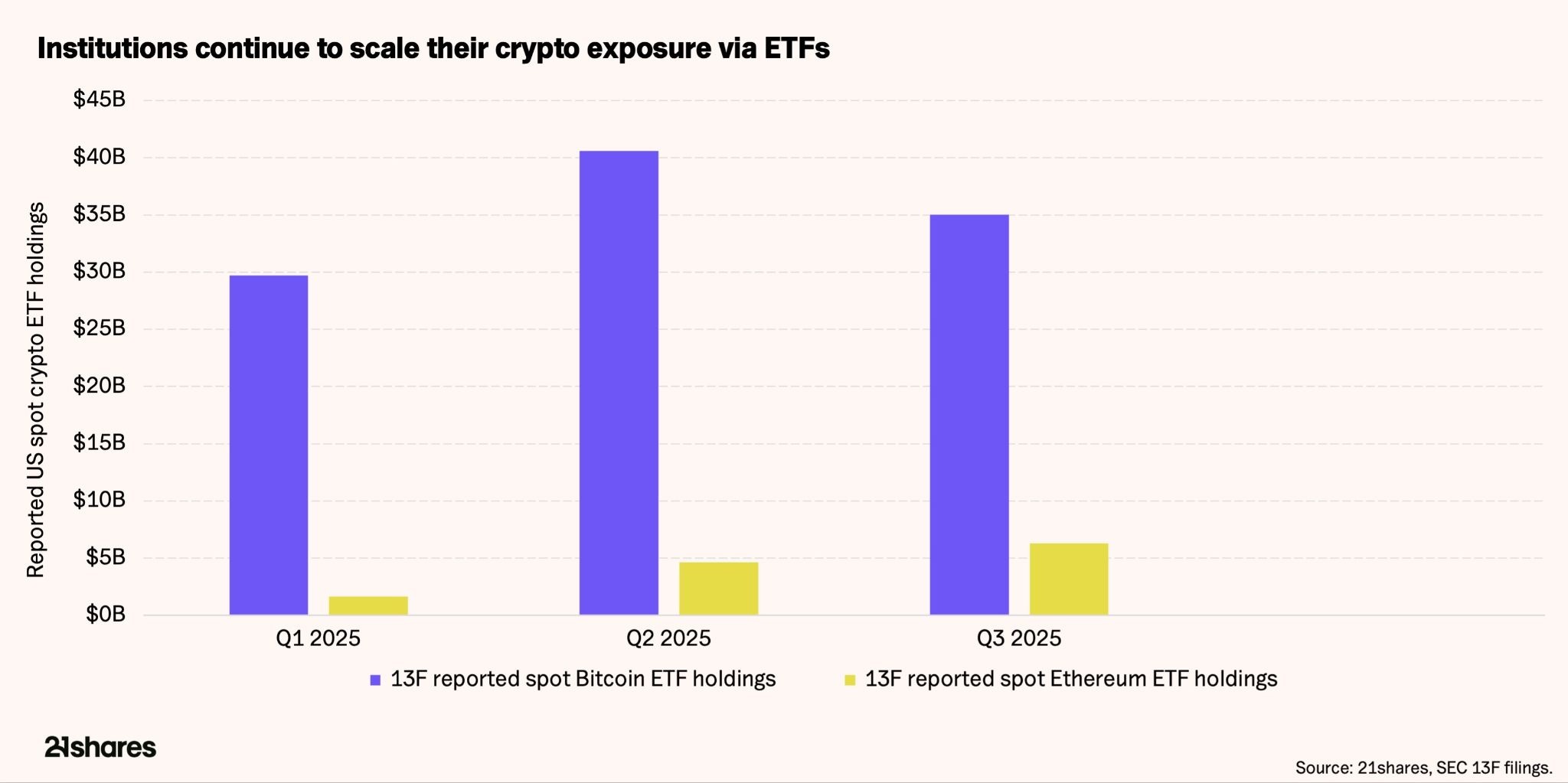
ETF adoption in 2025 broadened the crypto investor base beyond wealth managers to include endowments and public institutions. Disclosures from investors such as Brown University, Harvard Management Company, SWIB, and Mubadala illustrate how ETFs redirected ownership toward long-duration, policy-constrained capital – altering the composition, though not the volatility, of BTC and ETH ownership32.
Consumer applications took the lead as crypto infrastructure matured
Takeaway: By 2025, DeFi crossed from experimentation into production as consumer applications reached product-market fit, scaled to institutional size, and began generating sustainable revenue.
Key DeFi primitives – most notably lending – reached product-market fit. Protocols such as Morpho emerged as institutional-grade lending infrastructure, allowing professional curators to structure risk-defined vaults, bringing portfolio construction and credit selection onchain.
- Coinbase and Crypto.com integrated Morpho to power consumer lending and USDC yield33.
- Société Générale – FORGE deployed MiCA-compliant bank stablecoins on Morpho, enabling regulated bank liabilities to operate directly within DeFi34.
Scale followed adoption as DeFi moved from experimentation to production. Aave’s active loan book approached $25bn35, placing it within the top 50 US banks by loan exposure, while PayPal used Kamino to drive PYUSD adoption before expanding Ethereum access via Spark protocol36. Together, these developments signal DeFi’s integration into large fintech platforms and a broader shift toward revenue-generating business models with declining reliance on token incentives.
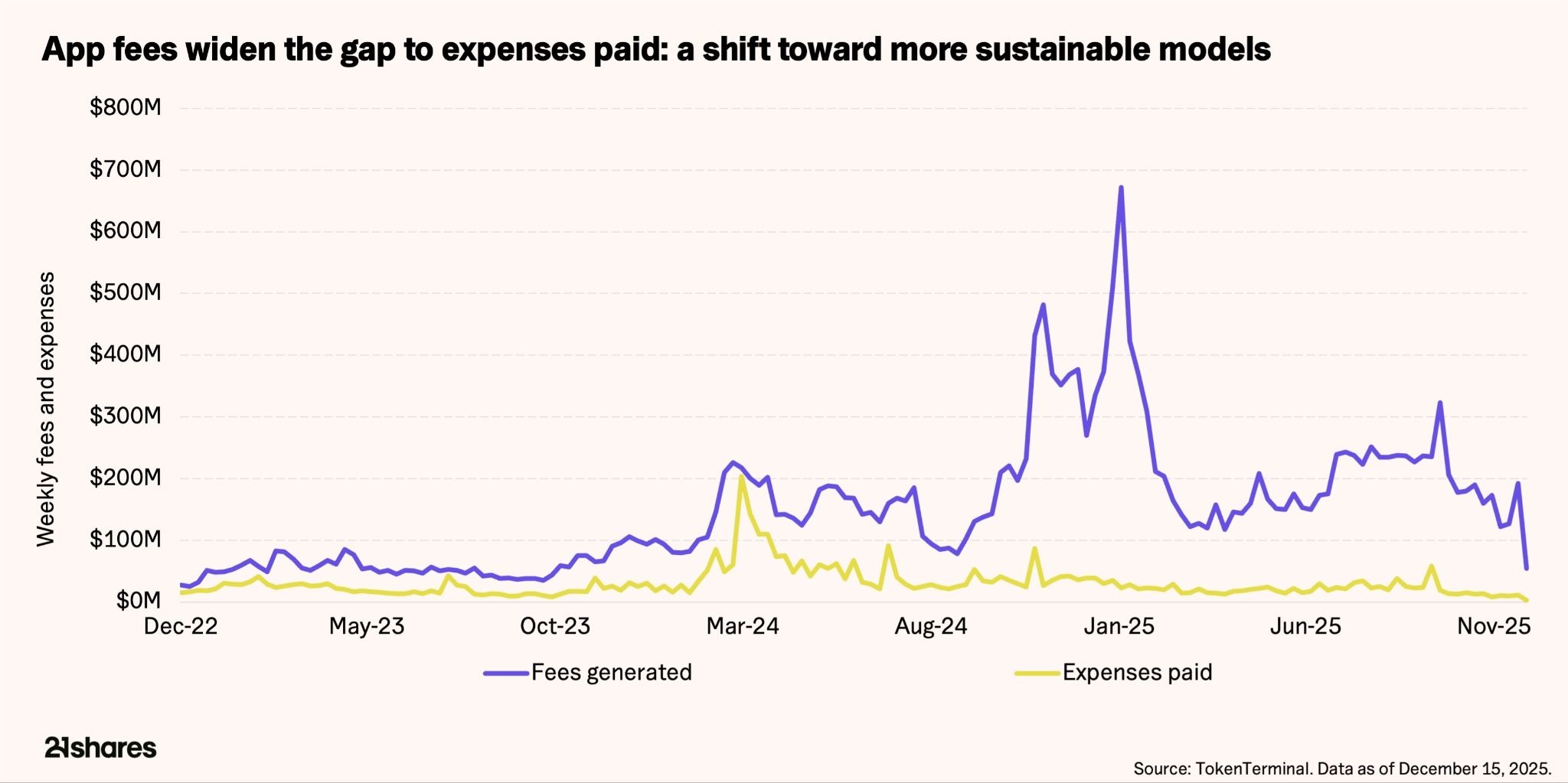
In parallel, many DeFi protocols began realigning tokenomics with real-world business models, shifting away from incentive-led growth toward direct value accrual through revenue sharing and buybacks. While not exhaustive, some of the most notable examples included:
- Hyperliquid: Reached $100 million+ in monthly revenue during peak periods throughout the year, illustrating how onchain trading infrastructure can scale to institutional-grade economics37.
- Uniswap: Governance advanced the “UNIfication” proposal, laying the groundwork to activate dividends and reposition UNI around value accrual rather than pure governance38.
- Aave: Approved a long-term token buyback program funded by protocol revenue, with an annual budget of $50m and flexible weekly execution39.
Similarly, prediction markets emerged in 2025 as the second application vertical to reach product-market fit, alongside DeFi lending. Volumes scaled from a niche crypto activity into mainstream forecasting infrastructure, increasingly used to express probabilities around real-world events.
Why prediction markets crossed the threshold
- Scale: Monthly volumes grew from less than $100 million in early 2024 to more than $13bn in 2025, driven by platforms such as Polymarket and Kalshi40.
- Mainstream distribution: Market-implied probabilities were embedded directly into traditional media and consumer platforms – including CNN referencing Kalshi odds41, Bloomberg citing Polymarket pricing42, and X and google integrating Polymarket markets into its platform43 – making prediction markets part of how information is consumed, not just traded.
- Institutional backing: Adoption attracted traditional capital – Kalshi raised ~$1bn at an ~$11bn valuation44, while Intercontinental Exchange (ICE) invested $2B in Polymarket45 – signaling confidence in prediction markets as durable financial infrastructure following the resolution of the regulatory hurdles these platforms were facing.
Like DeFi lending, prediction markets combined clear utility, scalable volumes, mainstream distribution, and TradFi capital, establishing themselves as a lasting application layer rather than a crypto-native experiment.
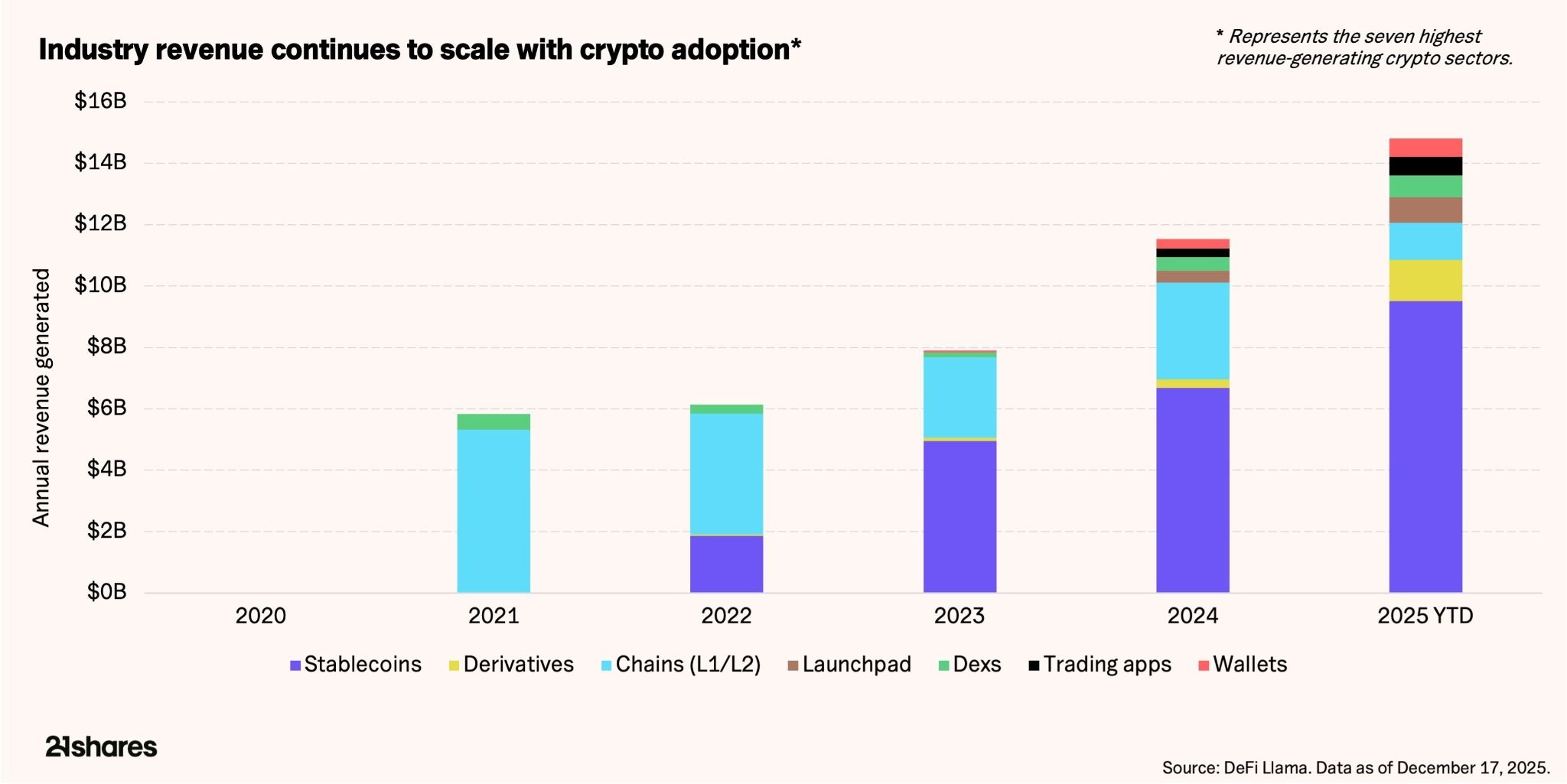
To conclude, one of the clearest signals from 2025 is the industry’s continued maturation as reflected in revenue growth. Excluding early base effects, total ecosystem revenue compounded at a 27% CAGR between 2021 and 202546, rising from roughly $6B to over $17B, its highest level to date. This trajectory underscores how growth is increasingly driven by the accumulation of multiple use cases and sectors – many of which moved closer to real-world financial and economic integration in 2025 – laying a more durable foundation as the industry enters its next phase.
______
Footnotes:
- Reuters. (2025, February 27). Argentina meme coin scandal dents Milei’s hunt for election allies. Retrieved from https://www.reuters.com/world/americas/argentina-meme-coin-scandal-dents-mileis-hunt-election-allies-2025-02-27/
- LunarCrush. (n.d.). Social and market intelligence dashboard [Interactive data]. Retrieved from https://lunarcrush.com/prompt/chat-1hlGoDAkxt4QPsvx
- Blockworks Research. (n.d.). Solana DEX activity analytics [Dashboard]. Retrieved from https://blockworks.com/analytics/solana/solana-dex-activity
- Glassnode. (n.d.). Bitcoin options open interest (aggregate) [On-chain analytics]. Retrieved from https://studio.glassnode.com/charts/derivatives.OptionsOpenInterestSum?a=BTC
- Token Terminal. (n.d.). Monthly active users (MAU) by protocol [Metrics dashboard]. Retrieved from https://tokenterminal.com/explorer/metrics/user-mau
- Artemis Analytics. (n.d.). Stablecoin market data [Analytics dashboard]. Retrieved from https://app.artemisanalytics.com/stablecoins
- Chainlink. (n.d.). United States Department of Commerce macroeconomic data on public blockchains [Blog post]. Retrieved from https://blog.chain.link/united-states-department-of-commerce-macroeconomic-data/
- NRW.BANK. (2025, July 10). NRW.BANK issues digital bond on public blockchain. Retrieved from https://www.nrwbank.de/en/news/2025/250710_digitale-anleihen_en.html
- Zand Bank. (2025). Zand launches UAE’s first AED-backed stablecoin on a public blockchain. Retrieved from https://www.zand.ae/en/news/zand-launches-uaes-first-aed-backed-stablecoin-on-public-blockchain
- Visa. (2025). Visa launches stablecoin settlement in the United States, marking a breakthrough for stablecoin integration. Retrieved from https://investor.visa.com/news/news-details/2025/Visa-Launches-Stablecoin-Settlement-in-the-United-States-Marking-a-Breakthrough-for-Stablecoin-Integration/default.aspx
- CoinDesk. (2025, December 15). JPMorgan launches tokenized money-market fund on Ethereum as Wall Street moves on-chain. Retrieved from https://www.coindesk.com/business/2025/12/15/jpmorgan-launches-tokenized-money-market-fund-on-ethereum-as-wall-street-moves-onchain-report
- CoinDesk. (2025, September 30). Société Générale’s crypto arm deploys euro- and dollar-denominated stablecoins on Uniswap and Morpho. Retrieved from https://www.coindesk.com/business/2025/09/30/societe-generale-s-crypto-arm-deploys-euro-and-dollar-stablecoins-on-uniswap-morpho
- Stripe. (2025). Stripe Tour New York 2025 [Newsroom announcement]. Retrieved from https://stripe.com/newsroom/news/tour-newyork-2025
- Revolut. (n.d.). 1:1 stablecoin conversion explained [Blog post]. Retrieved from https://www.revolut.com/blog/post/1-1-stablecoin-conversion/
- Western Union. (2025). Western Union announces USDPT stablecoin on Solana and Digital Asset Network. Retrieved from https://ir.westernunion.com/news/archived-press-releases/press-release-details/2025/Western-Union-Announces-USDPT-Stablecoin-on-Solana-and-Digital-Asset-Network/default.aspx
- Klarna. (2025). Klarna launches KlarnaUSD as stablecoin transactions reach $27 trillion. Retrieved from https://www.klarna.com/international/press/klarna-launches-klarnausd-as-stablecoin-transactions-hit-usd27-trillion/
- Baker McKenzie. (2025, July 30). The GENIUS Act: A new federal framework for stablecoin issuers, custodians, and banks in the United States. Retrieved from https://www.globalcompliancenews.com/2025/07/30/https-insightplus-bakermckenzie-com-bm-technology-media-telecommunications_1-united-states-the-genius-act-a-new-federal-framework-for-stablecoin-issuers-custodians-and-banks_07252025/
- Axios. (2025, December 12). U.S. banks move toward crypto OCC charters. Retrieved from https://www.axios.com/2025/12/12/banks-crypto-occ-charters
- JD Supra. (n.d.). The latest on crypto regulation: SEC developments. Retrieved from https://www.jdsupra.com/legalnews/the-latest-on-crypto-regulation-sec-1907368/
- U.S. Securities and Exchange Commission (SEC). (2025). SEC approves generic listing standards for commodity-based trust shares. Retrieved from https://www.sec.gov/newsroom/press-releases/2025-121-sec-approves-generic-listing-standards-commodity-based-trust-shares
- Financial Conduct Authority (FCA). (2025). FCA opens retail access to crypto exchange-traded notes (ETNs). Retrieved from https://www.fca.org.uk/news/press-releases/fca-opens-retail-access-crypto-etns
- Hong Kong Monetary Authority (HKMA). (n.d.). Stablecoin issuer regulatory framework. Retrieved from https://www.hkma.gov.hk/eng/key-functions/international-financial-centre/stablecoin-issuers/
- Digital Watch Observatory (DIG.Watch). (n.d.). UAE unveils first regulated AED-backed stablecoin. Retrieved from https://dig.watch/updates/uae-unveils-first-regulated-aed-backed-stablecoin
- RWA.xyz. (n.d.). Real World Assets ecosystem overview [Platform]. Retrieved from https://rwa.xyz/
- U.S. Securities and Exchange Commission (SEC). (2025, November 25). SEC’s approach to digital assets: Inside Project Crypto [Speech/statement by SEC official]. Retrieved from https://www.sec.gov/newsroom/speeches-statements/atkins-111225-secs-approach-digital-assets-inside-project-crypto
- Aave. (n.d.). Aave V3 Proto Horizon markets [DeFi lending market dashboard]. Retrieved from https://app.aave.com/markets/?marketName=proto_horizon_v3
- Depository Trust & Clearing Corporation (DTCC). (2025, December 15). SEC grants DTCC no-action letter on blockchain tokenization initiative. Retrieved from https://www.dtcc.com/dtcc-connection/articles/2025/december/15/sec-grants-dtcc-no-action-letter-on-blockchain-tokenization-initiative
- Forbes. (2025, December 2). Bank of America recommends crypto exposure in all client portfolios. Retrieved from https://www.forbes.com/sites/kirkogunrinde/2025/12/02/bank-of-america-recommends-crypto-exposure-in-all-client-portfolios/
- Bitcoin Magazine. (n.d.). Morgan Stanley advises Bitcoin allocation for investors. Retrieved from https://bitcoinmagazine.com/business/morgan-stanley-advises-btc-allocation
- CoinDesk. (2025, December 1). Vanguard opens platform to crypto ETFs in major shift [Bloomberg report]. Retrieved from https://www.coindesk.com/business/2025/12/01/vanguard-opens-platform-to-crypto-etfs-in-major-shift-bloomberg
- Bloomberg. (2025, October 24). JPMorgan to allow Bitcoin and Ether as collateral in crypto push. Retrieved from https://www.bloomberg.com/news/articles/2025-10-24/jpmorgan-to-allow-bitcoin-ether-as-collateral-in-crypto-push
- SSRN. (n.d.). [Institutional Adoption of Cryptocurrency Exposure: An Analysis of U.S. Pension Fund and Endowment 13F Filings (2024-2025] - working paper. Retrieved from https://papers.ssrn.com/sol3/papers.cfm?abstract_id=5840846
- Morpho. (n.d.). Morpho now powers USDC lending on Coinbase. Retrieved from https://morpho.org/blog/morpho-is-now-powering-usdc-lending-on-coinbase/
- Morpho. (n.d.). Société Générale–FORGE comes onchain with Morpho. Retrieved from https://morpho.org/blog/societe-generale-forge-comes-onchain-with-morpho/
- DeFiLlama. (n.d.). Aave protocol overview [TVL, revenue, and protocol metrics dashboard]. Retrieved from https://defillama.com/protocol/aave
- Unchained. (n.d.). PayPal launches PYUSD savings vault on Spark. Retrieved from https://unchainedcrypto.com/paypal-launches-pyusd-savings-vault-on-spark/
- DeFiLlama. (n.d.). Hyperliquid protocol revenue (monthly) [Analytics dashboard]. Retrieved from https://defillama.com/protocol/hyperliquid?revenue=true&groupBy=monthly
- Uniswap Labs. (n.d.). Unification: The next chapter for the Uniswap protocol. Retrieved from https://blog.uniswap.org/unification
- Aave Governance. (n.d.). Aave Improvement Proposal (AIP): Immediate $20M token buyback. Retrieved from https://governance.aave.com/t/aave-improvement-proposal-aip-immediate-20m-token-buyback/23265
- Dune Analytics. (n.d.). Prediction markets dashboard [Onchain data]. Retrieved from https://dune.com/datadashboards/prediction-markets
- Axios. (2025, December 2). CNN data highlights growth in Kalshi prediction markets. Retrieved from https://www.axios.com/2025/12/02/cnn-kalshi-prediction-market-data
- The Defiant. (n.d.). Bloomberg Terminal integrates Polymarket election data. Retrieved from https://thedefiant.io/news/defi/bloomberg-terminal-integrates-polymarket-election-data
- NBC News. (n.d.). Google, Kalshi, and Polymarket bring prediction markets to the mainstream. Retrieved from https://www.nbcnews.com/business/consumer/google-kalshi-polymarket-prediction-markets-rcna242670
- Kalshi. (n.d.). Kalshi reaches $11 billion valuation following Series E financing. Retrieved from https://news.kalshi.com/p/kalshi-11-billion-valuation-series-e
- Intercontinental Exchange (ICE). (2025). ICE announces strategic investment in Polymarket. Retrieved from https://ir.theice.com/press/news-details/2025/ICE-Announces-Strategic-Investment-in-Polymarket/default.aspx
- DeFiLlama. (n.d.). AI-assisted analytics session [Interactive chat]. Retrieved from https://defillama.com/ai/chat/9a24d1e5-b72e-4143-add8-f2063629acc2
This report has been prepared and issued by 21Shares AG for publication globally. All information used in the publication of this report has been compiled from publicly available sources that are believed to be reliable, however, we do not guarantee the accuracy or completeness of this report. Crypto asset trading involves a high degree of risk. The crypto asset market is new to many and unproven and may have the potential not to grow as expected.Currently, there is relatively small use of crypto assets in the retail and commercial marketplace in comparison to relatively large use by speculators, thus contributing to price volatility that could adversely affect an investment in crypto assets. In order to participate in the trading of crypto assets, you should be capable of evaluating the merits and risks of the investment and be able to bear the economic risk of losing your entire investment.Nothing herein does or should be considered as an offer to buy or sell or solicitation to buy or invest in crypto assets or derivatives. This report is provided for information and research purposes only and should not be construed or presented as an offer or solicitation for any investment. The information provided does not constitute a prospectus or any offering and does not contain or constitute an offer to sell or solicit an offer to invest in any jurisdiction. The crypto assets or derivatives and/or any services contained or referred to herein may not be suitable for you and it is recommended that you consult an independent advisor. Nothing herein constitutes investment, legal, accounting or tax advice, or a representation that any investment or strategy is suitable or appropriate to your individual circumstances or otherwise constitutes a personal recommendation. Neither 21Shares AG nor any of its affiliates accept liability for loss arising from the use of the material presented or discussed herein.Readers are cautioned that any forward-looking statements are not guarantees of future performance and involve risks and uncertainties and that actual results may differ materially from those in the forward-looking statements as a result of various factors.This report may contain or refer to material that is not directed to, or intended for distribution to or use by, any person or entity who is a citizen or resident of or located in any locality, state, country or other jurisdiction where such distribution, publication, availability or use would be contrary to law or regulation or which would subject 21Shares AG or any of its affiliates to any registration, affiliation, approval or licensing requirement within such jurisdiction.