

At first glance, Strategy, Metaplanet, and MARA may appear to have little in common. Strategy is known for its business intelligence software, Metaplanet started as a hospitality company in Japan, and MARA is a prominent Bitcoin mining firm. Yet despite their distinct beginnings, these firms now share a common thread as they are part of a fast-growing segment in financial markets: crypto-linked equities.
As investor demand for Bitcoin exposure grows, these stocks often trade at a premium, serving as indirect proxies for digital assets. In stock terms, a premium to net asset value (NAV) means investors are willing to pay more for a company’s shares than the value of its underlying assets. In the case of Bitcoin proxy stocks like Strategy, this NAV is typically defined by the market value of the Bitcoin held per share. So here, a premium to NAV reflects how much more investors are paying for exposure to Bitcoin via the stock than they would by buying Bitcoin directly.
However, with the rise of spot Bitcoin ETFs, which offer a cheaper, purer form of exposure without the operational risk of running a business, justifying that premium is becoming increasingly difficult.
These are publicly traded firms whose stock prices exhibit a high beta to cryptocurrency markets, especially Bitcoin, not necessarily because of their core operations, but due to aggressive crypto-related strategies such as direct Bitcoin purchases, mining investments, or public alignment with crypto narratives.
Strategy’s Bitcoin strategy has become the corporate playbook
Last month, we spotlighted how Bitcoin advocate and Strategy founder Michael Saylor pioneered the move to add Bitcoin to a company’s balance sheet back in 2020. The bold move has gained considerable momentum. What began as an unconventional tactic, raising capital and issuing debt to buy Bitcoin, has evolved into a model other companies are starting to replicate.
For instance, Metaplanet, often dubbed the "Strategy of Japan," has embraced the same strategy and quickly emerged as one of the largest corporate holders of Bitcoin in Asia.
Meanwhile, last month, SharpLink, a company known for digital marketing in gaming and sports betting, saw its shares skyrocket by 400% in a single day after announcing plans to raise hundreds of millions of dollars to purchase Ethereum, before even acquiring a single token.
Crypto stocks are the backdoor to Bitcoin
One reason why investors are drawn to publicly traded companies that incorporate Bitcoin into their corporate strategy is that these stocks offer both retail and institutional investors a way to gain exposure to crypto and often amplified returns tied to Bitcoin. On some occasions, it can serve as the only available crypto proxy in jurisdictions where directly holding Bitcoin or investing in fund mandates restrict ETFs. For institutions that are prohibited from holding ETF-like assets, owning shares in operating companies such as Strategy can serve as a backdoor method of gaining Bitcoin exposure.
The premium price of proxy Bitcoin plays
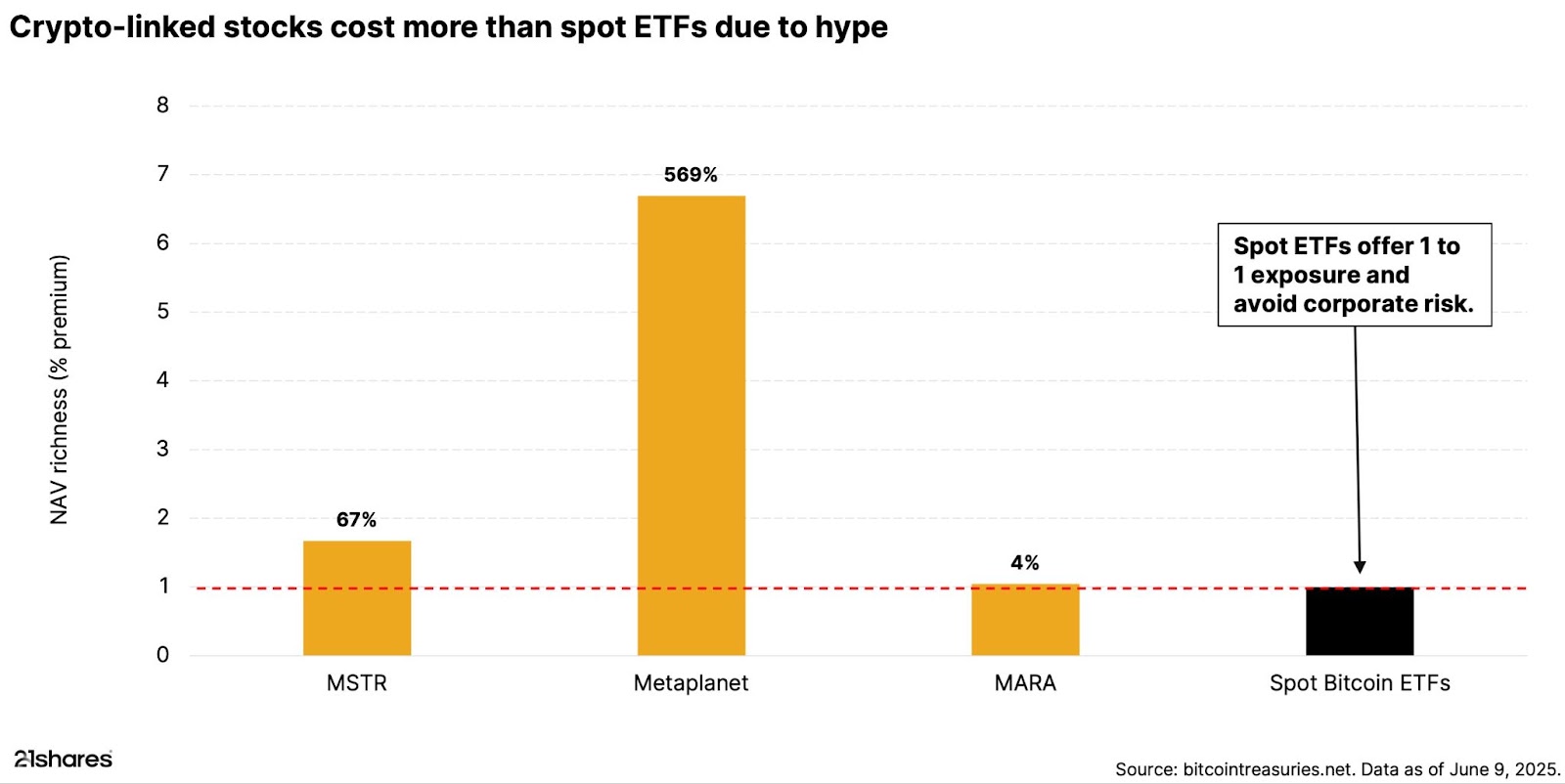
Gaining Bitcoin exposure through crypto-forward companies comes at a cost. These stocks often trade at significant premiums to the actual value of the Bitcoin they hold, premiums driven more by hype and momentum than by fundamentals.
For example, Strategy, which holds ≈2.8% of the total Bitcoin supply, recently traded at a 67% premium to its Bitcoin holdings. Similarly, Metaplanet saw its stock price soar to imply a staggering 569% NAV premium after aggressively acquiring Bitcoin. MARA, while not trading at such extreme prices, investors are still paying a 4% premium for the Bitcoin held.
While the market is currently rewarding firms that adopt crypto treasury strategies, that enthusiasm may fade as more players enter the space and investors begin to distinguish between pure crypto exposure and crypto-linked equities.
Unlike spot Bitcoin ETFs, these companies are operating businesses, which means shareholders are exposed to a host of additional risks, including management execution, debt, share dilution, and operational volatility. Many are also highly leveraged, making their stock performance even more sensitive to Bitcoin’s price fluctuations.
In contrast, spot Bitcoin ETFs offer a cleaner, more cost-effective way to gain exposure. They track Bitcoin directly, without the distractions or risks of running a business.










_logo.svg)

.svg.png)