
.jpeg)
Think of the Solana blockchain as a super-fast highway, with cars representing transactions.
Normally, cars rush onto the highway, but the way they line up isn’t always the most efficient. Sometimes, certain cars (transactions) cut in line, and traffic (the network) can get a little messy.
That’s where Jito’s BAM steps in. Think of it as a smart traffic controller, ensuring every car enters the highway in the right order for a smooth and efficient flow.
Jito Labs, Solana’s largest liquid staking provider, has launched the Block Assembly Marketplace (BAM), a major upgrade for the network. BAM isn’t just a technical improvement; it changes how blocks are built, how transactions are ordered, and how value moves across Solana. For developers, users, and SOL holders, it’s a key milestone in the blockchain’s evolution.
Let’s break it down.
What is BAM?
BAM is a new way of building blocks and processing transactions on Solana. Think of it as a smarter, safer system that replaces the old method of letting a single validator decide the order of transactions.
Here’s how it works:
- BAM Nodes privately organize transactions inside Trusted Execution Environments (TEEs), secure hardware black boxes that keep strategies hidden until execution.
- BAM Validators run updated Jito-Solana clients to confirm transactions.
- Plugins give developers control over transaction sequencing. Essentially, they allow apps to write their own rules for how trades and interactions are executed.
As a result, the block building becomes safer, faster, and more flexible. Transactions stay private until confirmed, and cryptographic proofs make it easy to verify exactly how everything was processed on the blockchain.
Why is BAM important for investors?
For everyday users, BAM means safer trading, fairer execution, and more innovative apps. Developers gain new tools and monetization opportunities to create financial products as sophisticated as those in traditional finance.
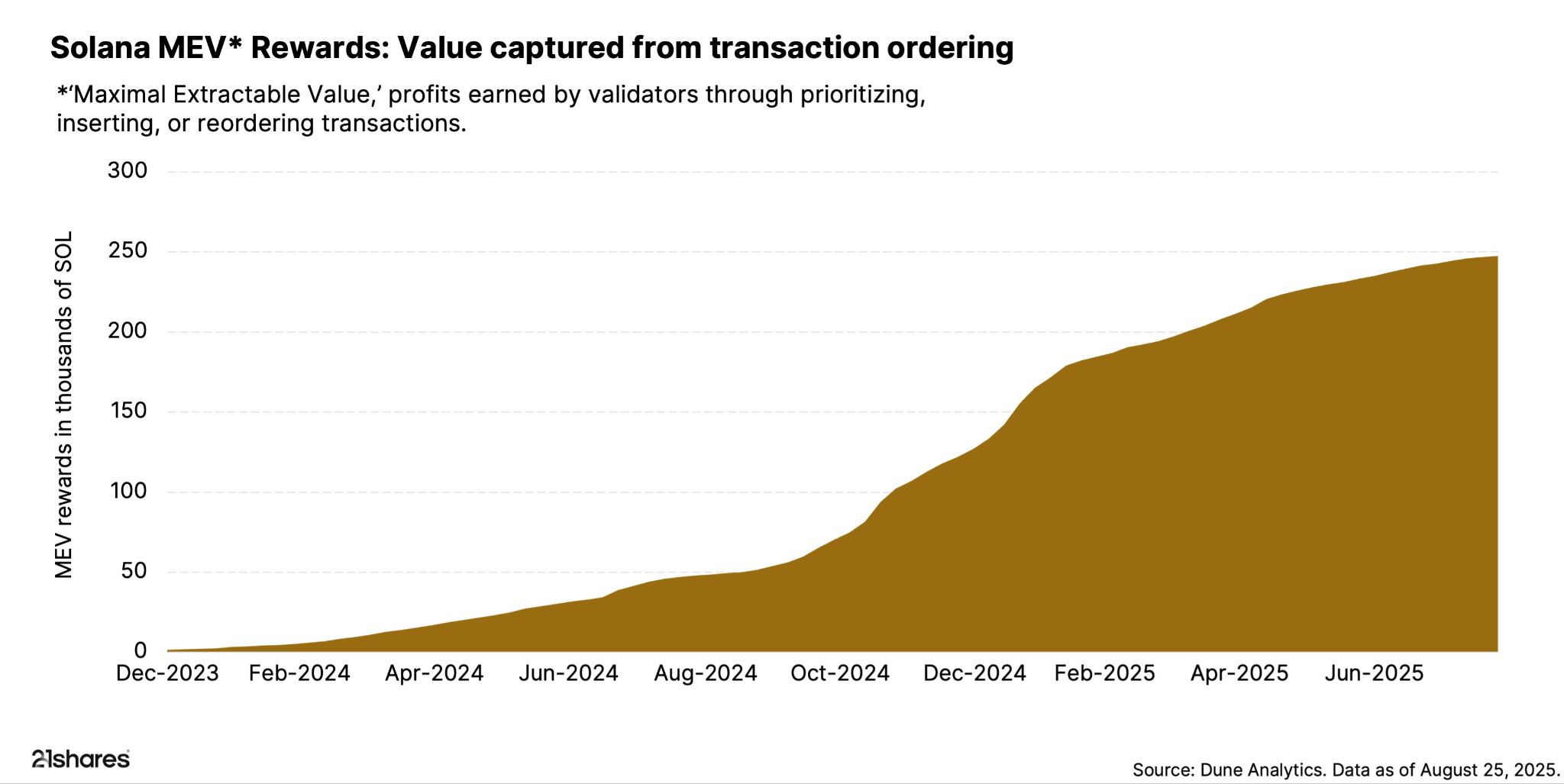
For the broader crypto ecosystem, BAM is the first large-scale programmable block-building system on a major Layer 1 blockchain, which aims to address the MEV (maximal extractable value) issue. MEV is an extra profit that block producers (like validators on Solana) can extract by manipulating the order of transactions within a block.
As shown in the chart below, the Maximal Extractable Value (MEV) has increased significantly on Solana over the past few years, which BAM is promising to solve.
BAM also strengthens SOL’s value in several ways:
- Ecosystem growth: By reducing harmful MEV and enabling new types of applications, BAM makes Solana more appealing to users and developers, increasing demand for the network’s blockspace and SOL.
- Competitive advantage: Solana becomes the first blockchain with native programmable blockspace. This boosts its edge in DeFi and high-frequency trading, keeping top apps on Solana instead of migrating to other chains or building separate rollups.
- Institutional catalyst: If BAM attracts significant traditional finance capital, it could drive a revaluation of Solana apps and SOL itself, as deeper institutional liquidity strengthens the ecosystem.
Conclusion
BAM has the potential to transform Solana by closing loopholes to protect users, redistributing value among validators, stakers, and apps, and unlocking programmable blockspace for developers. It boosts decentralization by spreading block-building across multiple nodes and creates an institutional-ready environment with privacy, verifiability, and predictable execution. Altogether, BAM strengthens Solana’s security, fairness, and flexibility, setting the stage for wider adoption and sustainable ecosystem growth.









_logo.svg)

.svg.png)