

Key takeaways
- Demand held through the drawdown. ETFs, corporations, and sovereigns absorbed 1.75 million BTC since 2024, about 3.4x the supply mined. We expect a new bitcoin all-time high in 2027, though not this cycle’s top.
- Rulebooks are replacing enforcement. We expect 15 of the 21 G20 members to operate under a digital asset rulebook by the end of 2027.
- Digital assets are plugging into everyday finance. We expect more than 100 million monthly active stablecoin addresses, and tokenized real-world asset trading rising from about $5 trillion to $15 trillion.
We head toward the end of 2026 with the AI investment boom in full swing, the war in the Middle East unresolved, and stirrings of a possible Eurozone debt crisis on the horizon. US growth is tech-led, but inflation is above target and interest rates are rising. Elsewhere, the energy supply shock is adding to inflation without the same growth, and credit spreads are widening as capital becomes more expensive to access.
Digital assets were tested in that environment. Bitcoin fell more than 50% from its October 2025 peak, and the CLARITY Act failed to reach consensus. Yet the asset class has begun a K-shaped recovery, and several sectors found new price discovery on stronger fundamentals. Four forces drove it:
- The need for stores of value: escalating debt, sticky inflation, and elevated rates have led investors to reassess bitcoin as an internet-native store of wealth, increasingly held alongside gold.
- Alignment on tokenization: even without CLARITY, the SEC and CFTC set out frameworks and definitions that lay the groundwork for real-world assets to settle on blockchains.
- The shift to 24/7 trading: market shocks and demand for pre-IPO exposure showed the value of always-on venues, and traditional exchanges such as the CME are moving toward round-the-clock trading.
- Privacy and quantum preparedness: concerns over AI-driven surveillance strengthened the case for privacy technology, and quantum resilience is now on the agenda for digital assets and critical national infrastructure.
Our view is that 2027 is the year resilience gets priced in. The ten predictions below map that next phase: what we expect, the data behind it, and the conditions that would have to hold. Each is a 21shares view based on data to October 2026, not a forecast of returns, and the biggest open question for any allocator is whether central banks keep tightening or ease off as growth weakens.
1. Bitcoin reaches a new all-time high, but not its cycle top
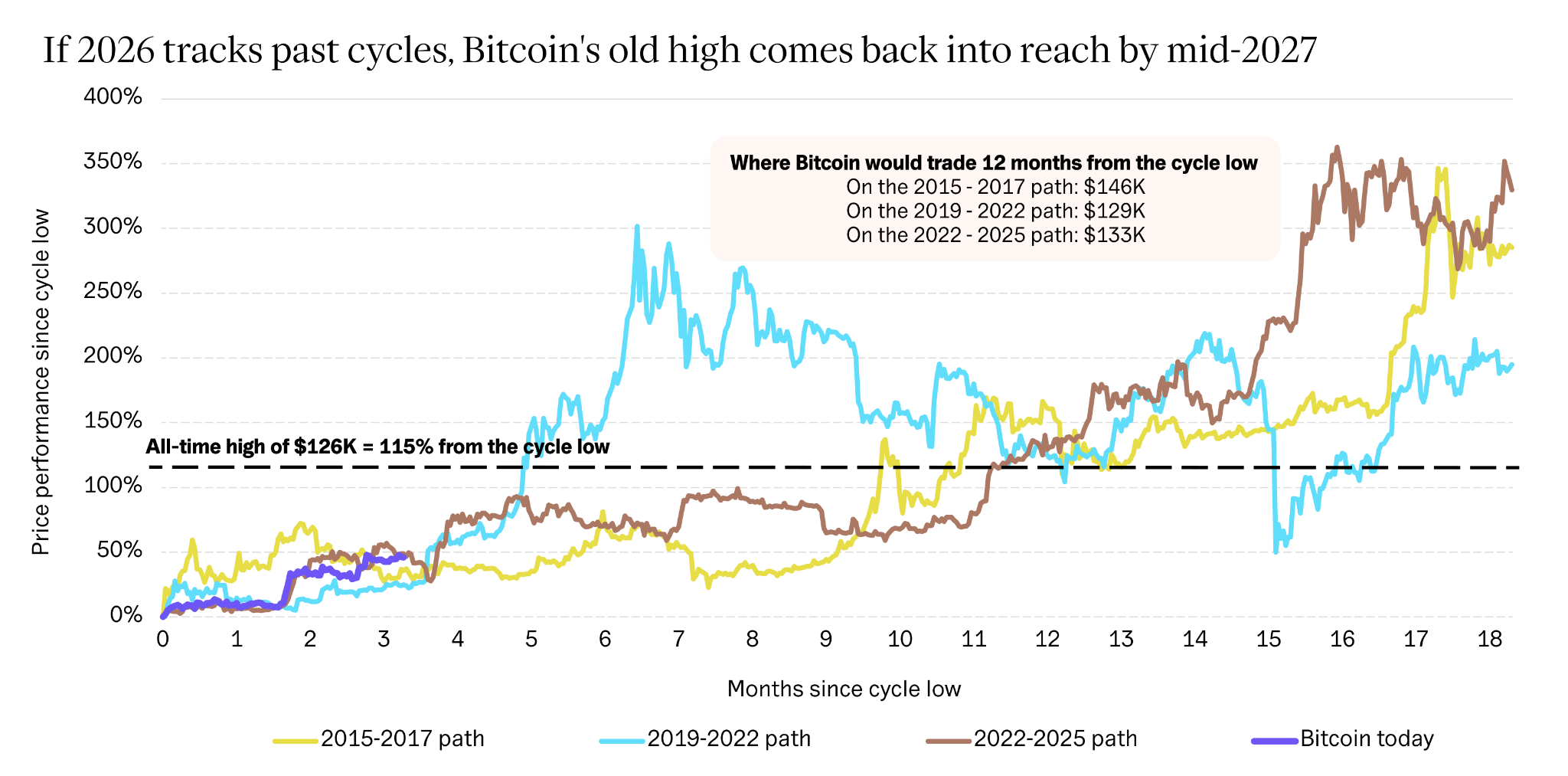
Bitcoin fell from its October 2025 peak of about $126,000 to a June 2026 low of $59,000. Buying continued regardless. Since 2024, ETFs, corporations, and sovereigns have absorbed 1.75 million BTC, worth about $145 billion today. In the bear market alone, they added 180,000 BTC against 122,000 mined (21shares, Glassnode, Farside, BitcoinTreasuries.net, to 6 October 2026). Wirehouses and 401(k) plans are widening the investor base.
Cycle history gives context. Low-to-peak gains have shrunk from 114x to 21x to 8x, and twelve months after each prior cycle low, bitcoin traded at least 2.2x higher. Applied to the June low, that pattern brings the prior high back within reach by mid-2027. The next halving is in 2028, and the last three cycles each peaked about 18 months after one, which is why we do not expect 2027 to mark the top.
The limits matter. Three prior cycles is a small sample, and past performance is not a reliable indicator of future results. Bitcoin has already fallen more than 50% and can do so again. The debasement argument some investors make for holding it, as a scarce asset outside any government’s control, remains contested.
2. A digital asset rulebook goes global
For most of the industry’s history, US policy came through lawsuits and enforcement. Since 2024, regulators have approved spot ETFs, dropped cases against major blockchain-based companies, scrapped the rule keeping banks out of custody, and signed a federal stablecoin law, the GENIUS Act. Regimes are already in force across the EU (MiCA), Japan, Canada, Brazil, and Turkey, among others. The UK and Australia go live in 2027. We expect the US and South Korea to bring the total to 15 of 21 G20 members.
The US is arriving in pieces. The CLARITY Act failed to reach consensus in September, but much of the agenda never needed it:
- GENIUS goes live in January.
- The SEC has given tokenized stocks a five-year runway and should finalize its token safe harbor in 2027.
- The CFTC is writing rules for perpetual futures and prediction markets.
- A federal digital asset tax framework cleared committee 38-5.
- The Fed, OCC, and FDIC confirmed that eligible tokenized securities get the same bank capital treatment as their traditional versions.
For custodians, exchanges, and stablecoin issuers, this is the legal footing that banks, advisors, and pension funds have been waiting for. Our count is a 21shares view, not passed legislation. South Korea shows how one dispute, whether banks or tech firms can issue won-backed stablecoins, can stall a whole market.
3. Stablecoins reach 100 million monthly active addresses
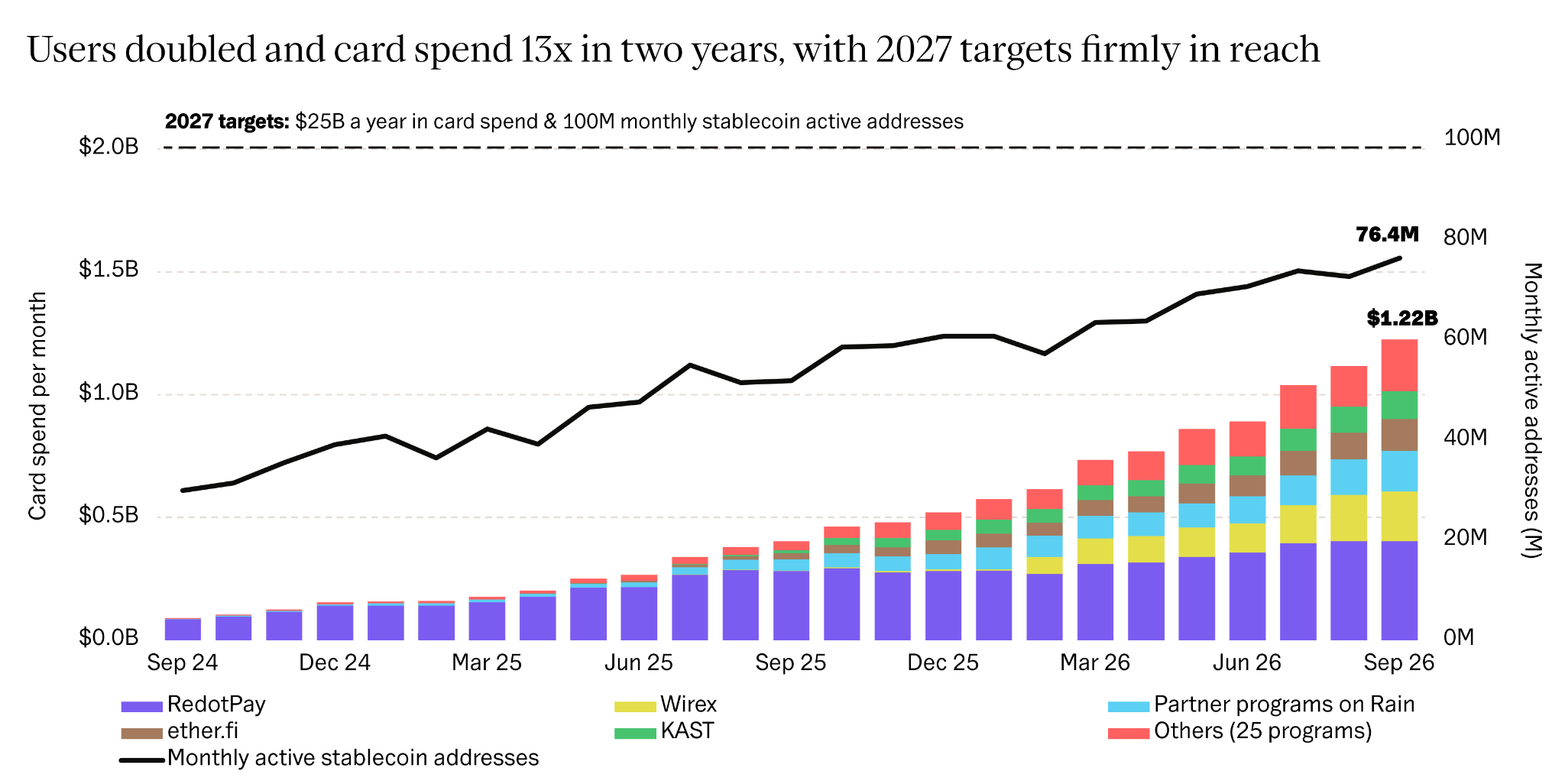
A stablecoin is a digital asset designed to hold the value of a currency such as the US dollar. Monthly active addresses reached 76.4 million in September 2026, and monthly card spend on digital asset neobank programs reached $1.22 billion (21shares, Paymentscan, Visa Onchain Analytics, Allium). We expect more than 100 million addresses and $25 billion in annual card spend in 2027. Addresses are not people, so read the figure as a measure of activity.
Distribution is doing the work. PayPal’s Hyperwallet pays out in PYUSD, Western Union offers a stablecoin-backed Visa card, and Stripe’s Bridge powers USDC payroll for World App. Recipients get digital dollars without changing how they bank. Our forecast depends on users staying beyond early incentives such as cashback, and RedotPay’s figures are self-reported and not verifiable onchain.
4. Real-world assets and fintech reach 15% of DeFi gross revenue
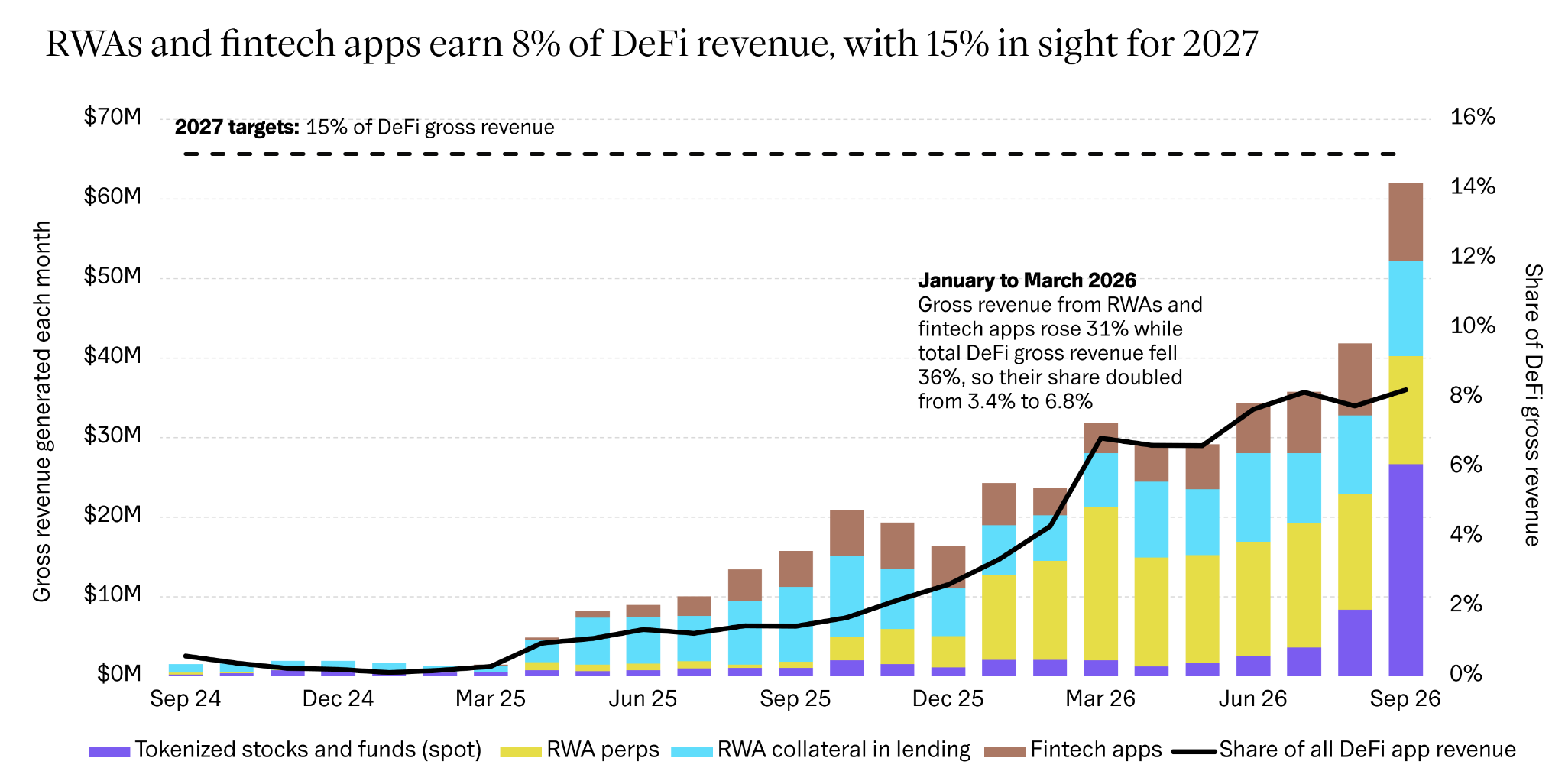
Decentralized finance (DeFi) has been held back by narrow, trading-centric products and the lack of customer support when things go wrong. Fintech apps are fixing the first problem. Robinhood Earn offers Morpho yields, and Phantom and MetaMask offer leveraged stock exposure powered by Hyperliquid.
Real-world assets and fintech distribution account for about 8% of DeFi gross revenue today, and we expect 15% by the end of 2027. Regulation is helping: the SEC’s conditional five-year exemption lets eligible tokenized US stocks trade on permissioned platforms, and bank regulators have settled capital treatment. A limited set of Coinbase’s tokenized assets can already be used as collateral on Aave. The result is that traditional assets can support borrowing and liquidity on blockchain rails while fintech apps handle the user experience.
5. Tokenized real-world asset trading triples to $15 trillion
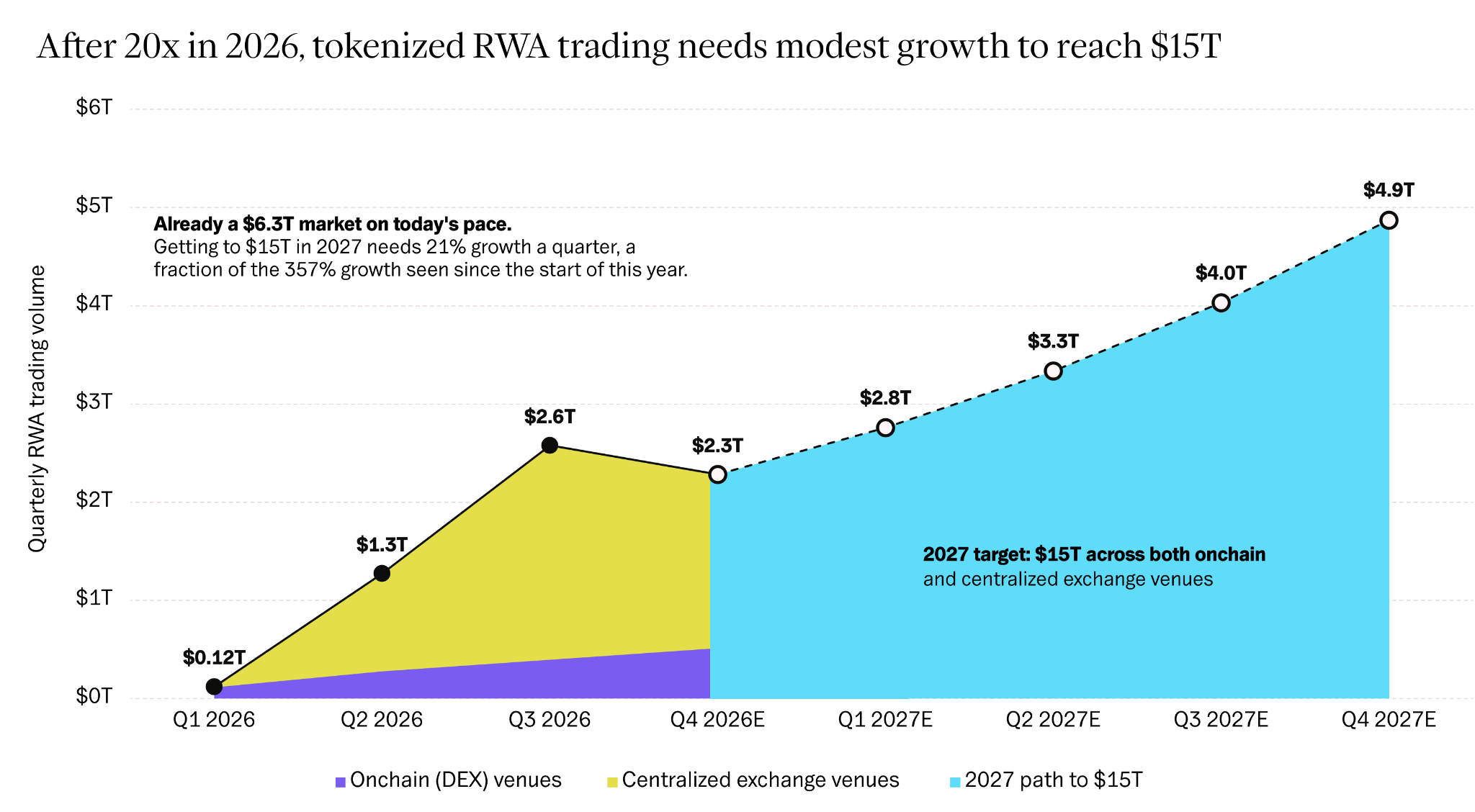
We expect trading of tokenized real-world assets (RWAs) to rise from $6.3 trillion in 2026 to $15 trillion in 2027, across spot and perpetual futures (perps) markets. Quarterly volume has already grown from $0.12 trillion in Q1 to $2.6 trillion in Q3. Three 2026 moments showed demand that traditional venues could not serve:
- Metals (January): silver perps drew over $1 billion in a day while traditional markets were closed.
- Oil (February): after the US-Iran strikes, Hyperliquid priced about 80% of an oil move before traditional exchanges opened.
- Pre-IPO equities (May to June): a SpaceX perp launched weeks before its listing, and the stock opened closer to the perp’s implied value than to the underwriters’ $135 price.
Reaching $15 trillion needs about 21% compounding growth per quarter from Q3, against roughly 357% in 2026. CME’s move toward 24/7 trading in digital assets and gold shows incumbents adapting to the same demand.
6. Onchain options volume passes $100 billion
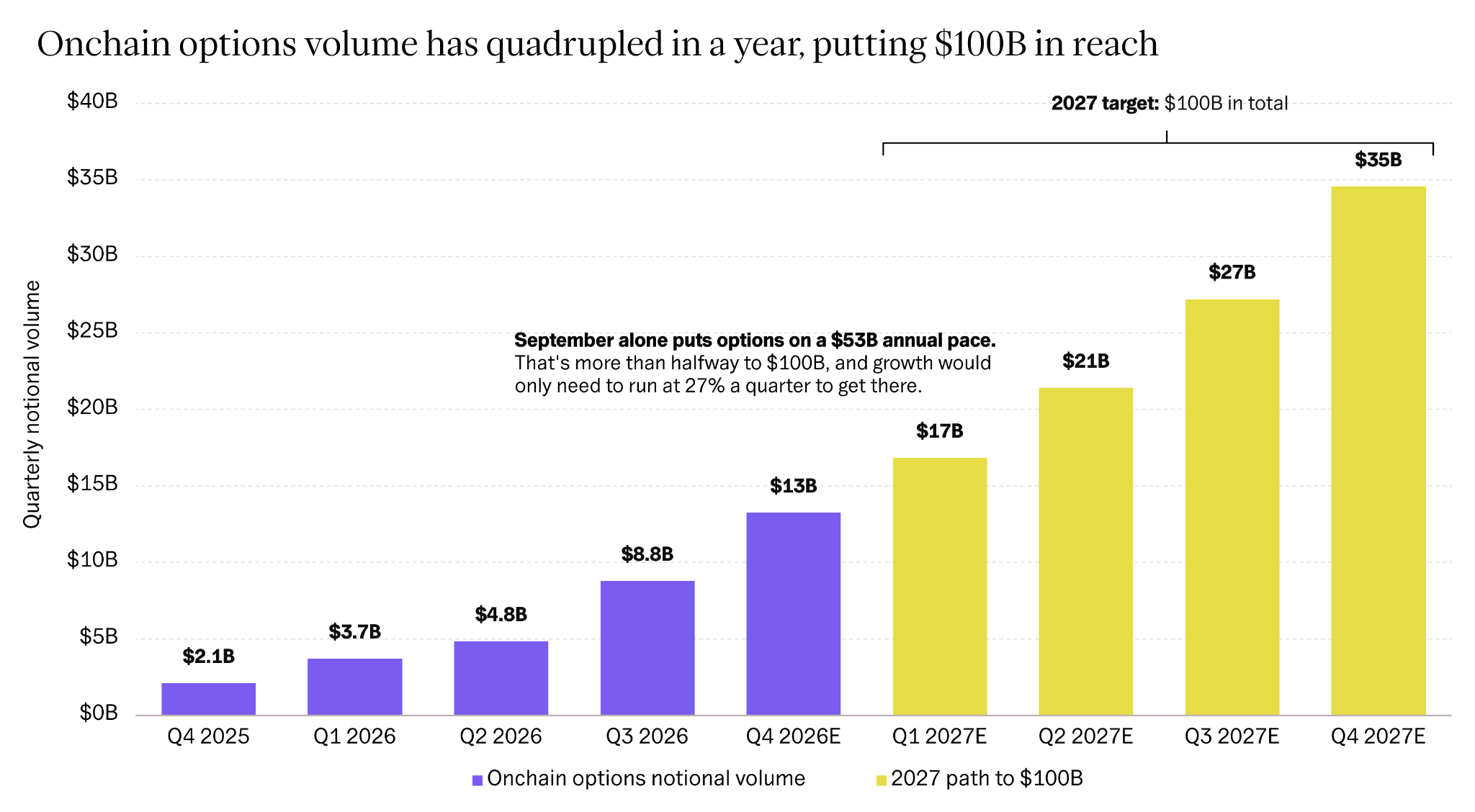
Options are among the largest markets in traditional finance, at roughly $4 trillion in daily notional volume. Onchain, they remain small: we estimate about $30 billion in 2026, with quarterly volume growing from $2.1 billion in Q4 2025 to $8.8 billion in Q3 2026. We expect over $100 billion in 2027 as the perps playbook repeats.
Hyperliquid’s founder has said options are the platform’s next frontier, and Lighter has added binary options. A buyer’s maximum loss is the premium paid, so a sharp move cannot force a liquidation, as happened during the October 2025 unwind with over $19 billion liquidated in 24 hours. Options also allow hedging and structured yield products, which traditional users need before they bring large positions onchain.
7. Prediction markets need a new playbook to reach $1 trillion
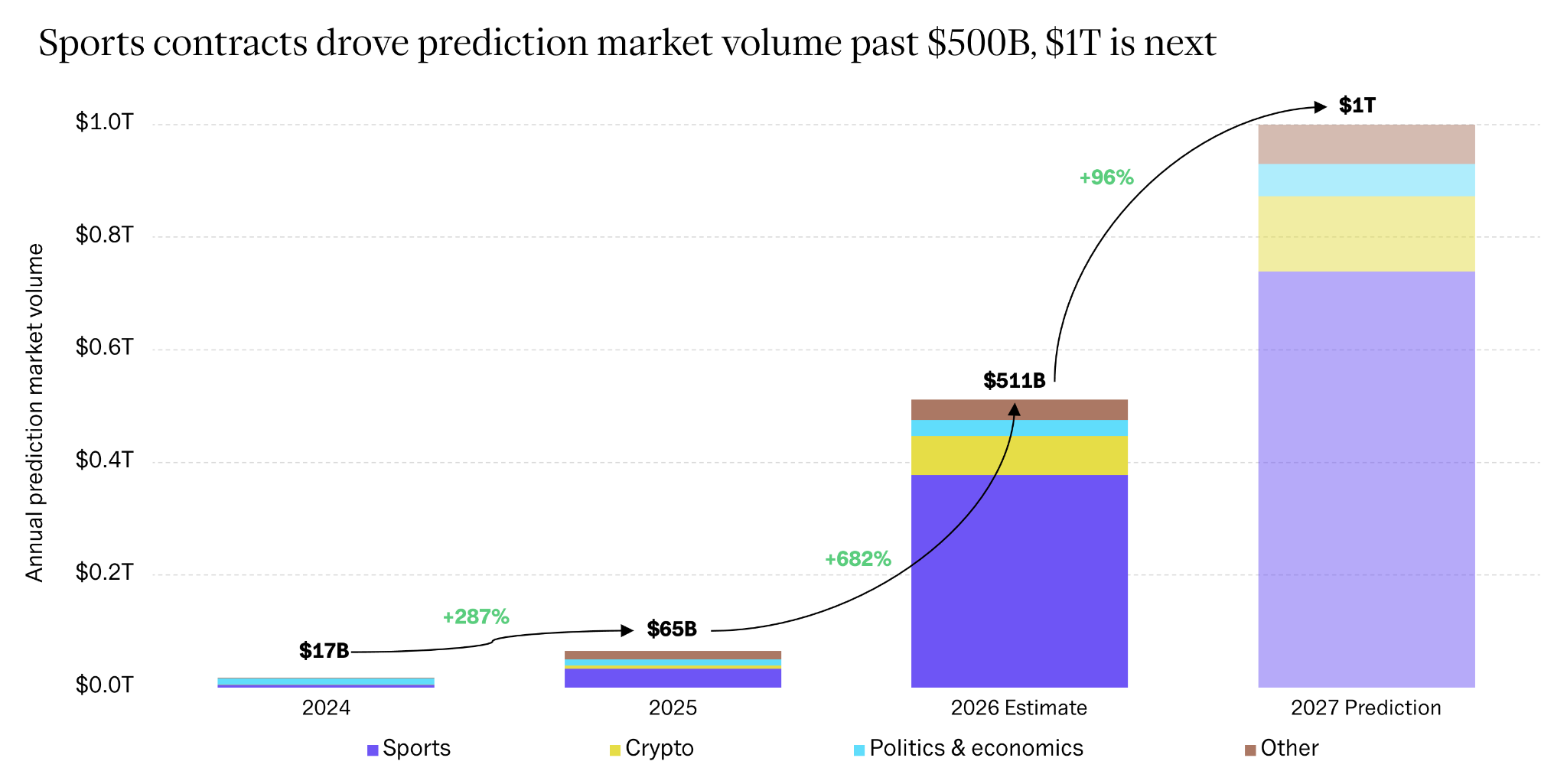
Sports drove prediction markets past $500 billion in 2026. Monthly volume on Kalshi and Polymarket roughly doubled from $26 billion to $53 billion between May and July as the World Cup drew in traders. Without another event like it, we expect growth to slow below 150%, though annual volume could still pass $1 trillion. That requires an average of $83 billion a month, meaning a higher baseline rather than occasional spikes.
The risks are concentrated. Sports made up 79% of July volume; the CFTC is defending federal oversight while states challenge sports contracts under gambling laws, and several countries have moved to block the platforms. Short-duration and financial contracts are the main route to broaden the product beyond sports.
8. The privacy sector triples to $100 billion
Privacy assets have grown from $4 billion at the end of 2024 to about $31 billion, roughly 1% of the $2.6 trillion digital asset market excluding stablecoins. We expect over $100 billion in market cap in 2027. Capturing just 5% of the market would be about $130 billion.
Three forces support the case:
- Investor safety: CertiK recorded 72 violent attacks on digital asset investors in 2025 and 52 in the first half of 2026.
- AI surveillance: models are ingesting more personal and financial data, and privacy tokens keep balances and payments encrypted onchain.
- Institutional need: institutions will not move large positions onchain without the discretion they have in traditional markets. Canton, backed by 30+ institutions, processes over $8 trillion in tokenized assets a month.
Since the October 2025 market top, ZEC and XMR are up 467% and 52%, while BTC and ETH are down 32% and 43%. Privacy is the only digital asset sector trading above its prior peak, which also means expectations are already elevated.
9. Private and blockchain-enabled AI take center stage
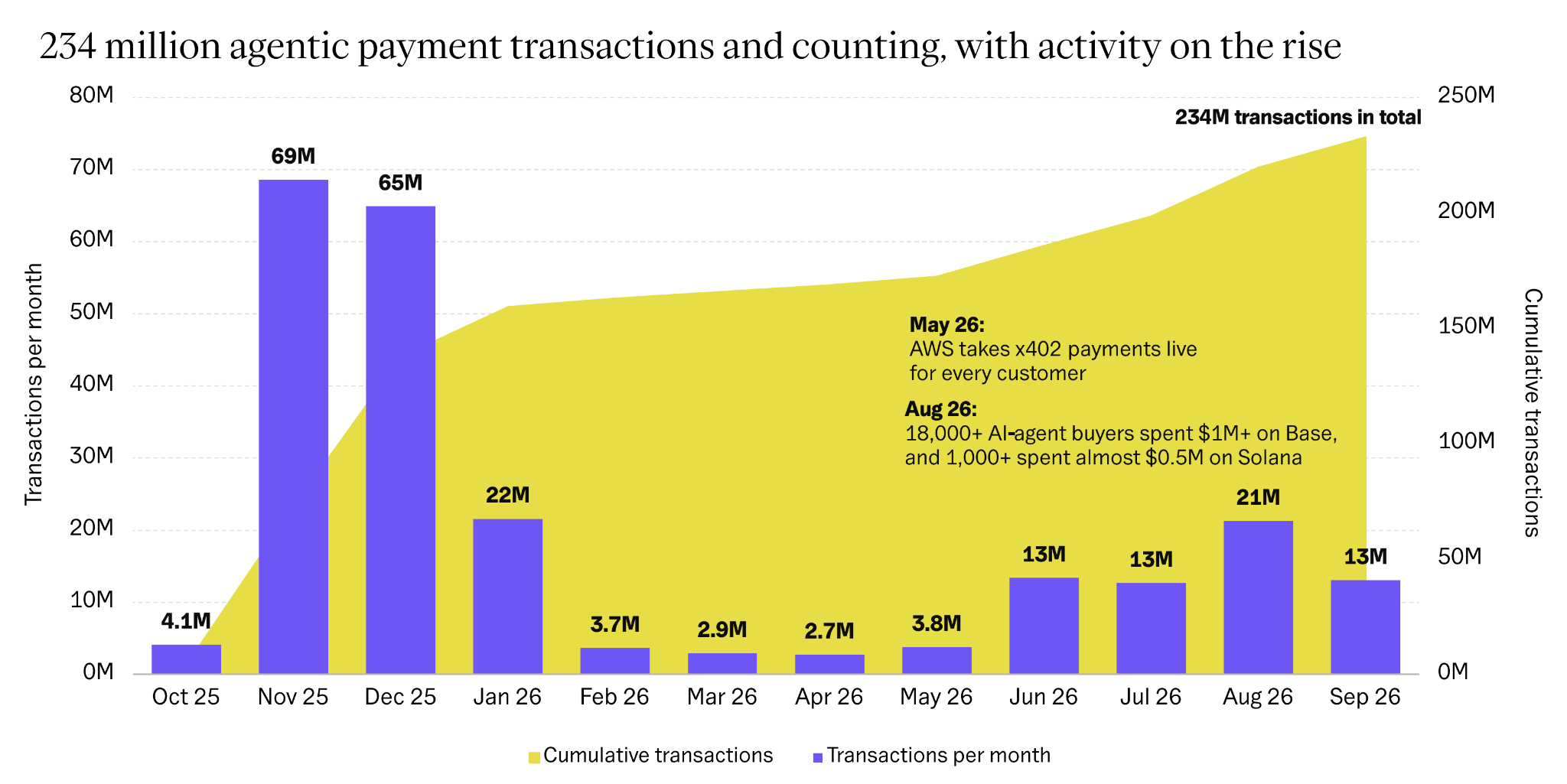
We expect agentic finance, where AI agents trade, lend, and pay onchain, to break out beyond crypto-native users in 2027. Agents cannot open bank accounts without human approval, but they can hold digital assets around the clock. Robinhood’s Agentic Accounts and Coinbase’s Agentic Wallets already let AI models transact, and the x402 payments protocol has processed over 234 million transactions.
Activity is uneven. Monthly x402 transactions peaked at 69 million in November 2025, fell to under 4 million in early 2026, and have recovered to about 13 million. Private inference matters here too: an agent acting for you needs exactly the information you would least want exposed. Venice AI, a private alternative to mainstream models that stores no user data, has grown from about 450,000 users in January 2025 to over 5 million.
10. Exchanges move 50,000 BTC behind hidden keys
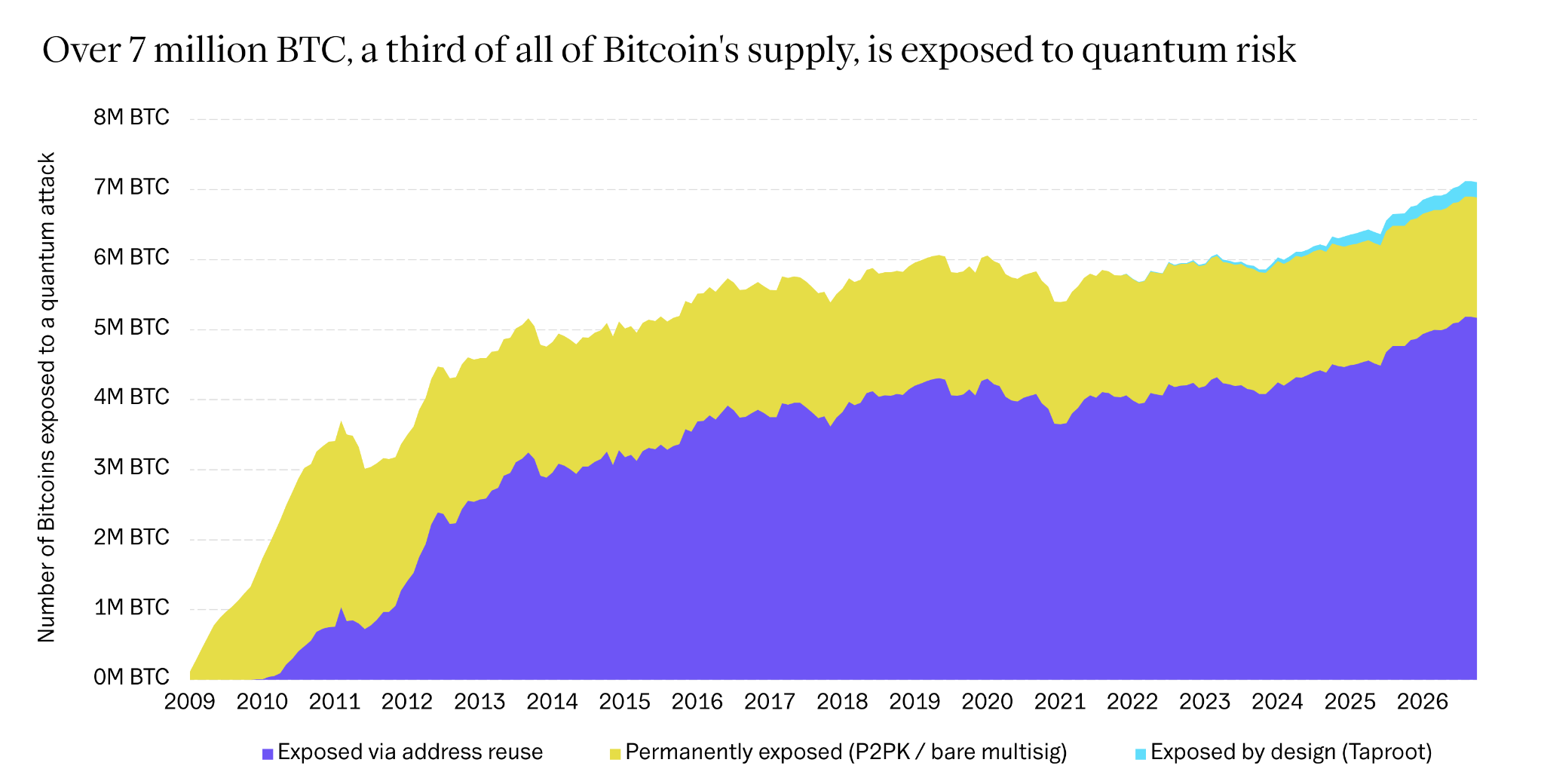
The US expects critical infrastructure across defense, banking, and healthcare to be quantum-safe by 2030. Bitcoin exposes public keys when coins are spent, and a powerful enough quantum computer could derive a private key from an exposed public key. That threat affects roughly half of exchange-held bitcoin. We project total exposure reaching 7.5 million BTC by the end of 2027 and expect providers to move at least 50,000 BTC to addresses that hide public keys. That is about 5% of their exposure, but it would mark a first shift in custody behavior.
No such machine exists. IonQ estimates a hypothetical 2028-era machine could crack a Bitcoin key in 26 days, and custodians need time to test new wallets and move holdings safely. All ten of the largest US bitcoin ETF issuers already flag quantum risk in their SEC filings. Coinbase’s planned mid-2027 signing upgrade is a milestone to track, though no custodian can make Bitcoin itself quantum-safe. The deeper fix sits with Bitcoin’s protocol, where proposals such as BIP-360 are under discussion.
Digital assets are being absorbed into the financial system investors already use
Step back from the individual predictions and the same pattern runs through all ten. Bitcoin lost more than half its value, and buyers still absorbed more than three times the new supply. Regulators in the world’s largest economies moved from enforcement to rulebooks. Stablecoins, tokenized assets, and 24/7 venues are being built into the payment apps, brokerages, and banks people already use. Even the newer corners of the market, from onchain options to AI agents, are growing on measurable usage, and custodians are asking the quantum question before it becomes urgent.
That is what we mean by resilience. Digital assets are no longer building a parallel system. They are being absorbed into the one investors already rely on, and that shift is what we expect 2027 to price in.
None of it removes the risk. Prices remain volatile, regulation will arrive unevenly, and several predictions depend on users staying once incentives fade. Treat each as a view to test, not a forecast to relay. The full report sets out the data, the sources, and the conditions that must hold for every one of the ten.
FAQ
What is the 21shares Investment Outlook for 2027?
It is our annual set of ten predictions for digital assets, covering bitcoin, regulation, stablecoins, tokenization, onchain options, prediction markets, privacy, AI agents, and quantum readiness. The theme is that 2027 is the year resilience gets priced in. These are 21shares views based on data to October 2026, not forecasts of returns. Past performance is not a reliable indicator of future results.
Will bitcoin reach a new all-time high in 2027?
21shares expects a new bitcoin all-time high in 2027, though not this cycle’s top, citing historical cycle patterns and institutional buying. The cycle comparison rests on three prior cycles. This is a view, not a guarantee. Bitcoin fell more than 50% from its peak and can fall by that scale again.
How many G20 countries will regulate crypto by 2027?
21shares expects 15 of the 21 G20 members to operate under a digital asset rulebook by the end of 2027, with France, Germany, and Italy counted under the EU (21shares, national regulators and legislatures, October 2026). This is a 21shares view, not passed legislation.