

For too long, many savers have seen their hard-earned money lose value because of inflation. This has made their financial goals harder to reach.
They have also had to trust in the banking system to look after their money for them, to grant them access to their savings when needed, and to facilitate transfers on their behalf.
We see bitcoin as a unique asset for wealth preservation. The characteristics it shares with gold are attracting many governments, businesses, and investors seeking a genuine store of value that does not rely on a “trusted” third party.
Like gold, bitcoin offers: limited supply, divisibility, portability, interchangeability, global acceptance, and independence from any single government, corporation, or authority.
What makes Bitcoin so attractive is that it betters gold in many of these characteristics. At 21shares, we believe Bitcoin may represent a significant long-term market development.
Supply is limited
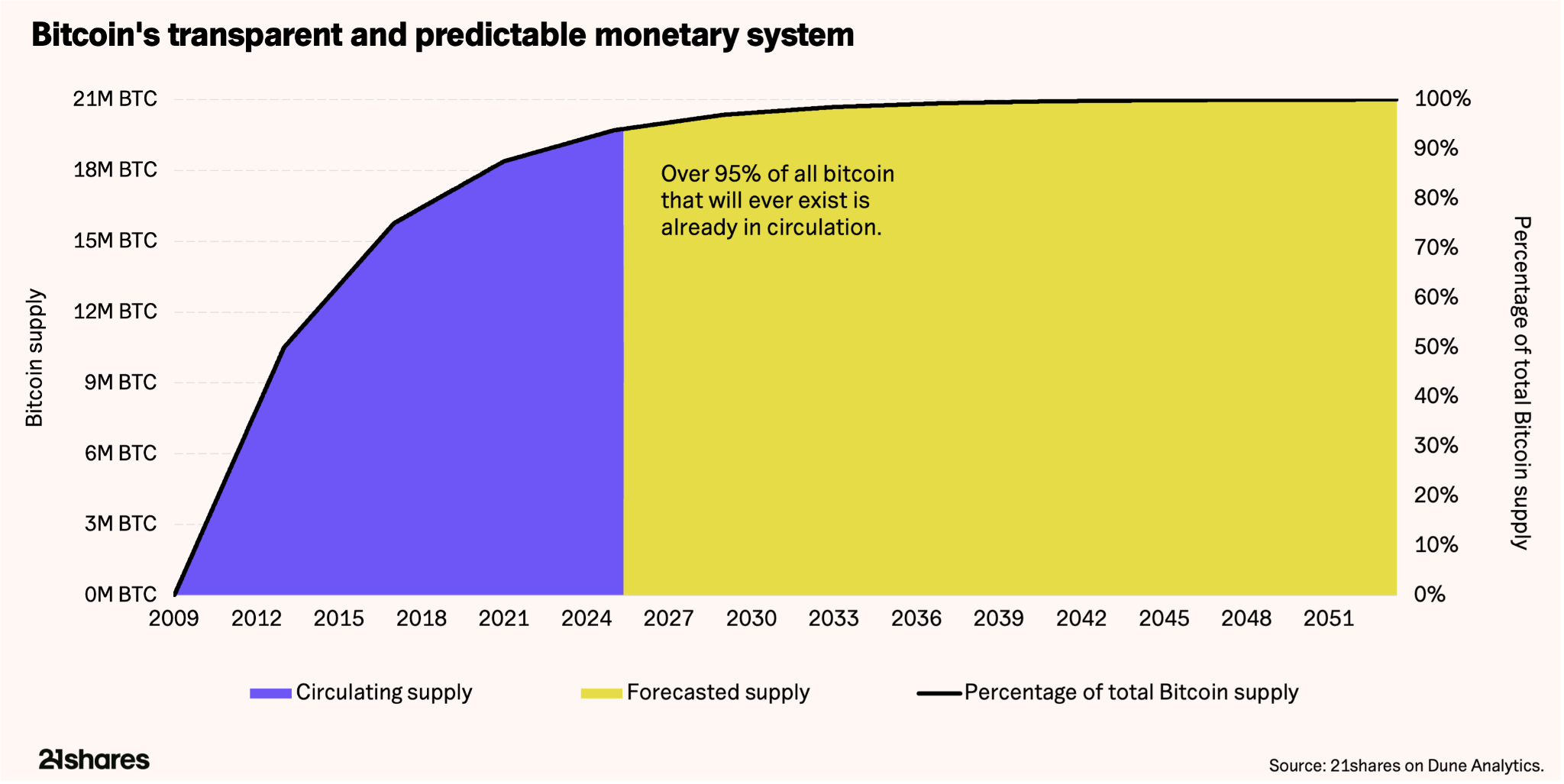
Arguably, the most important specs for a store of value are security and scarcity. Only about 21 million bitcoin will ever exist, and 20 million1 – over 95% – of all bitcoin supply has been issued since 2009 through a concept of mining like gold. Instead of using picks and shovels in remote places, the Bitcoin network leverages supercomputers.
This leaves about 1 million bitcoin, which is 4.76% of the total supply. We believe this scarcity helps make bitcoin an effective long-term hedge against inflation and currency devaluation. While gold's supply is also limited, there is no known maximum amount. In contrast, Bitcoin has programmed scarcity thanks to maths.
The system cuts the rewards for miners by 50% every four years, to get to 21 million by the year 2140. This event is known as "the halving" and controls the release rate of new bitcoin. This schedule will keep going until the last bitcoin is issued.

It’s designed to be inflation-proof
Most money we use today, like the US dollar or the British pound, is controlled by central banks. These banks act like managers for a country's money. If the government needs to pay off debt, these banks can simply print more money.
Printing too much money can reduce the value of the dollars you already have. We call this process inflation.
Bitcoin works differently:
- As outlined above, there is a set supply of 21 million bitcoin. This limit is hardcoded into Bitcoin's design. No government or central bank can change it.
- Instead of one bank or government being in charge, a large network of computers runs Bitcoin. We call this a decentralized network.
- It operates on a global blockchain. Think of this as a giant, digital "logbook" that everyone in the world can see, but no one can erase. Every time bitcoin moves, it is recorded in this public book.
- Because there is no "boss" to grant permission, a single company or government can’t shut down, manipulate, or censor it.
- Bitcoin can work offline using satellite or radio. This keeps the network active, even if local internet is disrupted or shut down.
Demand for bitcoin is increasing
Universally, people acknowledge that trust and consensus around a currency make it strong. At first, people viewed Bitcoin as something only tech-savvy individuals used. Now, many companies and even governments use it as a store of value.
Corporations now own over 4% of bitcoin’s total supply2. Governments, like the US, are looking into it for national reserves. And institutional demand is growing almost five times faster than miners are producing new bitcoin3.
The growth of Bitcoin exchange-traded products (ETPs) and exchange-traded funds (ETFs) is also speeding up Bitcoin's adoption. These products make it easier for both retail and institutional investors to access Bitcoin. They offer regulated and familiar ways to invest. They also provide solutions to common concerns about security and storage.
Footnotes:
- Blockchain.com: “Total Circulating Bitcoin” https://www.blockchain.com/explorer/charts/total-bitcoins (accessed April 29, 2026)
- CoinGecko: “Bitcoin Holdings by Public Companies” (accessed June 2025)
- Bitcointreasuries.net: Publicly Traded Bitcoin Treasury Companies (accessed April 29, 2026)