

To understand how XRP is used, start with the problem it was built to solve. Moving money across borders still typically runs through correspondent banking: a relay of intermediaries where payments can take two to five business days to clear, each hop adding time, cost, and the need for banks to park capital in pre-funded accounts around the world. These pre-funded accounts, known as nostro accounts, tie up capital estimated at hundreds of billions to several trillion dollars, sitting idle simply so payments can clear.
XRP as a bridge
The XRPL's answer is to use XRP as a neutral bridge between currencies. A payment provider converts the sending currency into XRP, moves it across the ledger, and converts it into the destination currency on the other side. No pre-funding, no relay of intermediaries, settlement in three to five seconds for roughly $0.0002 per transaction. This is the model behind Ripple's payments business and the reason institutions such as SBI Holdings and Tranglo route flows through the ledger.
Fees that protect the network
Every XRPL transaction destroys a small amount of XRP, with a base fee of 0.00001 XRP. This is not a payment to validators but an anti-spam mechanism: flooding the network becomes progressively expensive. A side effect is that total supply slowly declines, with more than 14 million XRP burned since 2012, resulting in a deflationary supply mechanism. That said, the scale is negligible: 14 million XRP is roughly 0.014% of the 100 billion supply, so the burn is better read as a security feature than as a meaningful deflationary force.
A built-in exchange
Unlike most other blockchains, the XRPL has had a decentralized exchange at the protocol level since its 2012 launch, the first of its kind. Any asset issued on the ledger can trade directly against any other, with XRP often serving as the intermediary pair. This gives the ledger native liquidity plumbing rather than relying on third-party applications. Decentralized finance on the XRPL remains small at north of $30 million, but the direction of travel is still positive, despite the recent wind-down due to market conditions. Lending, automated market making, and yield applications are arriving on top of the settlement base, although a live governance vote on lending is currently underway.
Stablecoins and tokenized assets
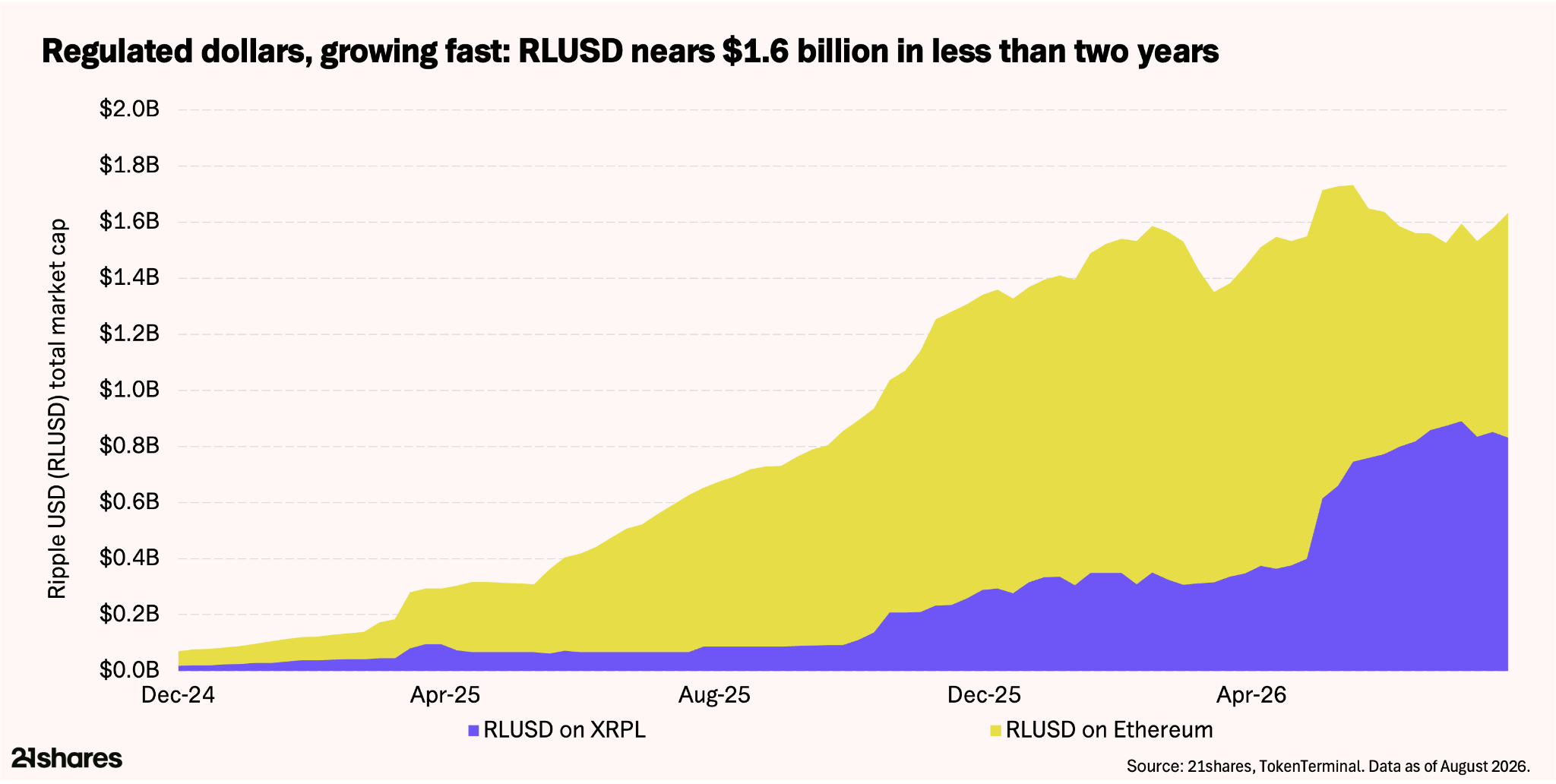
The newest and, in our view, most consequential chapter. Ripple's RLUSD stablecoin, at around $1.6 billion, provides regulated dollar liquidity directly on the ledger, and by mid-2026 over half of RLUSD's total supply circulated on the XRPL for the first time. The Multi-Purpose Token standard allows institutions to issue real-world assets, such as bonds or funds, with compliance requirements coded into the token itself: tokenized assets on the ledger have grown to around $4 billion, making it one of the largest networks for real-world assets. Combined with the native exchange, this turns the XRPL into a venue where assets can be issued, traded, and settled end to end. One important caveat: these assets live on the ledger but do not trade in XRP. The token's direct role is limited to the small fee burned on each transaction and the minimum reserve each account holds, so the case for XRP is that more activity on the ledger eventually lifts demand for it, not that the activity is denominated in it.
XRP's usage is institutional by design. The ledger competes less with consumer crypto apps and more with SWIFT (the global bank messaging network that coordinates most international payments), nostro accounts, and legacy issuance infrastructure. Whether that positioning wins is the open question, but it is a coherent one, and it is being tested in production at scale: over the past year, the ledger has processed around 1.7 million transactions and settled roughly $1.3 billion in on-chain value per day, close to half a trillion dollars in total.