
How is XRP being used? Payments, DeFi, and tokenized assets explained

How is XRP being used? Payments, DeFi, and tokenized assets explained

How is XRP being used? Payments, DeFi, and tokenized assets explained

To understand how XRP is used, start with the problem it was built to solve. Moving money across borders still typically runs through correspondent banking: a relay of intermediaries where payments can take two to five business days to clear, each hop adding time, cost, and the need for banks to park capital in pre-funded accounts around the world. These pre-funded accounts, known as nostro accounts, tie up capital estimated at hundreds of billions to several trillion dollars, sitting idle simply so payments can clear.

‍

XRP as a bridge

The XRPL's answer is to use XRP as a neutral bridge between currencies. A payment provider converts the sending currency into XRP, moves it across the ledger, and converts it into the destination currency on the other side. No pre-funding, no relay of intermediaries, settlement in three to five seconds for roughly $0.0002 per transaction. This is the model behind Ripple's payments business and the reason institutions such as SBI Holdings and Tranglo route flows through the ledger.

‍

Fees that protect the network

Every XRPL transaction destroys a small amount of XRP, with a base fee of 0.00001 XRP. This is not a payment to validators but an anti-spam mechanism: flooding the network becomes progressively expensive. A side effect is that total supply slowly declines, with more than 14 million XRP burned since 2012, resulting in a deflationary supply mechanism. That said, the scale is negligible: 14 million XRP is roughly 0.014% of the 100 billion supply, so the burn is better read as a security feature than as a meaningful deflationary force.

‍

A built-in exchange

Unlike most other blockchains, the XRPL has had a decentralized exchange at the protocol level since its 2012 launch, the first of its kind. Any asset issued on the ledger can trade directly against any other, with XRP often serving as the intermediary pair. This gives the ledger native liquidity plumbing rather than relying on third-party applications. Decentralized finance on the XRPL remains small at north of $30 million, but the direction of travel is still positive, despite the recent wind-down due to market conditions. Lending, automated market making, and yield applications are arriving on top of the settlement base, although a live governance vote on lending is currently underway.

‍

Stablecoins and tokenized assets

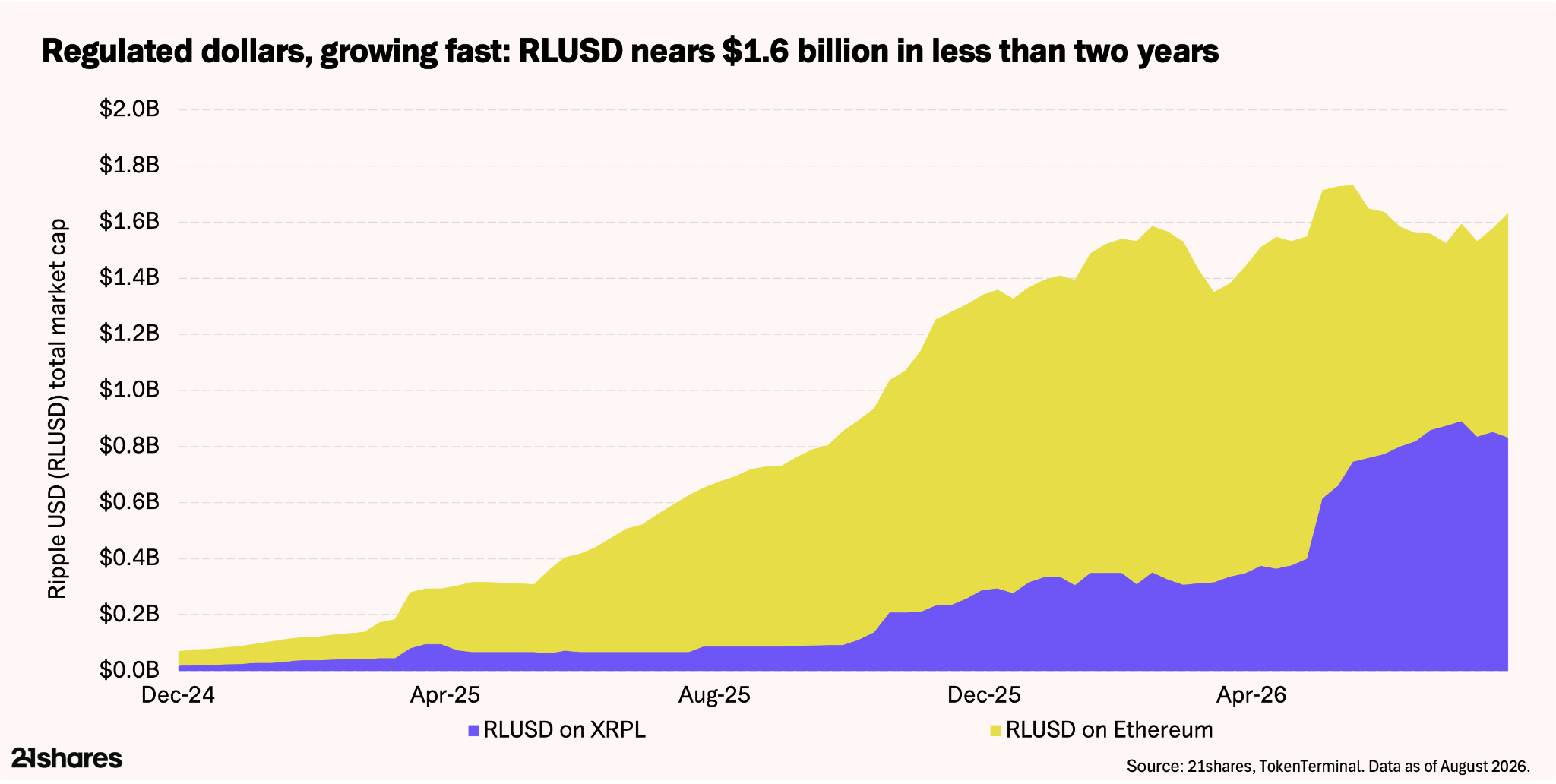
The newest and, in our view, most consequential chapter. Ripple's RLUSD stablecoin, at around $1.6 billion, provides regulated dollar liquidity directly on the ledger, and by mid-2026 over half of RLUSD's total supply circulated on the XRPL for the first time. The Multi-Purpose Token standard allows institutions to issue real-world assets, such as bonds or funds, with compliance requirements coded into the token itself: tokenized assets on the ledger have grown to around $4 billion, making it one of the largest networks for real-world assets. Combined with the native exchange, this turns the XRPL into a venue where assets can be issued, traded, and settled end to end. One important caveat: these assets live on the ledger but do not trade in XRP. The token's direct role is limited to the small fee burned on each transaction and the minimum reserve each account holds, so the case for XRP is that more activity on the ledger eventually lifts demand for it, not that the activity is denominated in it.
XRP's usage is institutional by design. The ledger competes less with consumer crypto apps and more with SWIFT (the global bank messaging network that coordinates most international payments), nostro accounts, and legacy issuance infrastructure. Whether that positioning wins is the open question, but it is a coherent one, and it is being tested in production at scale: over the past year, the ledger has processed around 1.7 million transactions and settled roughly $1.3 billion in on-chain value per day, close to half a trillion dollars in total.


‍

Table of contents

Share

For more information, please visit 21shares XRP ETF. Foreside Global Services, LLC serves as the Marketing Agent for the 21shares ETPs.

This report has been prepared and issued by 21Shares US LLC. for publication globally. All information used in the publication of this report has been compiled from publicly available sources that are believed to be reliable, however, we do not guarantee the accuracy or completeness of this report. Crypto asset trading involves a high degree of risk. The crypto asset market is new to many and unproven and may have the potential not to grow as expected.‍Currently, there is relatively small use of crypto assets in the retail and commercial marketplace in comparison to relatively large use by speculators, thus contributing to price volatility that could adversely affect an investment in crypto assets. In order to participate in the trading of crypto assets, you should be capable of evaluating the merits and risks of the investment and be able to bear the economic risk of losing your entire investment.‍Nothing herein does or should be considered as an offer to buy or sell or solicitation to buy or invest in crypto assets or derivatives. This report is provided for information and research purposes only and should not be construed or presented as an offer or solicitation for any investment. The information provided does not constitute a prospectus or any offering and does not contain or constitute an offer to sell or solicit an offer to invest in any jurisdiction. The crypto assets or derivatives and/or any services contained or referred to herein may not be suitable for you and it is recommended that you consult an independent advisor. Nothing herein constitutes investment, legal, accounting or tax advice, or a representation that any investment or strategy is suitable or appropriate to your individual circumstances or otherwise constitutes a personal recommendation. Neither 21Shares US LLC. nor any of its affiliates accept liability for loss arising from the use of the material presented or discussed herein.‍Readers are cautioned that any forward-looking statements are not guarantees of future performance and involve risks and uncertainties and that actual results may differ materially from those in the forward-looking statements as a result of various factors.‍This report may contain or refer to material that is not directed to, or intended for distribution to or use by, any person or entity who is a citizen or resident of or located in any locality, state, country or other jurisdiction where such distribution, publication, availability or use would be contrary to law or regulation or which would subject 21Shares US LLC. or any of its affiliates to any registration, affiliation, approval or licensing requirement within such jurisdiction.

‍

Latest insights

Stay informed with our Weekly Newsletter and deepen your insight with Monthly Reviews.

See all insights
Article page link
Bitcoin
Article page link
Bitcoin
Article page link
Markets and Macro

Start investing today

Step 1
Select a brokerage account below or contact your financial advisor.
Don't see your brokerage? Search for 21shares on your brokerage of choice.
*It is important to note that market orders will execute at the current market price, while limit orders allow investors to set a specific price at which to buy or sell the ETP.

Maximiliaan Michielsen

Investment Strategist

Max Michielsen is an Investment Strategist at 21shares, where he provides data-driven insights and conducts fundamental investment analysis to support the firm’s research initiatives. His work focuses on bridging the gap between traditional finance and the digital asset ecosystem. Prior to joining 21shares, he worked at an early-stage startup specializing in digital asset due diligence. He holds a degree in Economics and Finance from Università Bocconi.

See all articles