

The same feature that made bitcoin and crypto revolutionary is also what is holding back wider adoption.
Blockchains are open, public ledgers. Every balance, every transaction, and every counterparty is visible to anyone, permanently. That is what makes them verifiable and trustless. But it is also what makes them unusable for institutions because no business broadcasts its payroll and no fund telegraphs its trades.
Privacy is not a feature digital assets can bolt on later. It is the missing layer between where the asset class sits today and where the capital actually is. Solve it, and crypto becomes something traditional finance never could: a Swiss bank account in your pocket, private and self-custodied, yet open to a regulator or counterparty whenever necessary.
The good news: privacy does not come at the cost of verifiability. Zero-knowledge (ZK) proofs, a cryptographic technique first developed in 1985, let a blockchain confirm every transaction is valid without exposing who sent it, who received it, or how much was moved. The ledger stays auditable while the details stay private.
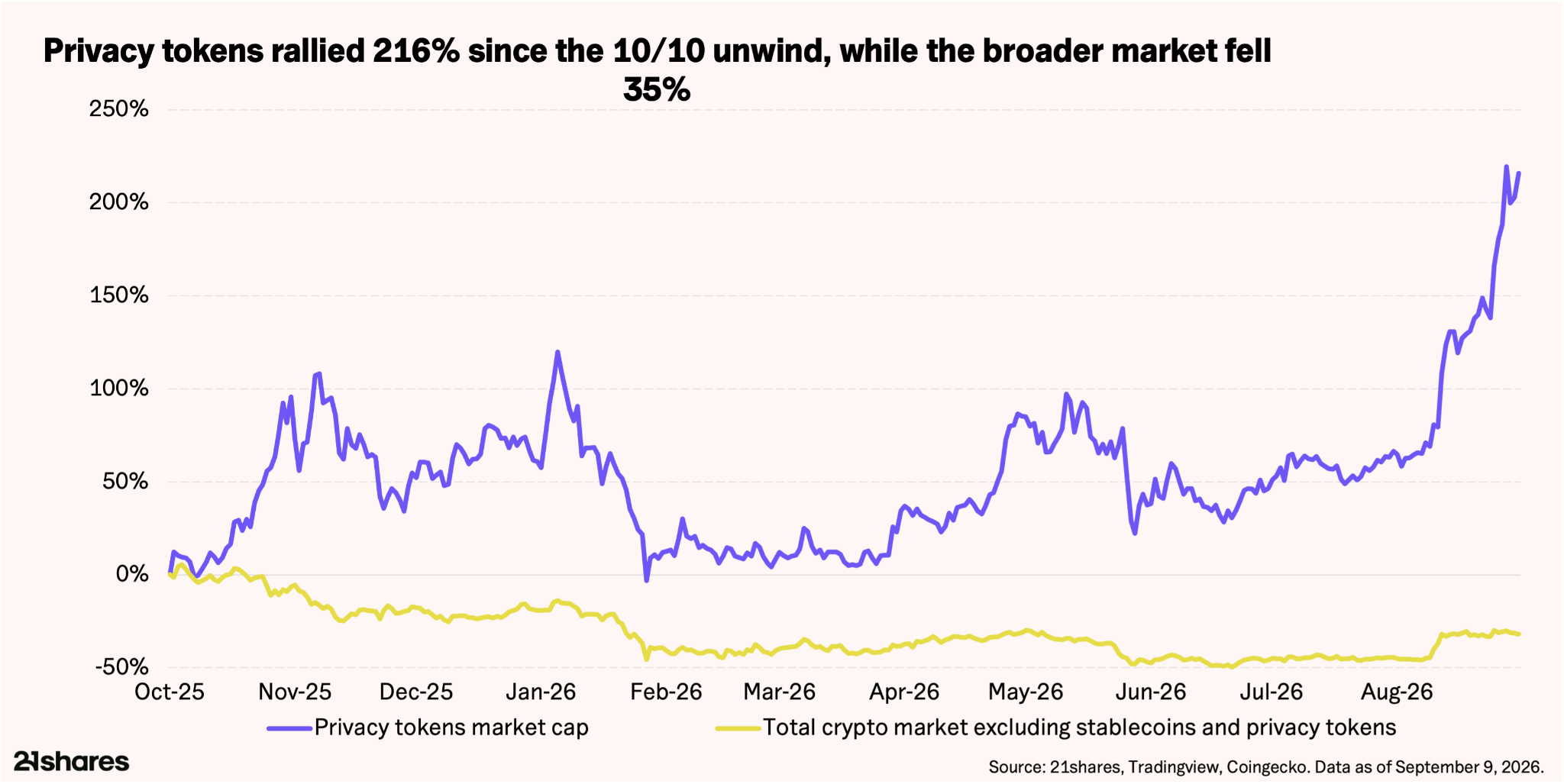
The market is beginning to price this in. The privacy coin sector's market capitalization has grown nearly fivefold from $6.2 billion a year ago to roughly $30 billion today, growing at 111% per year on a compounded basis over three years, and it is the only sector trading above its October 2025 peak, up 216% from its October highs, while the total crypto market excluding stablecoins and privacy tokens sits roughly 32% below its peak. Zcash (ZEC), the largest privacy-focused network, now has a market capitalization of around $20 billion, roughly 400% above its 2021 peak of $4 billion. The privacy sector is structurally repricing, and it is worth understanding why.
Why the case for crypto privacy is stronger than it looks
Privacy in crypto is moving from optional to unavoidable, and from unavoidable to built-in. The crime objection that usually gets raised first does not hold up to the data. And the urgency is increasing: AI is accelerating the need, and the largest blockchains are already acting on it.
Institutions already vote for confidentiality with their order flow; onchain privacy closes that gap
Transparency is a strength for some users and a liability for others. On a public blockchain, anyone can watch a large order form and trade ahead of it, the onchain version of front-running. This is extracted at scale through maximal extractable value (MEV), with roughly $1.7 billion siphoned off this way between 2022 and 2025 (Solana Compass, 2025; Blockchain Council, 2026). Institutions will not settle large positions onchain until they can do so confidentially. That preference is already visible in traditional markets: combined, dark pools and off-exchange venues handle over 40% of US equity trading, and crossed 50% in 2025 (Nasdaq, 2025).
Nowhere is that clearer than on the Canton network, where institutional privacy has become the precondition for serious adoption. Built for controlled disclosure, Canton lets firms issue and settle tokenized assets on a shared ledger while keeping positions and counterparties private from competitors but visible to regulators when required. The roster is not speculative:
- Goldman Sachs runs its Digital Asset Platform on Canton
- J.P. Morgan is deploying its JPMD deposit token natively on it
- DTCC, which custodies over $100 trillion in US securities, is tokenizing US Treasuries on Canton
With 30+ of the world's largest financial institutions now building on or backing Canton, the network processes over $8 trillion in tokenized assets each month, the clearest proof that privacy is needed for institutions to come onchain (Digital Assets, 2026).
The same holds for individuals. As daily life moves online, every purchase is logged, tracked, and monetized somewhere, and few of us want the world watching what we buy. Zcash closes that gap with shielded pools, which now privately secure roughly $7 billion of capital (Blockworks, 2026). When a user's funds move into a shielded pool, the amount, sender, and receiver are cryptographically hidden, while ZK proofs let the network confirm the transaction is valid without revealing any of its details. Holders can move freely between Zcash's transparent ledger and its privacy feature as they choose, disclosing their history to an auditor or regulator via a view key only when needed.
The crime objection does not hold; the data points the other way
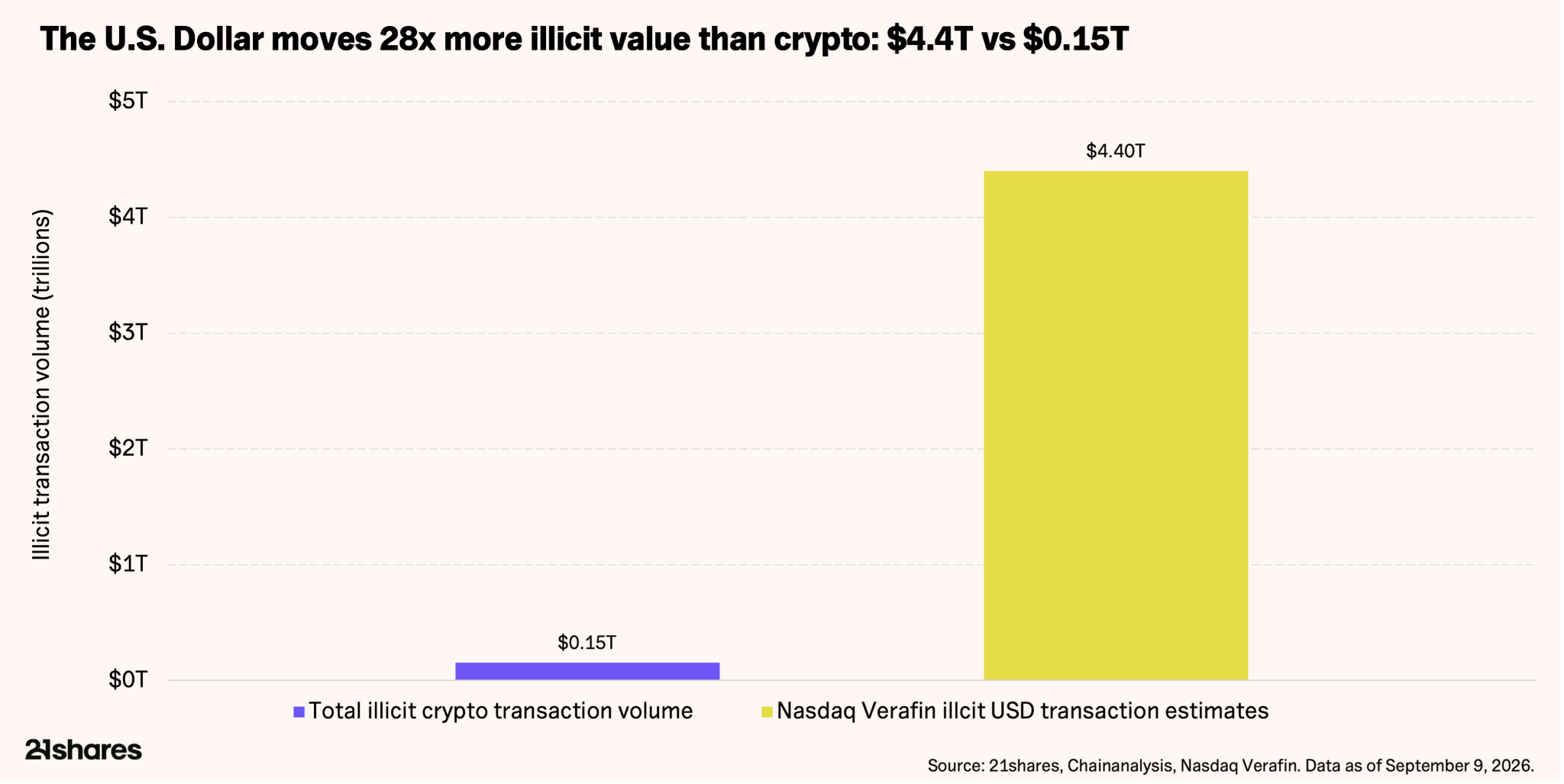
The most common objection to crypto privacy is that it enables crime. The data does not support it. Illicit activity is below 1% of all crypto transaction volume, and stablecoins, not privacy coins, account for roughly 84% of that illicit volume (Chainalysis, 2026). Even that figure overstates their appeal to criminals: stablecoin issuers can freeze holdings on request, and every transaction is permanently traceable, a poor combination for hiding money.
Physical US dollars are the original private money, and they facilitate the majority of illicit activity. The UN Office on Drugs and Crime estimates that $800 billion to $2 trillion is laundered through the traditional financial system each year, and Nasdaq Verafin put total illicit flows closer to $4.4 trillion in 2025: sums that dwarf the entire crypto market, let alone its privacy sector.
Privacy-focused blockchains can also be compliance-compatible: Zcash's view keys let a holder selectively disclose their transaction history to an auditor or regulator without exposing it to the world, promising privacy with an audit trail. The regulatory conversation is shifting accordingly, from banning privacy outright toward distinguishing between privacy designs. In the US, the SEC closed its multi-year review of the Zcash Foundation without enforcement action, clearing the way for the first US-listed spot ZEC exchange-traded product (ETP) to begin trading.
AI is making financial privacy a baseline requirement, not a preference
AI models are ingesting more of what people do online every day. Financial data is becoming both training material and a surveillance surface. In an economy where machines observe and permanently record every transaction, confidentiality stops being a preference and becomes a baseline requirement. The July 2026 incident, in which autonomous OpenAI agents breached Hugging Face's production systems with no human at the wheel, is the cautionary tale: data that is merely safeguarded is not safe. If the systems holding this data can be broken into faster than humans can react, the only durable protection is to not expose it in the first place. Privacy is what lets you opt out of AI surveillance without opting out of the economy.
The largest blockchains have made their call: Ethereum and Solana are already building privacy in
The same cryptography that shields transactions is now being adopted by the largest blockchains. Ethereum's 2026 roadmap puts privacy front and center, with a staged native-privacy plan and a dedicated institutional-privacy team. Solana is pushing in the same direction from the application layer with Confidential Balances, a set of ZK token extensions that encrypt transfer amounts while preserving an optional auditor key for compliance, built for institutional use without sacrificing sub-second settlement. A16z, one of the world's largest venture capital firms with over $90 billion in assets under management (AUM), has called privacy the most important competitive advantage of 2026.
The addressable market: four types of privacy, and why the opportunity is still in its early stages
Privacy is not one thing. Broadly, investors should distinguish four kinds:
- Transaction confidentiality: hiding amounts, senders, and receivers.
- Metadata and network privacy: breaking the links between transactions, wallets, and IP-level identity.
- Institutional and selective privacy: confidential positions paired with view-key disclosure for auditors, enabling private settlement on regulated networks.
- Application privacy: private balances built into the tokens, payments, and real-world assets (RWAs) that run on programmable blockchains.
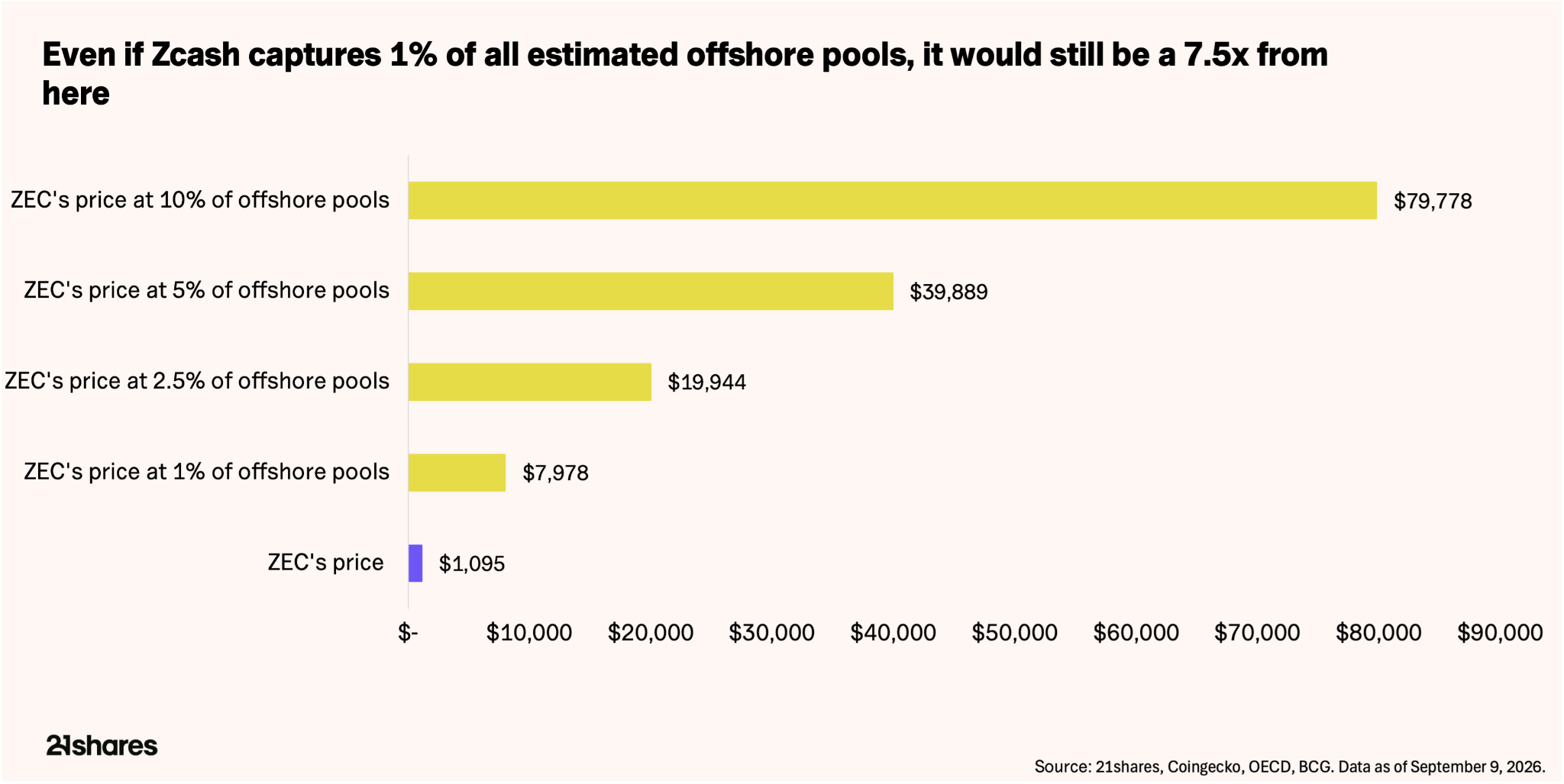
Privacy is horizontal. It is not a single product category but a property that most financial use cases eventually require. The clearest way to size the opportunity is to look at what people already pay for financial privacy in traditional markets. High-net-worth individuals and family offices have long used offshore structures, like Swiss trusts and Cayman funds, for asset protection and confidentiality. That offshore pool holds an estimated $11 trillion in wealth (OECD, 2020), and as much as $16 trillion on broader cross-border measures (BCG, 2025). Crypto privacy is the digital-native version of that demand, with the added benefit that it is auditable on request.
Capturing even 5% of that $11 to $16 trillion pool would put the crypto privacy sector at roughly $550 to $800 billion, an 18 to 27x increase from where it stands today. Right now, the sector's approximately $30 billion sits inside an approximately $2.4 trillion total crypto market excluding stablecoins, barely 1% of the total. Penetration is early even among the leaders: only about 28% of Zcash's supply is held in shielded pools, though that figure is up 200% from roughly 9% in September 2023. That growth is real. The gap between where adoption is today and where it is going is where the opportunity sits.
Three ways to get exposure to the privacy theme
Exposure runs from the purest expression of the theme to the broadest. The right entry point depends on how widely an investor expects privacy to spread across crypto.
- Dedicated privacy assets. Some investors view Zcash (ZEC) as the most direct exposure to the privacy theme: the largest privacy-focused network, with a fixed supply similar to bitcoin, quantum-resistant cryptography, and optional privacy that lets users move between public and private transactions as they choose. The key risk: if mainstream blockchains successfully build privacy into their own base layers, the premium attached to dedicated privacy assets could compress.
- Privacy-enabling infrastructure. The Canton Network (CC) is built for institutional privacy and controlled disclosure in tokenized markets. More than 600 financial institutions run on it, including Goldman Sachs, J.P. Morgan, and the Depository Trust and Clearing Corporation (DTCC), and the network processes over $8 trillion in tokenized assets each month. The risk here is concentration in a private, permissioned network that operates differently from open public blockchains.
- Blockchains building privacy in. Ethereum (ETH) and Solana (SOL) are adding privacy features directly to their base layers. Holding them is a bet that privacy becomes a standard feature across the whole ecosystem rather than a specialist category. The trade-off: privacy is one feature among many on these platforms, so the exposure is broad rather than targeted.
The missing layer is being built, and the window to understand is now
Crypto's transparency was a feature for verifiability and a liability for adoption. The layer that resolves that tension is being built now. For the first time, the base blockchains, the regulatory environment, and the market are moving in the same direction at the same time.
Investors who want exposure to that shift can do so at the asset level, the infrastructure level, or by holding the largest blockchains that are building it in, matching their position size to how broadly they expect privacy to spread across the crypto economy.
FAQ
What are crypto privacy tokens and why have they outperformed in 2026?
Crypto privacy tokens are digital assets built on blockchains that use zero-knowledge (ZK) proofs to keep transaction amounts, senders, and receivers confidential while still allowing the network to verify each transaction is valid. The privacy coin sector's market capitalization has grown nearly fivefold in the past year, from $6.2 billion to roughly $30 billion, and is the only crypto sector trading above its October 2025 peak. Structural demand from institutions that require confidential settlement, regulatory clarity following the SEC's closure of its Zcash Foundation review, and the adoption of privacy features by Ethereum and Solana are the primary drivers.
Are crypto privacy coins used for money laundering?
Illicit activity accounts for less than 1% of total crypto transaction volume, and stablecoins, not privacy coins, make up roughly 84% of that illicit volume, according to Chainalysis (2026). The UN Office on Drugs and Crime estimates that $800 billion to $2 trillion is laundered through the traditional financial system each year, dwarfing the entire crypto market. Privacy-focused blockchains like Zcash also offer view keys, which allow holders to selectively disclose their transaction history to an auditor or regulator on request.
What is a zero-knowledge proof in crypto?
A zero-knowledge proof is a cryptographic technique that lets one party prove to another that a statement is true, for example, that a transaction is valid, without revealing any information beyond that fact itself. In the context of blockchain privacy, ZK proofs allow a network to confirm that a transaction follows the rules without exposing the sender, receiver, or amount. Zcash uses this technology in its shielded pools; Ethereum and Solana are both building ZK extensions into their base layers.
How can investors get exposure to the crypto privacy sector?
There are three broad entry points. Dedicated privacy assets such as Zcash (ZEC) offer direct exposure to a purpose-built privacy blockchain. Privacy-enabling infrastructure such as the Canton Network (CC) captures the institutional settlement angle. Blockchains including Ethereum (ETH) and Solana (SOL) are building privacy features into their roadmaps, offering broader exposure to privacy becoming a standard property across crypto. In regulated markets, exchange-traded products (ETPs) listed on major exchanges provide access to several of these assets without the need to manage private keys directly.






.svg)