

A decade ago, Revolut, Nubank and others meaningfully improved the retail banking experience through an app on the back of the rise of mobile ubiquity. They obtained money-transmitter licences, partnered with a custodian bank, kept an interest margin, and removed the physical branch. The model proved itself: global fintech revenue passed $504 billion last year, growing 22% a year, more than four times faster than the incumbents it set out to replace.
Today a second wave is rebuilding the app without the bank. Protocols hold no deposits, run no loan book and, in most jurisdictions, carry no licence. Instead, a smart contract holds the user's assets, a card spends against them, and yield from staking or derivatives funding reaches the user directly minus a small protocol fee rather than being swallowed by a bank's interest margin.
The onchain financial apps sector is already producing serious valuations: Ethena and ether.fi, both just a few years old, are worth around $1.6 billion and $670 million respectively, while the fintech incumbents they are taking aim at, Revolut and Nubank, are valued at $115 billion and $74 billion. The gap is large, but so is the implied runway.
Onchain financial apps vs. banks: different plumbing, better economics for the user
A neobank such as Nubank is a licensed bank: it takes deposits, lends them out, and up to 85% of its revenue is interest income. Revolut leans on a different model, earning three-quarters of its revenue from card fees, FX, subscriptions, and trading. Both own the customer's primary financial relationship: the salary lands there, the card is in the wallet, the savings sit on the app. That is what the valuations above are justified for.
The onchain versions go after the same relationship with a different stack.
- Custody: the user keeps their own assets in a smart-contract account, and a card from a regulated card issuer like Visa or Mastercard spends against that balance.
- Interest: a bank pays interest at a rate it sets, funded by its lending margin, which shrinks when rates fall; a protocol pays a share of what it earns from staking or funding rates, minus a published fee, so what you receive moves with what the business makes. The numbers show how different the two models are. Nubank pays depositors 87% of the interbank rate and lends at credit-card rates, earning a risk-adjusted net interest margin of 10.5% and a net profit margin of 18% on $16.3 billion of revenue. Revolut turns $67.5 billion of customer balances, most of them unremunerated, into $1.3 billion of interest income and a 38% pre-tax margin. ether.fi, by contrast, has passed 76% of every dollar of fees it has ever generated to its users and kept 24%; Ethena has kept about a third of its gross yield, almost all of it in the reserve fund, and in a slow month like this one, it keeps close to nothing. The bank keeps the spread. The protocol keeps a sliver and gives the customer the rest.
- Distribution: with the balance sheet in code, a product can go live in dozens of countries at once where a bank would need a licence in each, which is why these apps are gaining share fastest in Latin America, Southeast Asia and Africa.
It is also why we call them onchain financial apps, not banks, and the distinction matters for the customer. A banking licence brings deposit insurance, capital requirements, supervision, and a central bank behind the system; none of that exists here. What the user gets instead is a regulated card issuer, a public ledger, and a real-time view of the protocol's assets that no bank offers. But that transparency stops at the protocol: the counterparties, the exchanges holding collateral, and the code not yet exploited are no more visible than at a bank.
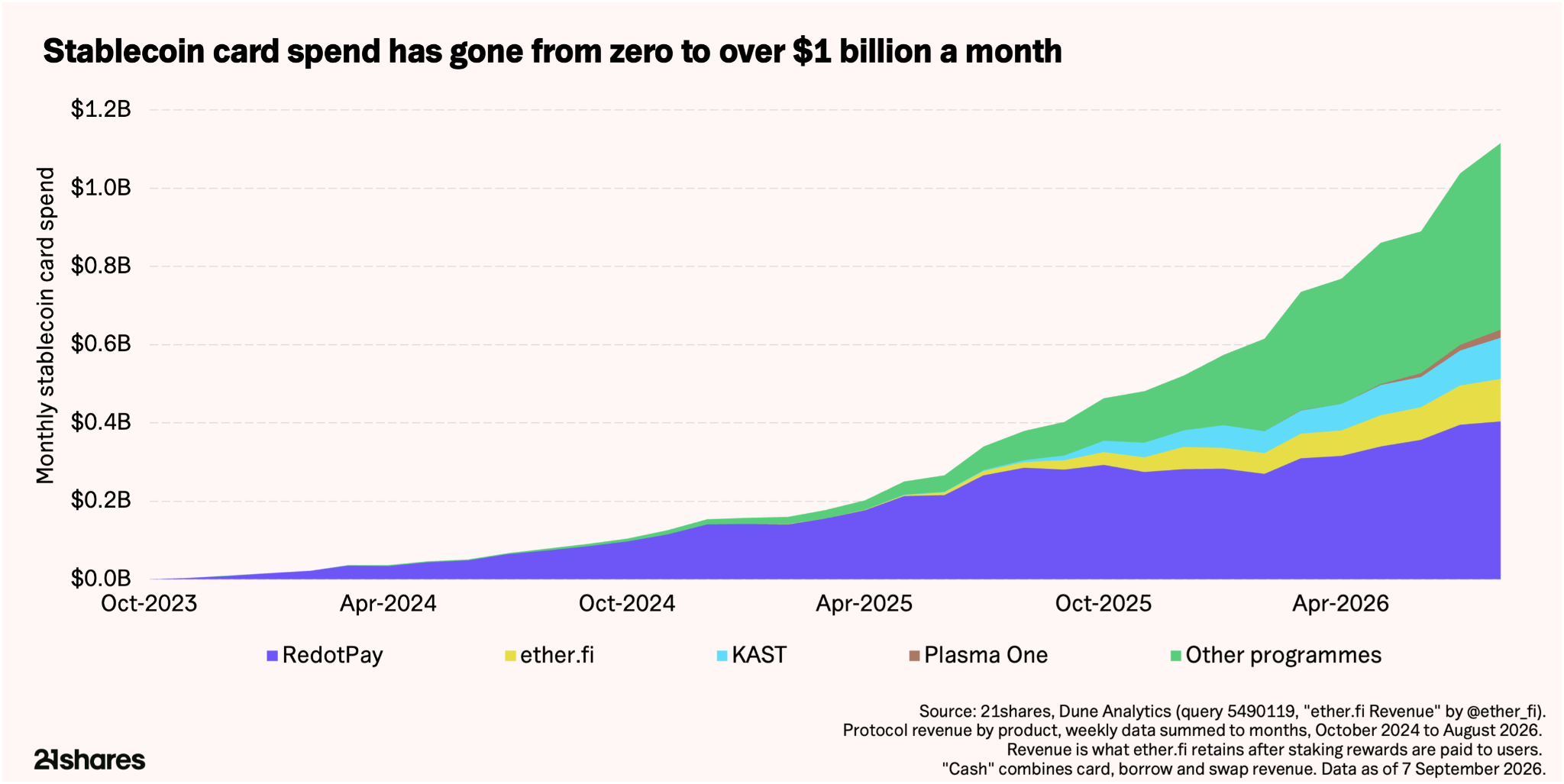
Ethena and ether.fi: the two onchain apps with the clearest token investment case
1. Ethena: the savings account minus the bank
Ethena is the savings account in this story. Its yield product, USDe, is dollar-denominated and pays yield to holders. Ethena holds T-bills, staked ETH, and BTC as collateral and shorts the same amount in perpetual futures, so the market risk cancels out. What is left is the staking yield on the collateral plus the funding rate that leveraged longs pay to shorts, and that is what sUSDe holders earn: between 4 and 15% through 2025, mid single digits today, with a reserve fund covering the shortfall when funding turns negative. USDe supply peaked above $14 billion in October 2025 and is around $4.5 billion now: the yield is cyclical, and savers follow it, as they would at any bank that cuts its rate.
Ethena has two characteristics that extend its significance beyond a stablecoin. Distribution is the first. USDe is accepted as collateral on roughly 60% of exchanges and is the largest stablecoin on Robinhood Chain, with a third of its roughly $1 billion supply. On 1 September, Ethena launched Ethena Pay, its own attempt at a neobank: a self-custodial app with a payment card, paying 5 to 6% on USDe balances and 4 to 5% cashback, live in 48 countries with the US and EU to follow. The yield layer other apps plug into now has a front door of its own. The token is the second. A late-August proposal directs 95% of the protocol's net revenue, what is left after savers and the reserve fund are paid, into ENA buybacks once USDe supply crosses $7.5 billion. That is a savings product whose rate is set by demand for leverage rather than by central bank policy, and a token that becomes worth more to hold the more the product is used, as usage funds the buyback.
2. ether.fi: building the fintech company, one product at a time
ether.fi started as an Ethereum liquid restaking protocol and still holds about $5 billion in assets, but the growth now comes from elsewhere. Its card product, ether.fi Cash, is a non-custodial Visa card paying up to 3% cashback that spends directly against staked and stablecoin balances. Cumulative card spend has gone from roughly $185 million at the end of 2025 to $840 million by early September 2026, with August a record month at $110 million, which makes ether.fi the second-largest stablecoin card program at roughly a tenth of the market. Cash accounted for 44% of protocol revenue in the last quarter of 2025 and has made up 64% so far in the third quarter of 2026: the card now earns twice what the staking business that built it does.
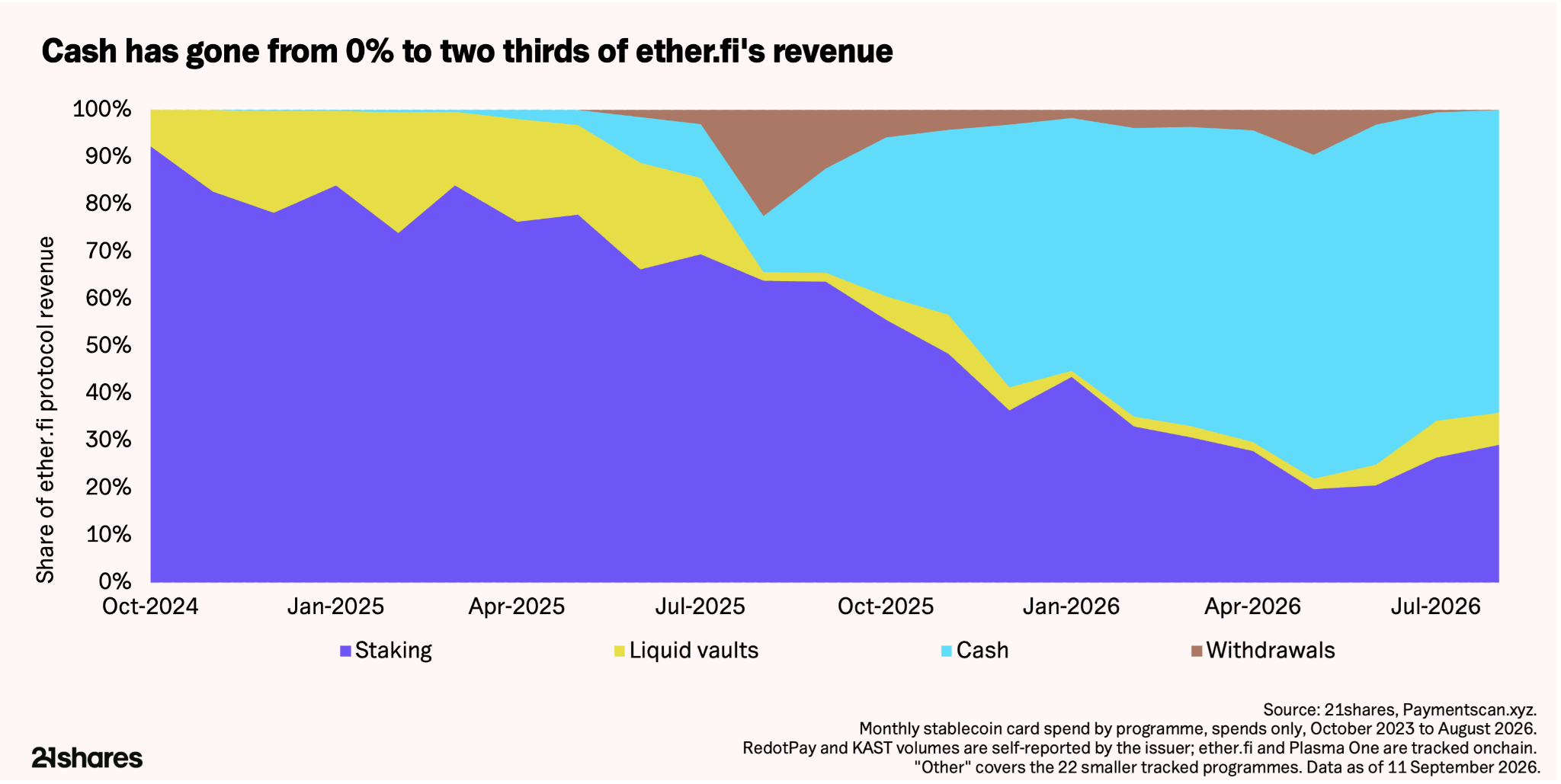
Why does this matter for the token? ether.fi now makes around $45 million a year in revenue and has just approved spending about $16 million of that each year buying back ETHFI. At a market cap of roughly $670 million, the token trades at about 15 times revenue. Revolut, by comparison, was valued at about 19 times in its July share sale, despite growing more slowly.
3. The rest of the playing field
Several other products address the same user need from different angles.
- Getting paid. You still need a bank account because that is where your salary arrives. UR, the neobank app built by Mantle, closes that gap: users get a Swiss account number in their own name at a Swiss-regulated institution, wages land there and are tokenized onchain, and the same balance can earn in dollars or stablecoins and be spent by debit card, all from one app.
- Dollar access. In much of the world, the product people want is not yield; it is the dollar itself. Plasma One was built for exactly that: zero-fee USDT transfers, up to 4% cashback, and availability in over 150 countries, many where dollar accounts are hard to open.
- Distribution is the problem incumbents are solving from the other direction. Onchain apps have the rails, but not the users; established platforms have the reverse. Robinhood answered by launching its own chain in July, with a peak of 320,000 daily active wallets. We read that as confirmation, not competition: the largest retail broker in the US, with 28 million funded customers, is rebuilding on the same architecture.
These examples differ in who holds the keys, which stablecoin sits underneath, where the yield comes from, and how much of the stack is regulated; the table below lays that out, with Revolut as the benchmark. There is no single model yet, but as the chart at the top shows, the direction is the same everywhere: the account, the savings product, and the card are moving onchain, and the bank is becoming optional.
The risks are real: no deposit insurance, cyclical yield, and open regulation
The risks are the mirror image of the advantages. No deposit insurance and no lender of last resort: when USDe briefly traded at a discount in October 2025, it recovered within hours, but nothing stood behind it except a reserve fund worth just over 1% of its assets.
Cyclical yield: Ethena's went from 18% to under 4% in two years, and ether.fi's card economics depend on card-fee and FX volumes that thin out in a bear market.
Open regulation: the US GENIUS Act bars licensed stablecoin issuers from paying yield, and the OCC's proposed rules would extend that to exchanges and white-label partners; synthetic dollars like USDe sit outside those rules today, but we read that as a gap rather than a permanent safe harbour.
Every product above also runs on code that can be exploited and on custodians and card issuers that can fail. And none of them can yet offer the product that makes banks their money: unsecured credit, the card balances and personal loans that are Nubank's highest-margin line. Until onchain apps can lend without collateral, they win on savings and payments and lose on lending.
The second wave of financial digitization is already underway
This is the second wave of financial digitization. The first wave moved banking from the branch to the phone. The second is moving the balance sheet itself onto public infrastructure anyone can build on and audit, and it is already underway: stablecoin supply passed $300 billion in 2026, up over 50% in a year.
For a client in Zurich or New York, the difference between a neobank and an onchain account is yield and convenience. For the 1.3 billion adults still unbanked, or the migrant worker paying 6.4% on average to send $200 home, it is the difference between being inside the financial system and outside it. That is what democratization means in practice.
The risks are real, but they are the kind that get engineered down over time, as reserve funds grow, custody moves to regulated providers, and the regulatory perimeter gets drawn, not the kind that breaks a thesis.
In our view, the firms that learn to build bank-like services onchain, whether they began as a protocol or a licensed bank, may define what a more inclusive financial industry looks like over the next decade, and ether.fi and Ethena are two of the clearest ways to own that shift today, though both carry material risks, including cyclical yield, unregulated protocol exposure, and no deposit insurance, which investors should weigh carefully.
FAQ
What is an onchain financial app and how is it different from a neobank like Revolut?
An onchain financial app replaces the bank's balance sheet with a smart contract. Instead of depositing money into a bank that lends it out, your assets stay in your own wallet and a card spends directly against them. The yield you earn comes from staking rewards or funding rates rather than a bank's lending margin, and the protocol typically passes most of that back to you. Unlike a neobank, there is no deposit insurance and no regulated bank behind the system.
How does ether.fi make money and what does that mean for the ETHFI token?
ether.fi earns revenue from three sources: its card product (ether.fi Cash), its liquid restaking protocol, and related DeFi services. It retains 24% of fees and passes 76% to users. The protocol has approved spending approximately $16 million per year buying back ETHFI tokens from the open market. At a market cap of roughly $670 million and annual revenue of around $45 million, the token trades at about 15 times revenue (21shares, September 2026).
Is Ethena's USDe yield guaranteed?
No. Ethena's yield comes from two sources: staking rewards on its collateral and the funding rate that leveraged traders pay to hold long positions in perpetual futures markets. Both are variable. The yield ranged from 4% to 15% through 2025 and was in the mid single digits in September 2026. Ethena holds a reserve fund to cover periods when funding turns negative, but the yield can fall significantly or temporarily cease. It is not comparable to a bank savings rate or a fixed-income return.
What are the main risks of using an onchain financial app instead of a bank?
The main risks are: no deposit insurance (if the protocol is exploited or fails, there is no government-backed protection); cyclical yield (rates fall sharply in bear markets); regulatory uncertainty (rules for yield-bearing stablecoins are still being written in the US and EU); and smart-contract risk (code can be exploited). These apps also cannot currently offer unsecured credit, which limits the range of financial services available compared to a licensed bank.
Can I use ether.fi Cash or Ethena Pay in my country?
ether.fi Cash is available in most countries but not in 16 US states (as of September 2026). Ethena Pay launched in 48 countries in September 2026, with the US and EU excluded at launch. Availability changes as the products expand, so check the relevant product pages for the most current list.






.svg)