


After every sell-off, Bitcoin investors end up asking the same question: is this the dip worth buying, or the start of a more aggressive drawdown? Typically, no single data point can answer that question. When several signals line up, though, the picture gets a lot clearer, and right now four of them point the same way. The cycle says the bottom is behind us, the bear market was milder than any before it, long-term demand held up throughout, and past recoveries put $100,000 within reach by year-end.
However, none of that means we’re going to see a straight line up. Bitcoin is trading around $75,000 after its weakest October in a decade and a choppy start to November. But for investors who think in terms of years rather than weeks, this is a setup worth paying attention to.
The cycle clock says the bottom is in
Bitcoin has moved in roughly four-year cycles, set by the halving, the event that cuts new supply in half every four years. The rhythm has been fairly consistent. Bitcoin tends to peak one to one and a half years after a halving, then spends about a year in a bear market, bottoming a little over two years after the halving.
This cycle followed the same script. The April 2024 halving was followed by an all-time high of $126,000 in October 2025, and Bitcoin found its low of about $59,000 on 30 June 2026. That was just over two years after the halving, right inside the window where every prior cycle has bottomed. If anything, the bear was faster this time: about nine months from peak to low, against roughly a year in each of the last three cycles.
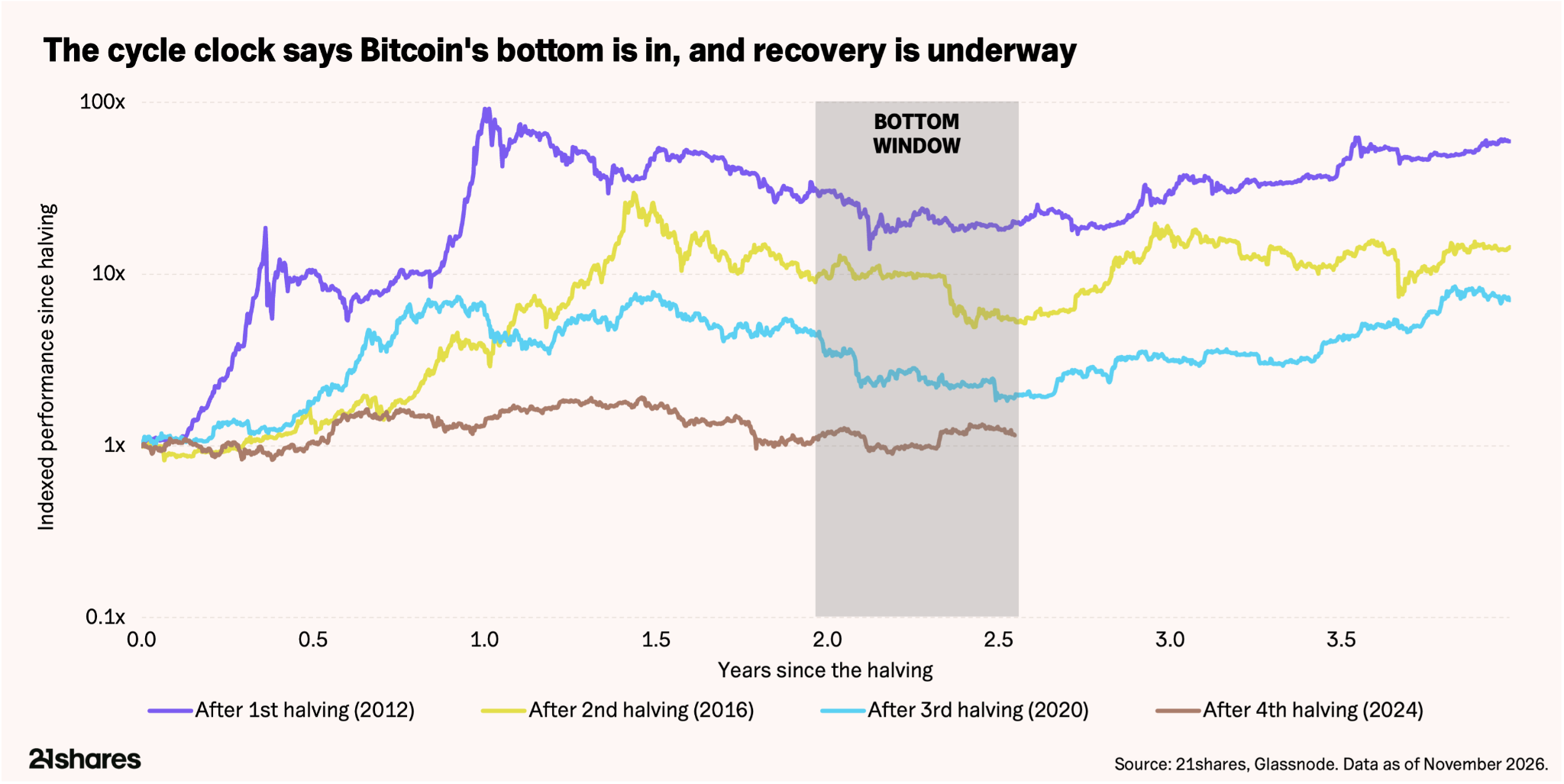
That window has historically been where long-term investors build their positions. Buying in it and holding until the next halving returned about 170% on average, without needing to catch the exact bottom. From each prior cycle low, Bitcoin went on to rally at least 8x to its next all-time high. Three cycles is a small sample and there will likely be some volatility from here, but the cycle clock has turned. For long-term investors, time in the market has mattered far more than timing the market.
The midlest bear on record and long-term money stayed put
Bitcoin fell about 54% from its $126,000 high to its cycle low. Painful, but mild by Bitcoin’s standards. Past bear markets took 77% to 86% off the price, which makes this the shallowest cyclical drawdown on record. There was also no black swan this time setting off contagion across the industry. Most of the pressure came from outside crypto: renewed Fed hikes, long-term bond yields at multi-decade highs, wars from Ukraine to Iran, and an AI build-out pulling capital elsewhere. Even the one big crypto shock didn’t break the market. October’s $6.3 billion Binance hack, the largest on record, knocked Bitcoin down about 6%, a fraction of the 15% to 39% drops that followed the collapses of Celsius, FTX and BlockFi.
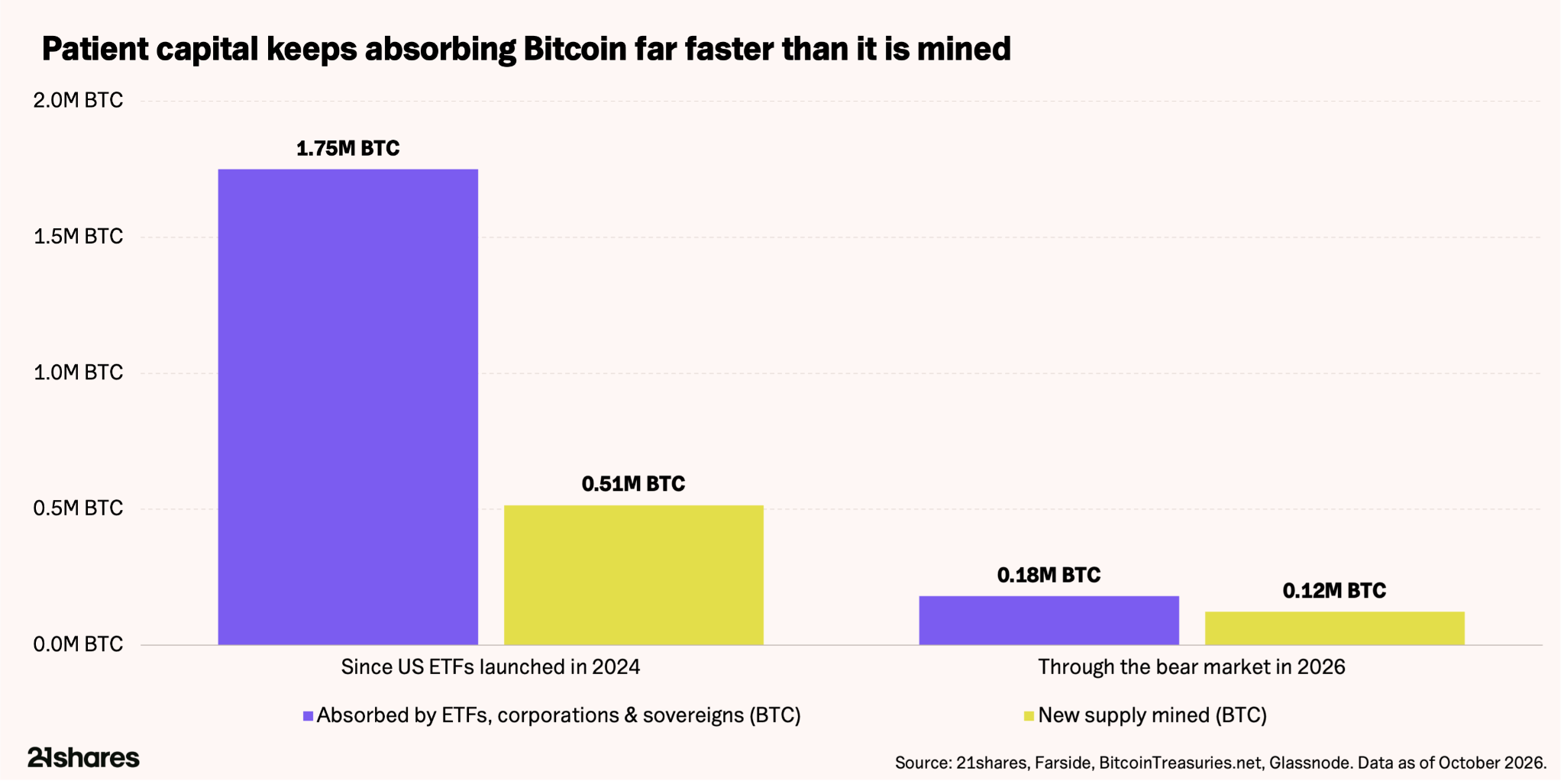
Who stayed invested tells you even more. US spot Bitcoin exchange-traded funds (ETFs), the main route for institutional capital, entered November with roughly flat net flows for 2026, even though the price had halved at one point. At the worst of the bear, their holdings were down just 11%, and more than a third of what left has already come back. Most investors who bought Bitcoin through regulated funds sat through the drawdown. Even in the bear market, ETFs, companies and governments added around 180,000 BTC against just 122,000 newly mined, so demand is still running ahead of new supply.
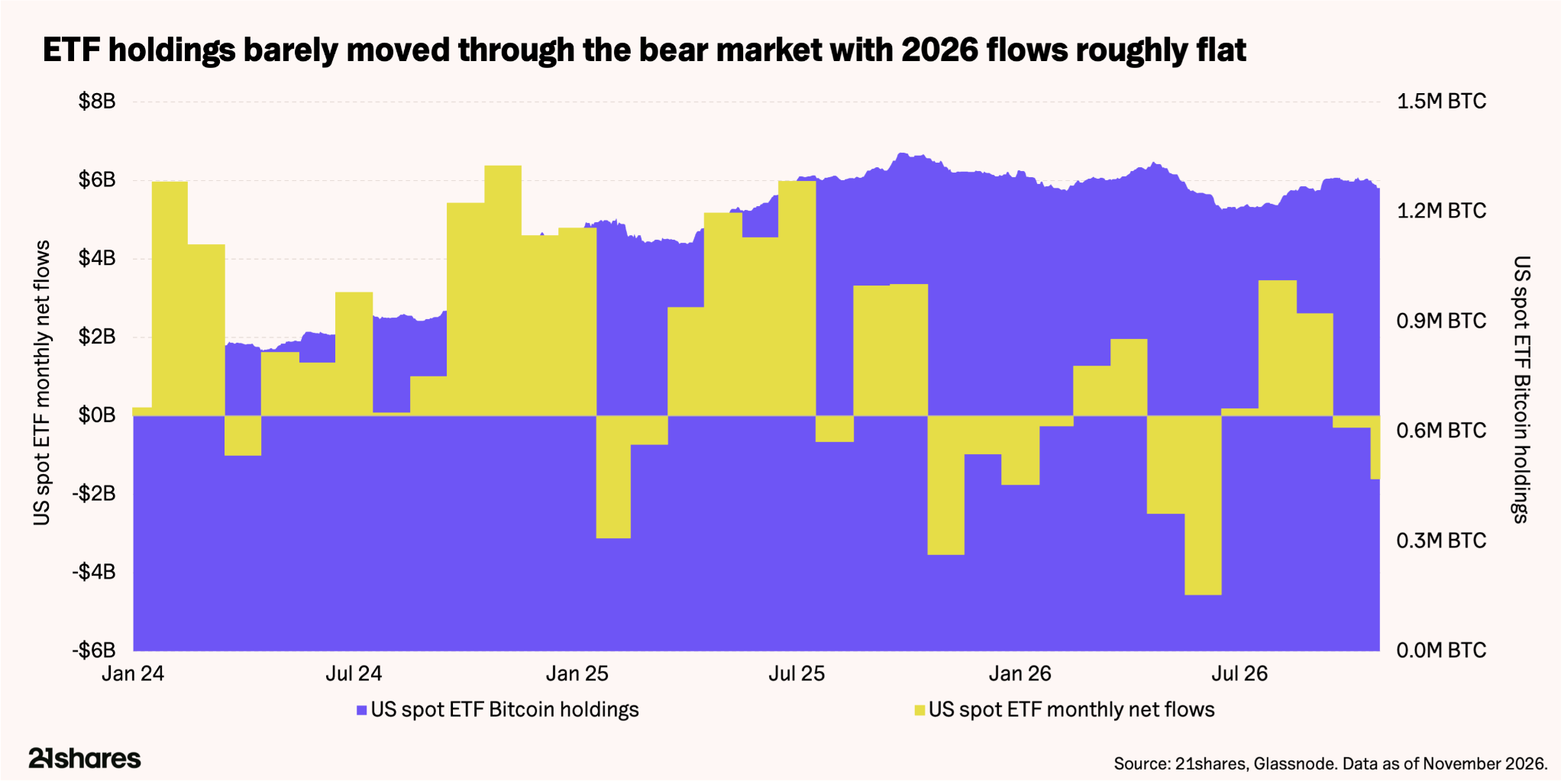
That doesn’t mean flows only go one way. About $1.6 billion left US ETFs in the first week of November, the most since June, but that’s still less than 2% of the roughly $94 billion the funds hold today. The wider market is also calmer than it was at the top: open interest has roughly halved and volatility hit record lows over the summer. Less leverage and fewer short-term traders leave a market led by buyers who think in years.
Investor demand rests on Bitcoin’s long-term case
So why do these buyers hold through a 50% drawdown during a tough bear market? Because they’re invested for the long run, for much the same reasons central banks have been buying gold, and those reasons got stronger this year.
- The first is scarcity. Bitcoin’s supply is capped at 21 million, more than 95% is already mined, and new supply now grows about 0.8% a year, slower than gold’s roughly 1.7%. That matters as the debasement trade returns. Bond markets are under strain, above all in the US, where interest costs now exceed a fifth of tax revenue, and investors are looking for assets no government can print more of.
- The second is neutrality. Since the G7 froze Russia’s reserves in 2022, central banks have trimmed their Treasuries and bought gold at a record pace: 533 tons in the first half of 2026 alone. Bitcoin offers the same property in digital form. It’s nobody’s liability, it’s hard to seize, and it moves anywhere online. Central banks don’t hold it yet in size, but professional investors are slowly becoming invested.
Step back, and the world Bitcoin was built for is arriving. Debt keeps rising, the monetary order is splitting, and finance is moving onto always-on digital rails. That world needs an asset no government controls, one that can’t be printed or frozen and moves as easily as information. Gold has filled that role for millennia. Bitcoin is its digital-native counterpart, and adoption is only getting started. Since US ETFs launched in January 2024, ETFs, companies and governments have absorbed 1.75 million BTC, about 3 times what miners produced. We believe markets are starting to price Bitcoin as what it is, a neutral reserve asset and at just about 5% of gold’s market value, it has plenty of room to grow.
Past recoveries point to $100,000 by year-end and a new high in 2027
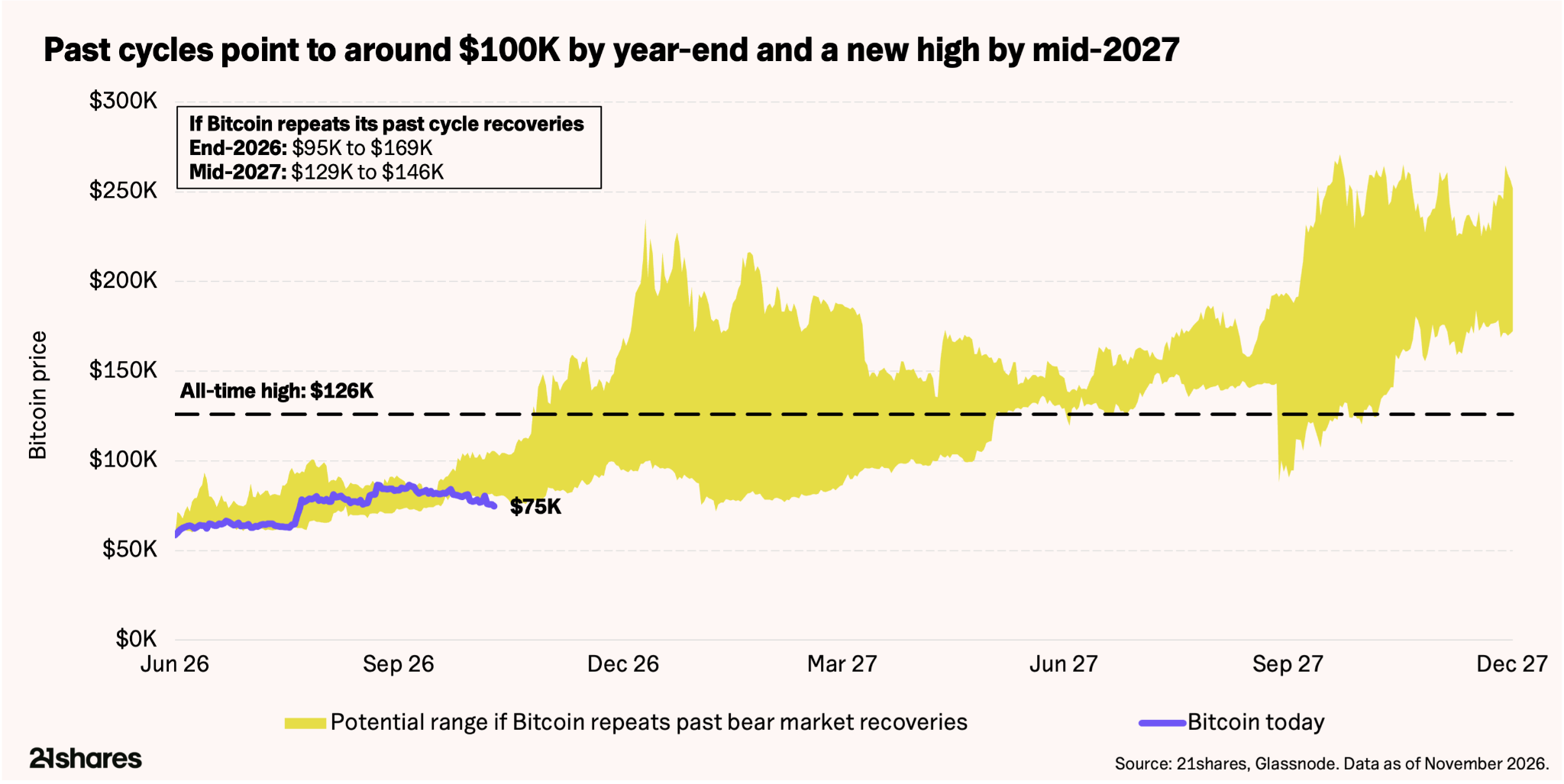
If the bottom is in, the next question is how far the recovery can run, and historical cycle performance gives us a useful guide. Six months after each prior cycle low, Bitcoin was up between 62% and 190%. Applied to the $59,000 low, that points to roughly $95,000 to $170,000 by the end of December, which is why we see $100,000 by year-end, about 33% above today’s price. After a soft October, Bitcoin is tracking below those paths, so getting there needs a strong finish to the year.
The longer view is more convincing. Twelve months after every past cycle low, Bitcoin traded at least 2.2 times higher. From June's low, that implies roughly $130,000 by mid-2027, a new all-time high above the $126K peak. We doubt that would be the top of this cycle either. The next halving comes in 2028, and the last three cycles each peaked about 18 months after one.
What could get in the way?
The recovery is unlikely to be smooth. In the near term, further Fed hikes, a sell-off in long-dated bonds or new geopolitical flashpoints could all slow it. Policy is another source of headlines: the CLARITY Act looks likely to be delayed after the US midterms, and index providers such as MSCI are reviewing whether to keep Bitcoin treasury companies like Strategy in their indices. October’s Binance hack was also a reminder that security risk at exchanges hasn’t gone away, which is one reason more investors are choosing regulated products with coins held in cold storage.
Over the longer term, the main risks are technological. Bitcoin’s security rests on cryptography, and rapid advances in quantum computing, or in mathematics accelerated by AI, could extend this risk surface. At some point the network will likely need upgrades to quantum-resistant cryptography, and older wallets that don’t move to new addresses could be exposed. Developers have made progress this year, and with the White House putting quantum readiness on the agenda in June, the issue is getting attention, but work remains. Finally, the four-year cycle itself may weaken as the investor base matures, and patterns built on a handful of cycles are no guarantee. Past performance is not a reliable indicator of future results.
How to put this to work
We see Bitcoin as a strategic holding in the alternatives sleeve, typically sized at 1% to 5% of a portfolio depending on the investor’s risk budget. Small allocations have historically lifted returns without adding much risk. Over the past three years, adding a 2% Bitcoin slice to a 60/40 portfolio and rebalancing it once a year raised the annual return from 10.9% to 11.9%, while volatility barely moved.
Investors who already hold gold have a natural starting point. Bitcoin is about 1.5 times as volatile, so a 4% gold position matches roughly 2.6% in Bitcoin at equal risk. Building the position in stages rather than in one trade, and rebalancing on a schedule, takes the guesswork out of timing. Exchange-traded products (ETPs) make it simple to hold Bitcoin through an existing brokerage account, with the coins kept in cold storage at independent custodians.
Watch 21shares Chief Investment Strategist Adrian Fritz explain the research behind it here.
FAQ
Is now a good time to buy Bitcoin?
No signal can time an entry perfectly. But Bitcoin's 2026 low came 26 months after the halving, inside the window where every past cycle has bottomed, and long-term demand held up through the bear market. For investors with a multi-year horizon, that is a supportive backdrop. Suitability depends on each investor's goals and financial situation.
How long after the halving does Bitcoin usually bottom?
In the last three cycles, Bitcoin bottomed 25 to 31 months after the halving. The most recent low, on 30 June 2026, came 26 months after the April 2024 halving.
How much of a portfolio should be in Bitcoin?
21shares research frames Bitcoin as a strategic holding sized at 1% to 5% of a portfolio. This is a sizing framework, not a recommendation, and the right allocation depends on mandate, risk budget and financial situation.