

Additional analysis by Maximiliaan Michielsen, Karim AbdelMawla
Key takeaways
- Bitcoin fell 7.3% in October to about $77,500 as credit spreads widened, the dollar strengthened, and a record $6.3 billion hack at Binance hit in the final days of the month.
- The market absorbed the largest hack in crypto’s history with a 6% drawdown, a fraction of the 15% to 39% declines around past exchange failures, and the protocols kept running.
- November hinges on bitcoin holding $76,000 to $78,000, Binance completing withdrawals and proving its reserves, and ETF flows returning.
October has historically been one of bitcoin’s best months, with a median gain of 12.9% since 2010, and this year it arrived with seasonality firmly on its side: bitcoin had just logged its fourth consecutive green September and its best third quarter since 2017. “Uptober” did not play out. The script held for the first few days, then macro took over. An early inflation scare, with the consumer price index (CPI) and producer price index (PPI) running hot and the 10-year Treasury yield touching 5.37%, its highest since 2002, gave way to something more damaging: worries about growth and default risk. Long-end yields fell over the month, but credit spreads widened, from high-yield bonds to French government debt, the dollar strengthened, and a renewed wobble in artificial intelligence (AI) equities pulled the Nasdaq-100 down almost 4%. With the Federal Reserve (Fed) offering no prospect of relief, financial conditions tightened through credit. Then, in the final days of the month, a $6.3 billion hack at Binance, the largest in crypto’s history (Cointelegraph, 2026), pushed bitcoin to a month low near $76,000. Bitcoin closed October down 7.3% at about $77,500, its first back-to-back red Octobers since 2011 and 2012. Beneath the price action, the picture is more constructive: the market absorbed a record hack far better than it absorbed past crises, the infrastructure build-out kept moving, and October delivered several fundamental catalysts.
What happened in October: credit tightened conditions and a record hack in crypto
- Credit, not yields, tightened conditions. October opened as an inflation story: CPI rose 3.7% year over year against a 3.6% consensus, PPI jumped 1.3% month over month, the largest increase since March 2022, and the 10-year touched a 24-year high on October 7. It ended as a credit story. As concerns shifted from inflation to growth and default risk, the 10-year fell about 29 basis points over the month, but credit moved the other way: high-yield spreads widened, French spreads blew out, and the dollar strengthened. That was the channel that hurt bitcoin: tighter credit drains the risk appetite and liquidity it relies on.
- The Fed sat on its hands. September payrolls rose just 29,000 against 90,000 expected (BLS, 2026), yet Fed minutes showed most officials still expected another hike by year-end. The Fed held on October 28 as expected (Federal Reserve, 2026) and gave no sign it would lean against the stress, with markets still pricing a December hike at roughly 70%. That is the tension to watch: if credit conditions keep deteriorating, we think the Fed and the European Central Bank (ECB) will ultimately have to step in, and central bank support has historically been one of bitcoin’s strongest tailwinds.
- Energy fears piled on. Brent did not close below $100 once in October, hit its highest close since April, and posted its highest monthly close since May 2022, as Houthi attacks spread across Saudi Arabia and reports surfaced of US-Israeli plans to resume strikes on Iran after the US midterms. Bitcoin’s drop toward $79,000 on October 24 came on reports of US staff evacuations in the Middle East, with $400 million of longs liquidated in four hours. Higher oil kept the Fed focused on inflation even as growth worries built, and gold also slipped below $4,000, so the weakness was not bitcoin-specific.
- Security risk dominated the headlines, ending with the largest hack on record. Late on October 29, Binance lost about $6.3 billion, roughly four times the $1.5 billion Bybit theft of February 2025, after attackers got in through a compromised engineer’s laptop (BleepingComputer, 2026) and what Binance called “additional points of breach.” Issuers froze about $3 billion, mostly in the USDT and USDC stablecoins; Binance reserved over $6.34 billion of its own funds to make users whole, and withdrawals reopened in phases. Chainalysis attributes the attack to North Korea’s TraderTraitor group (Decrypt, 2026). Bitcoin and Ethereum kept producing blocks as normal: what failed was one exchange’s access controls, not the protocols. Even before Binance, Ledger confirmed tampered devices sold through a Southeast Asian reseller (The Block, 2026). The threat extended beyond crypto, from critical flaws in core internet infrastructure such as PHP to a supply-chain attack on a popular AI developer package.
- AI jitters spilled into crypto. Doubts over AI capital spending kept resurfacing, and they reached credit markets too: CoreWeave’s 2031 corporate bonds fell to around 79 cents on the dollar (investingLive, 2026). The Nasdaq fell 4.5% in mid-October, and reports of Anthropic’s $80 billion 2026 net loss, largely a non-cash accounting charge, added to the unease. With crypto and AI still competing for the marginal risk dollar, crypto traded alongside the equity drawdown.
- Washington kept building, just not in Congress. The Commodity Futures Trading Commission (CFTC) opened rulemaking on October 5 for crypto exchanges offering leveraged retail products (CFTC, 2026), and the Office of the Comptroller of the Currency (OCC) became the first regulator to finalize GENIUS Act stablecoin rules, effective January 18, 2027 (OCC, 2026). Against that, the White House’s crypto advisor announced his departure with no successor named, CLARITY stayed parked until after the midterms, and index provider MSCI confirmed a screen that could remove bitcoin treasury firms such as Strategy from its indices, a risk we cover below.
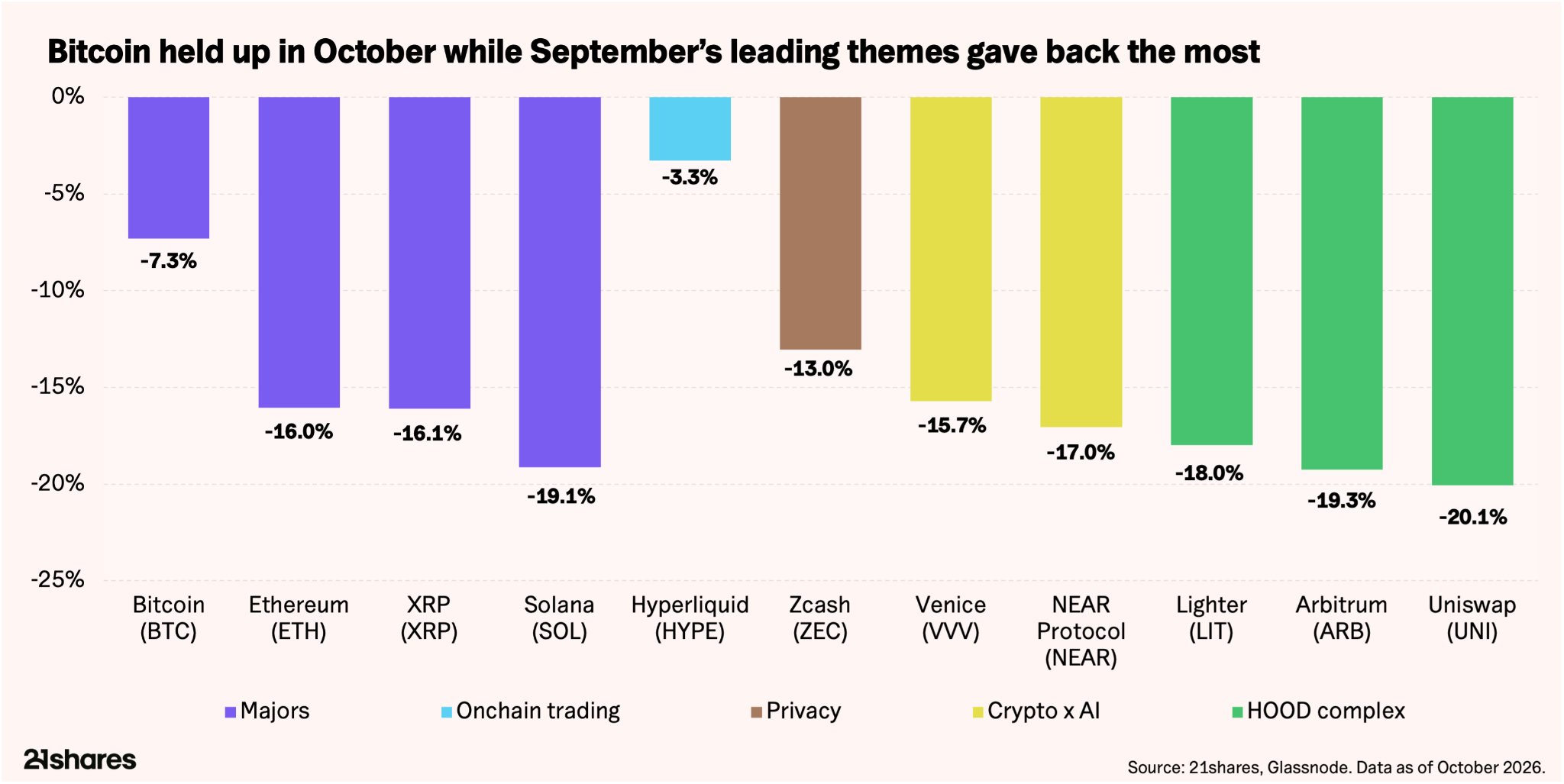
- Bitcoin held up best among the majors, but everything fell. Bitcoin ran from roughly $83,600 to above $87,000 on October 2 before grinding lower, and the Binance hack drove the final leg down to a low near $76,200 on October 30. It closed the month at about $77,500, down 7.3%. Ethereum fell 16% amid ETH exchange-traded fund (ETF) outflows and a Glamsterdam delay that pushes the upgrade past its end-2026 target. Solana fell 19% despite the long-awaited Alpenglow upgrade. September’s leaders bore the brunt, with the HOOD complex (tokens tied to Robinhood Chain) hit hardest: Uniswap fell 20%, Arbitrum 19% and Lighter 18%. Hyperliquid held up best at around -3%, helped by news on October 29 that ICE, the owner of the New York Stock Exchange (NYSE), had agreed to bring Hyperliquid-based perpetual futures to US traders, subject to regulatory approval (The Block, 2026), which sent HYPE up about 13% that day. Zcash fell 13%.
What markets are telling us: the investor cost basis is being tested
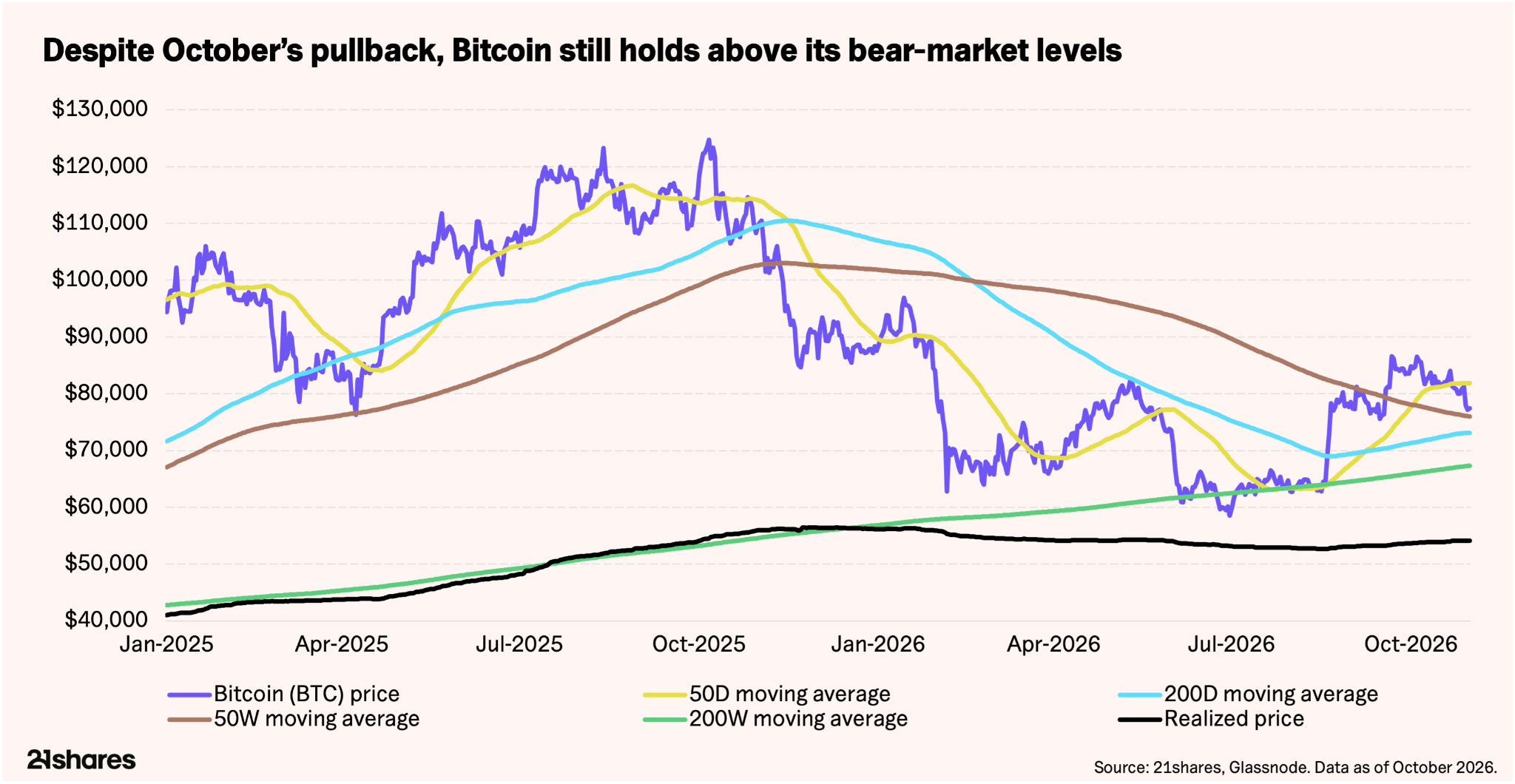
- Trend structure: the reclaim failed, and the investor cost basis is now being tested. September’s breakout above the $81,000 to $82,000 band held until mid-October, and the Binance hack pushed bitcoin clearly below it. It closed October near $77,500, below the 20-day and 50-day moving averages (about $81,000 and $81,900), the US ETF cost basis (about $82,000) and the average treasury company cost basis (about $80,000), leaving both cohorts underwater. Price now sits on the True Market Mean (the cost basis of active investors) near $77,600 (Glassnode, 2026) and on the lower Bollinger band, and the volatility squeeze that built through October resolved lower. The September golden cross remains intact, with the 50-day well above the 200-day near $73,100, and the daily relative strength index (RSI) at 35.5 is approaching oversold without being there yet. How ETF holders behave below breakeven remains the key tell for November.
- Key levels. Overhead, $80,000, the average treasury cost basis, is now the first hurdle, followed by $81,000 to $82,000, where the ETF cost basis and the 50-day meet, $84,000 to $85,000, where the October 21 push failed, and $87,000 to $87,500, October’s high, the year’s repeated ceiling, and the 2026 yearly open. On the downside, the $77,000 to $78,000 zone around the True Market Mean is being tested now. Below that, the 50-week moving average (about $76,000), the short-term holder realized price and the October 30 low (about $76,200) form a dense cluster between $75,800 and $76,200. Bitcoin’s weekly close on November 1 held above it. Below that, the 200-day near $73,000 is the line that would reopen the bear-market debate, with the 200-week moving average far lower near $67,000.
- Derivatives: the froth is creeping back. October partly reversed September’s spot-led rally: futures open interest rose about 6% in BTC terms while price fell, and long-side funding payments climbed above their high band, as traders kept paying to hold longs into a falling market. Liquidation waves through the month, including over $800 million on October 25 and 26, flushed some of the excess, but positioning is less clean than a month ago. Options traders are hedging too: put demand picked up, and the premium paid for downside protection over upside bets roughly doubled to 10% in the last two weeks of October, a sign the market is bracing for bigger swings into November.
Key fundamentals to watch: usage held up while prices fell
1. The themes kept shipping while prices fell
October’s sell-off was macro-driven, and none of the three themes behind September’s leaders broke.
- Digitization of financial infrastructure. JPMorgan brought its JPM Coin deposit token to Ethereum (Ledger Insights, 2026), HSBC launched a Hong Kong dollar-backed stablecoin to 3.3 million PayMe users (SCMP, 2026), SoFi rolled out an FDIC-insured tokenized deposit (SoFi, 2026), and Samsung is enabling USDC transfers on Solana across 82 million US Galaxy devices (The Block, 2026). These launches expand access, but the real test is how much capital will eventually move through them. The broader trend is more encouraging: stablecoin payments reached about $482 billion in the first nine months of 2026, up 45% year over year, even as supply plateaued near $305 billion (Crypto Briefing, 2026). Growing usage has not yet translated into stronger price action. Solana’s active addresses rose 17% to 51.7 million in October, even as SOL fell 19%, bringing its valuation down from 228 to 200 times annualized fees. Onchain lending also kept growing, with Morpho’s active loans up 7.7% to $5.5 billion. If macro pressure eases, that gap between growing usage and weaker price action should begin to close.
- The Robinhood test. Robinhood Chain had a strong debut quarter, with nearly 800 million transactions and about $590 million in app revenue. Last month we said October would show whether that holds once the gas subsidy expires. The early answer is mixed: daily transactions fell about 40% from mid-September, and decentralized exchange (DEX) volume is running at roughly a third of its early-September peak, but deposits held steady near $1.1 billion. Prices followed activity, and the HOOD complex was October’s weakest theme, with Lighter also hit by news that Robinhood’s US perpetuals will not run on its rails. That is the flip side of distribution: a link to a broker with millions of users drives usage and price, and losing it costs both. Uniswap, the chain’s most used app, saw average daily revenue fall 56% from September, while Robinhood Chain’s share of fees dropped from 69% to 50%. UNI fell 20%, far less than its revenue, so it now trades at 54 times annualized revenue, up from 29 times at the start of the month.
- Crypto x AI and privacy. Both gave back gains with the market, though privacy tokens such as Zcash held up better than most. ZEC ended the month down 13%, while crypto x AI sector leaders such as NEAR were down 17%. The drivers have not changed: AI agents need rails that do not require a bank account, and institutions moving onchain need confidentiality, a point October’s security incidents only strengthened.
2. Spot demand has to defend the cost basis
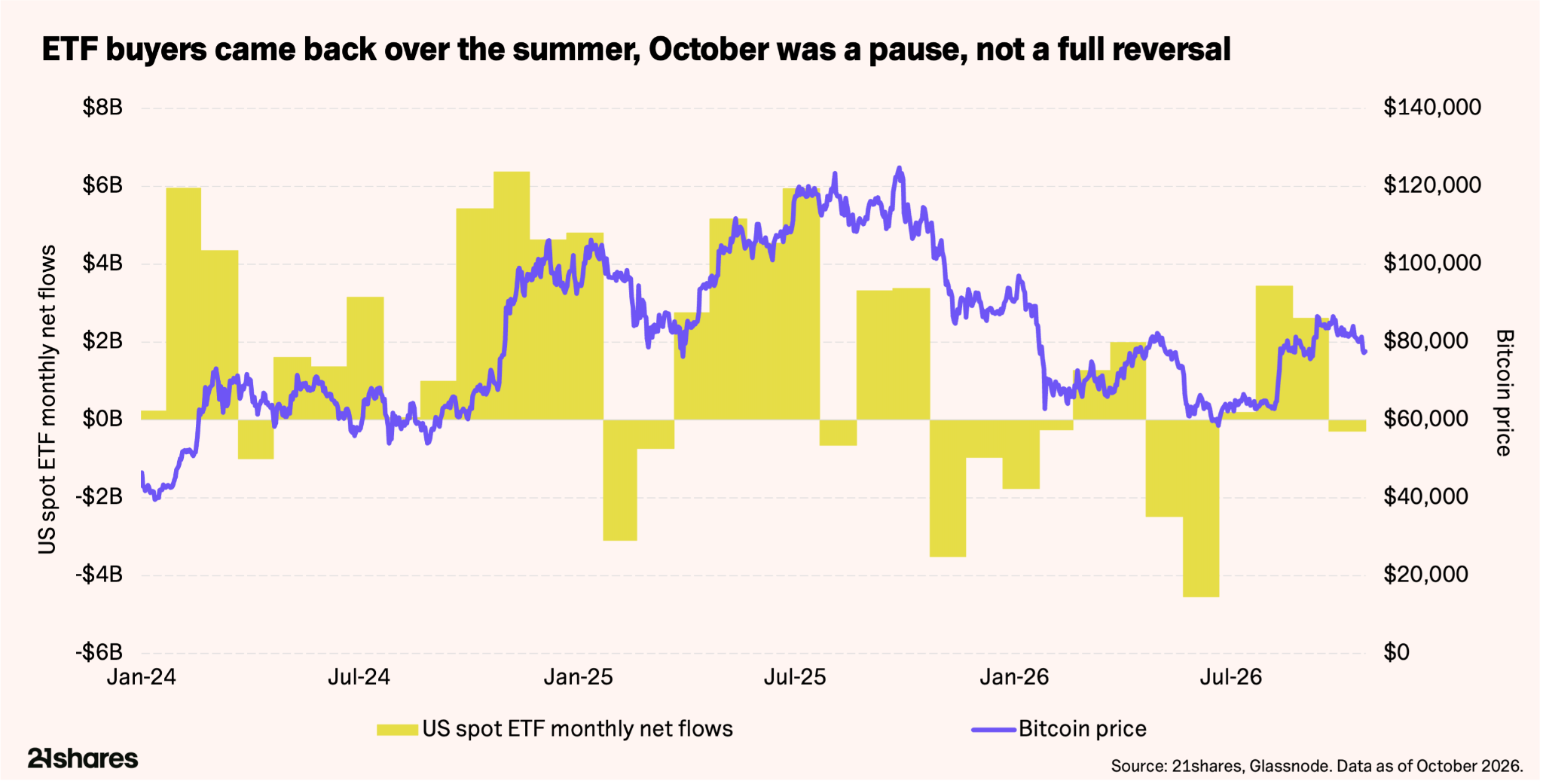
September’s $2.6 billion of ETF inflows turned into roughly $290 million of net outflows in October. Flows stayed two-way for most of the month, with inflows of $653 million on October 19 and $436 million on October 21 against a $540 million withdrawal on October 22, but the hack tipped the balance at month-end: ETFs shed $380 million on October 30, the day after Binance froze withdrawals. Treasury companies split: Strive bought about 13,500 BTC in October, roughly $1.1 billion, taking its holdings to 43,000 BTC (Bitcoin Treasuries, 2026), while Strategy skipped bitcoin purchases for a week to spend $205 million buying back its STRC preferred shares (SEC, 2026).
3. Exchange flows are the real test
Before the hack, exchange balances rose to roughly 3.37 million BTC, which we read as a potential headwind: more coins on exchanges means more potential supply for sale. The hack flipped that. When Binance reopened withdrawals on November 1, it processed $4.65 billion of withdrawals against $1.01 billion of deposits in the first nine and a half hours, a net outflow of $3.64 billion, or about 2.1% of its $171 billion in reported assets, with tracked net outflows reaching about $5.8 billion over 24 hours. Bitcoin outflows climbed to 30,000 BTC ($2.35 billion) on November 1, the highest since October 13 and well above September’s average of about 24,000. So far this looks like an orderly withdrawal rather than a run: Binance says it has replaced about 95% of the stolen assets, and bitcoin fell about 6% from its October 28 close to the October 30 low, a fraction of the 15% to 39% drawdowns around Celsius, FTX, BlockFi and Bybit. If those coins are moving into self-custody, lower exchange balances would reduce sellable supply. Withdrawal pauses have historically been a bad sign, though, so the test for November is whether Binance completes its withdrawal phases and its proof of reserves confirms full backing. A second-order effect is where trading goes next. DEXs were already taking share before the hack, with their spot volume reaching a record 24.1% of centralized exchange volume in July (The Defiant, 2026), and we expect the Binance breach to push that ratio higher (Cointelegraph, 2026), a shift that would favor onchain venues such as Uniswap and Hyperliquid.
4. MSCI decides on treasury companies on November 11
MSCI will publish which “non-operating” companies it removes from its indices on November 11, effective after November 30, and Strategy, holding about 848,500 BTC (SEC, 2026), is the most exposed. Forced index selling would hit the equity, not the coins, but could weigh on sentiment and on Strategy’s buying, which already slowed this month.
5. A dense November calendar
November has historically been one of bitcoin’s strongest months, with a median gain of 10.3% since 2010, and this year the November 3 US midterms open it. Polymarket puts the odds of Democrats taking the House at around 92% and of a sweep of both chambers at about 66%, so the vote should remove an overhang rather than add one. History backs that up: since 1950, the S&P 500 has never posted a negative 12-month return after a midterm election, averaging about 15%. Past performance is not a reliable indicator of future results. A Democratic Congress would slow legislation, but the rulemaking under way at the SEC, CFTC, and OCC does not need Congress. Then the data takes over: October payrolls on November 6 and October CPI on November 10 will shape the odds of a December hike, which Polymarket currently puts at around 77%.
Bull vs. bear scenarios: the $76,000 to $78,000 zone decides November
Bull case: macro relief and a reclaim
The Fed leaves December open, credit spreads stop widening, oil stabilizes, and the midterms deliver the expected result. Binance completes its withdrawal phases and its proof of reserves confirms full backing, turning the hack into a one-off rather than a trust event. Dip buyers defend the $76,000 to $78,000 zone, ETF flows turn positive, and bitcoin reclaims $80,000 and then $82,000, putting treasury companies and ETF holders back in profit before retesting $87,000 and the yearly open. A monthly close above $87,500 would flip 2026 to green, with the mean Market-Value-to-Realized-Value (MVRV) price near $94,000 as the next objective. Capital rotates back into themes with visible revenue rather than the speculative long tail.
Bear case: the hawks, oil, and the hack’s aftershocks win the tape
The Fed signals a December hike, credit spreads keep widening, the dollar keeps climbing, and Brent pushes beyond $120 if strikes on Iran resume. The hack’s second-order effects surface: Binance’s remaining withdrawal phases slip, the attacker starts selling unfrozen BTC and ETH, or outflows turn from self-custody into flight. ETF holders keep cutting losses below their cost basis, and with leverage still elevated, bitcoin loses the True Market Mean and the $76,000 cluster before testing the 200-day near $73,000, with MSCI exclusions adding an overhang. Even then, a hold of $73,000 would read as a deeper retest inside a repaired structure, while a sustained break below it would put the bears back in control.
Bottom line: the market absorbed a record hack better than past crises
October tested whether the September recovery could survive a hostile macro tape and then a record hack, and the answer was largely no. Bitcoin lost both the ETF and treasury cost bases and closed the month on the True Market Mean; the ETF bid stalled, leverage crept back in, and September’s leaders gave back much of their gains. The seasonal tailwind we flagged did not show up, a reminder that seasonality only matters when the backdrop allows it.
What we find most encouraging is how the market handled the worst of it. The largest hack in crypto’s history caused a far smaller drawdown than past crises; the protocols kept running, and none of the structural drivers broke: banks, payment networks, and asset managers kept shipping onchain products through the drawdown, and regulators kept writing rules. For allocators, we are watching four things into November: bitcoin holding $76,000 to $78,000 and reclaiming $80,000 to $82,000, Binance completing withdrawals and proving its reserves, credit spreads, oil and long-end yields, and whether ETF flows return. If those turn, the setup for the final weeks of the year remains constructive.
FAQ
Why did bitcoin fall in October 2026?
Bitcoin fell 7.3% in October 2026 to about $77,500 as credit spreads widened, the dollar strengthened, and a $6.3 billion hack at Binance pushed it to a month low near $76,200 on October 30. It was bitcoin’s first back-to-back red October since 2011 and 2012.
How did the Binance hack affect the bitcoin price?
Bitcoin fell about 6% from its October 28 close to the October 30 low, a smaller drawdown than the 15% to 39% declines around Celsius, FTX, BlockFi and Bybit. The Bitcoin and Ethereum networks kept producing blocks as normal: what failed was one exchange’s access controls, not the protocols themselves.
What bitcoin price levels matter in November 2026?
In 21shares’ analysis, the $77,000 to $78,000 zone around the True Market Mean is first support, followed by a cluster between $75,800 and $76,200 and the 200-day average near $73,000. Overhead, $80,000 and $81,000 to $82,000 mark the average treasury company and US ETF cost bases.
Is November historically a good month for bitcoin?
November has posted a median bitcoin gain of 10.3% since 2010, one of the strongest months of the year. Past performance is not a reliable indicator of future results.