

Additional analysis by Maximiliaan Michielsen
Key takeaways
- Despite a Fed hike, multi-decade yield highs, $100 oil, and a failed crypto bill, bitcoin closed September up 6.2%. Funding rates normalized after each liquidation event, and ETF inflows pushed year-to-date flows positive.
- September's top winners shared real revenue and visible usage. Uniswap fees nearly doubled on Robinhood Chain activity, NEAR surged ~180% on agent payment volume, and Zcash entered the top 10 on institutional privacy demand.
- Q4 sets up well, but three variables decide the outcome; Bitcoin’s $81,000 support level, the 30-year yield stabilizing, and ETF demand persisting after September's breakout inflows faded at month-end.
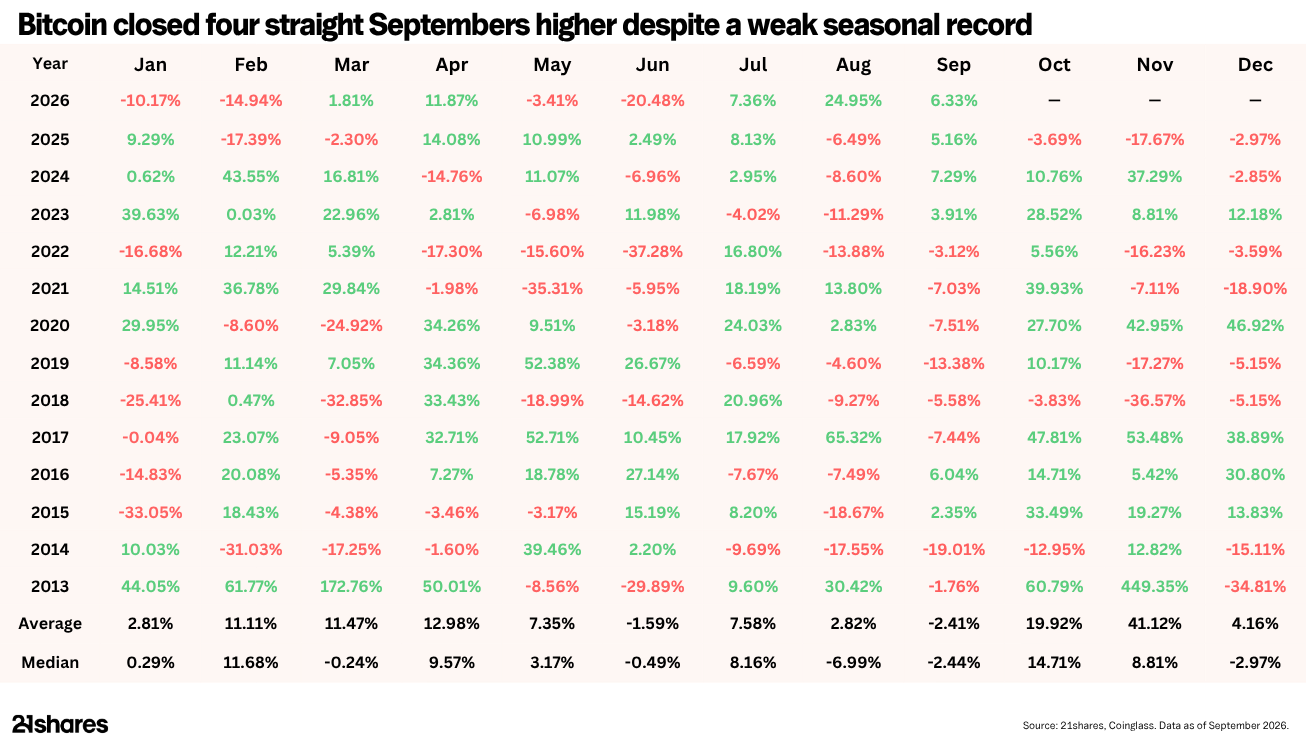
On paper, September should have been the month the August rally unwound. Seasonality alone argued for it: September has historically been one of bitcoin's weakest months, averaging a 2.4% loss since 2013, including six red Septembers in a row from 2017 to 2022 (21shares, Coinglass). The news flow piled on too: the Federal Reserve (Fed) hiked for the first time since 2023, the 30-year Treasury yield hit its highest level since 2004 despite enlarged buybacks, oil traded above $100 for 25% of the month with the Strait of Hormuz closed, and the CLARITY Act failed in the Senate. Bitcoin absorbed all of it, printed an eight-month high near $87,000, and closed a fourth consecutive green September, up 6.2%, capping its best third quarter since 2017 (21shares, Coinglass). Just as telling is what led the crypto market: tokens with strong fundamentals and clear product-market fit.
What happened in September: bitcoin absorbed every macro shock
- The macro hurdles kept coming. On September 16, the Federal Open Market Committee (FOMC) raised rates by 25 basis points (Schwab, 2026), the first hike since July 2023, with Chair Warsh stating that "inflation is too high and has been too high for too long." Markets briefly priced around 70% odds of a follow-up hike in October, but a softer core personal consumption expenditures (PCE) print on September 30 cut that to roughly 25% (CME Group, 2026) and pushed the next expected move toward December. Long-end yields kept climbing regardless, despite the Treasury's expanded buyback program, launched on September 9 to lower them. The 10-year is now above 5.2%, a level last seen in 2007, and the 30-year has pushed above 5.6%, its highest since 2002. Bitcoin slipped to roughly $75,000 on the hike, the low of the month, and was back above $80,000 within days.
- The Middle East remains the swing factor. Brent crude crossed $100 as US-Iran strikes intensified around the Strait of Hormuz, dipped on talk of reopening, then climbed back toward $108 as talks stalled. Bitcoin has treated this as noise so far, but higher oil feeds the inflation prints that keep the Fed hawkish and long-end yields elevated. If a closed Hormuz becomes the status quo rather than a phase, we would expect more pressure on risk assets through that channel.
- Washington disappointed, but the market moved on. The CLARITY Act's cloture vote failed 49 to 50 on September 15, with ethics language on officials' crypto holdings, not market structure, as the sticking point. Polymarket had passage under 20% going in; bitcoin gave up about 4% and recovered within the week. In our view, regulators are filling the gap. The Securities and Exchange Commission (SEC) proposed "Regulation Crypto Assets" (SEC, 2026) in August, gave tokenized stocks a five-year onchain runway with its September 17 innovation exemption, and on September 25 issued updated FAQs on token classification, investment contracts, decentralization, and token buybacks. The Commodity Futures Trading Commission (CFTC) sent its crypto market rules to the White House on September 18, and SEC Chair Atkins has said the agency will proceed "with or without the legislation." Legislation would be a cleaner outcome, but it is not the only path available.
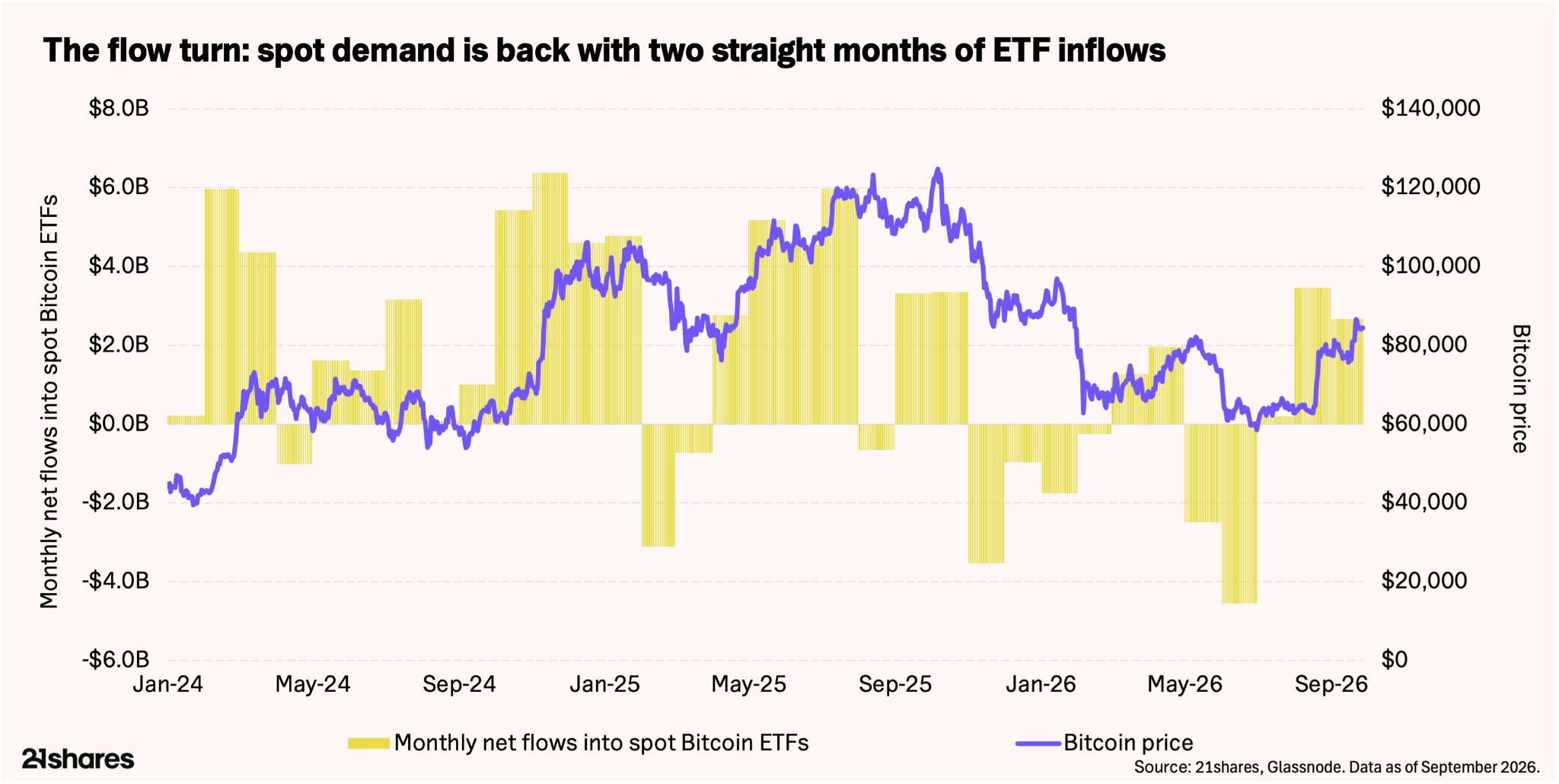
- Rising security risk strengthens the case for exchange-traded products (ETPs). Bitget lost $352 million in the largest hack of the year, covered by its protection fund and attributed to North Korea, whose 2026 haul now exceeds $1 billion (Bloomberg, 2026). Artificial intelligence (AI) is accelerating both sides of this: attackers are believed to have used AI to surface the Coldcard firmware flaw behind over $100 million of bitcoin theft in August, and decentralized finance (DeFi) has seen over $1 billion in exploits this year. Operational risk, from key management to exchange counterparties, is now a first-order consideration for investors seeking regulated crypto exposure. Regulated ETPs remove most of it, which is one reason they keep winning share. US spot bitcoin exchange-traded funds (ETFs) hold roughly 1.29 million BTC, over 6% of supply, on over $55 billion (Glassnode, 2026) of cumulative net inflows since January 2024, and that supply sink kept growing through this year's bear market.
- The crypto scoreboard. The majors moved in lockstep. Bitcoin ran from roughly $78,000 to a high near $87,000 before settling around $83,000, up about 6% on the month, while Ethereum climbed above $2,700 for the first time since January and Solana hit a seven-month high above $120. Hyperliquid set an all-time high at $95 as its lending market went live and Kraken's parent, Payward, moved to bring Hyperliquid's perpetual futures to US clients.
- Emerging crypto use cases: Beyond the majors, the clearest green shoots were in areas with visible usage and revenue: protocols at the intersection of crypto and AI, where agents need wallets and permissionless rails to transact; privacy, which institutions moving onchain will increasingly need to shield treasury and trading activity; and the Robinhood ecosystem, particularly applications powering the network launched in July. Strength in assets with clear product-market fit and improving fundamentals is exactly what you want to see in the early stages of a bull market. Under the hood, crypto’s revenue base was already turning before prices did: fees rose broadly in August, from base layers to applications, while two of September’s strongest re-ratings, Uniswap and Hyperliquid, also saw some of the fastest growth in revenue accruing to the token, up 112% and 37%, respectively.
What markets are telling us: spot buyers, not leverage, are driving the rally
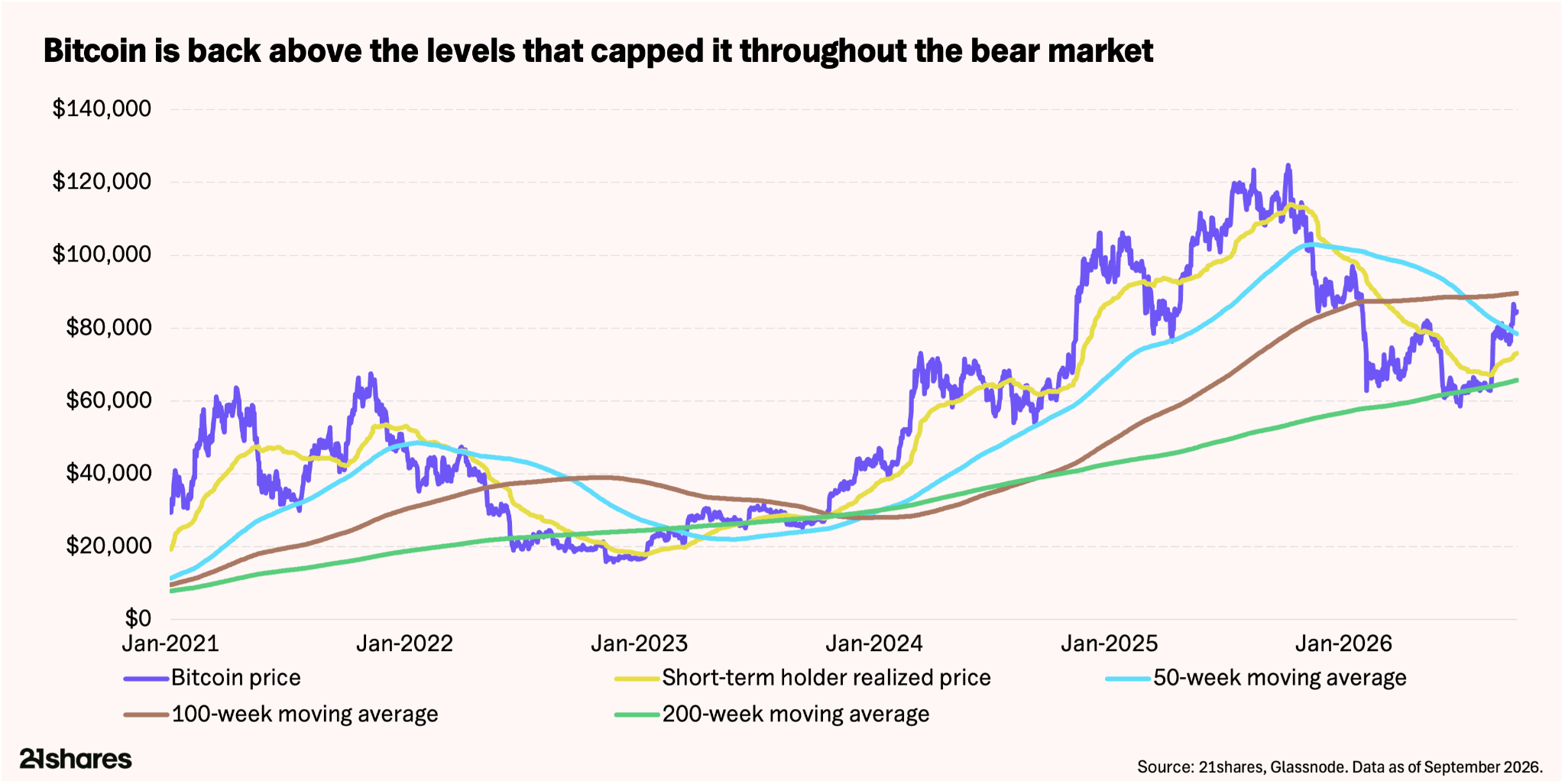
- Trend structure: the hurdle is cleared, now it has to hold. Last month we flagged the $81,000 to $82,000 band, where the 50-week moving average met the US ETF cost basis, as the most important resistance on the chart. After four rejections, bitcoin printed its first weekly close above it since November last year on September 20 and squeezed around 7% higher the next day as roughly $650 million of shorts were liquidated. A golden cross, in which the 50-day average crosses above the 200-day, had already printed on September 8. The one signpost still outstanding is a monthly close above the 2026 yearly open near $88,000, which would flip the calendar year to green.
- Key levels. First support is the $81,000 zone where the September breakout began. Below that comes $78,000 at the 50-week average, with the 50-day average close by at $77,000, then $73,500 (Glassnode, 2026) at the short-term realized price (the average price at which coins moved in the past six months last changed hands), about $2,000 below the September low. A break of $71,000 at the 200-day average would reopen the bear-market-bounce debate. Overhead, the September high near $86,000 is the first hurdle, and $88,000 is the yearly open. Beyond that sits the mean Market-Value-to-Realized-Value (MVRV) price near $97,000, the level at which bitcoin has historically traded at its average premium to holders' cost basis and where profit-taking tends to pick up.
- Derivatives: spot is driving, not leverage. Whether a rally rests on real buying or borrowed money decides how it behaves under stress. September delivered three separate liquidation events above $500 million (the Fed hike, the September 21 squeeze, and the yield spike two days later). Funding rates, the fee traders pay to hold leveraged longs and a gauge of how crowded that trade is, spiked on the squeeze and normalized within 48 hours, briefly turning negative on the pullback, meaning nobody was over-positioned. Dealer hedging into the call-heavy $16 billion quarterly options expiry on September 25 gave the move from $80,000 to $87,000 a tailwind that has now rolled off, so the next leg has to come from spot demand. Our read is unchanged: spot buyers, not leverage, are carrying this rally, and that is the sturdier base.
Key fundamentals to watch: the market is paying for revenue, not narrative
1. Fundamentals led in September, they need to keep leading
September's leadership was not random: it lined up with three structural trends we have been arguing for. For this recovery to last, the market has to keep paying for durable business models rather than narrative pitches.
- Digitization of financial infrastructure. Stablecoins, tokenized assets, onchain credit, and onchain trading are upgrading legacy rails, and most of this still lives on Ethereum and Solana: Ethereum holds about half of stablecoin supply and tokenized asset value, and Solana has become the highest-throughput venue for stablecoins and tokenized equities. Both built on a strong August. Ethereum's fees rose 53% month over month to $15.9 million in September, with monthly active addresses up 6% to 10.3 million, while Solana's fees rose 13% to $25.0 million, their highest level since January, with active addresses up 18% to 43.5 million (DeFiLlama, 2026). The clearest proof point this month was the Robinhood complex. Robinhood launched its own network in July, with tokenized stocks trading around the clock, a yield product built on Morpho, and swaps routed through Uniswap, and the SEC's September 17 exemption (SEC, 2026) gave that model a five-year runway. Uniswap's fees jumped 113% in July, the month Robinhood Chain went live, and nearly doubled again to $203.2 million in September, 69% of it generated on Robinhood Chain. Revenue reaching UNI holders through the burn rose 66% to $15.5 million, a record since the fee switch. Morpho's fees rose 43% in July as Robinhood Earn went live, and it has doubled its share of active loans among large lenders to 17% over the past year, while Aave's has fallen 19 points to 40%. The fee switch explains why UNI re-rated and MORPHO did not: Uniswap's is on and the revenue reaches the token, while Morpho's is still off, so its holders own the growth but not yet the cash flow. Even so, an incumbent broker building on public infrastructure with the regulator's sign-off shows that onchain finance has moved from pitch to product. The test now is durability. The gas subsidy in place since launch was due to expire at the end of September, so October will show whether activity holds without it, and Robinhood's late-October earnings will give the first full-quarter picture.
- The inevitable convergence of crypto and AI. NEAR was the standout of the month, up close to 180% over 30 days, with Venice's VVV setting an all-time high alongside it. The move speaks to a debate we have had all year: crypto and AI have competed for the marginal dollar in 2026, but we read that as a temporary capital sink. In the long run, the two are complementary: AI agents are becoming economic actors that need money they can hold and spend, compute they can rent, and rails that do not require a bank account, and crypto is the only stack purpose-built for that. NEAR's Intents layer, which lets agents settle payments and swaps across chains, has handled over $30 billion in cumulative volume, and Venice, which sells private AI inference and burns its token against application programming interface (API) revenue, is one of the few AI tokens tied to a business with more than $100 million in annualized sales (Decrypt, 2026). September was the first month the market priced convergence rather than competition, and we expect capital to keep flowing to both.
- Privacy is no longer optional. The two drivers above reinforce each other. Institutions moving onchain cannot run treasury, payroll, or trading on a ledger anyone can read, so the transparency that made blockchains auditable now holds size back, and AI-driven surveillance has turned financial privacy from a niche cypherpunk concern into a mainstream one. Zcash is the most direct expression: it became a top-10 asset this month, close to $1 billion went into a US spot ETF within a month of launch, the shielded share of supply keeps climbing, and its wallets are now one of the largest sources of flow into NEAR's confidential layer, which is where the themes meet.
2. Spot demand has to keep carrying the market
The bar is high. US spot bitcoin ETFs took in roughly $2.6 billion in September on top of $3.5 billion in August (Glassnode, 2026), their strongest two-month stretch since September and October 2025, enough to flip year-to-date flows positive after being $5.6 billion in the red at the end of July. The September buying was concentrated in the breakout: back-to-back inflows of about $1 billion on September 21 and 22, the largest two days in a row in almost a year, and $2.7 billion in the week to September 25, the biggest week since early October 2025. Outside that week, flows were net negative, and the month closed with a $142 million outflow on September 30.
Exchange reserves fell by roughly 28,000 BTC in the final week, and profit-taking remains light against past cycle tops, even as long-term holders stepped up their selling late in the month.
Strategy is back in the market: after a two-week pause, it added 2,615 BTC in September (SEC, 2026), including 1,665 BTC for $143 million in the week to September 27, taking its holdings to 847,666 BTC. The uplift from the August Treasury buyback announcement has held so far, but a break below the $81,000 band would hand the initiative back to the bears, and holding it depends on ETF demand. With short-term holders almost all in profit, ETF inflows fading into month-end and the options tailwind gone, the next few weeks will test whether spot buyers keep absorbing profit-taking.
3. "Uptober" and Q4 are crypto's home turf
Seasonality now starts working in Bitcoin’s favour. October has finished higher in 10 of the last 13 years, with a median return of 14%, while Q4 has historically been Bitcoin’s strongest quarter on both an average and median basis. In 2015, 2017 and 2020, it was also the strongest quarter of the year by a wide margin. After a green September, four of the last five Octobers were positive, and this year arrives with the structural signals already flipped. The caveat is fresh. October 2025 broke a six-year streak of green Octobers, and Q4 2025 fell 23% as the trade-war liquidation cascade marked the cycle top. Seasonality is a tailwind, not a thesis, and it only matters if the fundamentals hold. Past performance is not a reliable indicator of future results.
4. The calendar is dense, and the midterms are creeping in
With PCE and payrolls out of the way, the calendar runs from consumer price index (CPI) data on October 14 to the FOMC on October 27 and 28. The 30-year yield above 5.6% is the scoreboard: a further push higher tests the debasement trade thesis. Midterm season is, on paper, a weaker period for crypto: 2018 and 2022 were both midterm years and both bear markets. Both were also riddled with crypto-specific failures that are absent today, from the initial coin offering (ICO) bust to Terra, Three Arrows, and FTX, so we would expect any midterm effect to be more muted this time. How muted depends on the outcome: a large swing to the Democrats would raise the odds that parts of the rulemaking advancing without Congress get slowed or revisited. Even then, we doubt it poses the risk it once did: the banks that funded much of last cycle's anti-crypto lobbying are now building on these rails, removing the loudest voice for a reversal. We are not heading back to Operation Chokepoint or a second Gensler era: on both sides of the aisle, the direction of travel is crypto becoming more formally embedded in the financial system.
Bull vs. bear scenarios: the $81,000 support decides Q4
Bull case: confirmation into Q4
Bitcoin holds $81,000 on any retest, ETF inflows persist through the month, and long-end yields stabilize. A monthly close above the $88,800 yearly open flips the year to green and confirms the trend change, with a run at $100,000 into year-end as the next target. Rotation keeps broadening into key themes, not the long tail. History supports this path: bitcoin has reclaimed its 50-week average 13 times since 2011, and 11 of those never saw new lows.
Bear case: the hawks win the tape
The Fed hikes again by December on the back of a hot CPI print, and the 30-year yield pushes through and reprices everything with duration. With the options tailwind gone, funding turns negative and ETF flows stall. Bitcoin loses $81,000, the 50-week average at $78,100 gives way, and price falls back under the $75,000 September low. Even then, we would read it as a retest inside a repaired structure, with the golden cross and spot-led positioning intact. What would change our view is a break of $71,300 at the 200-day average, which would put the bears back in control. Past hiking cycles did coincide with weaker bitcoin, but 2018 and 2022 also carried the crypto-specific failures noted above, plus the 2018 hash wars, a layer of weakness absent today. A hike into fiscal dominance, with interest costs already above a fifth of federal tax revenue, also cuts both ways: it tempers the bid in the short run, but it strengthens the case for bitcoin, a scarce, non-sovereign asset that sits outside the problem.
Bottom line: fundamentals, not leverage, carried the recovery
September proved August was not just a temporary squeeze. A rate hike, two-decade highs in long-end yields, a stronger dollar, a failed bill, and $100 oil all landed inside four weeks, and bitcoin still closed the month and the quarter higher. The structural signals we track have flipped, and both of our scenarios describe a market that may have already bottomed.
The composition of the recovery is what we find most encouraging. The leaders were tokens with product-market fit: the infrastructure behind Robinhood's onchain push, the AI-agent rails at NEAR and Venice, and privacy at Zcash. That is a market rewarding fundamentals, the regime we said we were entering. For allocators, we are watching three things into October: the $81,000 support level, the 30-year yield, and whether ETF demand proves durable against the headwinds October may bring. How those factors develop will be a key determinant of the path forward.
FAQ
- Why did bitcoin rise in September 2026?
Bitcoin rose about 6% in September 2026 despite a Federal Reserve rate hike, 30-year Treasury yields at their highest since 200, and a failed CLARITY Act vote. Spot demand drove the move: US spot bitcoin ETFs took in roughly $2.7 billion during the month, while funding rates showed leverage was not crowded.
- Is October historically a good month for bitcoin?
October has closed green in 10 of the last 13 years, with an average gain near 20% (21shares, Coinglass). The streak broke in October 2025, and Q4 2025 fell 23%. Past performance is not a reliable indicator of future results.
- How do Federal Reserve rate hikes affect bitcoin?
Past hiking cycles coincided with weaker bitcoin, but 2018 and 2022 also carried crypto-specific failures such as the initial coin offering (ICO) bust, Terra, Three Arrows, and FTX. In September 2026, bitcoin fell to roughly $75,000 on the hike and was back above $80,000 within days.
- What bitcoin price levels matter for Q4 2026?
In 21shares' analysis, $81,000 is first support, followed by the 50-week average at $77,600 and the 200-day average at $70,800. A monthly close above the 2026 yearly open near $88,000 would flip the calendar year to green.
- How has Robinhood Chain affected Uniswap revenue?
Robinhood Chain generated 69% of Uniswap's $203.2 million in September 2026 fees (DefiLlama). Revenue reaching UNI holders through the burn rose 66% to $15.5 million, a record since the fee switch.





.svg)