Part 1: How to identify potential winners in digital assets



Bitcoin and crypto assets are now a key choice for investors. They have been the best-performing asset class over the last decade. This asset class is now worth about $3 trillion, but not all cryptoassets are the same.
Our Global Crypto Classification Standard, or GCCS, shows that they act differently in today’s market. Their values are likely to change over the next ten years. This publication provides a guide for value investors. It helps them find potential winners in key sectors. It begins with Bitcoin and then examines app platforms like Ethereum and Solana.
Bitcoin is unique as a global store of value, similar to gold. In contrast, platforms like Ethereum and Solana aim to support new financial and internet services. However, they face much more competition. The focus here is on the fundamental metrics that matter most in measuring success.
In the short term, the stock market is a voting machine; in the long run, it is a weighing machine, as Benjamin Graham said. So what carries the most weight for Bitcoin, Ethereum, and Solana? How does one pick the eventual winners? Is it a first-mover advantage or something else? Remember Nokia and Blackberry in the early 2000s?
How to value Bitcoin?
Bitcoin, the world’s largest digital commodity with over 60% of total crypto market value¹, shares many similarities with gold, including scarcity. Even though Bitcoin is nearly twenty years old, it has different qualities from gold, which has been used for thousands of years. These qualities are important to think about when deciding if Bitcoin is a good long-term investment. It comes down to two main questions:
- Security and Integrity: as an emerging store of wealth, investors must ensure it’s a safe asset. In the digital age, is Bitcoin secure against cyber threats? How is this measured?
- Investor Retention: as a global network, what’s the user and network participant retention rate of Bitcoin?
Security and Integrity: Hashrate
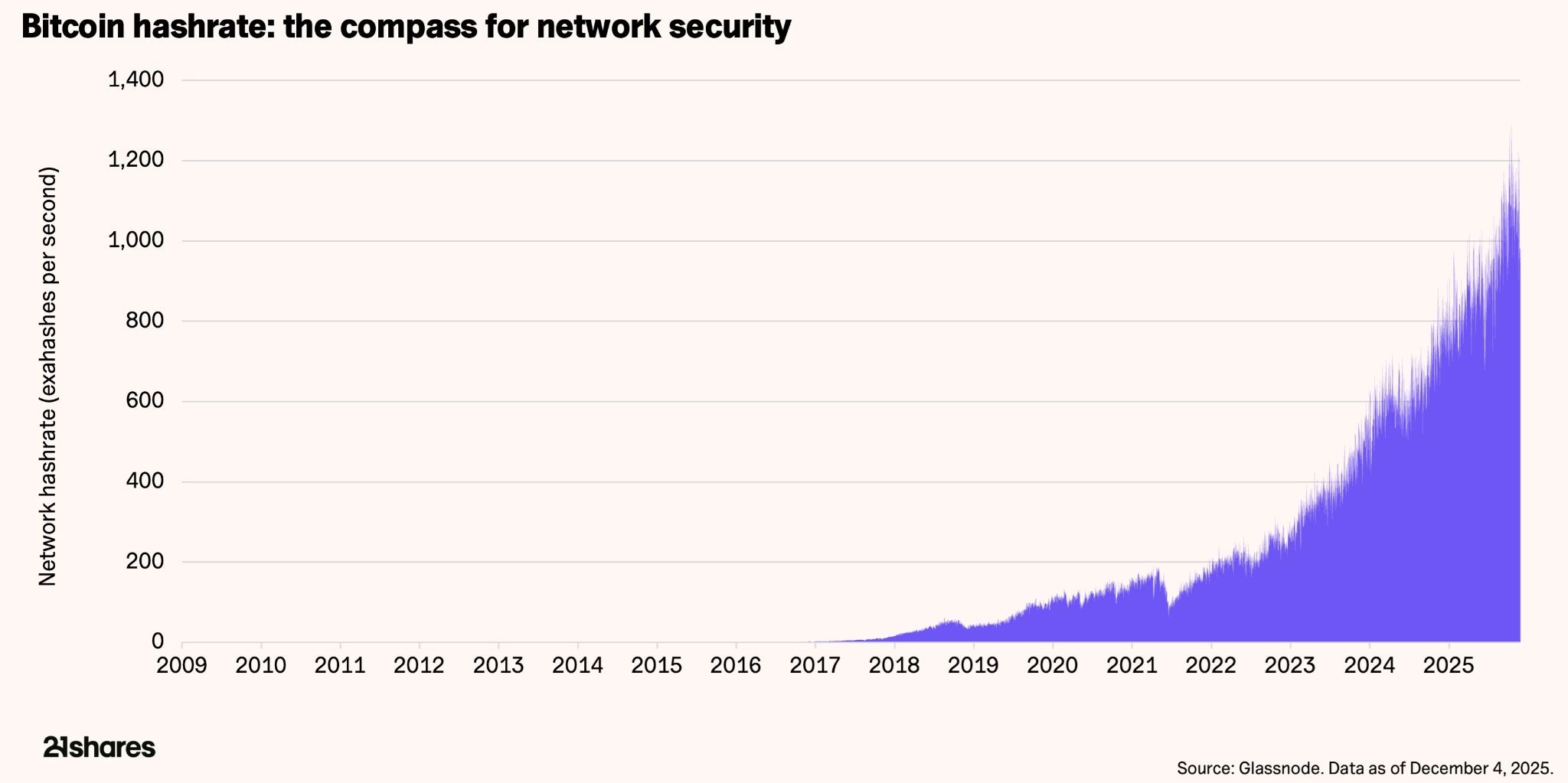
Bitcoin’s security is best measured by its hashrate, the computing power protecting the network through mining. Unlike gold mining, Bitcoin miners use specialized machines that consume significant electricity to verify and secure transactions.
The higher the hashrate, the harder the network is to attack. It has risen over 1,000% in five years, making a one-hour attack theoretically cost more than $1 million.
In practice, such attempts would be reversed by honest nodes, and none have ever succeeded since launch in 2009. Exchanges typically wait an hour for confirmations as a safeguard.
Investor Retention: Realized Price-to-Liveliness Ratio (RPLR)
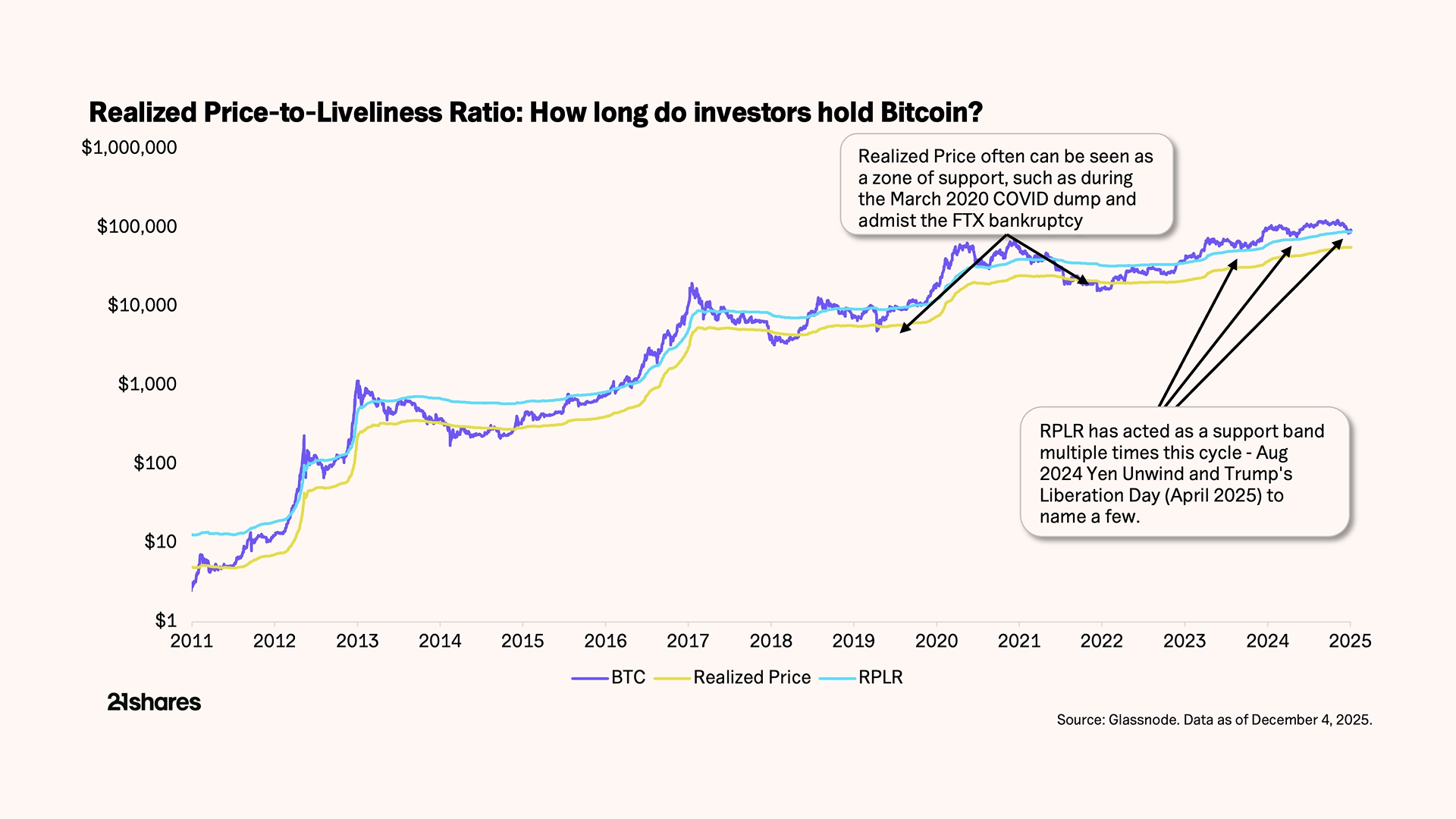
Beyond security, retention reveals asset strength. The Realized Price-to-Liveliness Ratio (RPLR) measures how long investors hold Bitcoin by comparing their cost basis to activity on the blockchain. Bitcoin’s aggregated cost basis surged from $17,000 in 2022 to $56,000, driven by $58 billion of inflows into US spot ETFs. Historically, realized price has marked cycle bottoms, such as the 2022 low near $17,000. On the liveliness side, around 64% of Bitcoins have changed hands since inception, with selling pressure rising briefly during major market events like the FTX collapse, yet overall stability has persisted.

Despite recent profit-taking from wealthy allocators near $126,000, Bitcoin remains largely held by long-term value investors as a sovereign store of value. For portfolio construction, its network security, integrity, and investor retention reinforce its role alongside gold within the alternative assets sleeve.
As noted earlier, not all cryptoassets are alike; application platforms like Ethereum and Solana resemble tech equities such as Apple or Google rather than direct Bitcoin competitors.
How to value app platforms like Ethereum and Solana?
For tech-savvy investors exploring Solana and Ethereum, analogous to Apple and Google, several core metrics matter:
- Revenue: How much value does the platform capture?
- Developer adoption: Is it attracting entrepreneurs to build the next generation of financial and internet services?
- User growth: Are governments, corporations, and consumers using these products at scale?
The key question is how to pick winners. In traditional finance, investors focus on revenue, developer adoption, and sustainable user growth to avoid backing the next Nokia or Blackberry ahead of an iPhone moment.
This publication concentrates on revenue, with future articles on the other two pillars: developer adoption and user growth.
Revenue: The case for Ethereum
Price-to-Revenue (P/R) ratio provides value investors a clear lens, much like P/E or P/S multiples in traditional finance. It compares market capitalization to the annualized revenue a chain retains from user-paid fees, revealing how richly the market is pricing its economic throughput.
Ethereum, valued at around $380 billion, functions like an open-source app store built on a Linux-like model. Its vertically integrated scaling platforms capture part of the value rather than fully sharing revenue with the base platform. Similar to how TCP/IP itself does not capture revenue, while Google, Amazon, and Facebook, built on top, became trillion-dollar companies. This design limits Ethereum’s direct value capture but reflects its long-term roadmap focused on this multi-layer architecture.
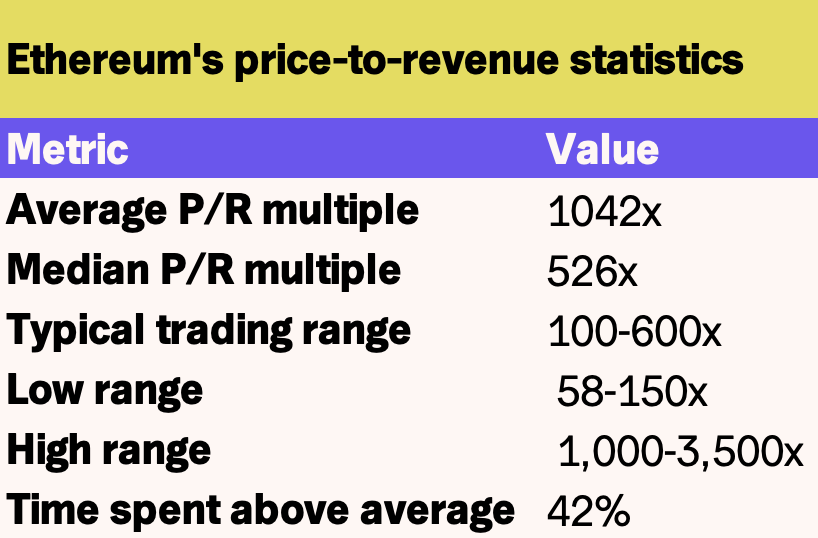
Since early 2024, Ethereum’s P/R ratio has averaged around 1042x. In downturns, it has fallen to the 150–250x range, near historical bottoms, while market expansions have seen peaks above 1,000x. Does this mean Ethereum is overvalued? Let’s compare it to Solana.

Revenue: The Case for Solana
Unlike Ethereum’s Linux-like architecture, Solana operates more like Apple, with vertically-integrated products including its app platform, phone, and a startup ecosystem built around it. This structure allows Solana to capture a larger share of revenue through user-paid fees.
Its P/R ratio is highly responsive to user activity since most throughput occurs directly on-chain. When revenue falls faster than market value, the multiple expands even if the price stays steady. In this cycle, Solana’s average P/R has been around 837x, with contractions to 60–150x signaling attractive valuations and expansions above 1,200x often coinciding with overheated markets near $200–$250.

For investors evaluating infrastructure assets on economic substance rather than speculation, P/R offers a reliable gauge of when networks trade near fundamentals versus when valuations run ahead. These are not definitive metrics; developer adoption, user growth, and macro conditions also play key roles. From a revenue perspective, Ethereum appears overvalued relative to Solana.
Bitcoin stands in a league of its own as the only true store-of-value asset in crypto, where investment merit is defined by network security and long-term holder retention rather than platform competition. In contrast, app-layer networks like Ethereum and Solana must earn their place through fundamentals more akin to high-growth tech platforms: revenue capture, developer adoption, and durable user retention. The next issue will explore developer and user adoption for a full 360-degree view.
______
Footnotes:
- Bitcoin (.D) chart. (n.d.). TradingView. Retrieved December 8, 2025, from https://www.tradingview.com/symbols/BTC.D/
This report has been prepared and issued by 21Shares AG for publication globally. All information used in the publication of this report has been compiled from publicly available sources that are believed to be reliable, however, we do not guarantee the accuracy or completeness of this report. Crypto asset trading involves a high degree of risk. The crypto asset market is new to many and unproven and may have the potential not to grow as expected.Currently, there is relatively small use of crypto assets in the retail and commercial marketplace in comparison to relatively large use by speculators, thus contributing to price volatility that could adversely affect an investment in crypto assets. In order to participate in the trading of crypto assets, you should be capable of evaluating the merits and risks of the investment and be able to bear the economic risk of losing your entire investment.Nothing herein does or should be considered as an offer to buy or sell or solicitation to buy or invest in crypto assets or derivatives. This report is provided for information and research purposes only and should not be construed or presented as an offer or solicitation for any investment. The information provided does not constitute a prospectus or any offering and does not contain or constitute an offer to sell or solicit an offer to invest in any jurisdiction. The crypto assets or derivatives and/or any services contained or referred to herein may not be suitable for you and it is recommended that you consult an independent advisor. Nothing herein constitutes investment, legal, accounting or tax advice, or a representation that any investment or strategy is suitable or appropriate to your individual circumstances or otherwise constitutes a personal recommendation. Neither 21Shares AG nor any of its affiliates accept liability for loss arising from the use of the material presented or discussed herein.Readers are cautioned that any forward-looking statements are not guarantees of future performance and involve risks and uncertainties and that actual results may differ materially from those in the forward-looking statements as a result of various factors.This report may contain or refer to material that is not directed to, or intended for distribution to or use by, any person or entity who is a citizen or resident of or located in any locality, state, country or other jurisdiction where such distribution, publication, availability or use would be contrary to law or regulation or which would subject 21Shares AG or any of its affiliates to any registration, affiliation, approval or licensing requirement within such jurisdiction.




.svg)