

If you have been watching prices stay stubbornly high while headlines fill with warnings about government debt, you are probably thinking: what does all of this mean for your long-term savings? The answer depends on how governments choose to manage debts they cannot fully repay through taxes alone. One of the most common approaches in history has been bad news for cash and bonds.
The debt trap that limits central banks
Fiscal dominance is the situation where a government's debt becomes so large that it can no longer afford to let interest rates rise to fight inflation. Think of it like a homeowner who took out a very large mortgage at a low fixed rate. When that rate resets to a higher one, the monthly payments become unmanageable. Governments face the same dynamic at a national scale.
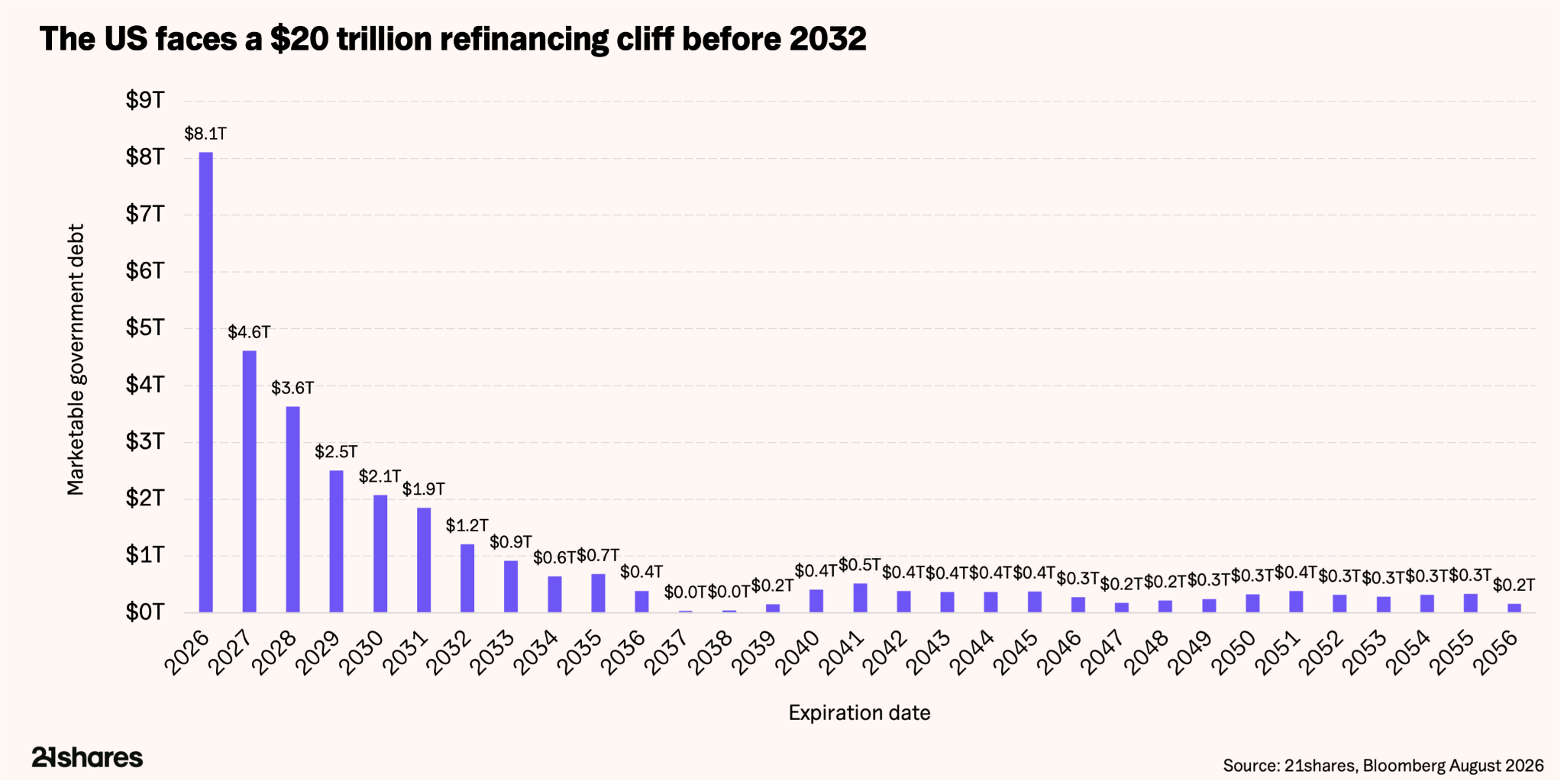
The United States currently has approximately $10 trillion in debt to refinance over the next 12 months (21shares research, Bloomberg, August 2026). Its interest payments are projected by the Congressional Budget Office to consume more than 20% of all federal tax revenue within three years. In that environment, aggressive rate rises could trigger a debt crisis. The alternative, allowing inflation to run higher than the central bank's target, erodes the real value of the debt over time. It is painful for savers, but it is politically simpler.
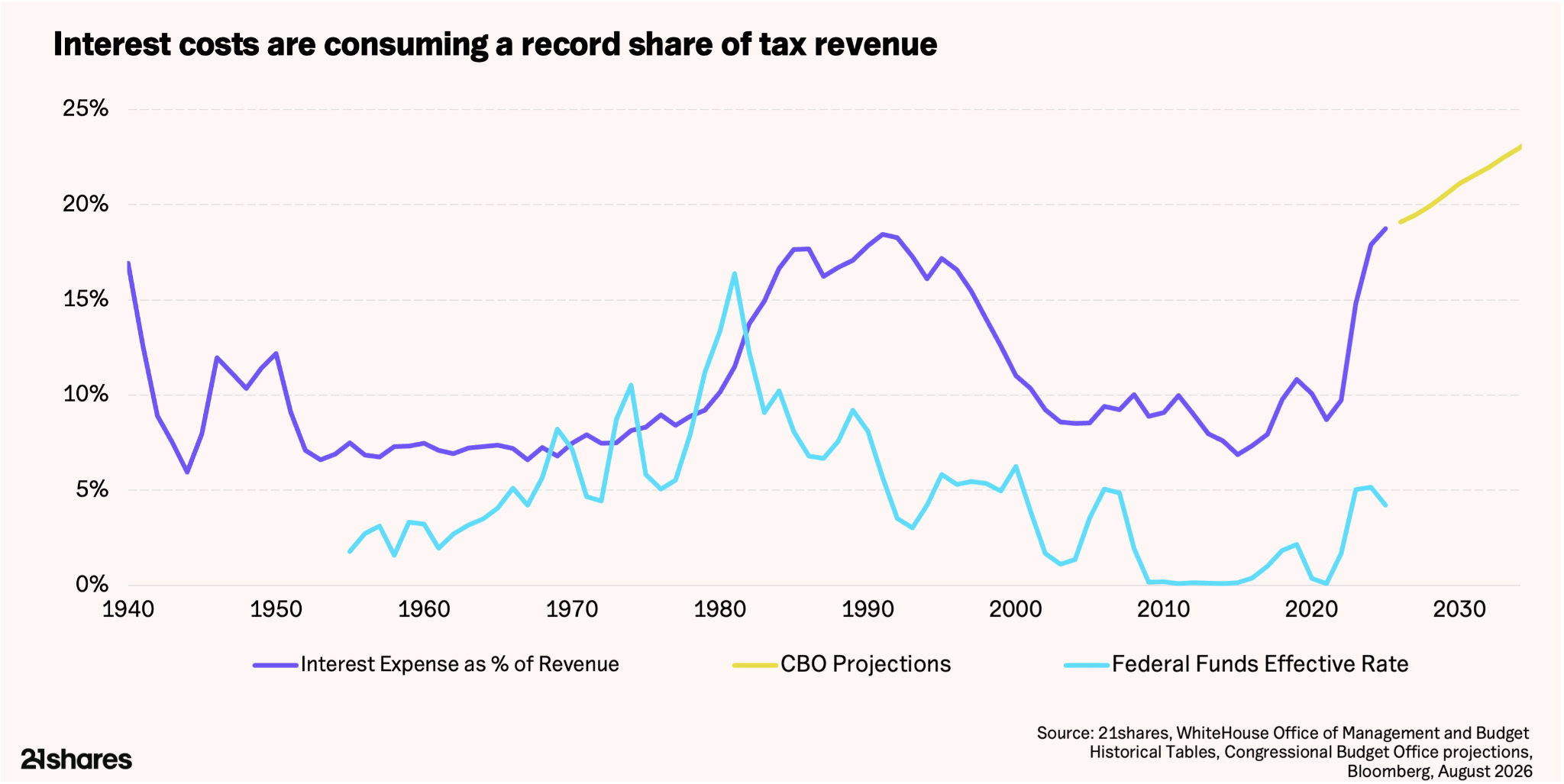
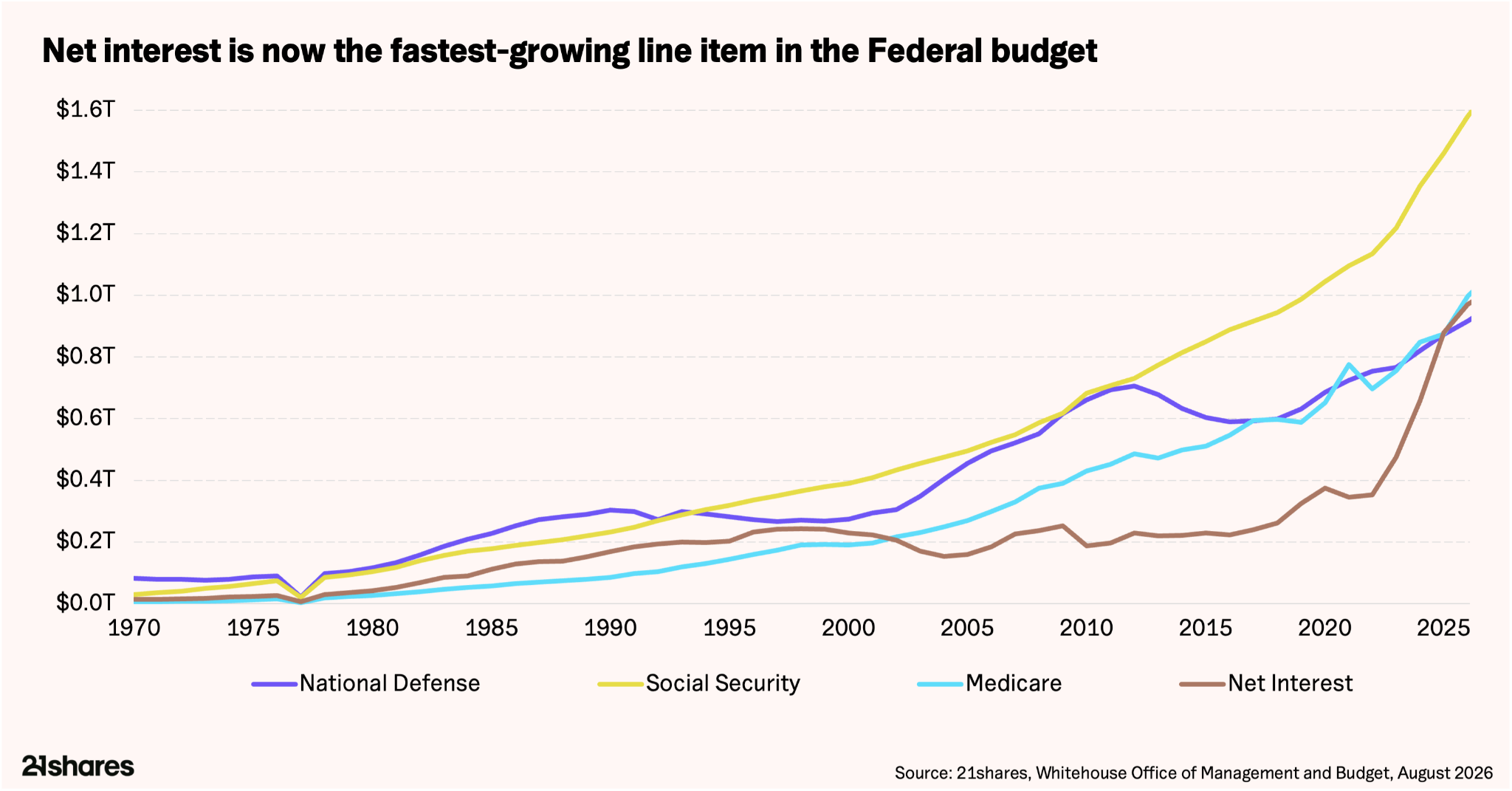
For now, the Fed is holding the line and responding to above-target inflation by maintaining a restrictive policy stance. The US dollar has been strong and the “debasement trade” has been in abeyance. However, an investor designing a robust strategic asset allocation must take into account the likelihood that at some point we transition into a regime where the US central bank is forced to prioritise financial stability over price stability. Particularly as the political will to narrow the deficit through a legislative process appears entirely absent. As that transition takes place, investors will exhibit a preference to avoid holding US dollars and US fixed income securities, and demand for non-sovereign stores of value such as gold and bitcoin will increase. It is difficult to look at trends in US government expenditures and believe that over the medium term the US dollar will not see an erosion of its purchasing power in excess of the Fed’s 2% target.
Japan already went through this
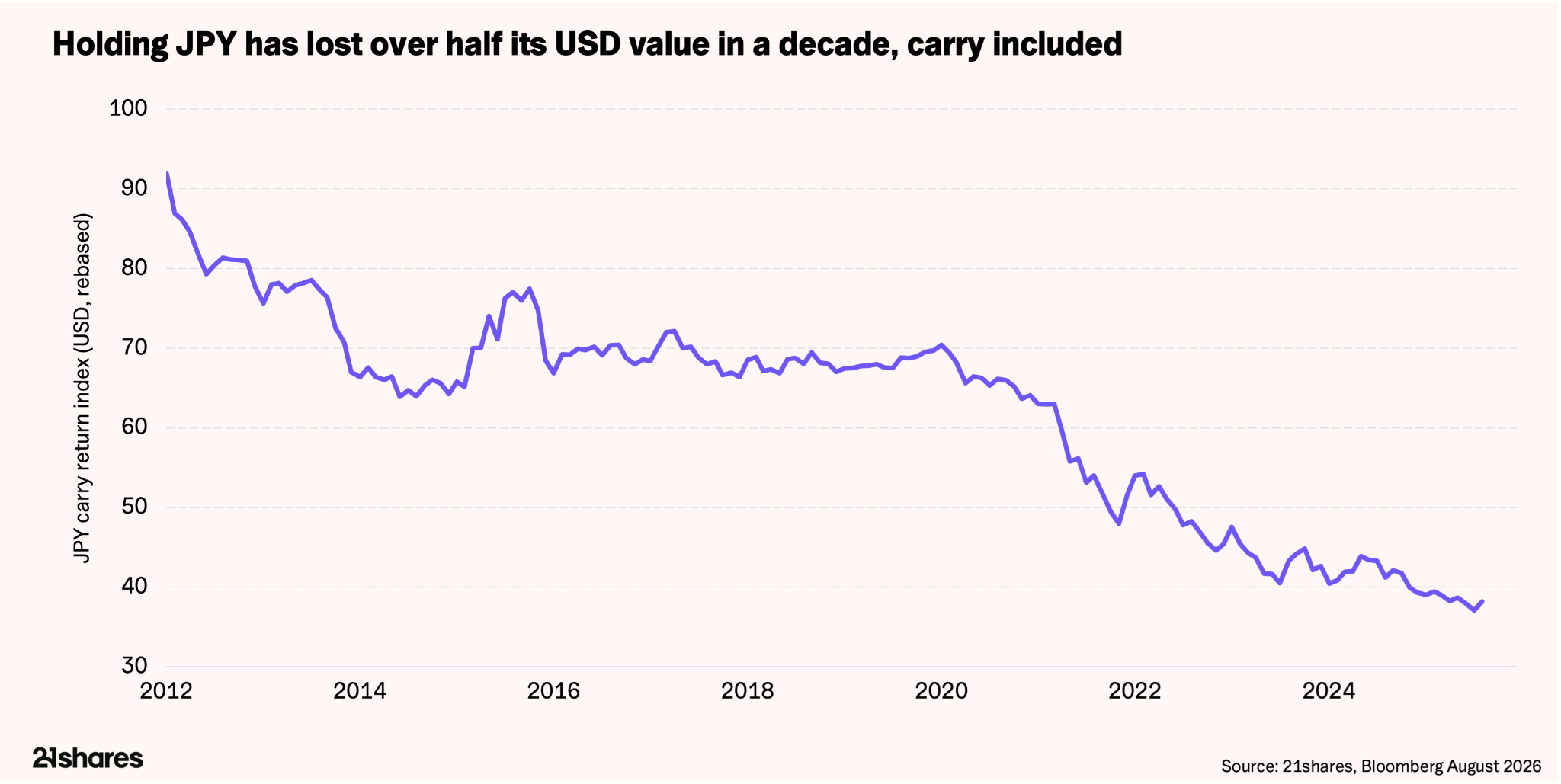
Japan offers the clearest example of what follows. By 2012, its government debt had reached close to 200% of GDP. Rather than default, Japan's central bank responded with a decade of deliberate monetary expansion. It held its policy rate below zero, locked government borrowing costs at 0% through a policy called yield curve control, and purchased bonds on such a scale that it eventually owned close to 50% of the entire Japanese government bond market.
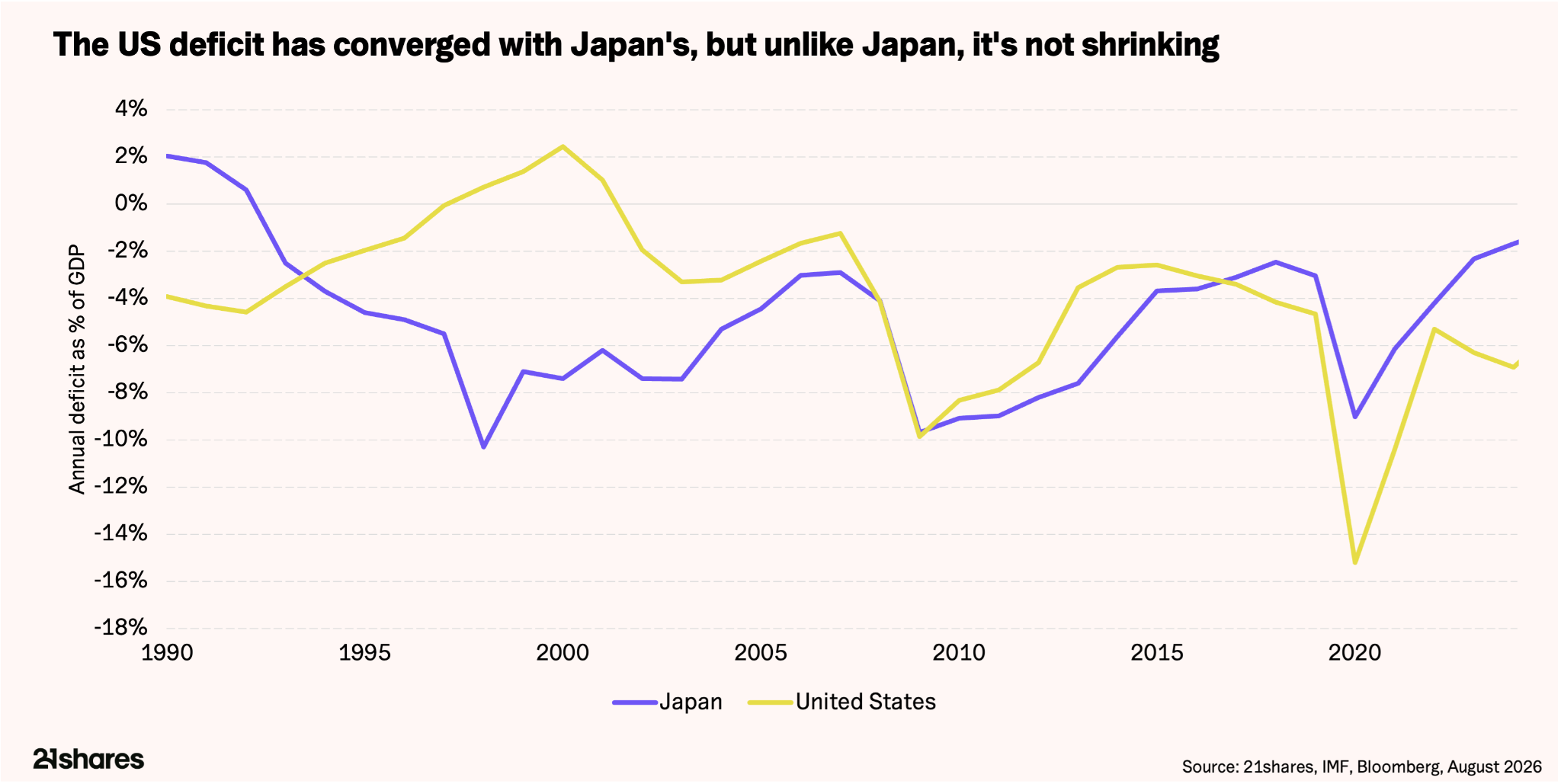
Inflation returned. The yen fell. Japanese savers who held government bonds experienced a total return of approximately -20% in local currency terms over that decade, even with interest payments reinvested (FTSE Japanese Government Bond Index, 21shares research, Bloomberg, August 2026). The government's debt burden shrank. The cost was absorbed by bondholders and currency holders.
What this means for a typical portfolio
A traditional portfolio holds roughly 60% in stocks and 40% in bonds. Bonds are supposed to cushion the portfolio when equity markets fall. Under fiscal dominance, inflation becomes the dominant risk driving both asset classes simultaneously. Bonds lose purchasing power at the same time as equities come under pressure. The cushion stops working at exactly the moment investors need it most.
Why scarce assets behave differently
Some investors hold a portion of their portfolio in assets whose supply cannot be expanded by a government decision. Gold's annual new supply has historically grown by less than 2%. Bitcoin's supply growth is now below 1% per year as it approaches its fixed cap of 21 million coins. Neither can be issued to fund a budget deficit.
Some market participants therefore use gold and bitcoin as potential stores of value in periods of fiscal dominance, pointing to their fixed supply as a limit on the purchasing power erosion that affects cash and bonds (while recognizing that digital assets are highly volatile, and bitcoin has experienced drawdowns exceeding 50% at multiple points in its history).
For a retail investor building a long-term savings plan, a modest allocation to scarce assets does not require being right about the precise timing of any policy shift. It is a structural hedge against a risk that is already visible in the data. Exchange-traded products (ETPs) that track gold and bitcoin are available through standard brokerage accounts, without the need to manage wallets, digital keys, or direct crypto ownership.
Investors should assess their own financial circumstances and risk tolerance before making any investment decision. The value of investments can fall as well as rise, and you may receive back less than you invest.
FAQ
How does high government debt affect my savings?
When government debt grows large enough, raising interest rates to fight inflation becomes too costly for the government itself — increasing borrowing costs on debt that must be continually refinanced. Central banks in this position may allow inflation to run higher than their stated target, which erodes the purchasing power of cash and nominal bonds over time. Savers holding those assets bear the cost of the adjustment; borrowers, including governments, see the real value of their debt reduced.
Is bitcoin a hedge against inflation?
Some investors hold bitcoin as a potential protection against inflation and currency debasement, citing its fixed supply cap of 21 million coins and its independence from government monetary policy. This is a contested thesis: bitcoin is a highly volatile asset that has experienced drawdowns exceeding 50% at multiple points in its history, making it unsuitable as a short-term hedge. Investors who hold bitcoin typically do so as a long-term, small-percentage allocation within a diversified portfolio. Past performance is not a reliable indicator of future results.
What is the difference between a bitcoin ETP and buying bitcoin directly?
A bitcoin exchange-traded product (ETP) is a regulated financial instrument that tracks the price of bitcoin and trades on a stock exchange, just like a share or a conventional fund. It allows investors to gain exposure to bitcoin through a standard brokerage account without needing to manage wallets, private keys, or digital custody infrastructure. The ETP issuer handles the technical and custodial complexity; the investor holds a regulated security in their existing account.
What happened to Japanese savers when the central bank prioritized debt stability over inflation?
Following Japan's 2013 policy shift, the Bank of Japan held interest rates below zero and locked government bond yields at 0% to ease the government's debt burden. Inflation returned and the yen weakened significantly over the following decade. Japanese government bondholders experienced a total return of approximately -20% in local currency terms over that period, even with interest payments reinvested (FTSE Japanese Government Bond Index, 21shares research, Bloomberg, August 2026). Savers holding cash or bonds absorbed the cost of the government's debt adjustment through the steady erosion of purchasing power.










_logo.svg)
.svg.png)