Aave 2026 outlook: From lending to onchain credit infrastructure



Price prediction has always fascinated finance, and that fascination intensifies in crypto, where fast-moving sentiment dominates markets. While no outlook can be certain, useful forecasts combine quantitative models with qualitative judgment.
In the opening weeks of the year, we’re releasing a series of outlooks covering the five leading crypto assets. After beginning with Bitcoin and Ethereum last week, we now turn to Solana, XRP, and Aave.
Aave enters 2026 as the most established onchain credit protocol, but its valuation is no longer determined by lending market share alone. This year, Aave’s price performance relies on five prongs:
- Aave’s shift toward credit infrastructure
- Balance sheet sustainability and token value
- Aave’s stablecoin and internal credit discipline
- Distribution, user ownership, and SAVE
- Institutional credit and governance credibility
As Aave expands beyond core lending markets, value creation becomes more distributed. Economic activity increasingly takes place across third-party applications for retail, corporates and institutions rather than a standalone lending app for cryptoassets. As a result, Aave’s valuation depends on whether this broader economic activity can be converted into sustainable cash flows that accrue to token holders. Growth alone is no longer sufficient; value capture and governance alignment will now be instrumental for a sensible valuation.
What is driving our 2026 outlook?
1. Aave V4 and the shift toward credit infrastructure
Aave V4 is the foundation of the 2026 outlook because it determines whether scale becomes more efficient rather than merely larger. The upgrade consolidates liquidity, risk management, and loan rates into a unified system, reducing fragmentation and lowering operational complexity. This allows the protocol to evolve by adding or retiring features without repeatedly migrating capital, and it improves competitiveness by reducing friction and costs across markets.
The relevance of V4 is not measured by whether it boosts volumes, but by whether it improves capital efficiency and margin quality per dollar of liquidity. If it succeeds, Aave’s size would become a durable advantage that competitors struggle to replicate. If it does not, the protocol would become more exposed to competitors that optimize for rates and curated risk, particularly across Ethereum scaling solutions, like Base, where competitors are gaining ground.
2. Balance sheet sustainability and token value
Aave now operates with sustainable net-positive economics. Protocol fees exceed incentives and operating costs, and borrow demand is increasingly organic rather than subsidized. This marks a clear break from earlier DeFi cycles where scale was maintained through incentives that diluted long-term returns.
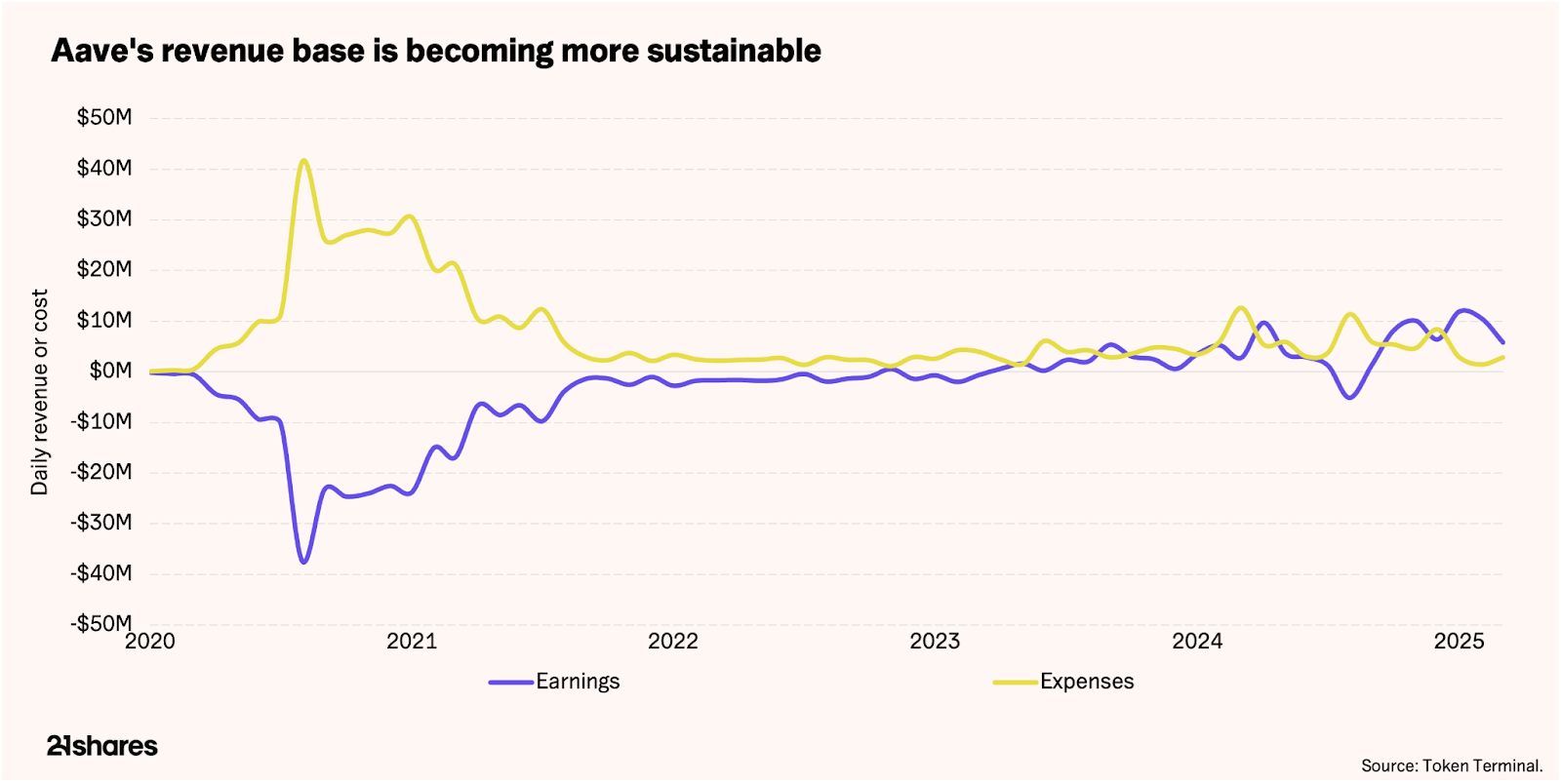
What remains unresolved is how clearly this economic value accrues to AAVE holders. While steps toward buybacks, improved safety mechanisms, and clearer governance alignment are directionally positive, the link between protocol activity and token value remains only partially explicit. In 2026, this becomes decisive. Either AAVE evolves into an asset that credibly reflects protocol cash flows, or valuation remains capped despite growth and revenue generation.
3. Aave’s stablecoin, GHO, and internal credit discipline
The strategic importance of Aave’s stablecoin, GHO, lies in its role as an internal credit and balance-sheet tool rather than a payments product. When used conservatively, GHO allows Aave to recycle capital internally, retain fees and yield from US treasuries within the system that are leaked to other stablecoin issuers, and manage liquidations more smoothly. This improves borrower outcomes, strengthens the stability of lending markets, and reinforces Aave’s position in stablecoin-denominated credit.
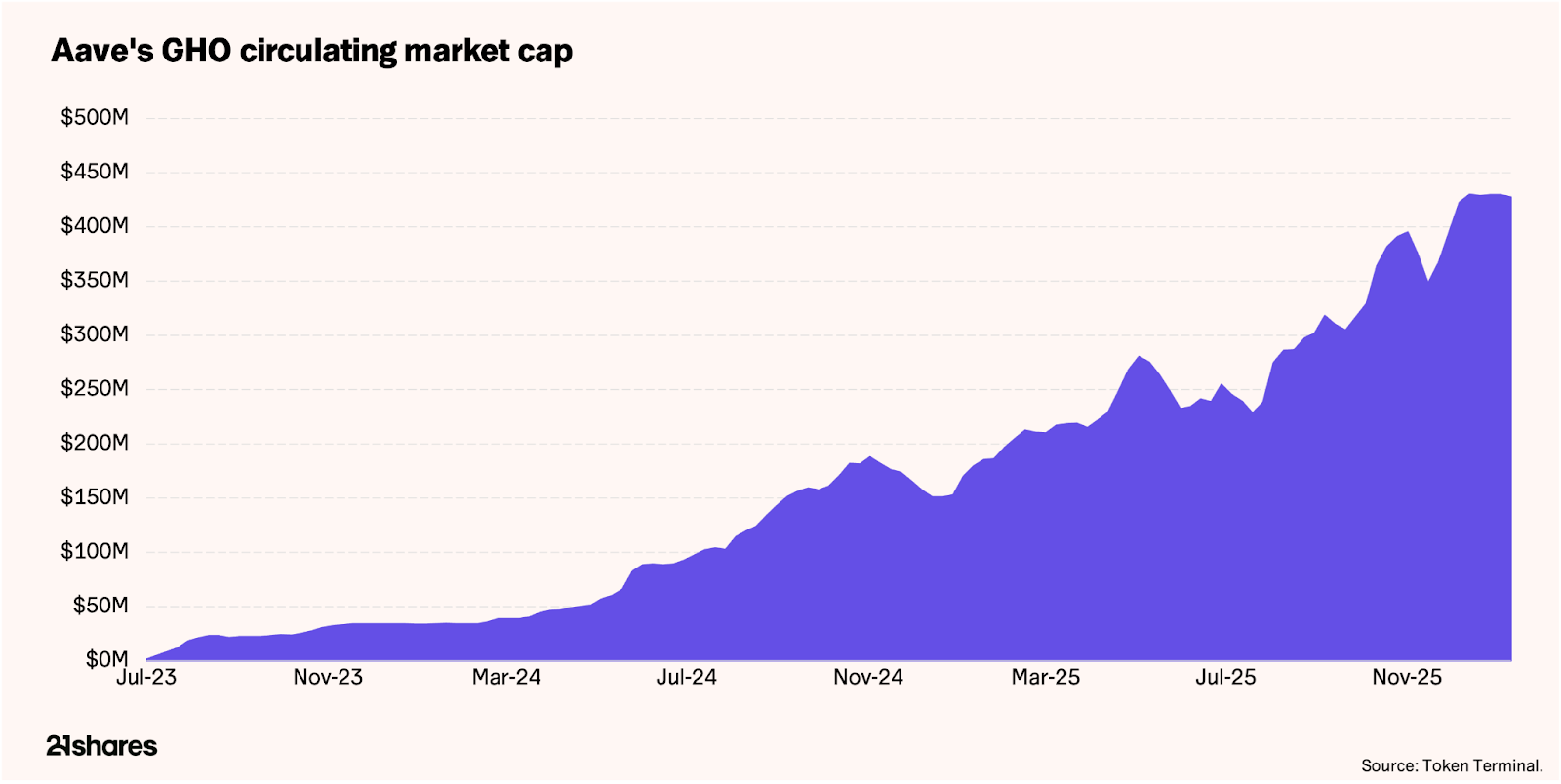
The risk associated with GHO is not adoption but operational excellence. If growth outpaces risk controls, GHO would introduce balance-sheet risk and undermine confidence in the protocol. Success depends less on scale and more on careful integration into Aave’s broader credit stack, with an emphasis on resilience rather than expansion.
4. Distribution, user ownership, and SAVE
As onchain credit matures, distribution increasingly determines where liquidity settles. The upcoming full rollout of the Aave app, SAVE, reflects a recognition that infrastructure alone captures less value without control over the user relationship. A direct, mobile-first front end allows Aave to lessen aggregator dependence, access a wider user base, and anchor more stable, long-term deposits.
If SAVE scales meaningfully, Aave would begin to function less like backend infrastructure and more like a consumer financial product. This supports a potentially sticky demand and adoption for Aave stablecoin and products. If adoption stalls, Aave would remain more exposed to speculative capital that can move quickly when conditions change, limiting the benefits of its scale.
5. Institutional credit and governance credibility
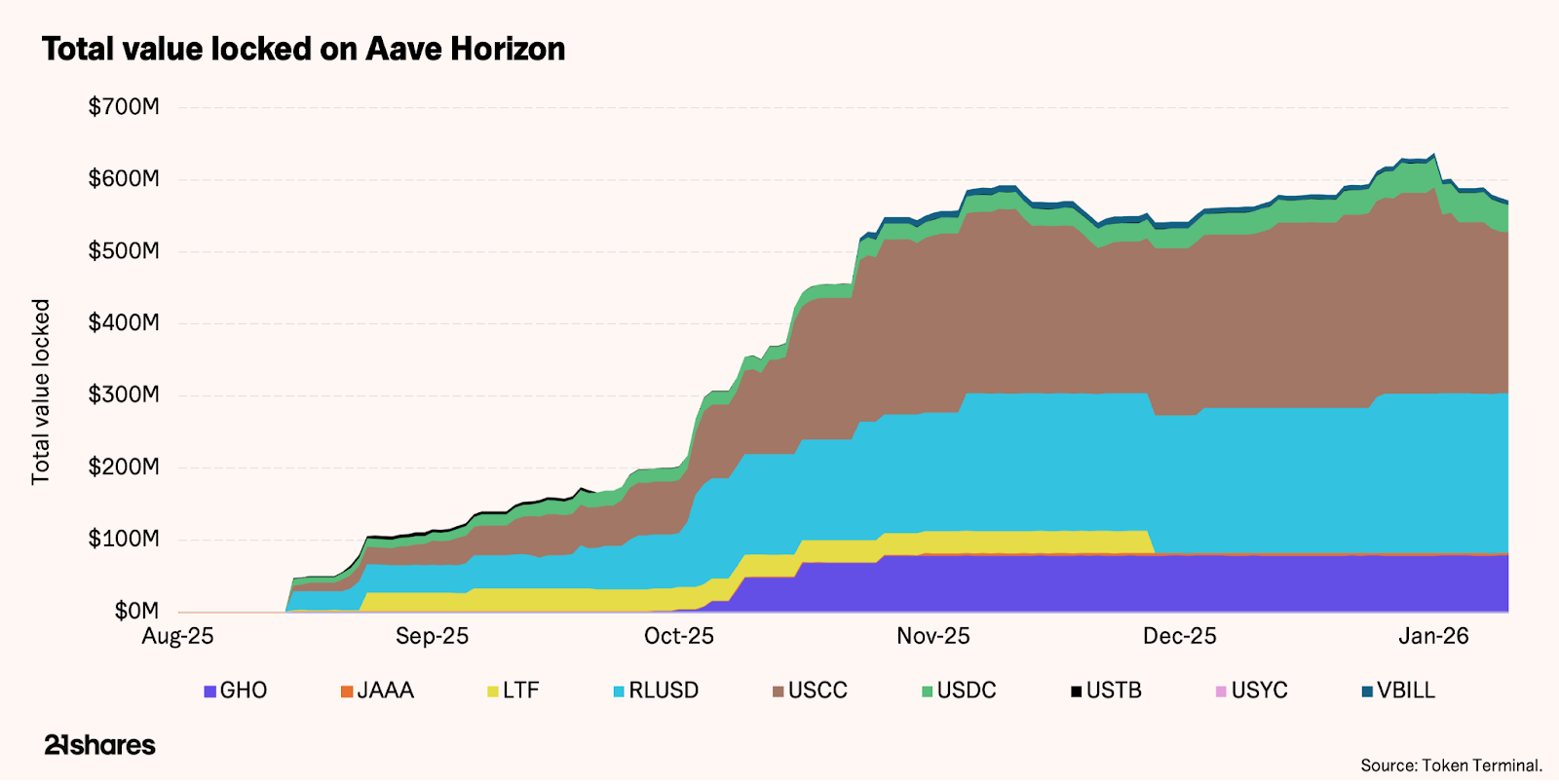
Aave’s institutional relevance is increasingly plausible at the protocol level, but far less settled at the token level. Horizon, the institution-friendly version of the Aave protocol, provides a structurally sound framework for permissioned credit markets, allowing regulated counterparties and tokenized assets to interact with Aave without introducing regulatory risk into permissionless pools. This makes Aave one of the few DeFi protocols that institutions can realistically use. However, Horizon’s success will be measured not by deposit growth alone, but by whether it brings genuinely new institutional inflows onchain rather than repackaging crypto-native capital under institutional labels.
More importantly, institutional usage does not imply institutional demand for the AAVE token. Institutions underwrite systems they can rely on, not governance tokens by default. As long as key decisions around front ends, brands, fee streams, and execution authority remain ambiguous, institutions can engage with the protocol while remaining structurally indifferent to the token. Recent governance disputes have reinforced this separation, highlighting that protocol resilience does not guarantee token-level alignment.
In 2026, governance credibility becomes the bridge, or the barrier, between protocol success and token valuation. Without clearer accountability and more explicit value accrual, Aave risks becoming institutionally important infrastructure with a token that captures only a fraction of the value it enables. In this scenario, protocol adoption expands, but AAVE remains capped as a speculative asset.
Our projected scenario range for 2026
Price predictions are not single-point forecasts, but scenario-based assessments grounded in both quantitative data and qualitative assumptions. By modeling varying adoption, macroeconomic, and market-structure outcomes, we estimate potential valuation ranges at peak levels under each scenario over the course of the year.
- Base case - $188 (30%): Aave remains the leading onchain credit protocol, but its transition into a full-stack credit system progresses gradually rather than decisively. Aave V4 launches and improves efficiency, though not enough to fully eliminate reliance on incentives in newer markets. SAVE strengthens distribution but primarily deepens engagement among crypto-native users, leaving deposit stability only modestly improved. GHO is managed conservatively and supports internal capital efficiency, but it does not materially change the growth profile.
Horizon continues to scale and surpasses $1 billion in deposits, yet institutional participation remains selective and largely infrastructure-focused. Governance frictions persist but stay manageable, allowing slow progress on value capture without fully resolving the gap between protocol relevance and token economics. In this environment, AAVE benefits from durability and improved fundamentals, but re-rates only modestly rather than structurally.
- Bull case - $220 (51%): Aave V4 delivers a clear improvement in capital efficiency, allowing the protocol to grow without renewed dependence on incentives and reinforcing its advantage at scale. SAVE evolves into a meaningful distribution engine, expanding Aave’s reach beyond crypto-native users and making deposits materially stickier. GHO remains tightly managed but meaningfully improves balance-sheet efficiency and protocol-retained revenue.
At the same time, Horizon attracts net new institutional flows, supported by clearer governance and execution. Institutions still primarily engage with Aave as infrastructure, but improved alignment enables a more explicit and sustained link between protocol activity and token value. As value capture becomes visible and durable, AAVE transitions from a governance-centric asset into one with a credible cash-flow token, driving positive repositioning for investors.
- Bear case - $113 (-22%): Aave’s core infrastructure remains relevant, but execution falters. Aave V4 underdelivers or is delayed, leaving capital efficiency largely unchanged and incentives elevated. SAVE adoption stalls, reinforcing reliance on yield-sensitive liquidity, while competitors capture marginal growth by undercutting rates. GHO either remains too small to matter or expands without sufficient discipline, raising balance-sheet concerns.
Horizon fails to scale beyond symbolic institutional engagement, and governance disputes resurface, delaying decisions around execution and value capture. Institutions continue to use Aave selectively as infrastructure while bypassing the token entirely. In this scenario, the protocol remains widely used, but AAVE struggles to justify its valuation as the gap between usage and economic accrual becomes increasingly clear.
What are the key risks?
- Structural value capture gap: Aave’s protocol can continue to grow even if AAVE fails to capture the economic value it enables. If activity across frontends, institutional rails, and branded products does not translate into a durable, cash flow investment, the valuation multiple remains capped regardless of usage.
- Capital efficiency under competition: Aave’s scale advantage depends on improving capital efficiency. If Aave V4 does not deliver meaningful margin gains, modular lenders optimized for rate efficiency may continue to capture marginal growth, pressuring returns despite protocol relevance.
- Institutional adoption bypassing the token: Institutional participation via Horizon may expand Aave’s role as infrastructure without increasing demand for AAVE. In this case, protocol adoption and token valuation continue to diverge.
- Governance and execution risk: As Aave expands across infrastructure, consumer apps, and regulated markets, governance becomes a binding constraint. Unclear authority or delayed execution could reinforce a persistent governance discount.
The determining factor is whether Aave’s protocol-level success translates into token-level value capture
In 2026, the market prices AAVE not on lending dominance, but on execution across capital efficiency, distribution control, governance credibility, and the clarity of economic linkage between usage and ownership.
This report has been prepared and issued by 21Shares AG for publication globally. All information used in the publication of this report has been compiled from publicly available sources that are believed to be reliable, however, we do not guarantee the accuracy or completeness of this report. Crypto asset trading involves a high degree of risk. The crypto asset market is new to many and unproven and may have the potential not to grow as expected.Currently, there is relatively small use of crypto assets in the retail and commercial marketplace in comparison to relatively large use by speculators, thus contributing to price volatility that could adversely affect an investment in crypto assets. In order to participate in the trading of crypto assets, you should be capable of evaluating the merits and risks of the investment and be able to bear the economic risk of losing your entire investment.Nothing herein does or should be considered as an offer to buy or sell or solicitation to buy or invest in crypto assets or derivatives. This report is provided for information and research purposes only and should not be construed or presented as an offer or solicitation for any investment. The information provided does not constitute a prospectus or any offering and does not contain or constitute an offer to sell or solicit an offer to invest in any jurisdiction. The crypto assets or derivatives and/or any services contained or referred to herein may not be suitable for you and it is recommended that you consult an independent advisor. Nothing herein constitutes investment, legal, accounting or tax advice, or a representation that any investment or strategy is suitable or appropriate to your individual circumstances or otherwise constitutes a personal recommendation. Neither 21Shares AG nor any of its affiliates accept liability for loss arising from the use of the material presented or discussed herein.Readers are cautioned that any forward-looking statements are not guarantees of future performance and involve risks and uncertainties and that actual results may differ materially from those in the forward-looking statements as a result of various factors.This report may contain or refer to material that is not directed to, or intended for distribution to or use by, any person or entity who is a citizen or resident of or located in any locality, state, country or other jurisdiction where such distribution, publication, availability or use would be contrary to law or regulation or which would subject 21Shares AG or any of its affiliates to any registration, affiliation, approval or licensing requirement within such jurisdiction.