

Bitcoin has a reputation for burning through electricity. It is one of the most repeated criticisms of the asset class, and it is not without basis. The network does use significant energy. But the conversation almost always stops there, before the comparison is made, before the source of that energy is examined, and before anyone asks what the alternative actually costs.
Truth: More than half of Bitcoin's electricity now comes from renewables and nuclear
High electricity use is inherent to Proof-of-Work networks such as Bitcoin. Cambridge’s latest mining survey estimates that 52.4% of the electricity used by the network comes from sustainable sources, including 42.6% renewables and 9.8% nuclear. Mining can also absorb power that might otherwise go unused and, because it can be switched off quickly, act as a flexible demand switch when grids are under stress.
Bitcoin uses approximately 151 terawatt-hours (TWh) of electricity per year, a figure that is tracked and updated daily by the Cambridge Centre for Alternative Finance (CCAF). That transparency itself should be celebrated. The global banking system (data centers, 600,000 branches, 2.91 million ATMs, armored cash vehicles, and financial regulators) has never had its full energy footprint measured in the same way. When 21shares Research assembled the components, the total came to approximately 237 TWh per year (21shares Research, 2025). Bitcoin uses roughly two-thirds of that. Around 131 TWh of the banking figure is physical infrastructure; the remainder is the energy footprint of the sector’s 22 million employees.
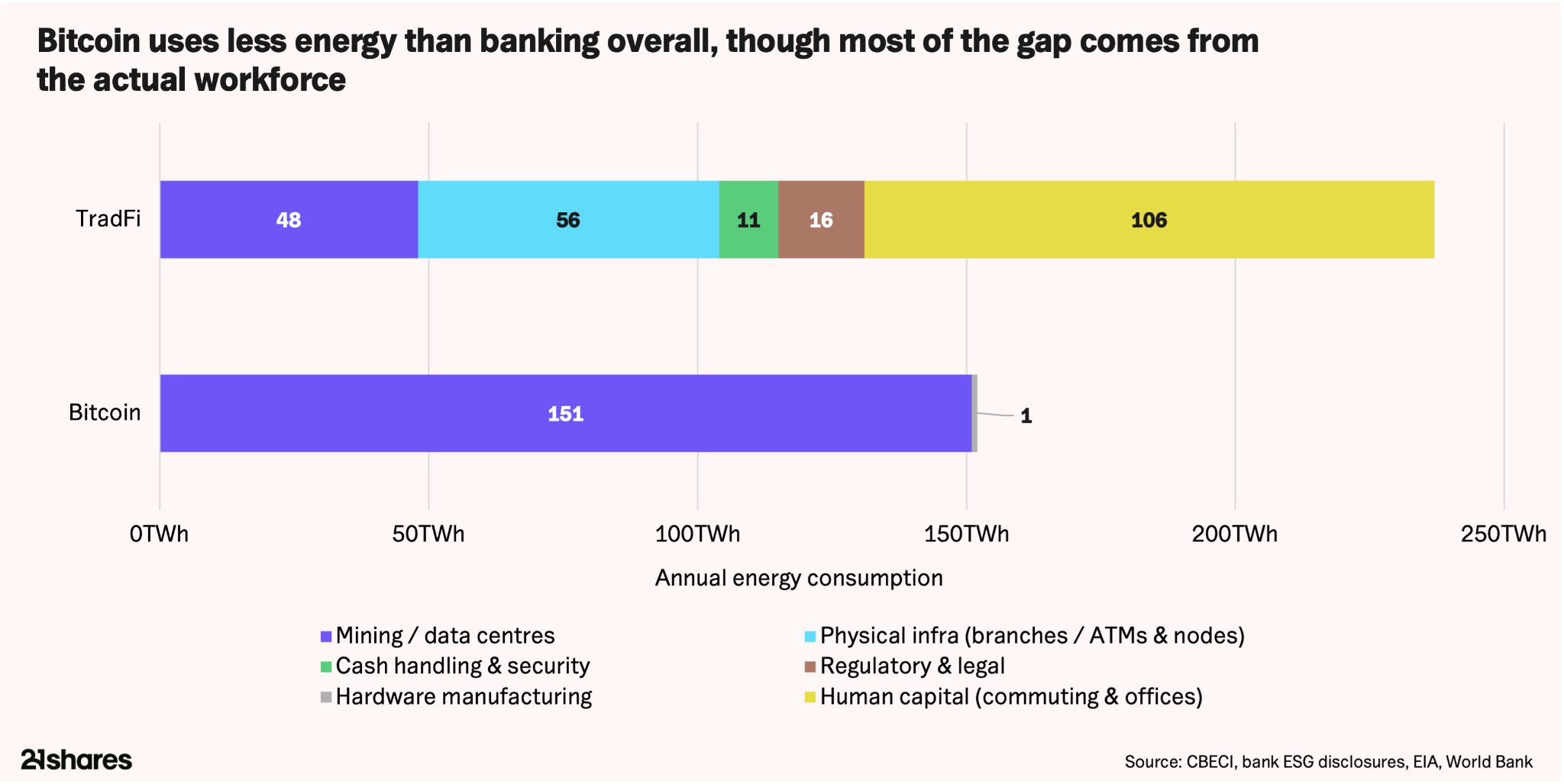
Thus, that comparison does not settle the debate, as traditional finance serves billions of people and moves trillions of dollars daily. But it does reframe the question: the scrutiny applied to Bitcoin's energy use has never been applied to the system it is being measured against.
That said, a more revealing comparison would be with data centres rather than the entire financial system. The International Energy Agency estimates they used around 415 TWh in 2025 and could reach roughly 945 TWh by 2030, with AI driving much of that growth. Bitcoin currently uses a fraction of this, while improvements in mining efficiency mean its electricity demand has grown far more slowly than the network itself.
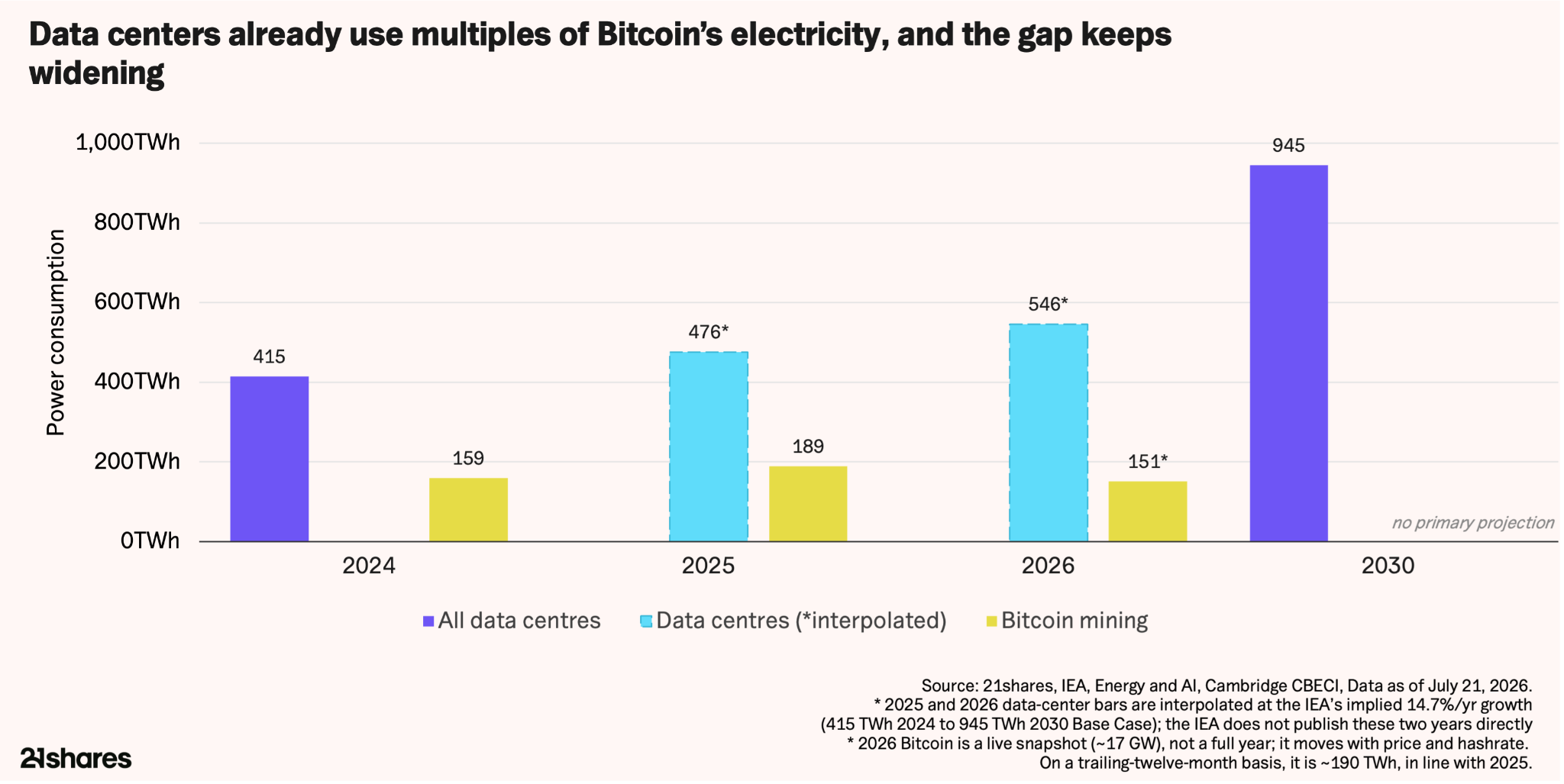
In other words, data centers are now the bigger driver of electricity demand, while Bitcoin is steadily becoming more efficient, allowing it to do more work per unit of power.
Beyond the energy mix, roughly 40% of Bitcoin's electricity would have been wasted without mining. This includes power from remote hydroelectric dams with no transmission line to the nearest city, wind farms producing more than local grids can absorb, and natural gas being burned into the atmosphere at drilling sites because no pipeline exists to capture it. Miners did not take that energy from someone else. They were the only customers who showed up (21shares Research, drawing on Cambridge's finding that 26% of mining runs off-grid).
Not all blockchains are highly energy-intensive. Proof-of-Stake networks require far less energy by design: Ethereum’s transition to Proof-of-Stake reduced its electricity consumption by roughly 99.95%.
The system is getting more efficient by design
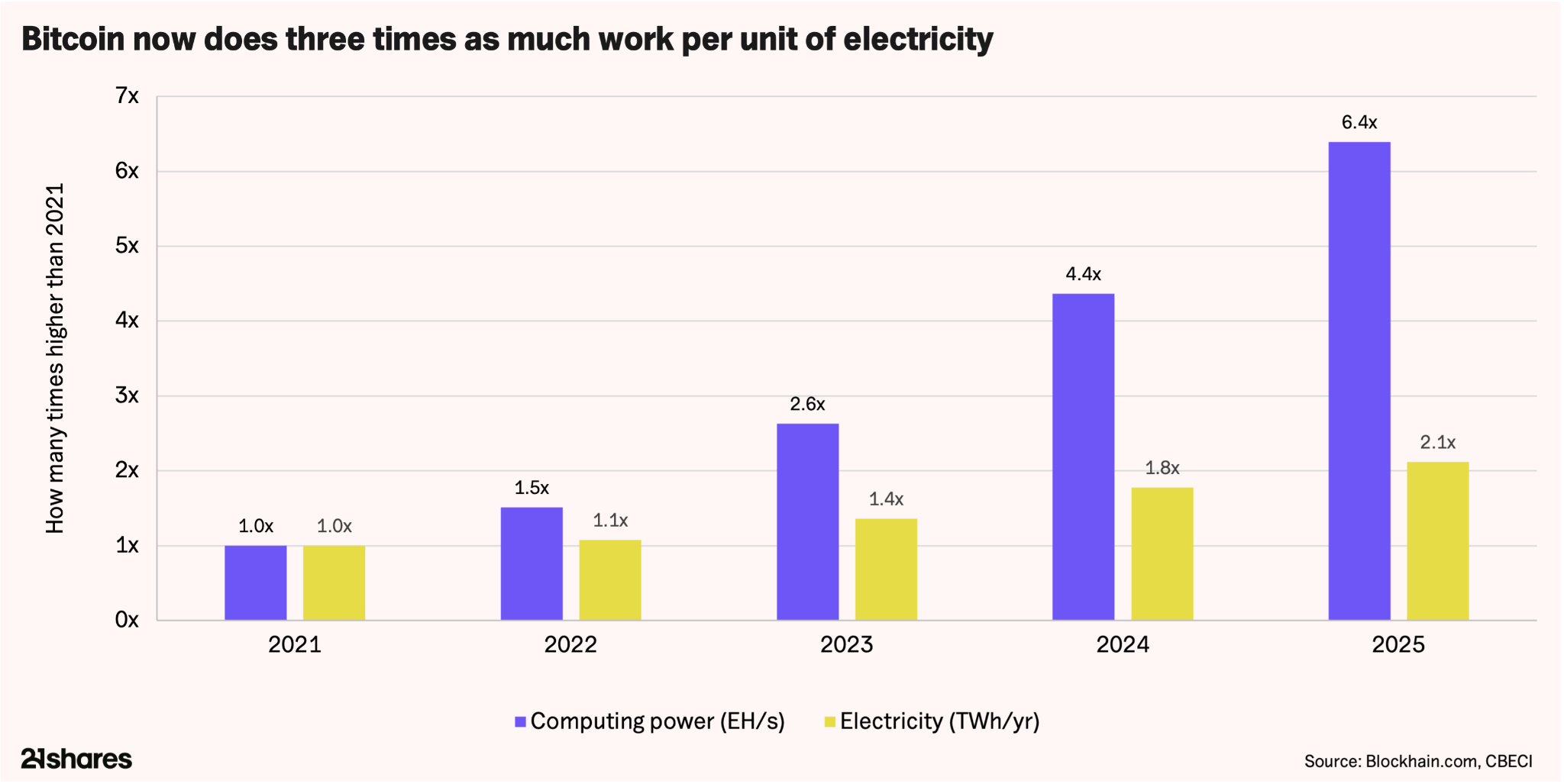
Bitcoin mining has become far more efficient. Between 2021 and 2025, the network’s computing power increased roughly sixfold, while electricity consumption only doubled. That means Bitcoin now produces around three times more computing power for each unit of electricity it uses. Cambridge’s hardware data tells the same story: the average mining machine became roughly two-thirds more efficient over the same period.
This was not driven by a sustainability pledge. It comes from the economics of mining itself. Roughly every four years, Bitcoin cuts the reward paid to miners in half, most recently in April 2024, from 6.25 to 3.125 bitcoin per block. That puts immediate pressure on margins. Older, less efficient machines become uneconomical and are switched off, while newer hardware and lower-cost power take their place.
The result is a built-in pressure to keep improving efficiency. And because electricity is miners’ largest operating cost, they are constantly pushed toward the cheapest available sources of power, which increasingly include renewables.
What this means if you are thinking about investing
Bitcoin consumes significant electricity. Its total energy use is lower than estimates for the banking system as a whole, though higher than the banking system’s physical infrastructure alone. It also makes use of energy that might otherwise be curtailed or wasted, while mining itself has become measurably more efficient over time.
That improvement is not driven by a sustainability mandate. It is a consequence of Bitcoin’s economics: miners are continually pushed toward more efficient hardware and lower-cost power sources. The sustainability impact is therefore a welcome unintended consequence.
For an investor weighing whether the environmental case is a reason to stay out, the data suggests the picture is more nuanced than the headline number implies.
FAQ
How much energy does Bitcoin use compared to the banking system?
Bitcoin uses approximately 151 TWh of electricity per year. 21shares Research totaled the energy cost of global banking infrastructure, including data centers, branches, ATMs, cash logistics, and financial regulators, and arrived at approximately 237 TWh per year (21shares Research, 2025). On that basis, Bitcoin uses roughly two-thirds of what the global banking system consumes annually.
Is Bitcoin mining bad for the environment?
Bitcoin mining's environmental footprint is significantly better than most headlines suggest. More than half of the electricity used by the Bitcoin network now comes from renewable or nuclear sources (Cambridge Digital Mining Industry Report, 2025). Roughly 40% of the electricity used to mine Bitcoin would have been wasted without mining, including surplus hydropower, excess wind generation, and natural gas that would otherwise have been burned into the atmosphere. Cambridge directly measures 26% of mining as running off-grid; 21shares Research adds an estimated 10% from curtailed renewables and 5% from flared gas to reach that figure. Despite rising computing power, Bitcoin's carbon emissions have stabilized at 39.8 million metric tons of CO2 equivalent per year, as the energy mix continues to shift toward renewables.
Is Bitcoin's energy use getting better or worse over time?
Bitcoin's energy efficiency has improved substantially and continues to improve, driven by the economics of the system rather than any sustainability mandate. Between 2021 and 2025, the network's computing power increased roughly sixfold while its electricity use only doubled. In practical terms, Bitcoin now produces around three times more computing power for each unit of electricity it consumes. Cambridge's hardware data confirms the same trend: the average mining machine became roughly two-thirds more efficient over the same period. That pressure is structural. Roughly every four years, the reward paid to miners is cut in half, squeezing margins and making older, less efficient machines uneconomical. Over time they are replaced by newer hardware that produces more computing power at lower cost.