
The stablecoin market cap has reached a new peak, evolving far beyond its original role as mere “digital dollars.” Today, stablecoins power everything from daily payments to global settlements, offering speed, programmability, and borderless access. But 2025 marks a turning point: stablecoins hit an all-time high of over $242 billion in May, stepping into the mainstream and becoming the financial infrastructure behind some of the internet’s biggest platforms.
Payment giants tap stablecoins
More internet companies are embracing stablecoins. Meta, for instance, is exploring stablecoins to pay content creators faster and more efficiently. Unlike traditional banking, which is slowed by business hours and high intermediary fees, stablecoins enable near-instant, low-cost cross-border payments, up to 99% faster and 90% cheaper.
That’s why platforms like Stripe and PayPal have supported stablecoin transactions for the past two years. Mastercard has also partnered with MoonPay to enable users to spend stablecoins via Mastercard-branded cards at over 150 million merchants, converting crypto to fiat in real time. Meanwhile, Visa is piloting stablecoin settlements on Solana, and PayPal’s PYUSD is gaining adoption.
Even traditional banks are stepping in: ING and Bank of America have announced plans to explore stablecoins in 2025. The takeaway? Stablecoins are no longer just a tool for crypto natives; they’re becoming the financial backbone of Web2, the era of social media, and digital commerce.
What is the size of the stablecoin market?
- Stablecoin market cap reached a record $242.81 billion in May 2025.
- Global stablecoin transactions totaled $27.6 trillion in 2024, per the World Economic Forum.
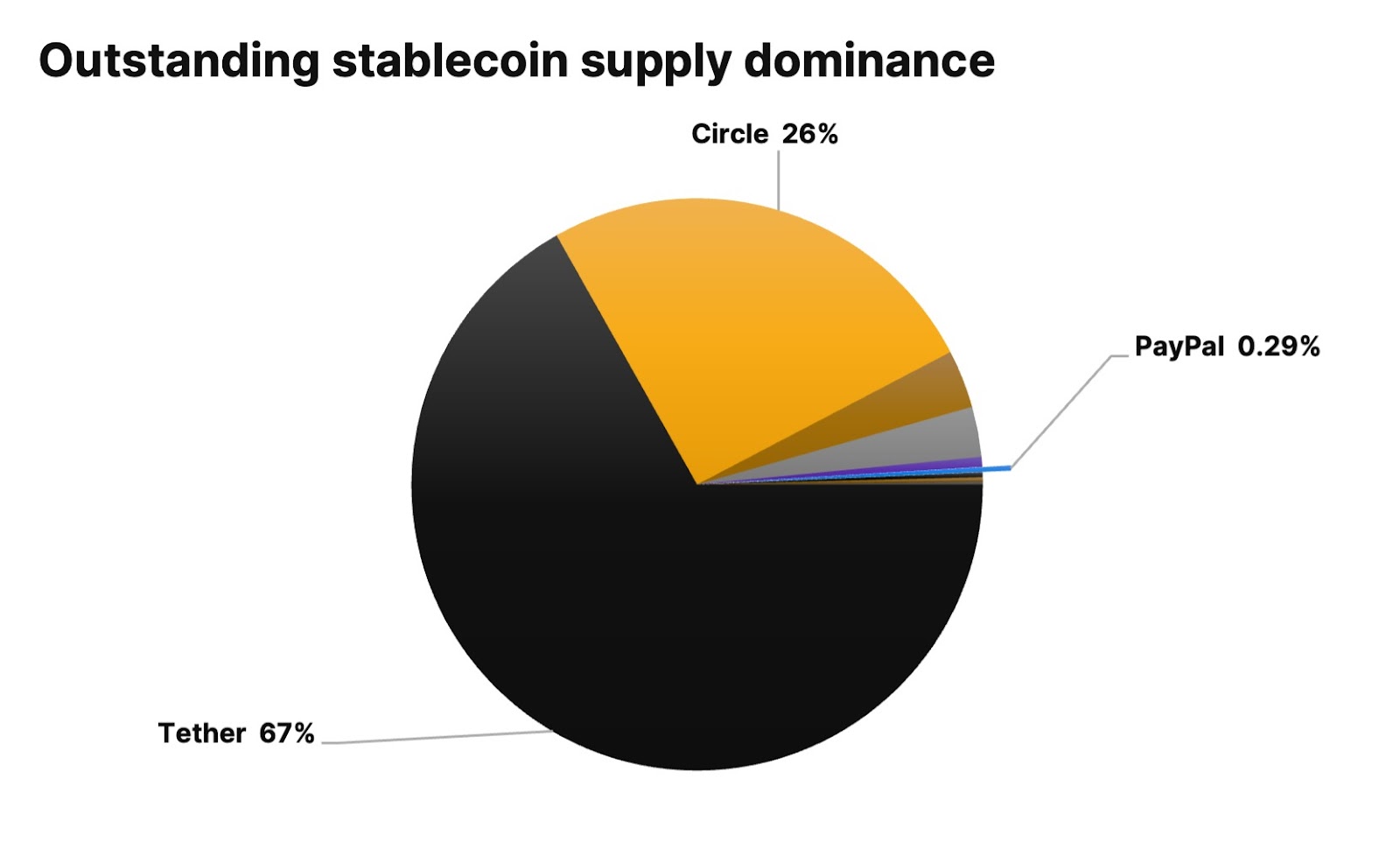
- USDT, the largest stablecoin by market cap, exceeded $150 billion in circulation as of May 12, 2025, gaining $11 billion this year and commanding 62% of the market.
- Citi’s Future of Finance think tank projects stablecoins could soon outpace the total crypto market cap, with supply potentially reaching $1.6 trillion.

Wall Street embraces stablecoins
A Fireblocks survey of 295 financial executives revealed that 90% of institutions are either using or actively exploring stablecoins. Nearly half (49%) are already leveraging them for payments, citing benefits like faster settlement, enhanced transparency, better liquidity, and lower costs. As clear use cases emerge and regulatory momentum builds, highlighted by the US Senate’s advancement of the GENIUS Stablecoin Act, institutions are gearing up for stablecoins to become a core part of the financial system.
What’s next? Yield-bearing stablecoins
Even more transformative is the rise of yield-bearing stablecoins, programmable digital dollars that offer returns similar to US Treasury bills (4%+ APY) while staying fully liquid. For DAOs (blockchain-based organizations governed by computer code), businesses, and everyday users, they present a smart way to earn on idle funds without losing flexibility. These assets are becoming a powerful link between traditional finance and decentralized tools.
Stablecoins unlock fresh use cases
Stablecoins are rapidly expanding beyond their original use case. From exchanges like Bybit, which now let users trade global equities using USDT, to tokenized U.S. Treasuries like BlackRock’s BUIDL, which jumped 19.3% last month to $2.89 billion, stablecoins are becoming more than just a bridge into crypto. They’re emerging as a global liquidity layer for finance.
In short, stablecoins have grown beyond their origins as simple crypto tools. They’re becoming the financial backbone of both today’s internet economy and tomorrow’s on-chain world. And for investors, this shift is just beginning.