

Ethereum (ETH) is reasserting its strategic relevance. After a period of consolidation, the second-largest cryptocurrency by market capitalization is once again drawing significant attention, not just from retail participants but more importantly from institutional investors, asset managers, and enterprise innovators. The shift is being driven by a series of structural developments that reinforce Ethereum’s role as the foundational layer of the decentralized economy. For investors seeking long-term value in digital assets, Ethereum is increasingly difficult to ignore.
Institutional capital is flowing back into Ethereum
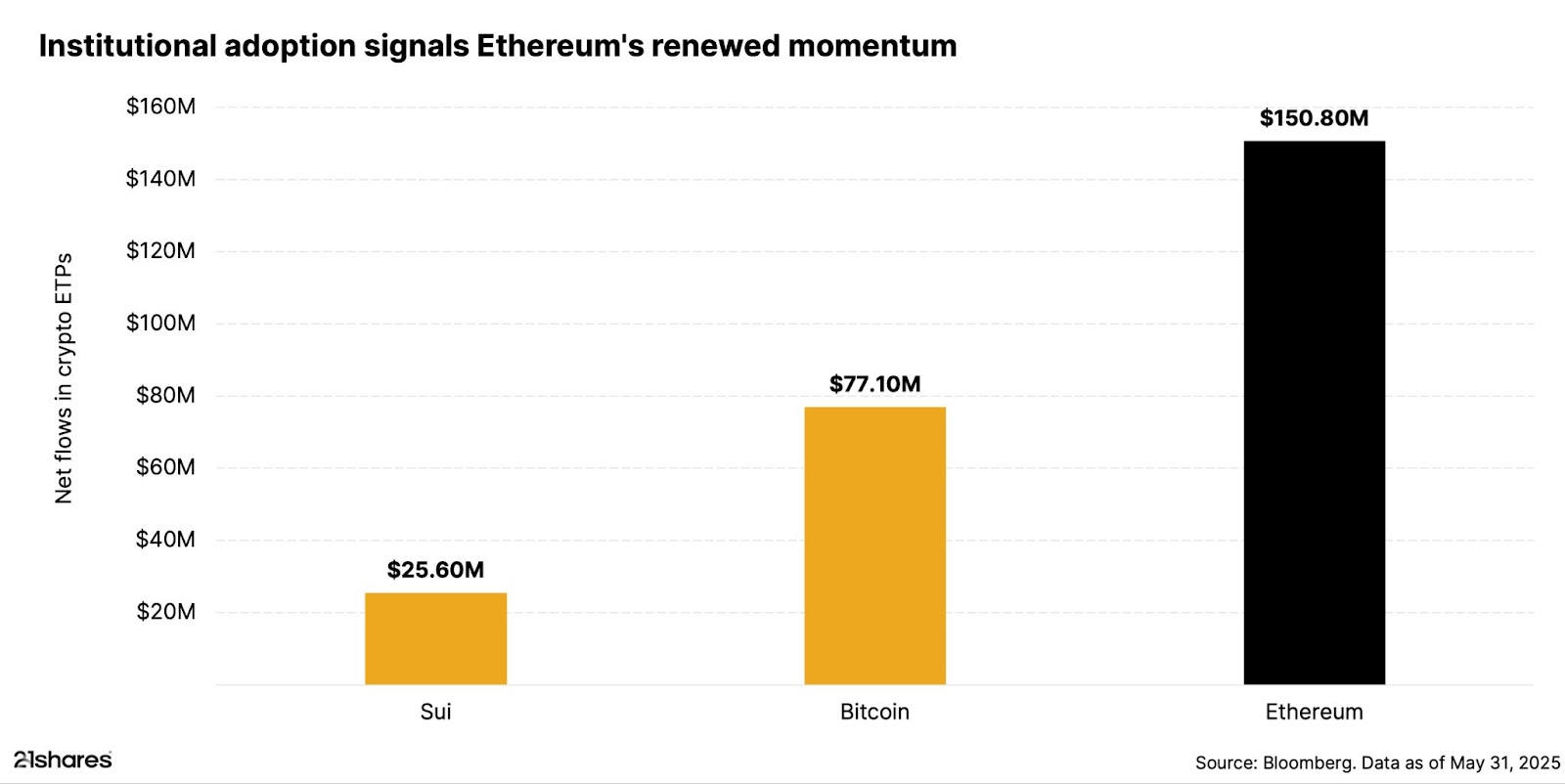
One of the most compelling indicators of Ethereum’s renewed momentum is the sharp uptick in institutional capital allocation. In May, Ether-based investment products in Europe attracted $150 million in inflows, surpassing all other digital assets and nearly doubling Bitcoin’s $77 million. This represents Ethereum’s strongest monthly inflow since December 2024 and signals a decisive shift in market sentiment.
After a prolonged period of underperformance, Ethereum is now at the forefront of capital flows within the crypto exchange-traded fund (ETP) space, underscoring a resurgence in investor confidence and positioning as an institutional priority.
Ethereum’s first public treasury strategy is here
A structural shift is taking shape as public companies begin adopting Ethereum not just as an asset, but as a core part of their operational strategy. In a landmark move, Nasdaq-listed SharpLink Gaming secured a $425 million private placement led by Consensys, the Ethereum-focused software firm. The capital will fund an aggressive initiative to establish the largest ETH treasury among publicly traded companies, a bold positioning that reframes Ethereum as both a strategic reserve asset and a growth enabler.
SharpLink’s plans go beyond balance sheet exposure. The company intends to actively stake ETH, participate in DeFi protocols, and build directly on Ethereum’s infrastructure. This level of integration signals a deeper institutional commitment to the Ethereum ecosystem. Notably, Consensys CEO and Ethereum co-founder Joe Lubin has joined SharpLink’s board as Chairman, solidifying the strategic alignment and validating the long-term thesis for Ethereum's enterprise relevance.
Scaling the base layer by 10x
At the core of Ethereum’s resurgence is growing conviction in its technical roadmap, one that is now beginning to deliver measurable results. At ETHGlobal in Prague, Ethereum co-founder Vitalik Buterin outlined a bold vision to scale the network’s base layer tenfold over the next year. This includes planned upgrades such as delayed execution, distributed storage, and a higher gas limit, all building on the recent Pectra upgrade, which aimed at improving the scalability of Ethereum.
While Layer 2 networks like Base and World Chain are already processing hundreds of transactions per second, Ethereum’s Layer 1 is being optimized to support a new era of high-value activity. This includes next-generation DeFi applications, tokenized real-world assets, and institutional-grade settlement layers. The architecture separating execution from data availability is beginning to fulfill its promise: delivering secure, cost-efficient, and globally scalable infrastructure. Early traction is particularly visible in the tokenization space, where Ethereum continues to lead in adoption and innovation.

A cultural shift toward execution and adoption
A cultural and organizational shift within the Ethereum ecosystem is accelerating alongside its technical and market momentum. The Ethereum Foundation, historically centered on research and conservative protocol design, is evolving toward a more product-driven, adoption-focused approach. The broader community is now prioritizing user experience and institutional onboarding, all while maintaining Ethereum’s core principles of decentralization, neutrality, and security.
There’s a growing recognition that being the most technically robust protocol isn’t enough. Ethereum is positioning itself to actively compete for block space and establish itself as the default infrastructure layer for the next generation of the internet.
Traders are following the fundamentals
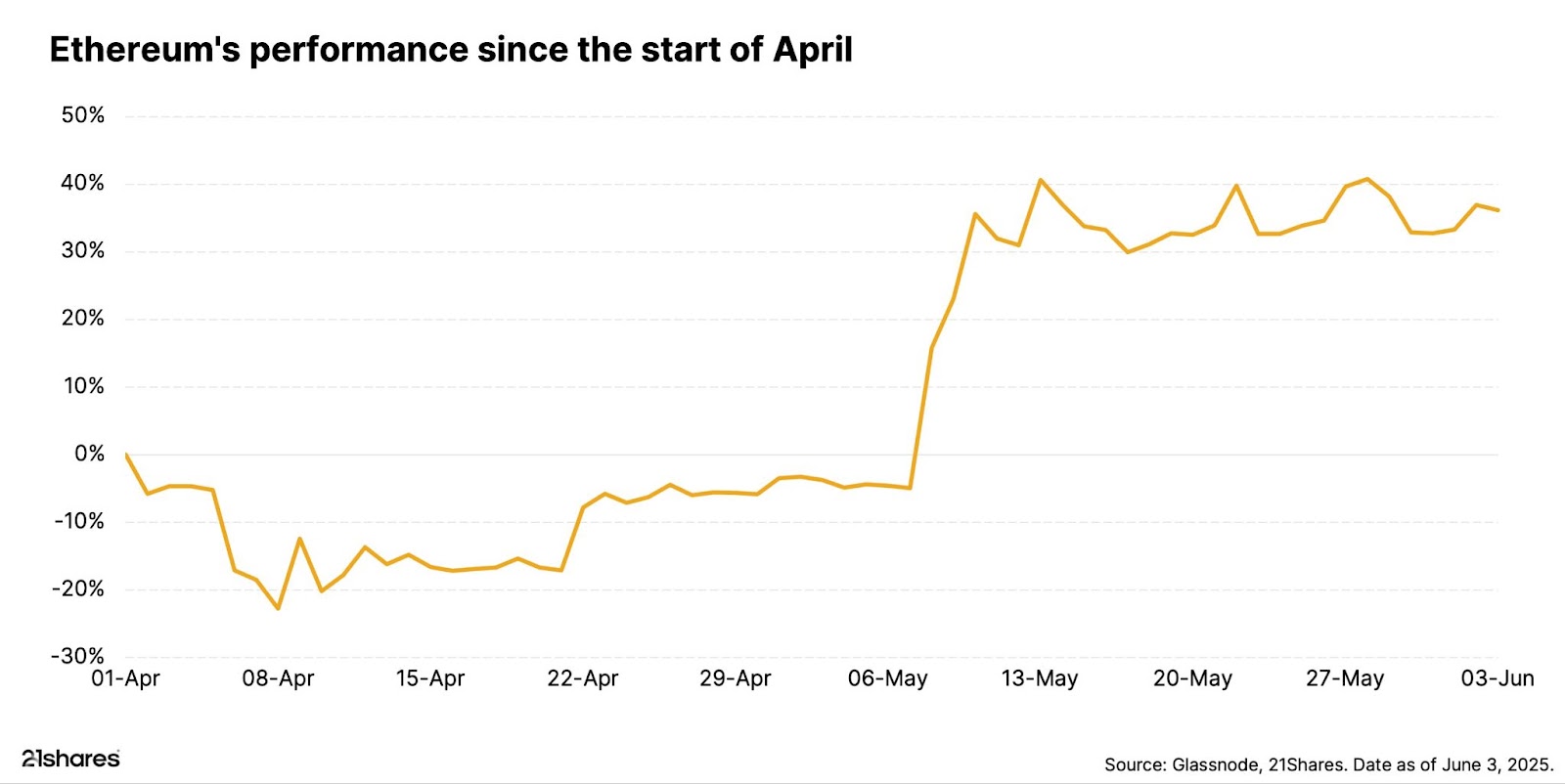
From its April lows around $1,400, Ethereum had rallied more than 80% when it briefly approached $2,800. Market sentiment has turned decisively bullish, with options activity providing clear confirmation. On Deribit, open interest in ETH contracts has exceeded $5 billion, with call options heavily outweighing puts, an indication of strong upside positioning.
Institutional capital is re-entering the market, and crypto-native whales are once again accumulating. This shift in sentiment isn’t just momentum-driven; it’s being fueled by tangible fundamentals and a renewed conviction in Ethereum’s long-term trajectory.
Conclusion
Ethereum is evolving from a smart contract platform into the coordination layer of the next-generation digital economy. From decentralized finance and AI-driven protocols to tokenized real-world assets, Ethereum is emerging as the default trust and settlement layer.
The renewed momentum from traders and institutions isn’t driven by hype as it’s grounded in real progress. Ethereum is stepping back into the spotlight, and this time, the market is paying attention for all the right reasons.










_logo.svg)
.svg.png)