Deine Fragen beantwortet: Wie identifiziert man potenzielle Gewinner im Bereich digitaler Assets? (Teil 1)




Da Investoren letztlich Gewinner auswählen wollen, war klar, dass unsere Serie Wie man potenzielle Gewinner erkennt Aufmerksamkeit erregen würde. Dieser Artikel beantwortet die wichtigsten Fragen, die nach der Veröffentlichung von Teil 1 eingegangen sind.
Wie steht der Umsatz im Vergleich zu anderen Kennzahlen?
Ist Umsatz das Wichtigste? Teil 1 erklärt, warum der Umsatz weiterhin eine zentrale Kennzahl ist, wenn man die nächste Generation digitaler Asset-Gewinner identifizieren möchte. Aber der Umsatz erzählt nur einen Teil der Geschichte. Schau dir zum Beispiel die frühen Tage von Facebook/Meta an: Würde man das Unternehmen damals ausschließlich anhand des Umsatzes bewerten, hätte man die weitaus wichtigeren Treiber für langfristiges Wachstum übersehen: das Nutzerwachstum und die Netzwerkeffekte, die in den nächsten zehn Jahren zu einer Rendite von über 500 % führten. Nur auf die Finanzen zu schauen, hätte den zugrunde liegenden Wachstumspfad übersehen, der den Aufstieg des Unternehmens ausmachte.
Bei digitalen Assets gilt dasselbe Prinzip: Ohne eine lebendige Entwickler- und Innovator-Community sowie eine wachsende Nutzerbasis riskieren selbst die vielversprechendsten Plattformen, in Vergessenheit zu geraten. Teil 2 unserer Serie geht hier noch tiefer ins Detail.
Wie sollte man bei der Bewertung von Netzwerken vorgehen?
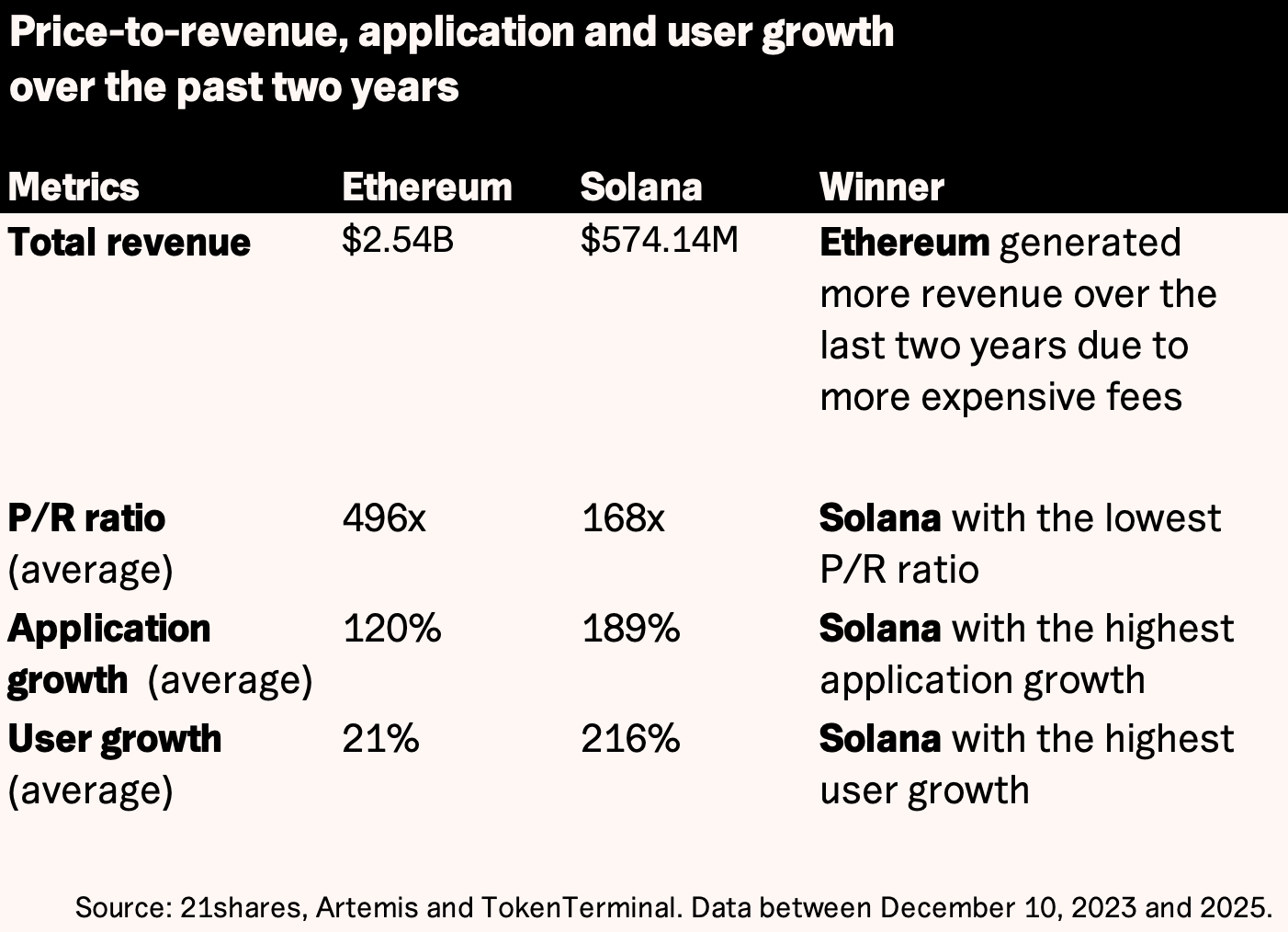
Eine Bewertung wird erst dann sinnvoll, wenn man sie im Kontext von Wachstum betrachtet. Ein höheres Kurs-Umsatz-Verhältnis (P/R) erfordert ein stärkeres Wachstum bei Entwicklern und Nutzern, um die Prämie zu rechtfertigen. Wie die Tabelle unten zeigt, handelt Solana auf Basis aktueller Daten mit einem niedrigeren P/R-Multiple als Ethereum, wächst dabei aber schneller bei Anwendungen und Nutzern. Das deutet darauf hin, dass es fundamental gesehen potenziell attraktiver bewertet sein könnte. Gleichzeitig scheint Ethereum gerade eine neue Phase mit verstärktem Momentum zu betreten, wie einige Entwicklungen (Teil 2) nahelegen, die auf eine mögliche Erholung des Umsatzes hindeuten.
Gibt es Parallelen zwischen der Auswahl von Krypto- und Internet-Gewinnern?
Die Krypto-Adoption 2025 ähnelt stark der Situation des Internets 2003. Damals hatten etwa 600 bis 700 Millionen1 Menschen Zugang zum Internet, rund 9-11 % der Weltbevölkerung. Heute liegt die Zahl der Krypto-Nutzer in einem ähnlichen Bereich, geschätzt bei 550-600 Millionen2. Wie nach der Dotcom-Blase ist die spekulative Überhitzung abgeklungen, der Umsatz hat sich normalisiert, und der Fokus verschiebt sich auf echten Nutzen. Verglichen mit dem Lebenszyklus des Internets befinden wir uns in der Phase, in der langlebige Unternehmen wie Amazon und Google aufgebaut wurden und ein ähnliches Muster zeigt sich nun auch bei Krypto-Netzwerken jenseits von ICO-, NFT- und Memecoin-Zyklen.
In welcher Marktphase befindet sich Solana?
Solana tritt in einer Phase ähnlich der frühen Expansion von Ethereum nach einem Hype-Zyklus ein, allerdings mit einem anderen Wertversprechen, das auf niedrige Gebühren und schnelle Verarbeitung setzt.
- Ein klarer Wandel in der Netzwerkaktivität ist bereits erkennbar: Das Volumen von Memecoins ist 2025 von über 35 % auf unter 10 % gesunken, während das Volumen von Stablecoins um fast 150 % gewachsen ist, von 2,87 % auf fast 7 % aller Aktivitäten auf den wichtigsten Börsen.
- Gleichzeitig haben Solanas Anwendungen bisher den höchsten Ökosystem-Umsatz erzielt: 2025 waren es 4,39 Mrd. USD gegenüber 4,10 Mrd. USD 2024, obwohl die spekulative Aktivität deutlich zurückgegangen ist.
Während die Protokoll-Umsätze also auf das Niveau Ende 2023 zurückgekehrt sind, positionieren Integrationen mit Klarna, Revolut und Western Union Solana für nachhaltigeres Wachstum. Stablecoins und Decentralized Physical Infrastructure Networks (DePIN), also Onchain-Mobilfunkanbieter, dürften diese Trends weiter verstärken.
Diese Integrationen helfen, Solanas adressierbaren Markt im kommenden Jahr und darüber hinaus einzuschätzen. Western Union3 und Revolut4 erzielten 2024 jeweils rund 4 Mrd. USD Umsatz, die zugrunde liegenden Zahlungsvolumina unterscheiden sich jedoch stark. Western Unions jährliches Remittance-Volumen von ca. 135 Mrd. USD5 liefert eine Basis für grenzüberschreitende Zahlungen, die über den geplanten Solana-basierten Stablecoin abgewickelt werden könnten. Revolut hingegen verarbeitete 2024 über 1 Billion Pfund (~1,3 Billionen USD)6, also mehr als das Zehnfache des Volumens von Western Union, und unterstützt jetzt direkt Solana-basierte Stablecoin-Transfers. Selbst wenn nur 10 % von Revoluts Zahlungsaktivität auf Stablecoins verschoben wird, würden über 130 Mrd. USD jährlich über Solana laufen und Solana als zentrales Settlement-Rail für einen der größten Fintech-Zahlungskanäle im Krypto-Bereich positionieren. Die Auswirkungen dieser Integrationen sollten also in den kommenden Monaten im Umsatz sichtbar werden.
In welcher Marktphase befindet sich Ethereum?
Ethereum adressiert seine langjährigen Herausforderungen hoher Kosten und Umsatzverluste durch Skalierungslösungen (Layer 2). Nach Jahren der Priorisierung externer Lösungen beginnt das Netzwerk, die Basisschicht selbst zu verbessern. Die Gebühren sind in den letzten Monaten auf unter einen Dollar gefallen, und Upgrades wie Fuska sollen die Nutzung des Mainnets effizienter machen, während die Sicherheits- und Liquiditätsvorteile von Ethereum erhalten bleiben. Wie wir in Teil 2 zeigen, berücksichtigen Entwickler dies zunehmend und beginnen wieder, auf Ethereum zu bauen, in Erwartung dieser Upgrades.
Welche Treiber für nachhaltiges langfristiges Wachstum gibt es?
Sowohl bei Solana als auch bei Ethereum zeigt sich, dass der nächste Schritt darin besteht, den Fokus auf die Fundamentaldaten zu legen, die langfristiges Wachstum tragen und ein differenzierteres Bild der technologischen Reife vermitteln. Im Zentrum stehen dabei Entwickler und Nutzer, die diesen Netzwerken letztlich ihren realen wirtschaftlichen Zweck geben.
Ähnlich wie in der traditionellen Finanzwelt sollten Krypto-Investoren vor einer Investition die zugrunde liegende wirtschaftliche Stärke einer Plattform prüfen. Entscheidend ist die Bewertung der Gesundheit des Ökosystems, also die Anzahl der Entwickler und die wachsende Nutzerbasis, die die Technologie tatsächlich nutzt und nicht nur die zugrunde liegenden Assets hält.
Am Ende bleibt das Ziel unverändert. Ein strukturiertes und datenbasiertes Rahmenwerk bereitzustellen, mit dem sich die potenziellen Gewinner von morgen identifizieren lassen, gestützt auf beobachtbare Fundamentaldaten statt auf Hype oder Spekulation.
______
Fußnoten:
- Global Policy Forum. (n.d.). Internet users [Archived statistics]. Retrieved from https://archive.globalpolicy.org/component/content/article/109-tables-and-charts/27519-internet-users.html
- Triple-A Technologies Pte. Ltd. (n.d.). Digital currency ownership data. Retrieved from https://www.triple-a.io/cryptocurrency-ownership-data
- Business Wire. (2025, February 20). Western Union reports fourth quarter and full year 2024 results. Retrieved from https://www.businesswire.com/news/home/20250204893052/en/Western-Union-Reports-Fourth-Quarter-and-Full-Year-2024-Results
- Revolut. (n.d.). Record growth and diverse product offering drive Revolut to $1.4bn profit in 2024. Retrieved from https://www.revolut.com/pt-PT/news/record_growth_and_diverse_product_offering_drive_revolut_to_1_4bn_profit_in_2024/
- International money transfer statistics report. (n.d.). TopMoneyCompare. Retrieved from https://www.topmoneycompare.co.uk/guides/international-money-transfer-statistics-report
- Rice, S. (2025, April 24). How Revolut redefined digital banking in 2024. FinTech Magazine. Retrieved from https://fintechmagazine.com/banking/how-revolut-redefined-digital-banking-in-2024
This report has been prepared and issued by 21Shares AG for publication globally. All information used in the publication of this report has been compiled from publicly available sources that are believed to be reliable, however, we do not guarantee the accuracy or completeness of this report. Crypto asset trading involves a high degree of risk. The crypto asset market is new to many and unproven and may have the potential not to grow as expected.Currently, there is relatively small use of crypto assets in the retail and commercial marketplace in comparison to relatively large use by speculators, thus contributing to price volatility that could adversely affect an investment in crypto assets. In order to participate in the trading of crypto assets, you should be capable of evaluating the merits and risks of the investment and be able to bear the economic risk of losing your entire investment.Nothing herein does or should be considered as an offer to buy or sell or solicitation to buy or invest in crypto assets or derivatives. This report is provided for information and research purposes only and should not be construed or presented as an offer or solicitation for any investment. The information provided does not constitute a prospectus or any offering and does not contain or constitute an offer to sell or solicit an offer to invest in any jurisdiction. The crypto assets or derivatives and/or any services contained or referred to herein may not be suitable for you and it is recommended that you consult an independent advisor. Nothing herein constitutes investment, legal, accounting or tax advice, or a representation that any investment or strategy is suitable or appropriate to your individual circumstances or otherwise constitutes a personal recommendation. Neither 21Shares AG nor any of its affiliates accept liability for loss arising from the use of the material presented or discussed herein.Readers are cautioned that any forward-looking statements are not guarantees of future performance and involve risks and uncertainties and that actual results may differ materially from those in the forward-looking statements as a result of various factors.This report may contain or refer to material that is not directed to, or intended for distribution to or use by, any person or entity who is a citizen or resident of or located in any locality, state, country or other jurisdiction where such distribution, publication, availability or use would be contrary to law or regulation or which would subject 21Shares AG or any of its affiliates to any registration, affiliation, approval or licensing requirement within such jurisdiction.








_logo.svg)
.svg.png)