

Additional contributions from Eliézer Ndinga and Karim AbdelMawla
TL;DR
- The Digital Asset Market Clarity (CLARITY) Act has successfully passed the House and cleared both Senate committees, but it has yet to be brought to the Senate floor. According to prediction market platforms, the probability of the bill being enacted in 2026 remains below 50%.
- Most of what investors were waiting on - spot ETFs and ETPs across bitcoin, Ethereum, Solana, and XRP - has already arrived. The bill's real value is regulatory durability and harmony for digital assets in the US: locking today's crypto-friendly regulatory posture into law so it may survive a change of administration potentially hostile to cryptoassets.
- Based on the 2024 US-election precedent, bitcoin and the broader crypto market are expected to become increasingly sensitive to the CLARITY Act's odds as the vote approaches. The closer the market gets to a final resolution, the more likely price action will mirror the legislative outcome.
While Congress is closer than ever to creating a permanent legal framework for digital assets, the final milestone remains further away than recent headlines imply. The CLARITY Act, a US bill designed to divide digital asset oversight between the Securities and Exchange Commission (SEC) and the Commodity Futures Trading Commission (CFTC) and legally define tokens as securities or commodities, has already progressed past the House and cleared two Senate committees.1 Typically, legislative bills originate in either chamber, requiring approval from both a committee and a full floor vote before repeating the process in the second chamber and reaching the president for signature. Notably, a presidential veto can be overridden by a two-thirds majority vote in both chambers. Nevertheless, the prospect of the CLARITY Act becoming law in 2026 remains uncertain.
Rather than serving as a catalyst for crypto access, the significance of the bill lies in structural changes. Investors can already obtain spot exposure to Bitcoin, Ethereum, Solana, and XRP via US-listed ETFs and ETPs without needing the CLARITY Act. Instead, it establishes a key structural distinction: a temporary regulatory stance dependent on the current administration versus an enacted statute that provides a durable, legally binding framework resistant to being easily overturned by future administrations.
Evaluating the subsequent points requires understanding this core distinction between a reversible administrative posture and durable statutory law.

Three blockers are standing between the bill and 60 votes
The outcome rests with a small group of Democrats who have engaged on crypto policy: Kirsten Gillibrand has tied her vote to an ethics provision. Mark Warner has conditioned his vote on closing national-security gaps around decentralized finance.
1. Stablecoin yield
While the Senate draft allows activity-based rewards for stablecoin holders, it prohibits passive interest similar to traditional deposits. Consequently, banks interpret this shift as a precursor to deposit flight that lacks equivalent regulatory safeguards.In late May, Jamie Dimon called it a structure that "would eventually blow up;" this is the banking lobby's live and economically grounded objection.2
2. An ethics standoff
To secure the vote, language that would prevent officials from holding cryptocurrency while actively regulating the asset class, originally aimed at ventures tied to the Trump family, was removed from the May Banking Committee text. Recently, however, this restriction was brought back in the form of a draft bill, establishing a temporary ban for the current administration that runs until 2029.3
3. Other priorities
The two Senate text versions must be merged before a floor vote is possible, and the calendar is congested. Government funding, the defense authorization bill, and a surveillance-law renewal all take priority over a market-structure bill with no hard deadline to enforce.4
The structural risks the bill does not resolve
1. Understaffed regulator
Operating with a staff reduction of roughly 20% and one of its five commissioner seats left vacant, the Commodity Futures Trading Commission (CFTC) is receiving oversight responsibilities for a growing digital asset markets.5 Hence, Democrats have explicitly raised CFTC funding and quorum as conditions, highlighting that the concern over creating "the appearance of regulation without meaningful oversight" is structural rather than partisan.¹¹
2. Investor-protection gap
The introduction of a maturity mechanism, enabling a token to move outside SEC oversight upon attaining sufficient network decentralization, could introduce a critical regulatory gap. This loophole has prompted warnings from a former SEC chief accountant regarding the potential for another FTX-style failure. Such an alarm highlights genuine litigation exposure and increases the likelihood that a subsequent Congress might re-examine the proposed framework.
3. The crypto access hurdle has already been resolved
Regarding market access specifically, the bill's intended impact has already been largely overtaken by events. The SEC's approval of generic listing standards in September 2025 dramatically shortened the ETF/ETP approval window from approximately 240 days to just 75. As a result, spot Solana and XRP funds were successfully introduced in the following months, entirely independent of the CLARITY Act.6
Passage odds have fallen: here is what could shift them
The probability on Polymarket's "signed in 2026" contract declined to the mid-40% range in early to mid-June, falling from about 73% just one month prior.8 Kalshi placed passage before August at roughly 22%. Galaxy has trimmed its own estimate to 60%.9
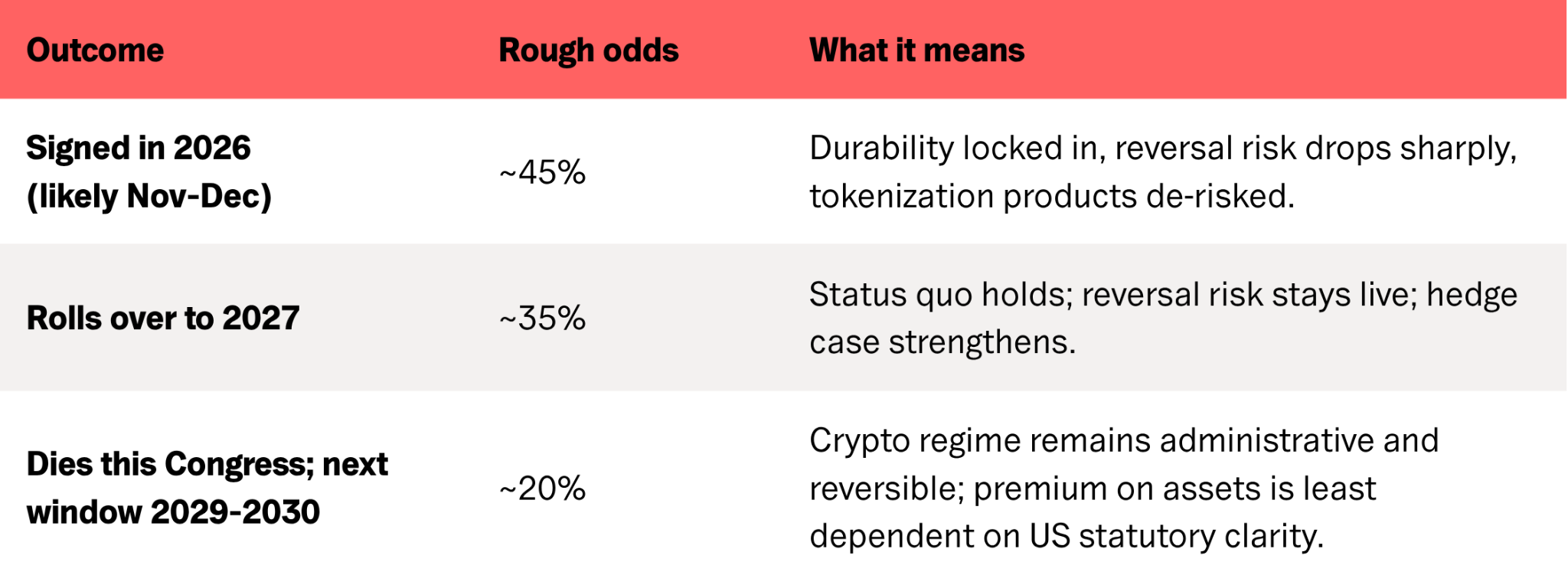
The base case: 2026 passage is more likely in the post-election lame-duck window than before the summer recess, and a slip into 2027 is firmly on the table.
What would shift the odds upward? A firm floor commitment from the Senate Majority Leader before the August recess. Credible trackers suggest that alone would push passage probability back toward 75%.9 The near-term signal to watch is whether his office places the bill on the active floor schedule within roughly the next two weeks.
What would shift them downward? A public break by any one of the swing Democrats.
The table below maps the three most likely outcomes and what each means for crypto market access.
What history can tell us about Bitcoin’s potential reaction to CLARITY
While past performance doesn't indicate future results, it can give us historical context for how bitcoin may react if CLARITY is or is not passed. To that end, we can look at how bitcoin reacted to the 2024 presidential election and use that as a benchmark for how Bitcoin might react if CLARITY fails to pass.
When we ran a regression analysis of the 2024 presidential election, Bitcoin exhibited no statistically significant relationship with election odds for most of the campaign cycle, only becoming sensitive in the final two weeks as the outcome neared resolution. When Trump's probability of winning rose, as an indication of an upcoming crypto-friendly US environment, bitcoin broke key resistance levels and rallied approximately 25%.
A similar analysis applied to CLARITY Act and 2026 House prediction markets currently shows no statistically significant relationship with bitcoin price. This is likely a function of market size: the Presidential Election market generated $3.7 billion in volume, versus $1.6 million for CLARITY and $8.4 million for the House race, limiting the signal available. Additionally, Democrats have been heavy favorites in the House market throughout most of its two-year duration, reducing price-sensitive uncertainty.
Drawing on the 2024 precedent, we would expect Bitcoin and the broader crypto market to grow increasingly sensitive to CLARITY Act odds as a vote approaches. The closer the market gets to resolution, the more likely price action will begin to reflect the legislative outcome.
Key dates on the 2026 Senate calendar
- Early August: runs August 8 - September 13, offering a brief legislative window prior to the August recess.
- September 14 onward: a realistic though rapidly closing post-summer legislative window.
- October 3 - November 8: midterm campaign period, resulting in minimal legislative progress.
- Post-election lame-duck session (November-December): represents the most probable route to achieving a presidential signature in 2026.10
What a CLARITY Act crypto framework would - and would not - cover
It is market-structure law, not tax law. It does not resolve how tokens or staking rewards are taxed. It does not retroactively ratify every existing token as a commodity - assets must still clear the maturity test, and contested ones remain contested. It does not settle decentralized finance cleanly, which is where the two Senate texts diverge most sharply. And it does not touch the GENIUS stablecoin regime, which is already law.⁸
Bottom line
CLARITY is worth watching, but investors waiting on it for access have largely already got what they needed through other means. The spot ETF and ETP landscape has expanded faster than the legislative calendar - Solana, XRP, and others arrived without a statute. The bill's contribution, if it passes, is durability: making today's posture harder to reverse. The risk it hedges against is real, but it is a tail risk, not an immediate one.
The clearest second-order beneficiary is tokenization - onchain treasuries and similar instruments represent a market approaching $30 billion that CLARITY would de-risk rather than originate. Regulatory and liquidity risks in tokenized instruments remain material regardless of the bill's outcome. Watch the Senate Majority Leader's scheduling decisions over the next two weeks. That is the most concrete near-term signal of whether 2026 is still in play.
FAQ
Q: Has the CLARITY Act passed? A: The CLARITY Act has passed the House and cleared both Senate committees, but it has not reached the Senate floor and is not law. Prediction markets placed the odds of a 2026 signing below 50% as of mid-June 2026.
Q: What does the CLARITY Act do? A: It establishes in law which US regulator - the SEC or the CFTC - governs which digital assets. It is market-structure legislation, not tax law, and does not resolve how tokens or staking rewards are taxed.
Q: Why is the CLARITY Act stalling in the Senate? A: Three factors: a banking-industry dispute over stablecoin yield, a standoff over ethics provisions targeting officials who hold crypto while regulating it, and a crowded Senate calendar that prioritizes must-pass spending and defense legislation.
Q: What happens to crypto investments if the CLARITY Act fails? A: Existing spot ETFs and ETPs would not be affected. The current regulatory posture would remain in place but stay reversible by a future administration - which is the core risk the bill is designed to eliminate.
Q: Does the CLARITY Act affect bitcoin and Ethereum ETFs? A: No. Bitcoin and Ethereum ETFs and ETPs are already approved and trading. The bill's primary impact would be on the longer-term durability of the regulatory framework and on the path for broader token listings and tokenized asset products.
Footnotes
- U.S. Congress. (2025). H.R. 3633 – Digital Asset Market Clarity Act: All actions, 119th Congress. Congress.gov. https://www.congress.gov/bill/119th-congress/house-bill/3633/all-actions
- Braun, H. (2026, May 29). 'The banks will not accept it': JP Morgan's Dimon escalates battle over stablecoin rewards in CLARITY Act debate. CoinDesk. https://www.coindesk.com/policy/2026/05/29/the-banks-will-not-accept-it-dimon-escalates-battle-over-stablecoin-rewards-in-clarity-act-debate
- Hamilton, J. (2026, July 22). New draft of Clarity Act is out, and it would impose limits on Trump's crypto empire. CoinDesk. https://www.coindesk.com/policy/2026/07/22/new-clarity-act-emerges-that-s-a-start-on-the-final-draft-makes-ethics-rule-temporary
- Hamilton, J. (2026, June 3). Clarity Act survival depends on the U.S. Senate getting a lot of non-crypto work done. CoinDesk. https://www.coindesk.com/news-analysis/2026/06/02/clarity-act-survival-depends-on-the-u-s-senate-getting-a-lot-of-non-crypto-work-done
- Commodity Futures Trading Commission. (2025, December 22). Michael Selig sworn in as 16th CFTC Chairman (Release No. 9164-25). https://www.cftc.gov/PressRoom/PressReleases/9164-25
- Securities and Exchange Commission. (2025, September 17). SEC approves generic listing standards for commodity-based trust shares (Release No. 2025-121). https://www.sec.gov/newsroom/press-releases/2025-121-sec-approves-generic-listing-standards-commodity-based-trust-shares
- Polymarket. (n.d.). CLARITY Act signed into law in 2026 [Prediction market]. Retrieved July 23, 2026, from https://polymarket.com/event/clarity-act-signed-into-law-in-2026
- The Defiant Team. (2026, June 8). Over 200 crypto firms urge Senate vote on CLARITY Act as Galaxy cuts passage odds to 60%. The Defiant / Converge. https://thedefiant.io/converge/regulation/200-crypto-firms-urge-senate-vote-clarity-act-galaxy-cuts-passage-odds-60-percent
- The Defiant Team. (2026, June 8). Over 200 crypto firms urge Senate vote on CLARITY Act as Galaxy cuts passage odds to 60%. The Defiant / Converge. https://thedefiant.io/converge/regulation/200-crypto-firms-urge-senate-vote-clarity-act-galaxy-cuts-passage-odds-60-percent
- McIntire, M. E. (2025, November 19). Senate releases its 2026 calendar. Roll Call. https://rollcall.com/2025/11/19/senate-calendar-2026-midterm-election/