Part 2: How to identify potential winners in digital assets



Key takeaways:
- While revenue is a health check of a network right now, the depth and pace of developer activity indicate its potential, and user growth reflects current and expected value delivery.
- Both Ethereum and Solana are strengthening, but in different directions: Ethereum for high-security institutional applications, and Solana for fast, low-cost consumer activity with growing institutional integrations.
- Ethereum’s builder momentum has strengthened materially as fees fell and the software upgrade, “Fusaka”, arrived.
- Solana is finding its product-market fit in payments and high-frequency consumer applications.
- Solana is increasingly taking on the role of crypto's Silicon Valley, as an accelerating number of applications built on the network have already crossed the $100M mark in revenue.1
Identifying potential winners in digital assets goes beyond assessment of network security and revenue. This article explains why development activity, viewed through the lens of application deployment, and user growth dynamics are key factors to consider, using Solana and Ethereum as case studies.
Why is developer activity important?
If revenue tells us what a network is today, developer activity tells us what it can become. In digital assets, where open-source ecosystems evolve in realtime, the pace and depth of developer engagement are among the strongest leading indicators of long-term network value. Developers decide what gets built, how quickly the technology improves, and whether the platform can support new categories of applications. Put simply: without builders, there is no future cash flow, no expanding user base, and no durable competitive advantage.
However, developer activity is not a single metric but a range of signals that collectively reveal the strength of an ecosystem. Some capture early experimentation, others reflect real application deployment, and a few highlight the competitive advantage maintaining the protocol itself.
If we were to compare the development of cryptoassets to that of cities, four indicators provide the clearest view:
- Code commits, like ongoing city maintenance.
- Contract deployers, akin to entrepreneurs opening new shops.
- Contracts deployed, the businesses that fill the city.
- Core developers, the planners and engineers who build and protect its foundations.
With this in mind, the key metric to watch is the number of applications being built out. This is the one of the stronger signals that real value is being created and that the ecosystem is gaining momentum as they attract users and keep them engaged.
Another simple analogy is smartphones: people didn’t choose early iPhones or Android devices for the hardware alone – they chose the platform with the stronger app ecosystem offering the games, social apps, and everyday tools they relied on. Those early differences then helped attract more developers, creating an even richer ecosystem over time.
Crypto infrastructure networks follow the same logic. The platforms that draw the most useful and engaging applications grow faster, retain users, and ultimately generate the durable value that translates into higher revenue for the network itself.
Application growth: the prime gauge for network effects
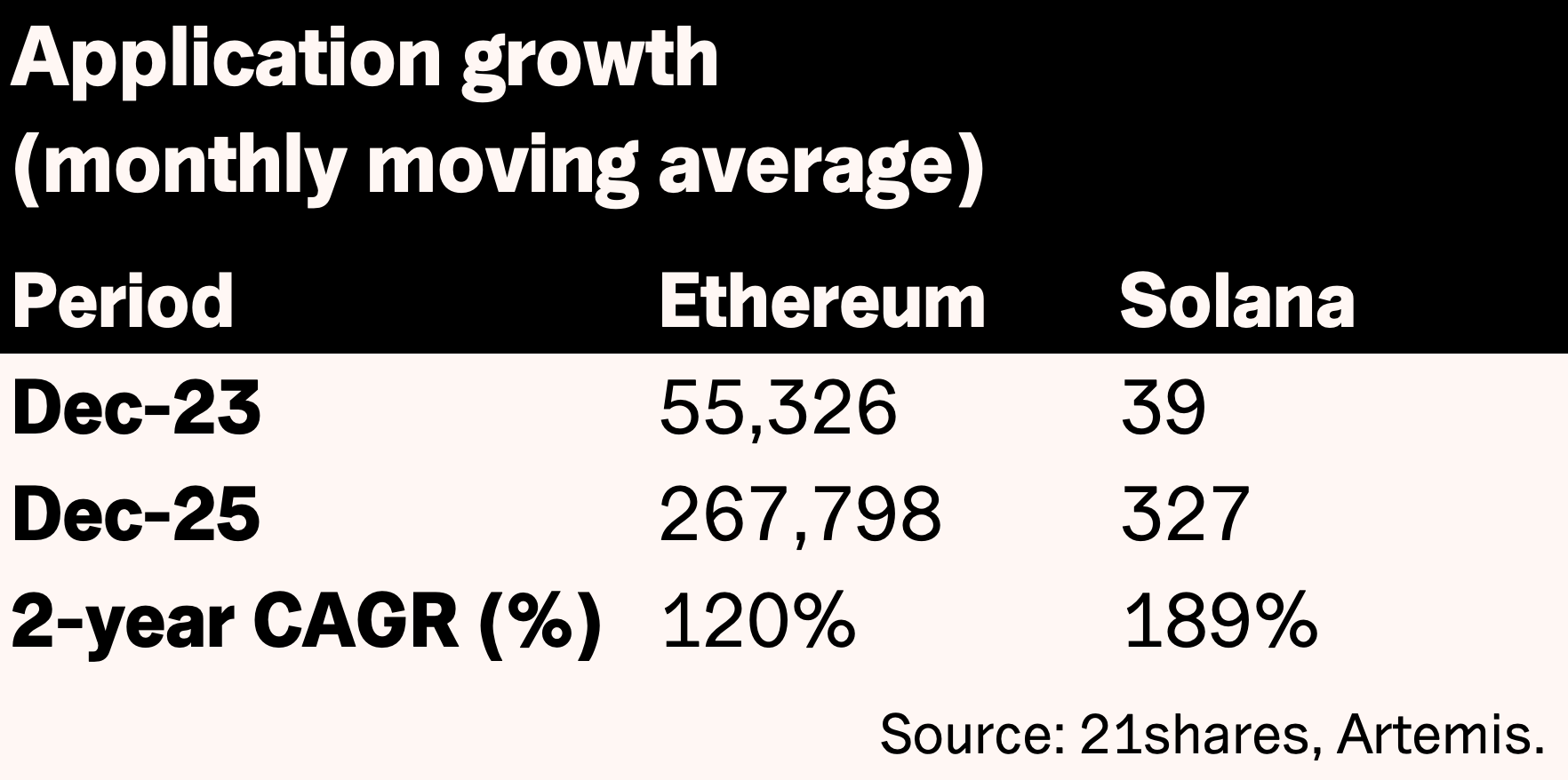
Smart contracts, which are self-executing lines of code, are the invisible forces governing platforms like Ethereum and Solana, essentially differentiating them from platforms like Amazon and GoDaddy. These smart contracts are the backbone of ecosystem effects that are now increasingly visible in development data with Ethereum and Solana showing distinct trajectories.
Ethereum
Ethereum’s builder base has expanded meaningfully over the past two years, with average monthly smart contract deployments rising from ~55,326 in December 2023 to ~267,798 by December 2025, a 120% CAGR that reflects durable long-term momentum.
Developer activity rebounded sharply in 2025, growing from an average of 47.6k monthly deployments in January to ~560k by year-end, a surge supported by consistently low fees throughout the year and app development slowly returning to the main layer.
The inflection point came in Q4, when deployments increased +977% from September (~50k) to December (560k). This late-year spike reflects both the release of pent-up builder demand and developers accelerating deployment ahead of Fusaka, which went live on December 3 and further reduced data costs for both Ethereum and its scaling layer.
These structural improvements; lower execution costs, better Layer 2 data handling, and predictable fees, make Ethereum far more attractive for teams building high-value, security-critical applications, reinforcing its position as the settlement layer of choice for scalable, institutional-grade use cases.
Solana
Alternatively, Solana’s application deployment base has expanded rapidly over the past two years, with average monthly contract deployments rising from an average of 39 in December 2023 to 327 by December 2025, a 189% CAGR from a small but accelerating builder footprint.
Developer activity in 2025 showed a normalization pattern, starting at ~394 monthly deployments and settling into the mid-300s as the ecosystem matured and earlier spikes in contract deployment moderated following the memecoin frenzy we’ve discussed earlier in this article.
Momentum strengthened again in Q4, with deployments rising ~50% from 218 in early October to 327 in the last four weeks, signaling renewed building cycles that are venturing into more mature use-cases beyond memecoins.
Solana’s ultra-low fees and high throughput are beginning to attract serious teams building fast, user-facing applications, especially in payments and stablecoin flows, anchoring its role as the chain optimized for high-frequency, consumer-scale activity as we’re seeing through integrations with payments giants such as Revolut and Western Union.
User growth: Are governments, corporations, and consumers using these products at scale?
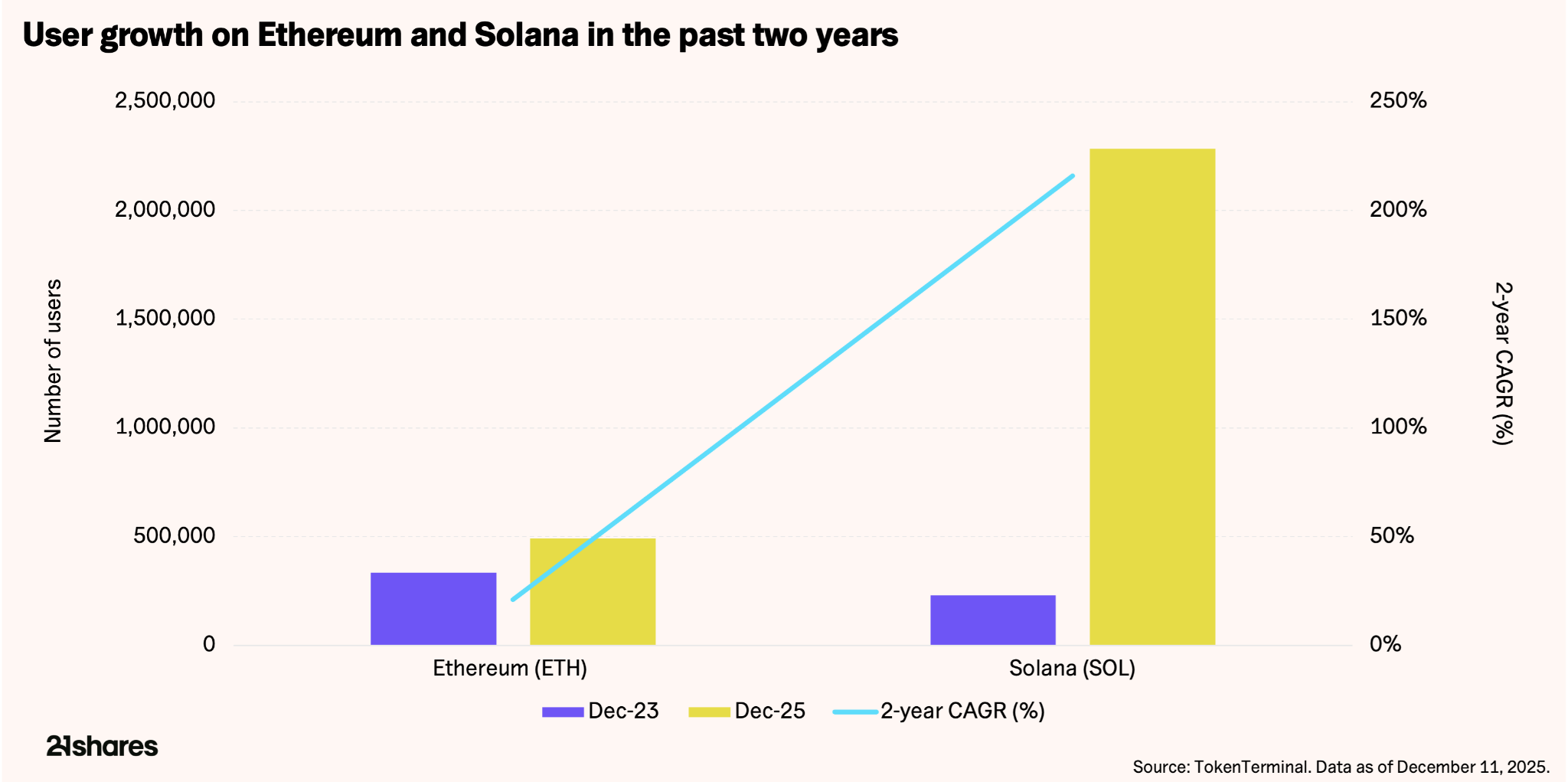
If developers show us what a network can become, user growth shows us whether it is actually delivering value today and in the future. As we touched upon earlier, a city can have skilled architects and new buildings going up, but without residents filling the streets, shops, and public spaces, it never becomes a living economy.
Crypto networks work the same way. Developer activity tells us the potential; user activity tells us the reality. Tracking how often people transact, explore apps, and move value across a network is one of the clearer signals of whether the ecosystem is gaining real traction. So while the table above shows the compounded annual rate of growth for the last two years, we’re also going to be looking at this year’s performance to give further context/insight.
Ethereum
Ethereum’s 21% CAGR shows steady, durable user growth. User growth is up 19% year to date, supported by stable sub-dollar fees and re-emerging interest in using Ethereum for institutional applications that require strong security but do not depend on faster transaction throughput.
Solana
Solana's 216% CAGR reflects exponential expansion from a smaller base. User activity is down 47% from unusually elevated levels at the start of 2025, when President Trump’s memecoin launch fueled a surge similar to Ethereum’s NFT boom in 2021. As that speculative wave faded, usage normalized, but the network is increasingly becoming the preferred platform for real commercial applications, reinforced by the integrations highlighted throughout this article.
______
Footnotes:
- SatoshiClub (@esatoshiclub). (2025, May 15). Image from X [Photograph]. X. https://x.com/esatoshiclub/status/1999036444933865557/photo/1
This report has been prepared and issued by 21Shares AG for publication globally. All information used in the publication of this report has been compiled from publicly available sources that are believed to be reliable, however, we do not guarantee the accuracy or completeness of this report. Crypto asset trading involves a high degree of risk. The crypto asset market is new to many and unproven and may have the potential not to grow as expected.Currently, there is relatively small use of crypto assets in the retail and commercial marketplace in comparison to relatively large use by speculators, thus contributing to price volatility that could adversely affect an investment in crypto assets. In order to participate in the trading of crypto assets, you should be capable of evaluating the merits and risks of the investment and be able to bear the economic risk of losing your entire investment.Nothing herein does or should be considered as an offer to buy or sell or solicitation to buy or invest in crypto assets or derivatives. This report is provided for information and research purposes only and should not be construed or presented as an offer or solicitation for any investment. The information provided does not constitute a prospectus or any offering and does not contain or constitute an offer to sell or solicit an offer to invest in any jurisdiction. The crypto assets or derivatives and/or any services contained or referred to herein may not be suitable for you and it is recommended that you consult an independent advisor. Nothing herein constitutes investment, legal, accounting or tax advice, or a representation that any investment or strategy is suitable or appropriate to your individual circumstances or otherwise constitutes a personal recommendation. Neither 21Shares AG nor any of its affiliates accept liability for loss arising from the use of the material presented or discussed herein.Readers are cautioned that any forward-looking statements are not guarantees of future performance and involve risks and uncertainties and that actual results may differ materially from those in the forward-looking statements as a result of various factors.This report may contain or refer to material that is not directed to, or intended for distribution to or use by, any person or entity who is a citizen or resident of or located in any locality, state, country or other jurisdiction where such distribution, publication, availability or use would be contrary to law or regulation or which would subject 21Shares AG or any of its affiliates to any registration, affiliation, approval or licensing requirement within such jurisdiction.