

Ethereum staking has become one of the most important ways to earn passive income in crypto. It rewards participants for helping keep the Ethereum network secure, much like earning interest for supporting a financial system through bonds. When combined with the potential price gains, staking returns have often surpassed those of traditional assets.
As of September 2025, staking is being integrated into regulated US exchange-traded funds (ETFs), following the lead of European exchange-traded products, which have included it since 2019. There’s growing attention on how these funds manage rewards, risks, and liquidity for investors.
How does staking work in ETPs?
Staking through an ETP or an ETF combines efficiency and accessibility. Here’s how it works:
- Transparent setup: The ETP issuer “stakes” the Ethereum (ETH) held by certain ETPs using staking providers, such as Coinbase Cloud or Blockdaemon. These assets stay in segregated, cold-storage accounts under the safekeeping of the ETP issuer’s custodians.
- Network participation: The staking provider uses the ETP’s ETH to help validate transactions on the Ethereum network, earning rewards in return.
- Reward reinvestment: These rewards, distributed as new ETH, are reinvested into the ETP to enhance its long-term performance, with the ETP issuer typically taking a small fee to administer the process.
- ETPs maintain liquidity buffers: Unstaking (withdrawing staked ETH) involves waiting periods set by the Ethereum network, ranging from days to months. ETP issuers use proprietary systems to manage these timelines and adjust staking levels based on redemptions and market conditions. To ensure investors can buy or sell shares at any time, part of the ETH remains unstaked.
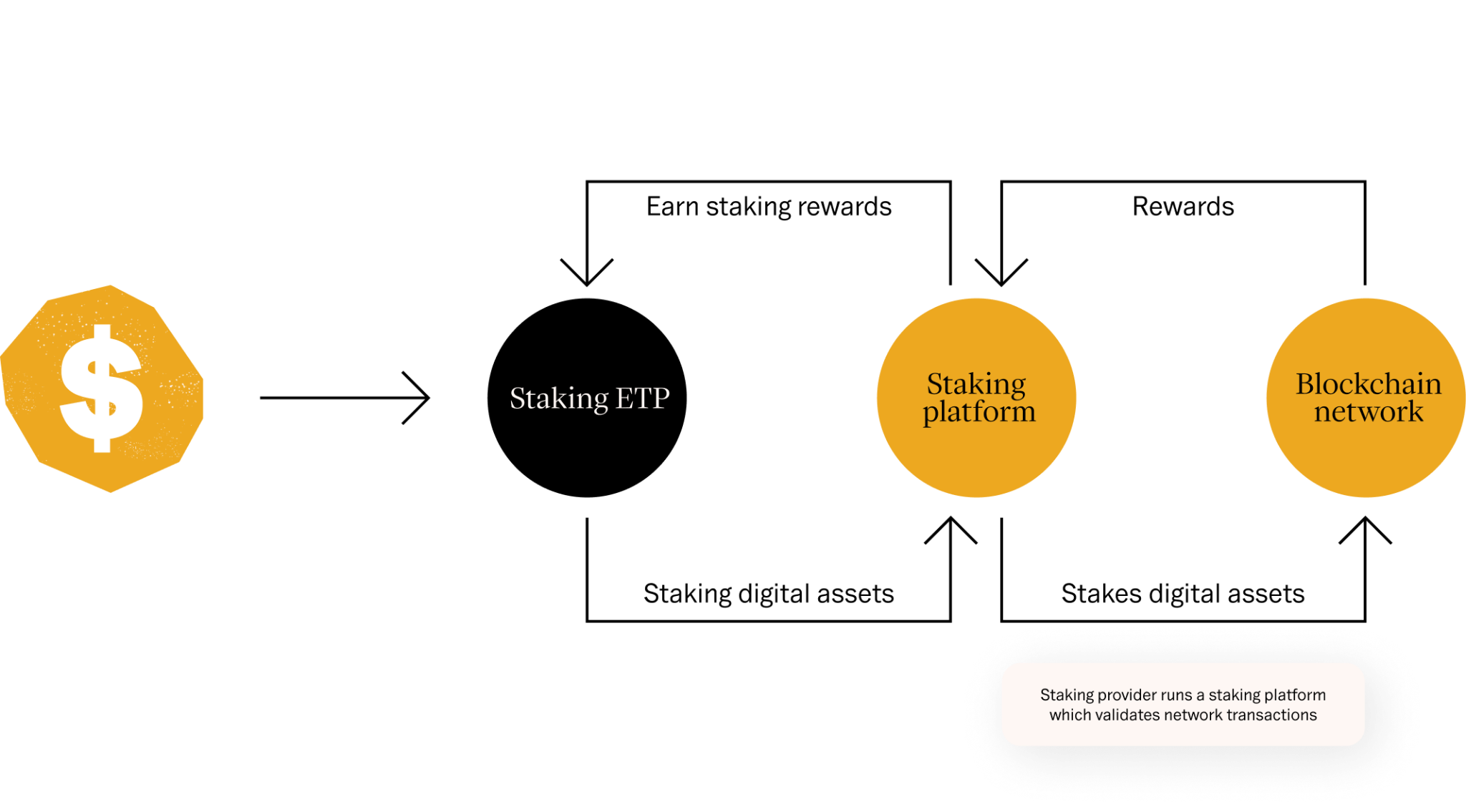
Staking through an ETP removes the technical complexity of doing it yourself. No need to run software, manage private keys, or worry about network penalties. Investors get the same exposure to staking rewards with:
- Institutional-grade custody
- Regulatory oversight
- Easy trading on traditional exchanges
- Simplified tax reporting
Why not stake 100%? Lessons from recent turbulence
The rationale boils down to risk management.
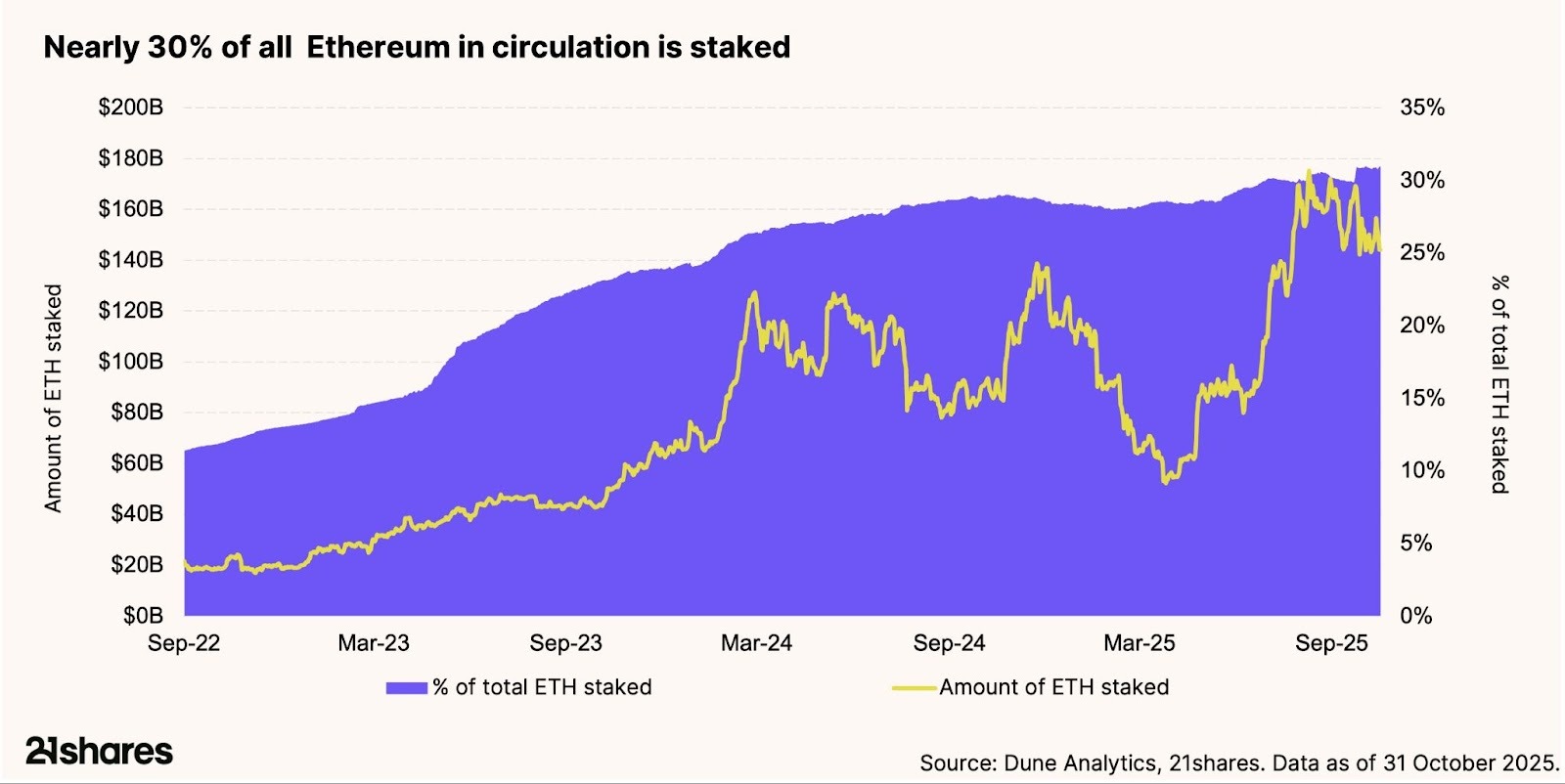
Last month, a security breach at Kiln1, one of the industry’s major staking providers, exposed a key vulnerability. Hackers compromised Kiln’s API, redirecting a $41 million Solana withdrawal. In response, Kiln paused operations and began mass unstaking clients’ ETH. This sudden rush into Ethereum’s exit queue injected billions of dollars’ worth of ETH, pushing withdrawal times from about 20 days to more than 45 days, the longest delays in the network’s history. Even now, as shown in the chart below, over 2.5 million ETH remain lined up for withdrawal, keeping the queue highly congested.

Nearly 30% of all Ethereum in circulation is currently staked, a record level of participation. While that demonstrates confidence in the network, it also concentrates risk: A sudden drop in staking yields or investor confidence could cause mass withdrawals, which would further clog Ethereum’s exit queue, delaying redemptions across the market.
How do ETPs protect investors, and what are the risks?
One approach is imperative: protecting liquidity and investor confidence over maximizing short-term yield.
For issuers of staking ETPs, staking too much, say, over 90% of assets, creates a major risk. In a withdrawal backlog, they might struggle to meet investor redemptions, eroding trust and liquidity.
Although not risk-free, one solution that avoids this pitfall is through a dynamic staking strategy. ETP Issuers adjust staking levels based on market conditions and redemption flows, keeping ample unstaked reserves on hand. This buffer ensures that investors can redeem their shares smoothly, even during periods of extreme volatility.
The bigger picture: Diligence over yield
As US crypto ETFs begin to incorporate staking, infrastructure security, and liquidity management are coming under greater scrutiny. Incidents like Kiln’s highlight how a single operational weakness can ripple across the entire ecosystem.
In this environment, design, discipline, and durability matter more than ever. That’s why ETP issuers don’t stake 100% of assets; it's not a limitation but a deliberate choice rooted in risk management.
As Ethereum’s exit queues gradually normalize, the lesson is clear: vigilance today prevents crises tomorrow.
Footnotes:
- Nijkerk, Margaux. “Kiln Exits Ethereum Validators in ‘Orderly’ Move Following SwissBorg Exploit.” The Block, 10 Sept 2025. Accessed 2 Nov 2025. https://www.theblock.co/post/370141/kiln-exits-ethereum-validators.





.svg)



_logo.svg)

.svg.png)