

The Solana network generated $1.09 billion in gross revenue in H1 2025. By H1 2026, that figure had fallen to $141 million, an 87.1% year-over-year (YoY) decline. The silver lining beneath the revenue drop is a transition to real-world use cases such as tokenized equities and stablecoin settlement away from solely memecoin trading.
Solana’s revenue fell with the memecoin demand
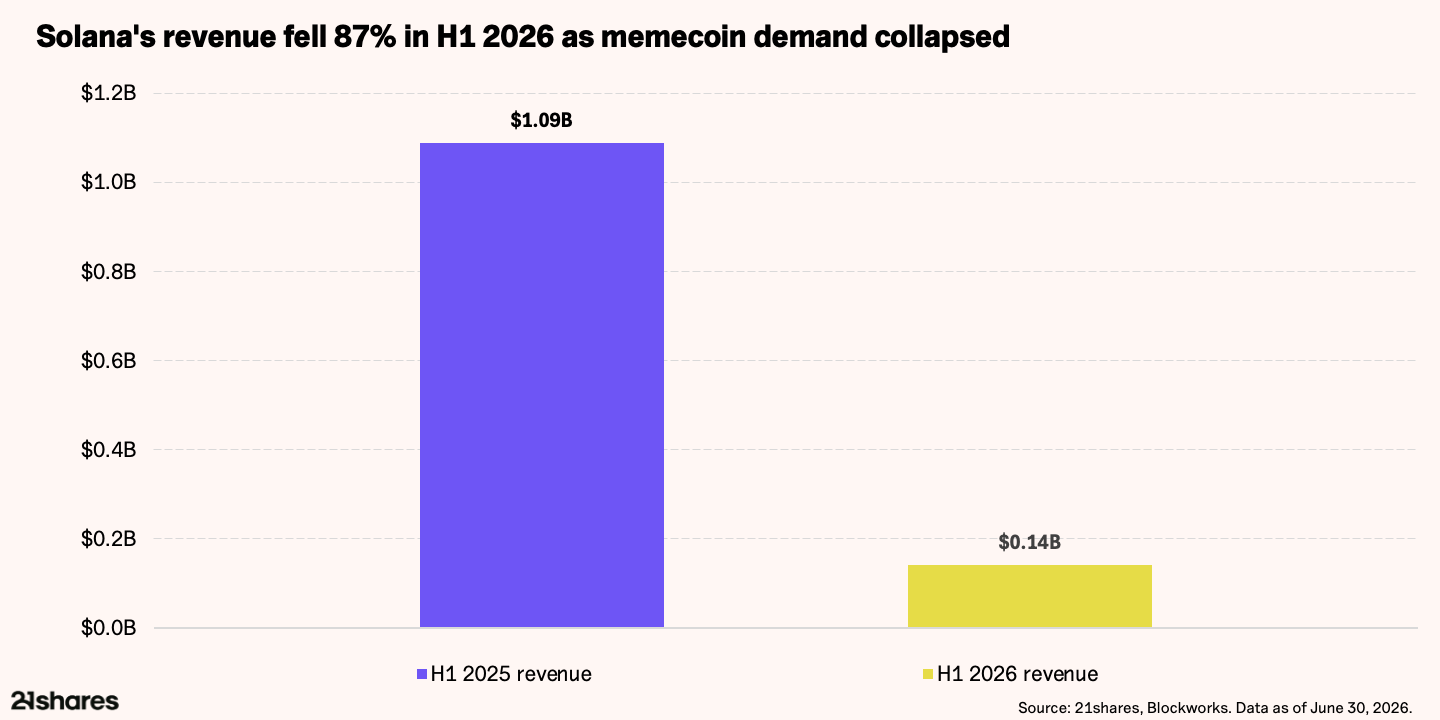
The H1 2025 revenue spike was driven almost entirely by memecoin trading. Memecoins generated intense, short-burst demand for block space, which boosted priority fees and Jito tips, the two largest revenue line items on the network. Combined, priority fees and Jito tips accounted for 95% of Solana’s H1 2025 revenue, 40% and 55% respectively (Blockworks; data as of 30 June 2026).
While trading activity on Solana is still high, as its north star is to be the onchain Nasdaq, memecoin activity has fallen significantly. Other assets are now getting more attention on Solana, such as stablecoins and tokenized real-world assets (RWAs), a topic we’ll dive further into in this report.
Memecoin trading is a high-fee-generating activity: traders compete to enter blocks first, through front-running and priority tips, so they can buy ahead of others at a lower price. As that speculative demand has faded since H1 2025, the fees it generated have receded with it, pulling Solana's annualized run rate (ARR) down to $282 million.
Solana remains one of the most active networks in crypto, if not the most active, still generating real fee revenue from real economic activity unrelated to memes. The composition of that activity has changed significantly, and that change is more important than the headline decline. That shift could be reinforced on the supply side: network upgrade proposal SIMD-550, approved via governance proposal SGP-0002, doubles Solana's annual disinflation rate from 15% to 30%, bringing its 1.5% terminal inflation rate forward by roughly three years, from H1 2032 to H1 2029. As staking yields compress under the faster schedule, some capital may rotate out of staking and into onchain activity in search of higher yields, potentially deepening usage and supporting the network's revenue base.
The activity mix is shifting away from memes
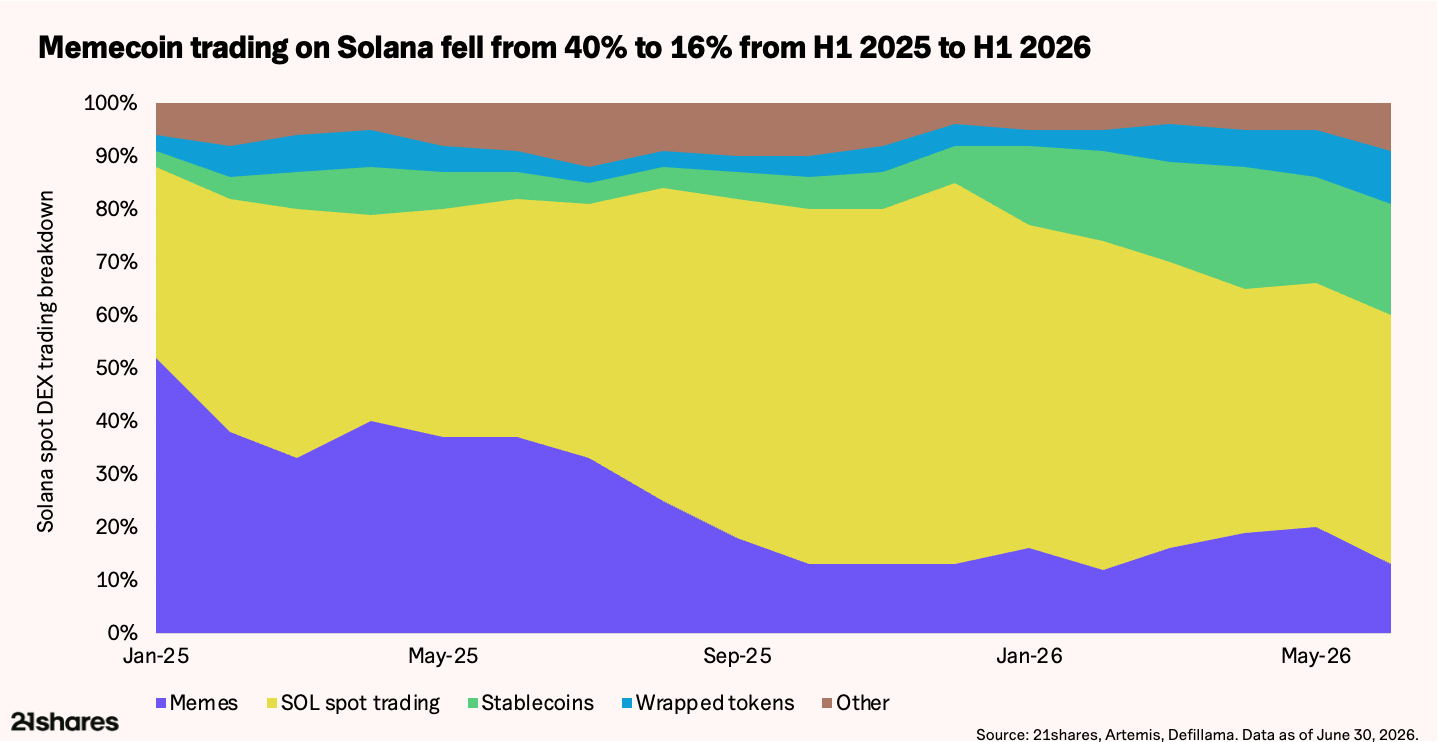
Using spot trading volume by sector as a proxy for revenue, memecoins on average made up 40% of Solana's spot trading volume in H1 2025. By H1 2026, that share had dropped to 16%, a 60% year-over-year decrease. Over the same period, stablecoin swaps climbed from 6% to 19% of volume and general Solana spot trading rose from 41% to 53%. The categories that grew are the ones tied to payments, settlement, and asset issuance rather than speculation, so as memecoin trading receded, non-speculative use cases expanded to take its place rather than leaving a gap. Solana is increasingly settling the kind of activity that persists across market cycles rather than activity tied to bull-market euphoria.
Solana now dominates equity token trading
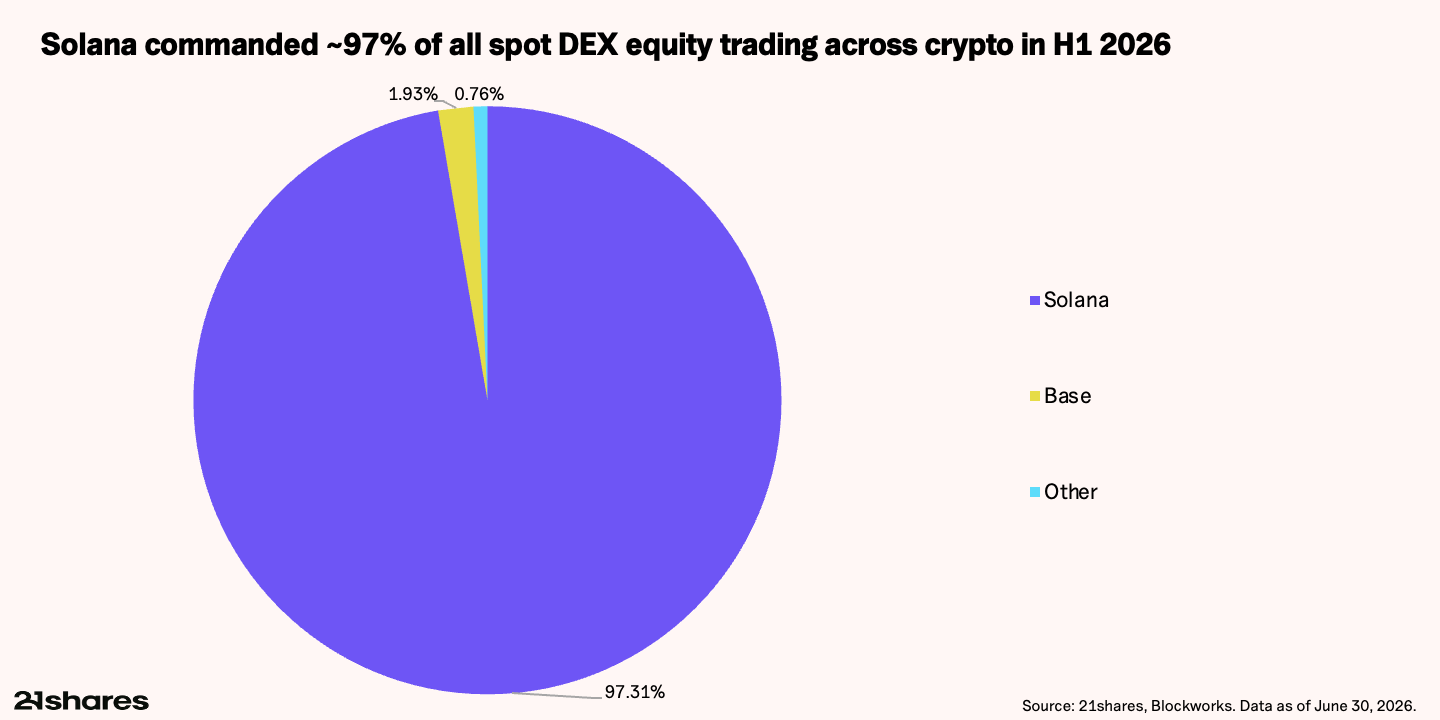
Solana dominates spot trading. Solana's share of onchain trading of tokenized RWAs, such as equities, grew from 7% in H1 2025 to commanding roughly 97% of spot DEX RWA volume across all of crypto in H1 2026. Established applications and issuance platforms are building off this moment by now issuing equities directly on the network. Securitize became the first company to list its own public stock as a token on Solana, and xStocks (issued through Backed Finance) brought tokenized exposure to individual US stocks onto the chain. Crucially, Backpack Securities completed this infrastructure loop by launching a 1:1 “two-way door” that allows users to seamlessly convert real US stocks back and forth between traditional DTCC brokerages and onchain Solana tokens. For instance, it tokenized SpaceX shares on Solana the exact same day the stock debuted on Nasdaq, generating hundreds of millions in volume within its first week. Activity like this marks the emergence of institutional-scale settlement infrastructure. As adoption of tokenized equities accelerates, that positioning strengthens the case that Solana's activity base is diversifying into durable, higher-quality revenue sources. Each of these steps moves the network closer to its north star of becoming the onchain Nasdaq.
Stablecoins are becoming a structural revenue driver
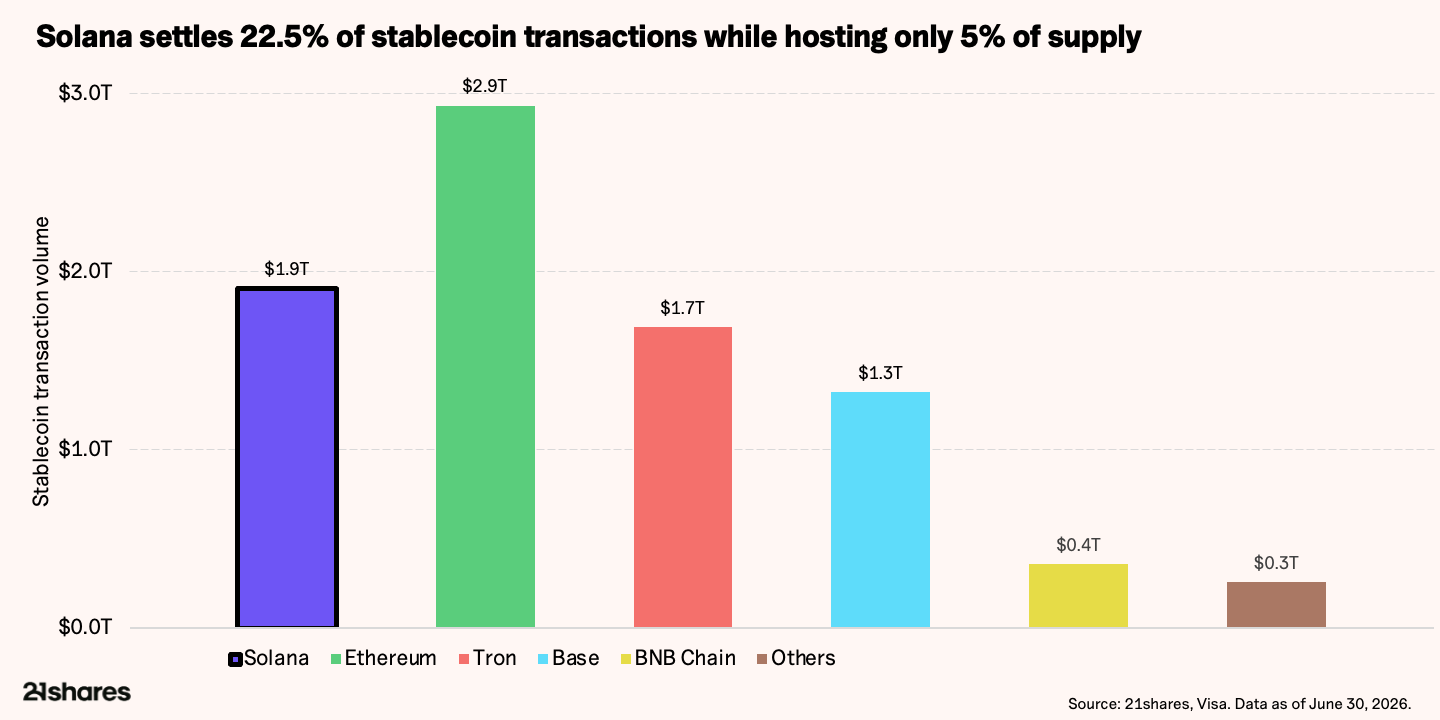
Stablecoin assets under management (AUM) on the network grew 51% YoY, from $10.4 billion in H1 2025 to $15.7 billion in H1 2026. Beyond this growth, Solana hosts roughly 5% of total stablecoin supply but settled over 22.5% of all stablecoin transactions globally in H1 2026 with over $1.9 trillion in settled value.
That imbalance between supply share and transaction share signals that Solana serves as the preferred execution layer for stablecoin activity rather than simply a place to hold it, a position built on its low transaction costs and high throughput. The projected total addressable market (TAM): McKinsey projects the stablecoin market could reach $2 trillion to $4 trillion by 2030, BCG projects roughly $2 trillion, and US Treasury Secretary Scott Bessent has said supply could reach $3 trillion over the same period, up from around $300 billion today. These remain forecasts, and actual outcomes will depend on regulatory and adoption developments, but if the trend holds, Solana's dominance in transaction throughput positions it to capture meaningful fee revenue as the market scales, especially as AI agents come onchain and need cheap, fast, permissionless rails to settle on.
DEX leadership is holding
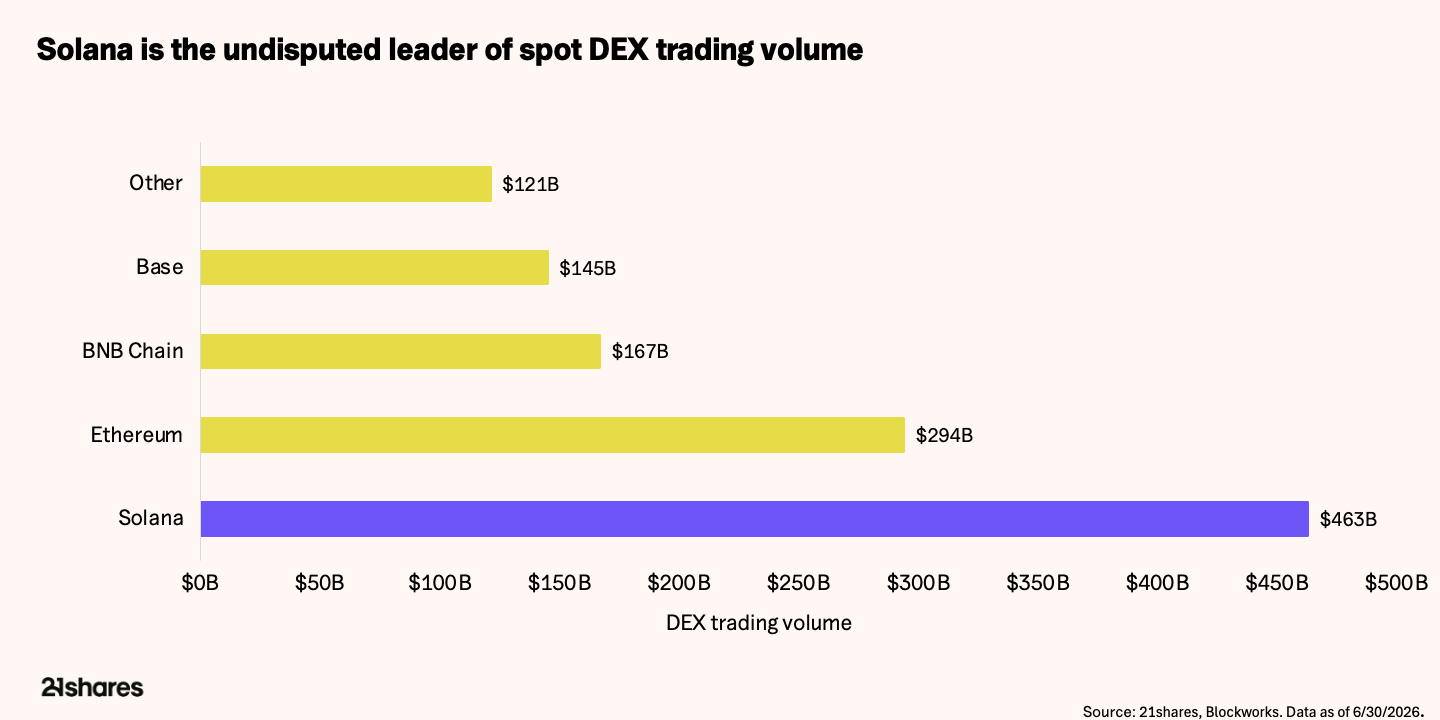
Despite accounting for just 9.5% of the total smart-contract blockchain market cap, Solana accounted for over 36% of all spot decentralized exchange (DEX) volume globally in H1 2026, roughly double Ethereum's share. All while Ethereum accounts for 41.8% of the total smart-contract blockchain market cap yet holds only 23.5% of spot DEX trading volume. The same gap shows up in Solana's spot DEX volume-to-price ratio: in H1 2026, Solana turned over 10.5x its value in spot DEX volume against just 1.5x for Ethereum, meaning each dollar of Solana's valuation supports roughly ten times as much onchain trading activity. Maintaining this position as activity diversifies beyond memecoins into tokenized assets and stablecoins is the structural argument for Solana's revenue having a defensible floor. As Solana deepens its lead in spot DEX trading, the revenue that DEX trading generates should scale alongside it.
Four key catalysts for Solana’s revenue recovery
- Tokenized equities are one of the main drivers for Solana’s road to recovery. In H1 2026, the network captured 97% of onchain spot tokenized equity market share, recording $4.9 billion in trading volume, a sixfold increase in just six months. As institutional appetite for onchain equity exposure grows, Solana's speed and low fees position it as the default venue for this emerging asset class.
- The agentic economy needs a settlement layer, and Solana is positioning to be it. As AI agents begin paying each other and settling transactions autonomously, Solana's sub-cent fees and sub-second finality make it one of the few blockchains capable of supporting machine-to-machine economic activity at scale. This use case represents a structural demand driver largely independent of retail market cycles.
- Alpenglow pushes Solana toward mainstream-grade transaction speed. Expected in late 2026, the upgrade cuts finality to approximately 150ms, roughly the responsiveness users expect from everyday applications. Closing this gap with Web2 performance standards is a meaningful step toward onboarding the next wave of users and developers who currently find blockchain latency a barrier to adoption.
- ETF momentum continues to accelerate. Since launching in October 2025, the product suite has accumulated roughly $1.3 billion in AUM, reaching the $1 billion milestone faster than nearly any other ETF launch in history and ranking in the top 50 of all time. Institutional validation followed quickly: Q2 13F filings revealed Goldman Sachs as the largest single holder, confirming genuine demand from top-tier Wall Street clients and setting the stage for billions in direct SOL inflows.
Four risks could cap Solana's revenue recovery
Four risks are material:
- Fee revenue is inherently cyclical; bear-market conditions compress demand for block space and transaction fees.
- Competition is rising in Solana's key verticals: Canton for real-world assets, Hyperliquid and Robinhood Chain for trading, and Tempo for stablecoins.
- The shift away from memecoins may not prove durable. The thesis rests on non-speculative activity (stablecoins, RWAs, equity tokens) replacing memecoin demand, and the categories replacing memecoins generate lower fees per trade. Memecoin activity also tends to rebound in bull markets: by August 2026, memecoins had jumped back to roughly 34% of Solana DEX volume as bull-market spirits returned. If speculative volume reasserts itself rather than converting into higher-quality use cases, Solana may continue to be viewed as a memecoin chain, potentially deterring institutional investors and institutions from building on it.
- Infrastructure concentration is a structural concern: a routing failure in August 2026 briefly took approximately 29% of staked SOL offline, within approximately 20 million SOL of the threshold at which Solana can no longer reach finality (21shares Research; data as of 30 June 2026). However, that risk is being actively addressed and that is evidenced by the network remaining operational despite the routing failure; 597 of 699 staked validators kept voting, and those affected recovered within 40 minutes.
Digital assets remain highly volatile. Solana's revenue is inherently cyclical, which historically has been tied to trading activity that can decline sharply in bear markets. It must be noted that past performance is not a reliable indicator of future results, and what has happened in the past may not spell out the same for the future. Solana is also punching above its weight in revenue; Solana posted roughly $15 million more in YoY revenue than Ethereum in H1 2026 while trading at a $43 billion market cap, approximately 22% of Ethereum's $194 billion market capitalization (Blockworks, CoinGecko; data as of 30 June 2026). That divergence between network activity and valuation is what makes the current moment worth examining carefully.
FAQ
How much did Solana's revenue fall in 2026?
Solana's gross revenue in H1 2026 was $141 million, down 87.1% compared to $1.09 billion in H1 2025 (DeFiLlama, Blockworks, TokenTerminal; data as of 30 June 2026). The decline was driven primarily by the end of the 2025 memecoin trading boom, which had generated significant short-term fee revenue that was not sustained into 2026.
What is Solana actually used for if not memecoins?
Solana in H1 2026 commanded roughly 97% of spot equity token trading volume, handles over 22.5% of all stablecoin transactions despite hosting only around 5% of stablecoin supply, and holds over 36% of all DEX trading volume globally (Blockworks; data as of 30 June 2026). These represent real-world asset settlement, payments, and trading use cases rather than speculative activity.
Does Solana still generate more revenue than Ethereum?
Yes. Despite the revenue decline, Solana generated approximately $15 million more in year-to-date revenue than Ethereum by mid-2026, yet trades at around 25% of Ethereum's market capitalization of $194 billion (Blockworks, CoinGecko; data as of 30 June 2026). This valuation divergence is one of the central arguments made by some analysts for Solana's relative positioning, though digital asset valuations are highly volatile and this comparison does not constitute investment advice.
What are the main risks to Solana's revenue recovery?
Four risks are identified in 21shares' analysis: cyclical fee revenue tied to trading activity; rising competition in key verticals from Canton (real-world assets), Hyperliquid and Robinhood Chain (trading), and Tempo (stablecoins); proving out diversifying of activity away from memecoin speculation; and validator infrastructure concentration, where a routing failure in August 2026 briefly took approximately 29% of staked SOL offline (21shares Research; data as of 30 June 2026).
Is Solana's developer activity growing despite the revenue decline?
Yes. Developer activity grew 21% year on year through H1 2026, and assets denominated in SOL grew 13% over the same period (TokenTerminal; data as of 30 June 2026). Builder activity is a leading indicator of future network utility; it suggests the infrastructure is growing even as short-term fee revenue has compressed.