

Additional analysis by Eliézer Ndinga
Two governance proposals are moving through Solana's development pipeline that will directly reshape the economics of holding SOL: SIMD-550, proposed by Solana's leading RPC and API platform, Helius, and SIMD-553, submitted by Solana R&D firm Temporal. The latter was approved and merged on July 20, 2026, and SIMD-550 has been going through a vote since August 23.1 Together, they will roughly halve staking yield within two years and simultaneously make SOL structurally scarcer.
Is the yield cut bad news for Solana investors? The case here is more nuanced than that.
What SIMD-550 and SIMD-553 actually change
Solana's staking yield of approximately 5.25% (as of August 24, 2026) draws from three sources:
- protocol inflation (the largest, at roughly 3.78%),
- transaction base fees and priority tips, and
- maximal extractable value (MEV), the revenue generated by high-frequency trading and arbitrage that adds approximately 2% to annualized yield.
SIMD-550 targets the first source, protocol inflation. It doubles Solana's annual disinflation rate from -15% to -30%, compressing the timeline to Solana's 1.5% terminal inflation rate from approximately 5.7 years to 2.8 years, reaching that level by H1 2029 rather than H1 2032. The projected nominal staking yield under SIMD-550 declines to approximately 4.34% in year one, 3% in year two, and 2.25% in year three.
SIMD-553 introduces a burn fee on requested compute units from financial activity, analogous to AI token usage for complex tasks that require credits for completion. At current network activity, daily SOL burns would rise from approximately 600–800 SOL to approximately 7,500–9,000 SOL, or $712,500 to $855,000, as of August 24. It is a meaningful acceleration in supply destruction, though not sufficient alone to offset current inflation of roughly $4.5 million per day.
Paired, the two proposals are projected to cut emissions by approximately $1.4–1.5 billion over six years.
Impact of the proposals
Beyond the mechanics, the proposals affect the Solana ecosystem in three main areas, summarized below and explored in more depth in the sections that follow.
- Validator concentration and decentralization: Lower yield from SIMD-550 meets potentially higher costs from SIMD-553's unresolved fee design, squeezing validator margins from both sides. The risk is that smaller validators, unable to cover the cost of running their machines under the new economics, are forced to shut them down. As they drop off, stake and influence concentrate among the larger operators who can absorb the squeeze, pushing the network toward greater centralization rather than away from it. Current projections show 2 of 738 validators turning unprofitable in year one, rising to ~30 by year three, and if SIMD-553's voting fee lands at the high end (~21x), that pressure grows.
- Loss of staking revenue: The protocol-inflation portion of staking yield, currently ~3.78%, falls to the 1.5% terminal rate in roughly 2.5 years, a decline of more than 60% and three years ahead of the original schedule. The intended offset is performance-based disinflationary pressure: tie issuance to real economic growth, and let rising MEV and tip fees fill the gap. Those would need to climb roughly 55–95% to fully compensate.
- Solana's focus on consumer products: The yield cut is partly meant to push capital out of staking and into productive use. The long-run payoff rests on Solana building consumer and financial products at scale, including its lead in tokenized equities and settling over 22% of 2026 stablecoin transactions on just ~5% of global supply.
Taken together, the near-term effects fall on validators and stakers, while the longer-term case rests on whether Solana can convert lower issuance into a more active onchain economy; topics we examine later in this report.
The staking yield hit is real. Here is the math
The revenue compression is direct: staking income scales with nominal yield. A decline from approximately 6% to approximately 3% within two years of SIMD-550 passing roughly halves staking revenue per unit of staked SOL, all else equal.
One complicating factor is validator economics. SIMD-553's design for validator voting fees remains unresolved: costs could rise modestly or by as much as 21 times, which would squeeze validator profitability at precisely the moment SIMD-550 is cutting their yield. Under SIMD-550 projections, an estimated two of 738 validators turn unprofitable in year one, rising to 30 by year three. Both SIMDs have advanced to formal Solana Governance Proposals (SGP-0002 and SGP-0003), headed for stake-weighted community votes that require a two-thirds supermajority to pass.
It is also worth noting the structural rationale behind the yield reduction. Solana's staking ratio sits at approximately 67.93%, nearly double Ethereum's 34.14%. The proposals are partly designed to redirect capital from staking into productive use within the Solana economy. The thinking is that if staking pays less, investors will look for better yield elsewhere onchain, turning to decentralized finance (DeFi) and other innovative use cases. That activity should drive more usage and fee revenue, spurring developers to build the next generation of apps.
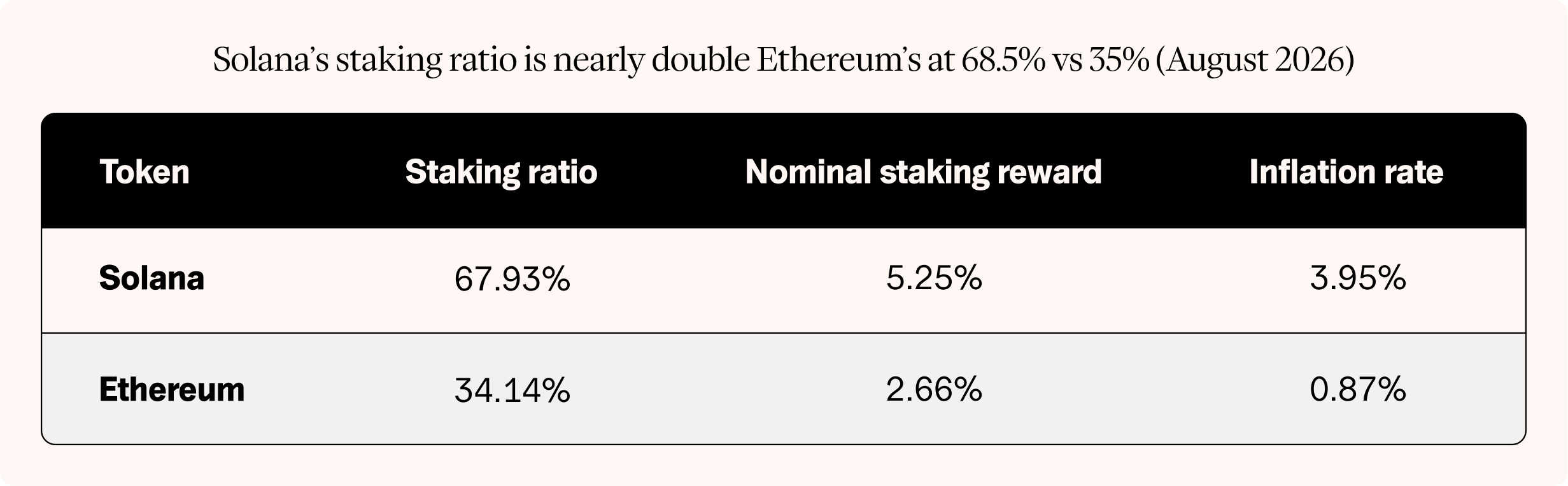
We believe inflation should be tied to economic performance and growth to help offset the decline in staking revenue. Over the long run, MEV and tips are expected to become primary revenue sources for stakers, though they would need to rise roughly 55–95% over the window to fully compensate for that loss.
Moreover, adoption doesn't appear to have slowed during the last cycle due to a higher inflation rate. The more significant headwinds for Solana have been reputational and operational: its association with FTX, perceptions of it as a memecoin chain, and network outages, rather than inflation dynamics.
How the market may react (according to historical precedent)
Two comparable upgrades offer a reference point. Ethereum's EIP-1559 burn mechanism, introduced in August 2021, delivered +37% over one month and +60% over three months, though that window ran straight into the cycle's market top, so broader market conditions played a factor. On the disinflation front, Cosmos's Proposal 848, which halved maximum inflation in November 2023, produced +25% over one month and +10% over three months, but that period also happened to overlap with the anticipation around the Bitcoin ETF approvals that kicked off the 2024 bull market.
In both cases, the near-term move (1–3 months) likely came from a mix of the disinflationary signal and supportive market conditions, not the upgrade alone. For Ethereum, the burn added genuine deflationary pressure, which made the case for ETH stronger; for Cosmos, the returns ATOM saw on the back of the lower-dilution narrative outweighed the yield compression that came with it. The subsequent 6–12 month drawdowns had little to do with the upgrades: for ETH, the onset of the 2022 bear market and the Fed beginning its rate hiking cycle; for ATOM, the broader summer 2024 slump.
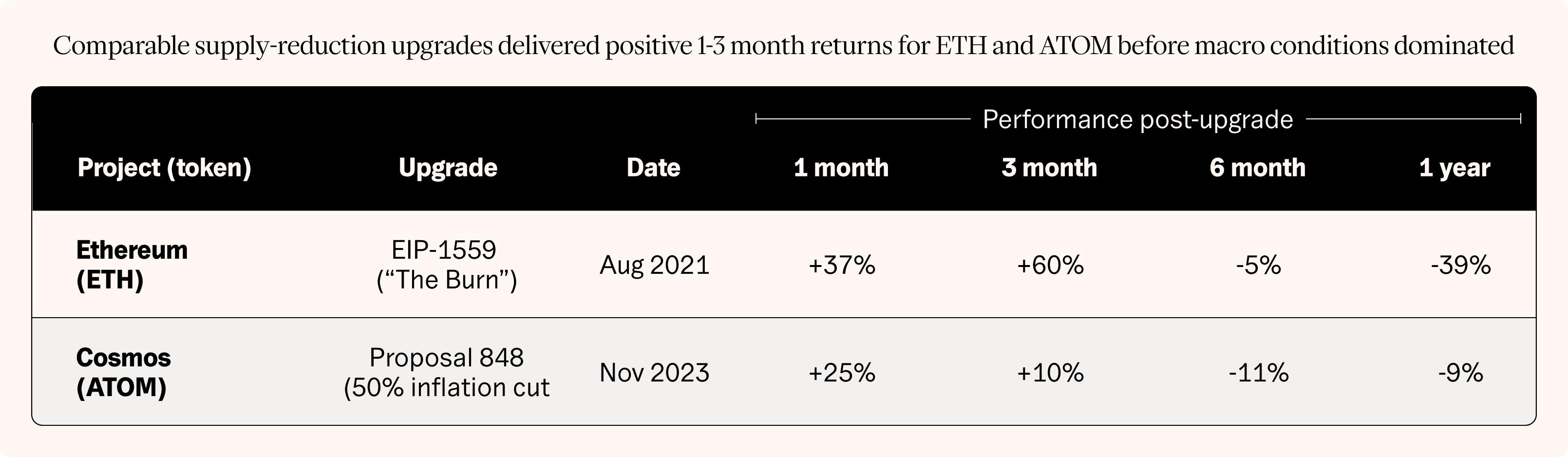
The precedent is imperfect. External variables drove both outcomes well beyond the governance decisions themselves. But for a holder already positioned in SOL, the historical pattern suggests the market tends to reward supply-reduction signals. It is worth reiterating, though, that past performance is not a reliable indicator of future results. Staking reward rates are variable and not guaranteed, are subject to network conditions, and may vary or cease at any time.
What this means for your SOL position
Lower issuance and higher burns support SOL's long-term supply/demand balance. Price appreciation at the asset level could partly offset the per-SOL yield decline as the structural narrative strengthens, particularly if the reduction in staking ratio redirects capital into Solana's broader DeFi ecosystem, expanding onchain activity.
Longer term, what will determine Solana's success is whether it can build a base of financial products (the most proven use case for crypto, particularly in trading and, increasingly, payments) that consumers and businesses use regularly at scale, without necessarily being aware of the underlying infrastructure. A terminal inflation rate is likely unavoidable at some point; the more pressing question is whether Solana can compound its distribution advantages in the meantime.
To compete with successful consumer products like Hyperliquid, Solana would benefit from two complementary strategies: acquiring businesses that control user distribution (particularly those with low churn, high satisfaction, and strong margins in winner-takes-most markets) while maintaining ecosystem neutrality; and investing meaningfully in developer talent acquisition, along the lines of a Y Combinator model.
The foundation is already there. Solana holds a leading share in tokenized equities, has settled over 22% of stablecoin transactions in 2026, and does this while hosting only 5% of the global stablecoin supply, a meaningful signal of network efficiency and untapped headroom.
The exact magnitude and timing of the staking revenue impact will not be clear until both proposals complete governance.
FAQ
What is SIMD-550 and how does it affect Solana staking yield?
SIMD-550 is a Solana governance proposal submitted by Solana's leading RPC and API platform, Helius, that doubles the network's annual disinflation rate from -15% to -30%. This accelerates the path to Solana's 1.5% terminal inflation rate from approximately 2032 to 2029, reducing nominal staking yield from approximately 5.25% today to an estimated 2.25% by year three.
Has SIMD-553 been approved?
Yes. SIMD-553, submitted by Temporal, was formally approved and merged by the Anza and Firedancer development teams on July 20, 2026. It introduces a burn fee on requested compute units, increasing daily SOL burns from approximately 600–800 SOL to approximately 7,500–9,000 SOL at current network activity levels.
Do lower staking rewards mean SOL will fall in price?
Not necessarily. Historical precedents from Ethereum's EIP-1559 upgrade in August 2021 and Cosmos's inflation cut in November 2023 both show positive short-term price performance in the 1–3 months following comparable supply-reduction upgrades. Lower issuance and higher burns reduce net SOL supply growth, which has historically been treated as a positive signal by markets. Longer-term returns were driven predominantly by broader market conditions.
How do these proposals affect the 21shares Solana ETP?
Since the ETP's staking income scales with nominal yield, a decline from approximately 6% to approximately 3% within two years would roughly halve staking revenue per unit of AUM, all else equal. Offsetting this, lower net SOL issuance and higher burns may support the asset price over time, cushioning the bottom-line impact as AUM grows.
What should I watch for next?
The governance vote for SIMD-550 started on August 23. SIMD-553's final validator fee design also remains unresolved; the cost to validators could range from modest to approximately 21 times current levels. The precise impact on staking economics will not be clear until both parameters are finalized.
Footnotes
- Helius. (2026, August 23). SGP-0002: SIMD-550 — Accelerated disinflation schedule [Governance proposal]. Solana Validator Governance. https://governance.solana.com/proposal/7QJD8MzheHWJLHS39NkoAbFCGFKg5d9QbVviRqD4YExP