

Key takeaways
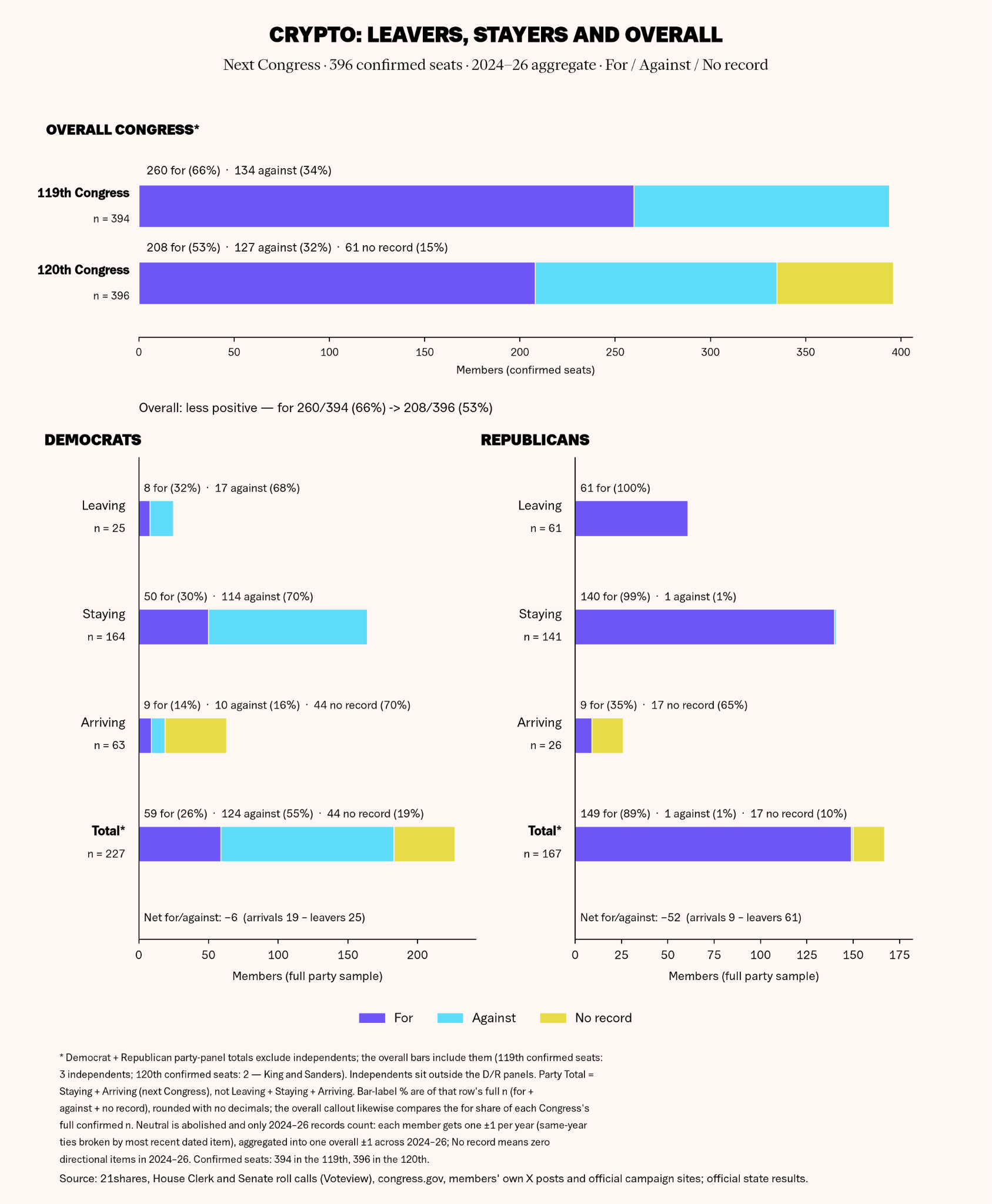
- Digital assets backing in the incoming US Congress declines to 62% from 66% among members with an established record, primarily due to Republican seat losses rather than shifting intra-party views (21shares research, 396 confirmed seats, as of Nov 5, 2026).
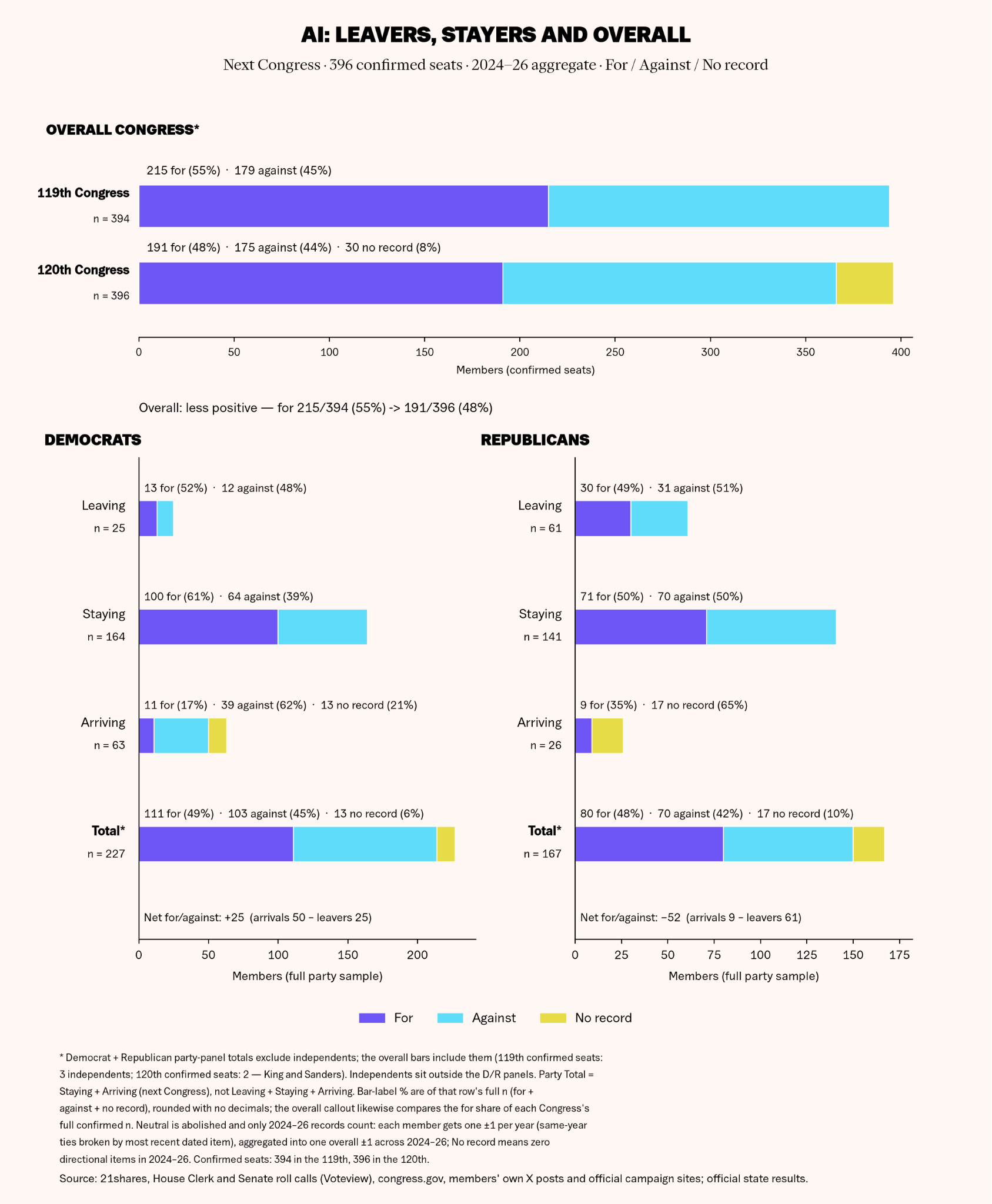
- Artificial/Super intelligence (AI or SI) support among recorded members eases to 52% from 55%, influenced by 39 newly elected Democrats opposing AI, including 30 who explicitly raise concerns over data centers (21shares research, as of Nov 5, 2026).
- The broader digital asset rebound is expected to follow a K-shaped path according to our research, with bitcoin and round-the-clock trading venues and privacy solutions likely to outperform memecoin platforms, prediction markets, and AI-linked bitcoin mining operations.
- Because digital assets trade globally, a change in one legislature moves only one piece of the bigger picture and not the entire market trajectory.
Looking at members who have established a clear stance, pro-digital assets sentiment in the incoming Congress sits at 62%, down from 66% in the outgoing legislature. When factoring in the 61 representatives (15% of the total) without a prior record, digital assets supporters account for 208 out of 396 seats (53%), whereas opponents hold 127 seats (32%).
Republicans lost seats, but almost every Republican with a clear record supported digital assets before the vote and still does. Democratic support barely moved, from 31% to 32%. Recalculating the incoming Congress using the prior partisan distribution yields a net balance of 33 points, compared to 32 points previously.
Democrats cite oversight gaps on digital assets, oppose data centers on AI
Lawmakers opposing federal stablecoin or market-structure legislation argued that such measures undermine Securities and Exchange Commission (SEC) regulatory oversight while failing to adequately address fraud, illicit finance, and localized mining zoning issues. Meanwhile, newly elected members primarily targeted the influence of political spending by the digital assets sector in their public statements.
Regarding artificial/super intelligence, 39 of the 59 newcomers with an established position express opposition, all belonging to the Democratic Party. Within this group, 30 specifically target data center development, raising concerns over tax incentives, resource allocation for power and water, or calling for temporary moratoriums on new facilities. Consequently, overall AI support among Democrats with a recorded stance dropped from 60% to 52%.
21shares research expects a K-shaped recovery, not a rising tide
A K-shaped trajectory describes a market split, where select sectors advance while others stagnate or decline. Our research outlines the following dynamics:
- The upward trends: Bitcoin, which saw the approval of the first spot ETFs even under a regulatory climate widely viewed as hostile, remains on an upward trajectory alongside 24/7 trading venues that broaden access to real-world and digital assets, privacy protocols, and quantum-resistant solutions. We anticipate positive momentum across these areas, driven by balanced oversight from the SEC and CFTC, bipartisan support for digital assets as technological innovation, and heightened demand for privacy and quantum security amid expanding AI breakthroughs.
- The potential downward trends: Memecoins, prediction markets, and AI build out and AI-linked Bitcoin mining may face downward pressure. Viewed increasingly as speculative or gambling-adjacent, memecoins and prediction venues remain prime targets for heightened consumer protection enforcement and legal scrutiny. Concurrently, AI-build outs from Bitcoin mining could encounter headwinds from escalating power expenses, elevated capital costs, and data center permitting bottlenecks, factors that heighten competition from China and favor well-capitalized, low-debt scale operators in this market environment.
Bitcoin does not wait for Washington
Operating across global time zones, Bitcoin functions continuously under diverse jurisdictional frameworks. A prime example is the European Union's Markets in Crypto-Assets Regulation (MiCA), which remains completely unimpinged by changes in US congressional seat distributions. Consequently, while US midterm election outcomes shift local policy dynamics, global supply, international demand, and foreign regulatory structures continue to shape the broader asset landscape.
Following the election results, Bitcoin recorded a 24-hour gain of 4% on November 4. However as of November 15, the asset is down by more than 15% due to broader macro tightening pricing in another rate hike this year and subsequent derivative liquidations. Looking at historical precedents, Bitcoin appreciated by nearly 45% and 92% in the 12 months following the 2018 and 2022 midterms, respectively. However, two data points do not constitute a definitive forecast, particularly given preceding market events such as the approximately $6.3 billion Binance security incident on October 29, 2026. As always, historical performance offers no guarantee of future returns.
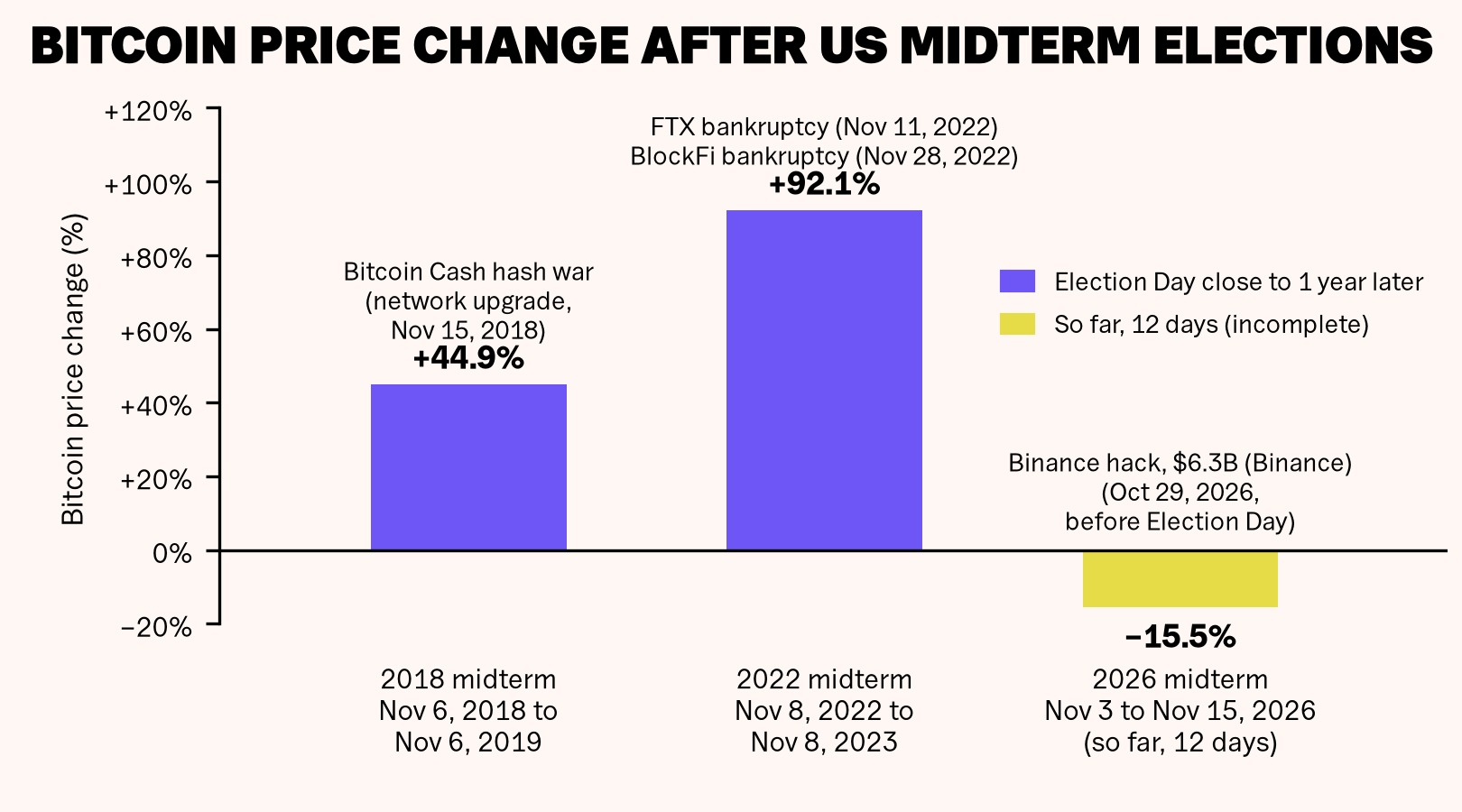
Source: 21shares, Coinbase Exchange (third-party; BTC-USD daily closes), Bitstamp (third-party; BTC/USD daily closes and ticker, cross-check), Bitcoin ABC (third-party), Bitcoin Magazine (third-party), US Bankruptcy Courts, Louisiana Office of Financial Institutions, FBI, Binance (third-party), as of Nov 4, 2026.
How 21shares research built the dataset
Our research team built its own member-level dataset from official records. Each member’s votes, sponsored and cosponsored bills, and public statements on digital assets and AI from 2024 to 2026 are read and marked For or Against, and a member with nothing that takes a side is marked No record. The dataset holds 7,217 directional items across 535 projected members, 86% of them votes and bills and 13% posts on X.
Seats count only when an official state results page shows a leader. That gives 331 of 470 races (70%), plus 65 senators not up for election, for 396 voting seats. These are election-night counts, not certified results, and non-voting delegates are excluded. Incumbents are scored mainly on votes and bills and newcomers mostly on statements, and only 28 of 89 newcomers have a digital assets record, so newcomer figures can move a lot.