How does crypto fit into a portfolio?



With crypto, even a small allocation does some of the heavy lifting.
In addition to potential returns, investors also look to crypto for its diversification benefits.
A key to smart portfolio building is choosing assets that do not always move in the same direction. Our analysis shows that crypto maintains a relatively low long-duration correlation to global stocks, and has resulted in improved portfolio performance historically. Adding even a small amount to your portfolio can have an impact.
This is because crypto’s drivers can be different from stocks and bonds.
Think of crypto as a way to avoid putting all your financial eggs in one basket. Because it’s driven by new technology rather than corporate profits, it did and could move to its own beat, independent of the stock market.
Your allocation will depend on your goals and your risk tolerance, and, as with any investment, sizing it with discipline from rebalancing so you can sleep comfortably at night is a great place to start.
Crypto in a traditional portfolio
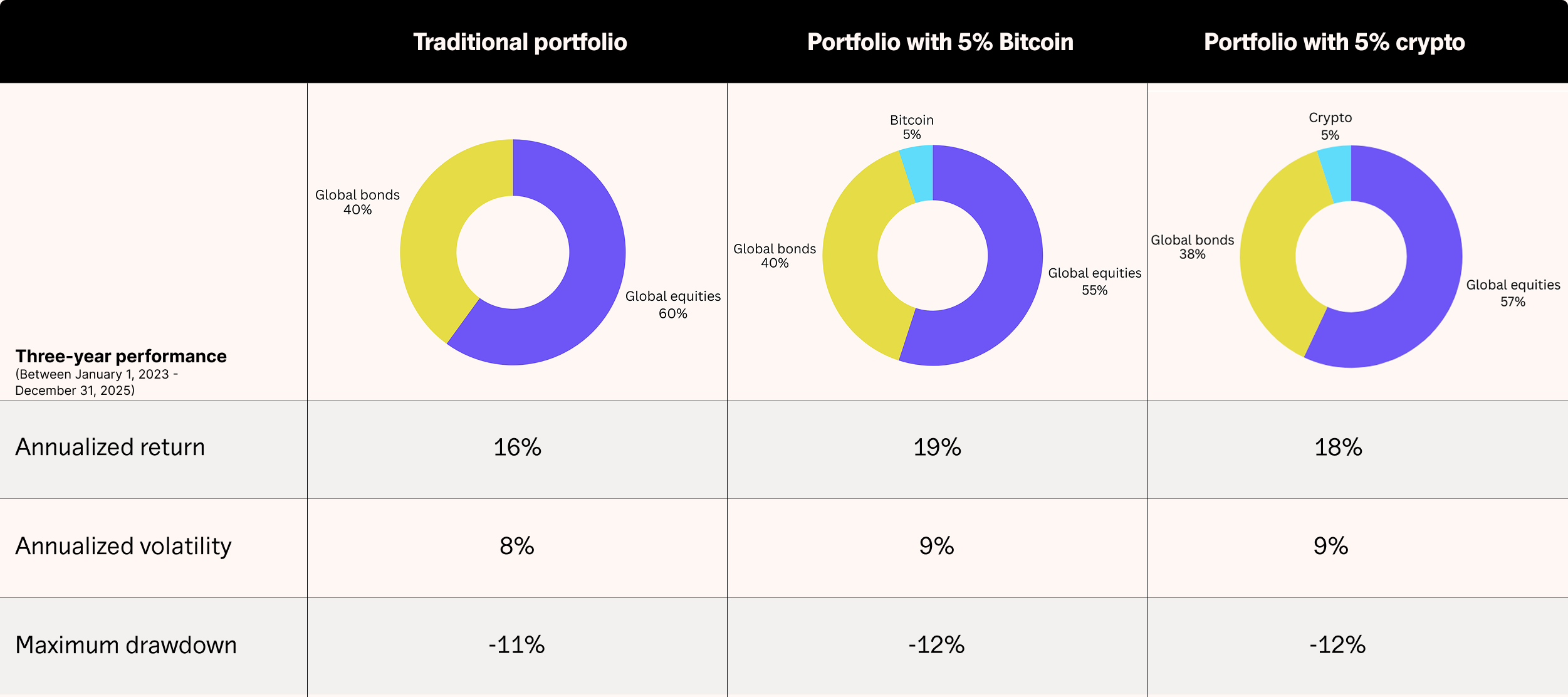
The table below compares a traditional portfolio – made of 60% stocks and 40% bonds – with a more modern portfolio that includes a small amount of crypto. These examples are based on historical data from the last three years to illustrate how different strategies performed.
Interestingly, the portfolios that included crypto recovered faster from their largest price drops. During the market fall triggered by US tariffs in April 2025, the traditional portfolio took 22 days to return to its previous value. In contrast, the portfolios containing bitcoin recovered in just 17 days. This suggests that a small amount of crypto may help a portfolio bounce back more quickly during certain types of market stress.
This report has been prepared and issued by 21Shares AG for publication globally. All information used in the publication of this report has been compiled from publicly available sources that are believed to be reliable, however, we do not guarantee the accuracy or completeness of this report. Crypto asset trading involves a high degree of risk. The crypto asset market is new to many and unproven and may have the potential not to grow as expected.Currently, there is relatively small use of crypto assets in the retail and commercial marketplace in comparison to relatively large use by speculators, thus contributing to price volatility that could adversely affect an investment in crypto assets. In order to participate in the trading of crypto assets, you should be capable of evaluating the merits and risks of the investment and be able to bear the economic risk of losing your entire investment.Nothing herein does or should be considered as an offer to buy or sell or solicitation to buy or invest in crypto assets or derivatives. This report is provided for information and research purposes only and should not be construed or presented as an offer or solicitation for any investment. The information provided does not constitute a prospectus or any offering and does not contain or constitute an offer to sell or solicit an offer to invest in any jurisdiction. The crypto assets or derivatives and/or any services contained or referred to herein may not be suitable for you and it is recommended that you consult an independent advisor. Nothing herein constitutes investment, legal, accounting or tax advice, or a representation that any investment or strategy is suitable or appropriate to your individual circumstances or otherwise constitutes a personal recommendation. Neither 21Shares AG nor any of its affiliates accept liability for loss arising from the use of the material presented or discussed herein.Readers are cautioned that any forward-looking statements are not guarantees of future performance and involve risks and uncertainties and that actual results may differ materially from those in the forward-looking statements as a result of various factors.This report may contain or refer to material that is not directed to, or intended for distribution to or use by, any person or entity who is a citizen or resident of or located in any locality, state, country or other jurisdiction where such distribution, publication, availability or use would be contrary to law or regulation or which would subject 21Shares AG or any of its affiliates to any registration, affiliation, approval or licensing requirement within such jurisdiction.