

Earlier this month, the Financial Conduct Authority (FCA) proposed lifting its ban on crypto exchange-traded notes (ETNs) for retail investors, allowing access via approved exchanges under strict promotion rules.
Aiming to be a “crypto hub,” this move supports the UK’s goal of competitiveness in this space and reflects a broader global trend: countries are accelerating efforts to regulate digital assets and compete for leadership in the rapidly evolving market for crypto exchange-traded products (ETPs).
Exchange-traded product (ETP) is generally an umbrella term for a broad category of investment products traded on public exchanges, encompassing exchange-traded funds (ETFs), exchange-traded commodities (ETCs) and exchange-traded notes (ETNs).
It is important to note that, depending on the jurisdiction in which they are traded, crypto ETPs may be classified differently. In Switzerland, these products are called crypto ETPs without further subclassification, while the UK classifies them as crypto ETNs (cETNs). In both jurisdictions, these products are structured similarly, as physically backed debt securities that track the performance of cryptocurrencies. Unlike ETFs, investors do not directly hold the assets but rather have a claim to the performance of the underlying assets.
Returning to the global race for crypto ETP dominance, the US leads the pack, with institutional investors trading a daily average of over $6 billion in Bitcoin and Ethereum ETFs this year. The EU follows, averaging more than $100 million in average daily volume across multiple jurisdictions. The UK, however, remains well behind, with just $1.5 million in average daily volume for crypto ETNs, currently limited to professional investors.
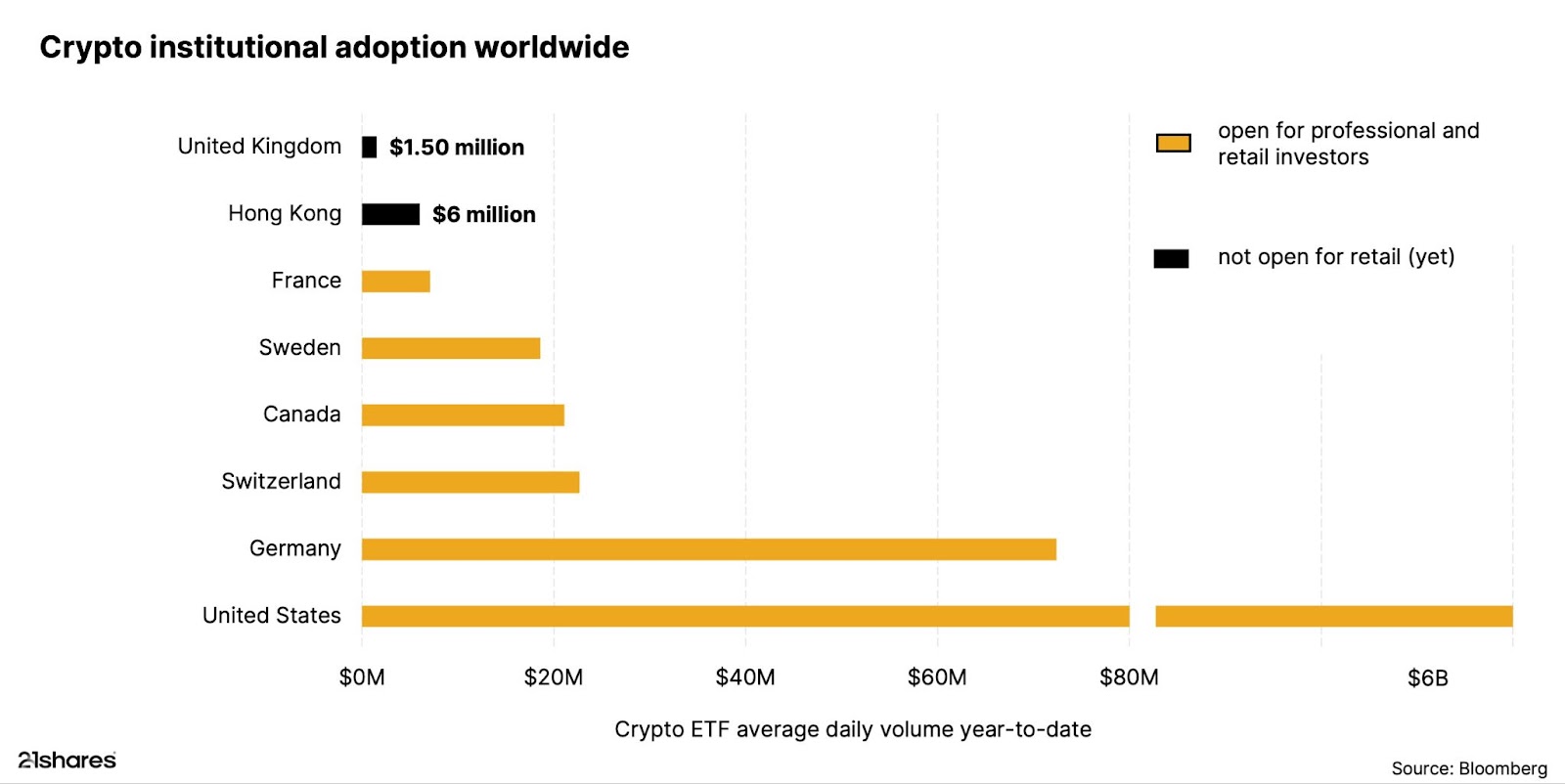
Countries race toward crypto ETP adoption
In the European Union, the European Securities and Markets Authority (ESMA) is reviewing whether UCITS funds, which make up 75% of all collective retail investments in the EU, should be permitted to gain exposure to crypto assets. Similar to mutual funds in the US, UCITS funds can be registered and sold in any country in the EU using unified regulatory and investor protection requirements. These funds are considered safe, well-regulated investments, hence their €12 trillion market valuation and popularity among pension funds and risk-averse investors.
In South Korea, newly elected President Lee Jae-myung has pledged to legalize spot crypto ETFs and expressed his intention to allow the country’s $884 billion National Pension Fund to invest in Bitcoin and other digital assets, signaling a bold shift in national investment policy.
Canada, which launched the world’s first spot Bitcoin and Ethereum ETFs in 2021 and is often viewed as a "litmus test" for financial innovation ahead of US adoption, expanded its crypto ETF lineup earlier this year with the introduction of four spot Solana ETFs.
Conclusion
The appeal of crypto ETPs for countries is clear: they offer a simple, regulated gateway to digital assets. Investors can buy, hold, and trade them through standard brokerage accounts, just like traditional ETFs, while benefiting from the security and oversight of established financial institutions. As the global crypto landscape evolves, ETPs are emerging as a key bridge between traditional finance and the digital future.