

Additional analysis by Karim AbdelMawla, Maximiliaan Michelsen, and Matthew Mena
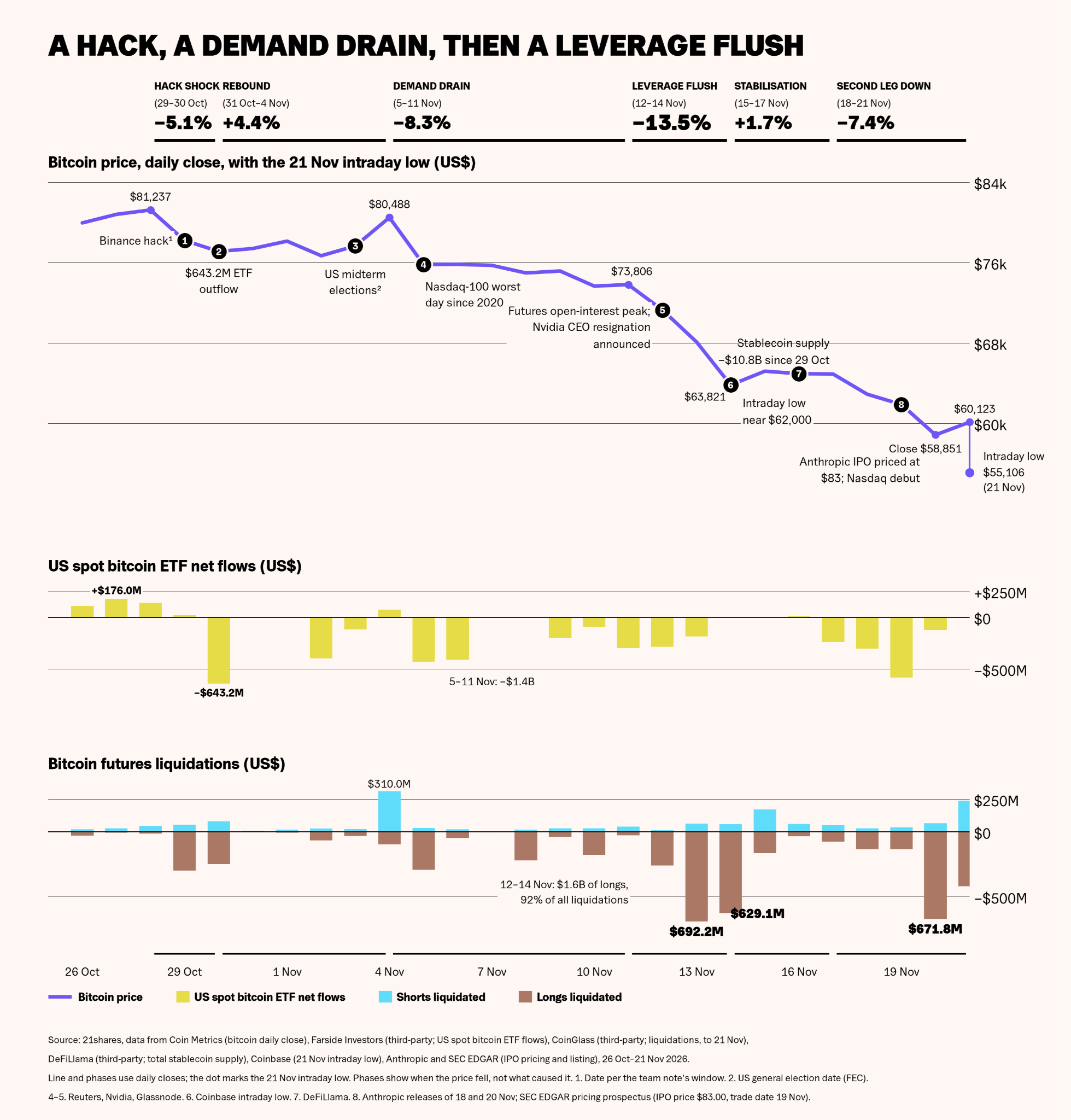
The Binance hack started the bitcoin sell-off, but it did little of the damage. Bitcoin fell 5.1% in the two days after the hack and had won almost all of that back by November 4, the day after the US midterms. The heavier losses came over the next 10 days, first as money left US spot bitcoin and ether exchange-traded funds (ETFs) and stablecoins, which took bitcoin down 8.3% to $73,806, and then as leveraged long positions (borrowed-money bets on a rising price) were forced out, costing another 13.5% in three days. We expect the risk-off environment to last until buyers return through positive ETF flows.
Key takeaways
- The hack was the spark, but on November 9 bitcoin was still only about 7% below its pre-hack level.
- Weak demand did more harm, with stablecoin supply down $10.7 billion and US spot bitcoin and ether ETFs losing $3.9 billion between October 30 and November 13.
- Forced selling did the most, with $5.8 billion of crypto liquidations in the week to November 15, 81% of them longs.
- The sellers many feared have mostly stayed put, and Strategy has kept buying.
- We expect rallies to fade until stablecoin supply and ETF inflows recover, and with $60,000 already broken, the realized price near $53,250 is one of the low levels to watch. In past bear markets bitcoin bottomed 24% to 61% below it, a repeat we see as low probability for now, though still possible.
The Binance hack started the bitcoin sell-off, but most of the fall came later
The hack hit sentiment straight away. Bitcoin lost 5.1% in two days, and on October 30 US spot bitcoin ETFs had $643.2 million of net outflows, their worst day in our window from October 26 to November 19 (Farside Investors, 2026). Then the market steadied. Bitcoin was back at $80,488 by November 4, the day after the US midterms, and even on November 9 it was only about 7% below its pre-hack level. Most of the fall came after that, as outflows grew and the wider market turned risk-off.
Demand drained out of stablecoins and ETFs, taking bitcoin down 8.3%
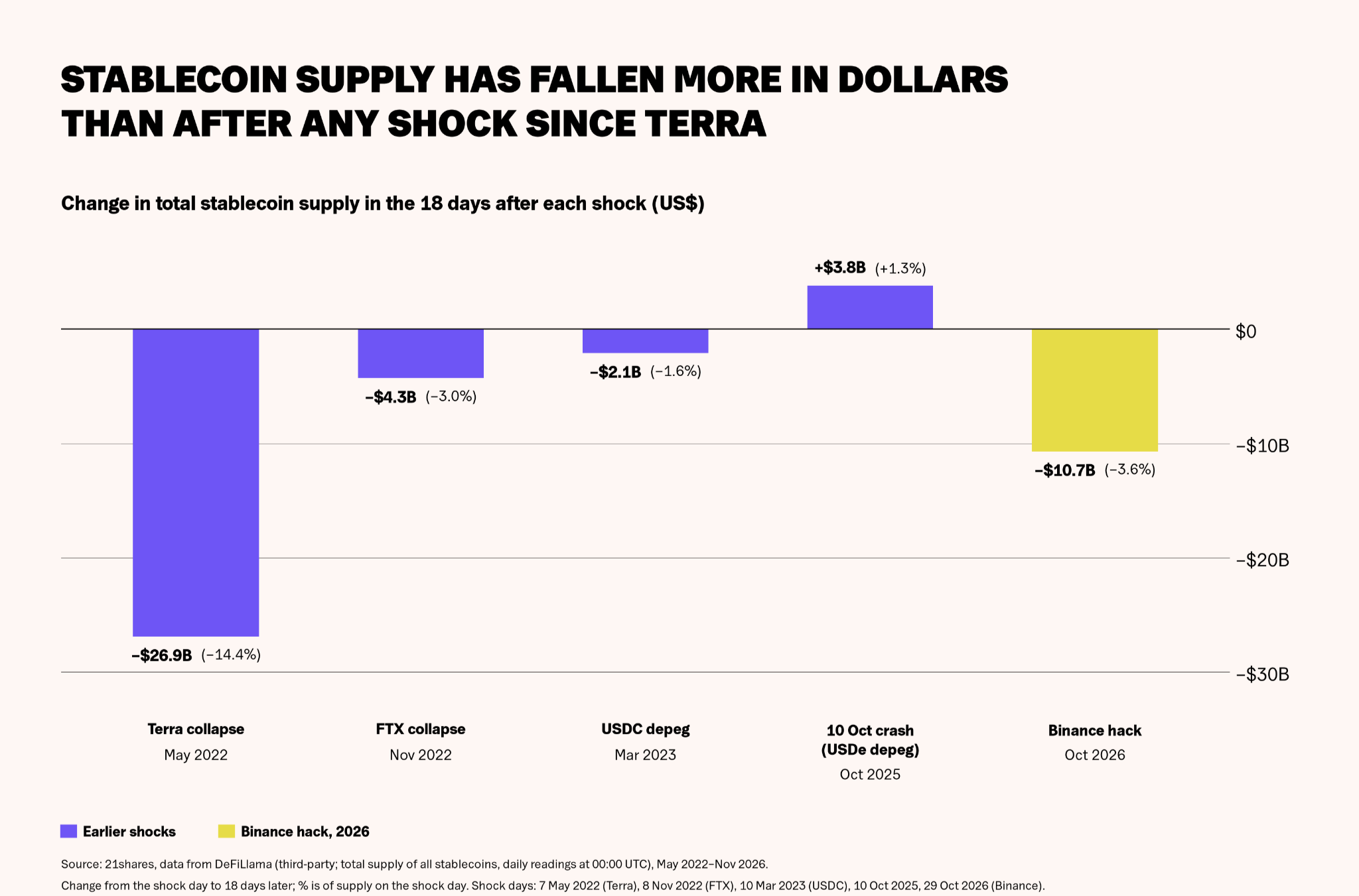
Between November 4 and November 11 bitcoin fell 8.3% to $73,806, mainly because money was leaving the market. Stablecoin supply has fallen by $10.7 billion since the hack, the largest 18-day drop in dollar terms since the Terra collapse in 2022. On exchanges, where stablecoins are the cash most readily available to buy crypto, balances are down 15%, and US spot bitcoin and ether ETFs lost $3.9 billion from October 30 to November 13 (DeFiLlama; Glassnode; CryptoQuant; Farside Investors, 2026). Even so, supply is still only 8% below its May record, while in the 2022-2023 bear market it fell by about 30%.
Forced selling of leveraged longs drove the steepest drop
The steepest leg came between November 11 and 14, when bitcoin dropped 13.5% to $63,821. Trading volumes were close to normal, so the extra push came from forced selling. A liquidation is an exchange closing a leveraged position because the trader's collateral no longer covers the loss. In bitcoin futures, $1.6 billion of longs were liquidated from November 12 to 14, 92% of all bitcoin liquidations in those days. Across crypto, liquidations reached $5.8 billion in the week to November 15, the highest since August (CoinGlass, 2026). Most of the leverage added since the hack has now been unwound, though, so there is less left to force out (Glassnode, 2026). Even so, another $671.8 million of bitcoin longs were liquidated on November 20, 91% of that day's bitcoin liquidations, as bitcoin fell 4.9% (CoinGlass; Coin Metrics, 2026).
The attacker and the largest holders show little sign of selling
The sellers many investors feared after the hack have mostly stayed put. The attacker's 18,270 bitcoin and 522,409 ether were still unspent in mid-November (Elliptic, 2026). Miners are sending the least to exchanges since at least 2020, and neither the US government nor the Mt. Gox trustee has sent coins to exchanges since the hack. Long-term holders' coins did move, but about 33% of that was Binance shifting old reserves on October 30. Strategy kept buying, adding 2,332 bitcoin between October 26 and November 15 (Glassnode; Arkham; Strategy, 2026).
Miners themselves are moving very little bitcoin. On Glassnode's data, the seven-day average of coins leaving miners' addresses has stayed mostly below 1,000 bitcoin a day since the April 2024 halving, its lowest range since the data begins in 2018, and was about 600 bitcoin in late November, close to the low end of that range (Glassnode, 2026). CoinGlass data also show miners' daily transfers to exchanges in the bottom percentile of the past four years (CoinGlass, 2026).
That does not mean miners have stopped selling. Listed miners' own reports show heavy sales, including to fund their move into artificial intelligence (AI) data centers. Riot sold 20,264 bitcoin in the first nine months of 2026 for about $1.5 billion, mainly to fund data center development. MARA sold about 26,984 bitcoin for $1.9 billion over the same period and another 13,597 bitcoin after September, using most of the latest proceeds to repay loans, and says it will keep using bitcoin to raise cash for uses including AI infrastructure (Riot; MARA, 2026). Glassnode builds its miner data from labeled mining-pool and reward addresses and notes that they do not capture miners' full onchain flows, so in our view coins sold from company treasuries can be missing from them (Glassnode, 2026).
Strategy faces pressure on its preferred stock and index membership
STRC, Strategy's preferred stock with a $100 stated amount, pays a 12% annual dividend, and Strategy reviews the rate each month to keep the price near $100. STRC closed between $99 and $100 from late October to November 13, then fell 6.3% to $93.60 by November 20 as bitcoin dropped 13.6%. That was its lowest close since at least September, and November 18 was its busiest trading day over that period (Nasdaq; Yahoo Finance; Coin Metrics, 2026).
Strategy has kept the rate at 12% for December, and management says it will recommend keeping it there until STRC has shown sustained, healthy trading near $100. Instead of selling new STRC, Strategy bought back $624.6 million of it (6,262,009 shares) between October 26 and November 15, with money raised by selling Strategy common stock (MSTR) and the rest from its cash and the interest earned on it (Strategy, 2026).
MSCI's decision adds to the pressure. On November 11, MSCI confirmed that it will remove Strategy from the MSCI All Country World Investable Market Index (ACWI IMI) and the MSCI US Prime Market 750 and US Investable Market 2500 indexes at the close of November 30 (MSCI, 2026). Funds that fully replicate those indexes would be expected to sell. Before the decision, while the exclusion was still a proposal, Strategy said such funds held about 3.1% of its shares, less than a day's trading. In our view, the bigger risk is not that one-off sale but a weaker MSTR price, which would make it more costly for Strategy to raise the cash it uses to support STRC and buy bitcoin. Its $4.9 billion of dollar reserves and cash, which it says covers about 3.4 years of preferred dividends and interest, buys it time (Strategy, 2026).
Macro pressures explain only part of the drawdown
Macro made things worse, though it does not explain the size of the fall. Markets now fully price in another Federal Reserve (Fed) hike in December after core inflation rose 0.3% for a third straight month. Doubts over AI spending also gave the Nasdaq-100 its worst day since 2020 on November 5 (CME FedWatch; US Bureau of Labor Statistics; Reuters, 2026). Yet in the week to November 13, the Nasdaq-100 rose about 3% while bitcoin fell 10%, and by November 15 bitcoin and ether were down 19.6% and 22.1% from the eve of the hack (Glassnode; Hyperliquid, 2026). By November 21, bitcoin's loss had grown to about 26% (Coinbase; Coin Metrics, 2026). The Democrats' midterm win also delayed crypto's policy agenda, with prediction-market odds of US market-structure legislation passing before 2028 falling from about 50% in early September to 26% after the elections (Kalshi, 2026).
Outages outside crypto reinforced investor caution after the Binance hack
Between November 12 and 16, a Microsoft outage, a nationwide halt to US flight departures and access problems at several major US banks showed how much of everyday life depends on a handful of digital systems, even though none of these incidents have been linked to a cyberattack. If institutions with decades of experience can still fail like this, investors have reason to approach a younger asset class with more caution after the Binance hack. In Binance's case, though, the breach stayed inside the exchange, and the Bitcoin network kept running without interruption.
Risk-off sentiment is likely to last until stablecoin supply and ETF inflows recover
In our view, this sell-off is likely to prolong the risk-off sentiment for now, as investors stay cautious about cyber threats and a tighter macro backdrop. Bitcoin lost its 200-week moving average near $68,000 and sits well short of the $73,000 to $75,500 zone it would need to reclaim to restore upside momentum. On the way down, bitcoin has already broken $60,000, and the realized price near $53,250 is another low level to watch (Glassnode, 2026).
Bitcoin's realized price near $53,250 is the next level to watch
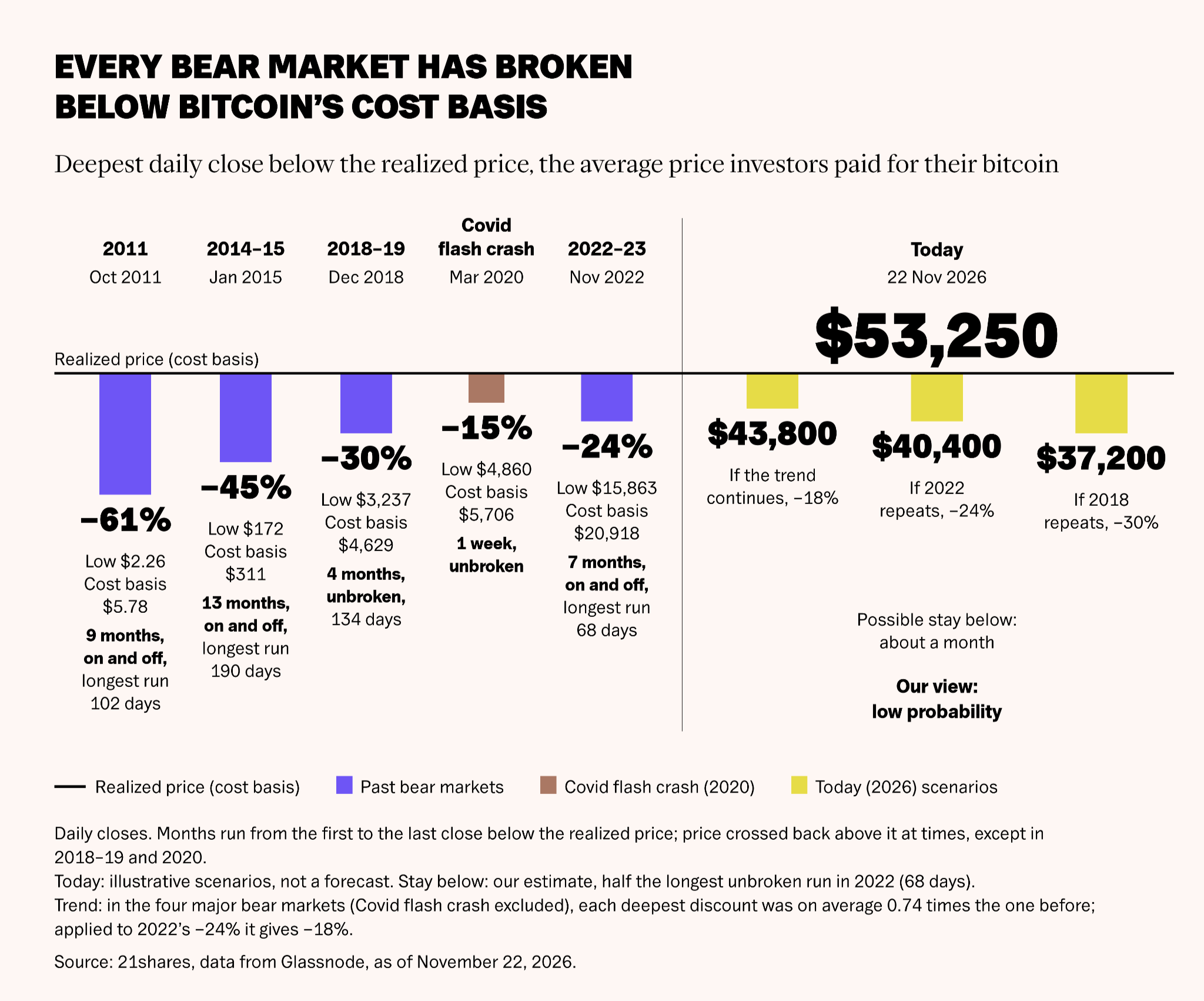
Bitcoin's realized price is the average investor cost basis, the average price at which every bitcoin last moved onchain. It stood at about $53,250 on November 22 (Glassnode, 2026). When bitcoin trades below it, the average holder is sitting on a loss, and each of the four major bear markets so far spent months around or below it.
On daily closes, bitcoin bottomed 61% below its realized price in October 2011, 45% below in January 2015, 30% below in December 2018 and 24% below in November 2022. From the first close below it to the last, those spells lasted about nine, 13, four and seven months. Only in 2018-2019 did bitcoin stay below the whole time, for 134 days. In 2011, 2014-2015 and 2022 it moved back above at times, and its longest unbroken runs below were 102, 190 and 68 days. The COVID-19 flash crash of March 2020 was shallower, a 15% dip that lasted a week. The realized price itself also fell by 11% to 30% in those bear markets, as coins changed hands at lower prices (Glassnode, 2026). Past performance is not a reliable indicator of future results.
If the 2022 discount repeated from today's realized price, bitcoin would fall to about $40,400, and the 2018 discount would take it to about $37,200. Each bear market's deepest discount has been about 75% of the one before. If that pace held, the next would be about 18% below the realized price, or about $43,800 (21shares analysis of Glassnode data, 2026). These are illustrative levels, not a forecast, and a falling realized price would pull them lower.
In our view, the chance of such a fall is low for now, because US spot ETFs and institutional buyers hold bitcoin today and they were absent in past cycles. It could still happen. The longest unbroken run below the realized price has also shrunk since 2014-2015, from 190 days to 134 and then 68. Our estimate is that a stay below it this time could last about a month, 50% of the 2022 run, although bitcoin could still spend several months around the realized price, as it did for about four months in 2018-2019 and seven in 2022-2023.
Cyclical bear markets have lasted 2.5 years, shorter ones about two months
Bitcoin has had two kinds of bear markets. The cyclical ones have fallen about 84% on average and lasted about 2.5 years. The shorter ones have fallen about 36% from the prior peak, lasted about two months, and taken about three months to recover. In our view, we are more than a year into a cyclical bear market.
Historically, the triggers have varied. Security failures were one: Bitcoinica1 was put into liquidation by a New Zealand court in November 2012, and Mt. Gox applied for civil rehabilitation in Tokyo in February 2014, after reporting that a large amount of bitcoin had disappeared and was likely stolen,2 and was declared bankrupt that April.3 Fraud was another: the US Securities and Exchange Commission (SEC) charged the founder of Bitcoin Savings and Trust4 with running a bitcoin Ponzi scheme in 2011 and 2012, says Bitconnect ran a fraudulent lending program until January 2018,5 and charged the founder of FTX with fraud in December 2022.6 Speculative excess with few guardrails played a part too, as in the 2017 boom in initial coin offerings (ICOs) that the SEC chairman warned about that December,7 and the decentralized finance (DeFi)8 and non-fungible token (NFT) peaks of 2021.9 Regulatory crackdowns played a role as well: China banned crypto trading in 2021.10 Tightening macro cycles mattered too: the 2018 and 2022 bear markets came as central banks pulled liquidity, with the Federal Reserve still raising rates in December 201811 and starting again in March 2022,12 when it also said it expected to start shrinking its balance sheet at a coming meeting.
Large daily moves have become rarer since US spot bitcoin ETFs launched
The longer view is calmer. Since 2014, bitcoin has had 101 days with a move of 10% or more, 57 up and 44 down, or about one every 44 days. Since US spot bitcoin ETFs launched in 2024, there have been only four, about one every 262 days, or roughly every nine months. The latest leg lower did not add to that count. From November 18 to 21, bitcoin fell 7.4% to $60,123, and its worst day was a 4.9% drop on November 20 (Coin Metrics, 2026). Excess kurtosis, which measures how much more often extreme days happen than a bell curve predicts, with zero meaning exactly as often, stood at 8.07 (21shares analysis of Yahoo Finance daily closes to November 21, cross-checked with Coin Metrics, 2026). Bitcoin can serve as a long-term store of wealth, but investors should still expect volatile days and plan for them, even as they become rarer.
Quantum-safe transactions and onchain pre-IPO markets cut against the downturn
Two developments cut against the downturn. A quantum-safe bitcoin transaction13 is now possible without any change to Bitcoin's rules. The first one was mined on August 26 using StarkWare's Quantum-Safe Bitcoin (QSB) method, which adds a second lock built on hash functions that known quantum attacks cannot break. StarkWare estimates14 that the graphics processing unit (GPU) computing needed to prepare one such transaction has fallen from about $320 at the first transaction to about $59, before network fees. QSB protects only coins whose public key has not yet been exposed, and StarkWare still sees a change to Bitcoin's rules as the better long-term answer. The $59 is StarkWare's modeled estimate and has not yet been confirmed in an actual transaction. QSB transactions are also larger than the normal relay rules allow, so they have to be sent directly to a miner rather than through the usual bitcoin network (StarkWare, 2026).
Onchain markets also cut against the downturn. Pre-initial public offering (pre-IPO) markets are becoming an anchor for investors to gauge demand and sentiment before a listing. For more than three weeks before Anthropic listed on Nasdaq15 on November 19, a perpetual contract (a derivative with no expiry date) on Hyperliquid, an onchain trading venue, tracked the price of one Anthropic Class A share around the clock. In the last minute before the first Nasdaq trade, the contract closed at $111.00. The stock's official opening price was $111.21, only $0.21 higher, and both sat about 34% above the $83 IPO price (Hyperliquid; Nasdaq; Anthropic, 2026). This market could feel like 2018 before one last leg down, though we see that as a low probability. Unlike previous bear markets, investors no longer question crypto's existence, but it is no longer the only frontier technology in their minds. AI and robotics are today's main growth stories and are drawing talent and capital away from digital assets, although we believe the asset class will converge with several other industries as part of its next stage of growth. We expect markets to split into winners and losers, which our report on the US Congress stance on digital assets described as a K-shaped recovery, where select sectors advance while others stagnate or decline. Bitcoin, 24/7 trading venues, privacy protocols and quantum-resistant solutions are on the upward path. We expect memecoins and prediction markets to face downward pressure from litigation, and the AI build-out and AI-linked bitcoin mining to face a higher cost of capital.
Rising stablecoin balances and lasting ETF inflows would change our view
Rising stablecoin balances on exchanges and lasting ETF inflows would show buyers coming back with an appetite for risk. The Fed could help on December 9 with a 25-basis-point hike and a signal to pause, while a larger hike would drag the weakness out. Based on the Bybit precedent, we expect the $2.2 billion in bitcoin and ether stolen in the Binance hack to reach the market through over-the-counter (OTC) brokers over several months.
Three data releases will show whether investors are ready to take on more risk
Until stablecoin supply grows again and ETF inflows resume, rallies are likely to be short-lived. US employment data on December 4, the Fed's decision on December 9 and inflation data on December 10 will show whether investors are ready to take on more risk, digital assets included.
Footnotes:
- New Zealand Gazette, BITCOINICA LP (in liquidation) (Notice No. 2012-al7221, Issue No. 134, p. 3831), November 8, 2012, https://gazette.govt.nz/notice/id/2012-al7221
- MtGox Co., Ltd., Announcement Regarding an Application for Commencement of a Procedure of Civil Rehabilitation, February 28, 2014, https://www.mtgox.com/img/pdf/20140228-announcement_eng.pdf
- MtGox Co., Ltd., Announcement of Commencement of Bankruptcy Proceedings [Q&A], April 24, 2014, https://www.mtgox.com/img/pdf/20140424_announce_qa_en.pdf
- U.S. Securities and Exchange Commission, SEC Charges Texas Man With Running Bitcoin-Denominated Ponzi Scheme (Press Release No. 2013-132), July 23, 2013, https://www.sec.gov/news/press-release/2013-132
- U.S. Securities and Exchange Commission, SEC Charges Global Crypto Lending Platform and Top Executives in $2 Billion Fraud (Press Release No. 2021-172), September 1, 2021, https://www.sec.gov/news/press-release/2021-172
- U.S. Securities and Exchange Commission, SEC Charges Samuel Bankman-Fried with Defrauding Investors in Crypto Asset Trading Platform FTX (Press Release No. 2022-219), December 13, 2022, https://www.sec.gov/news/press-release/2022-219
- Jay Clayton, Statement on Cryptocurrencies and Initial Coin Offerings, U.S. Securities and Exchange Commission, December 11, 2017, https://www.sec.gov/newsroom/speeches-statements/statement-clayton-2017-12-11
- Board of the International Organization of Securities Commissions, Final Report with Policy Recommendations for Decentralized Finance (DeFi) (Report No. FR/14/2023 [IOSCOPD754]), December 2023, https://www.iosco.org/library/pubdocs/pdf/IOSCOPD754.pdf
- Kristen E. Busch, Non-Fungible Tokens (NFTs) (CRS Report No. R47189), Congressional Research Service, July 20, 2022, https://crsreports.congress.gov/product/pdf/R/R47189
- People's Bank of China et al., 关于进一步防范和处置虚拟货币交易炒作风险的通知 [Notice on Further Preventing and Disposing of Risks in Virtual Currency Trading and Speculation] (Document No. 银发〔2021〕237号), September 24, 2021, https://www.pbc.gov.cn/tiaofasi/144941/3581332/4348658/index.html
- Board of Governors of the Federal Reserve System, Federal Reserve Issues FOMC Statement [Target range raised to 2-1/4 to 2-1/2 percent], December 19, 2018, https://www.federalreserve.gov/newsevents/pressreleases/monetary20181219a.htm
- Board of Governors of the Federal Reserve System, Federal Reserve Issues FOMC Statement [Target range raised to 1/4 to 1/2 percent], March 16, 2022, https://www.federalreserve.gov/newsevents/pressreleases/monetary20220316a.htm
- StarkWare, The First Quantum-Safe Bitcoin Transaction Has Been Mined, StarkWare Blog, August 26, 2026, https://starkware.co/blog/the-first-quantum-safe-bitcoin-transaction-has-been-mined/
- StarkWare, Can Bitcoin Coins Be Made Quantum-Safe Without a Soft Fork?, Quantum Hub, 2026, https://quantum.starkware.co/research/quantum-safe-bitcoin
- Anthropic, PBC, Anthropic Prices Initial Public Offering, Anthropic News, November 19, 2026, https://www.anthropic.com/news/anthropic-prices-initial-public-offering
FAQ
Why did bitcoin fall after the Binance hack?
The hack caused the first drop, 5.1% in two days, but bitcoin had won almost all of it back by November 4. Most of the fall came later, as stablecoin supply fell $10.7 billion and US spot bitcoin and ether ETFs lost $3.9 billion, and then as forced selling of leveraged long positions took bitcoin down 13.5% in three days between November 11 and 14 (DeFiLlama; Farside Investors; CoinGlass, 2026).
What is bitcoin's realized price?
Bitcoin's realized price is the average investor cost basis, the average price at which every bitcoin last moved onchain. It stood at about $53,250 on November 22. When bitcoin trades below it, the average holder is sitting on a loss (Glassnode, 2026).
How far below its realized price has bitcoin fallen in past bear markets?
On daily closes, bitcoin bottomed 61% below its realized price in October 2011, 45% below in January 2015, 30% below in December 2018 and 24% below in November 2022. Only in 2018-2019 did it stay below the realized price the whole time, for 134 days (Glassnode, 2026).
Are bitcoin ETF outflows causing the price drop?
ETF outflows contributed but were not the largest factor. US spot bitcoin and ether ETFs lost $3.9 billion between October 30 and November 13 (Farside Investors, 2026), while forced liquidations of leveraged long positions drove the steepest leg, a 13.5% fall to $63,821 between November 11 and 14 (CoinGlass, 2026).
What would signal that buyers are returning to bitcoin?
In 21shares' view, rising stablecoin balances on exchanges and lasting ETF inflows would show buyers coming back with an appetite for risk. US employment data on December 4, the Federal Reserve decision on December 9 and inflation data on December 10 will show whether investors are ready to take on more risk.