

XRP is one of the oldest and largest digital assets in the market. Launched in 2012 by David Schwartz, Jed McCaleb, and Arthur Britto, it is the native asset of the XRP Ledger (XRPL), the public blockchain network on which XRP operates, designed with one job in mind: moving value quickly, cheaply, and reliably. More than a decade on, XRP ranks among the largest crypto assets, with a market capitalization north of $60 billion.
How the XRP Ledger settles transactions in under five seconds
That focus shows in the design. Transactions on the XRPL settle in three to five seconds and cost roughly $0.0002, with the network processing around 1.7 million transactions a day. Rather than relying on power-intensive mining like Bitcoin, the ledger runs on a consensus protocol in which independent validators agree on the state of transactions, consuming negligible energy in the process. More than 150 known validators operate on the network today, run by universities, exchanges, businesses, and individuals, and the ledger has validated more than 100 million batches of transactions, one every few seconds, without interruption since 2012. Supply works differently here than in most of the industry too. All 100 billion XRP were created at the ledger's launch, and no new XRP can ever be issued. In fact, supply slowly shrinks: every transaction burns a small amount of XRP as a fee, a mechanism designed to deter spam, with more than 14 million XRP destroyed to date.
XRP, XRPL, and Ripple, untangled
A common point of confusion is the relationship between XRP, the XRPL, and Ripple.
- The XRPL is the open, decentralized public blockchain network.
- XRP is the asset that lives on it.
- Ripple is a private technology company that builds payment and custody infrastructure on top of the ledger and remains its most prominent contributor.
At launch, the ledger's founders gifted 80 of the 100 billion XRP to Ripple to fund development, and in 2017 the company locked 55 billion of those into escrow. Roughly 34 billion remain there today, entering circulation on a public schedule. Despite common misconceptions, Ripple does not control the network: it runs just one of the 35 validators on the ledger's default trust list, and anyone can build on the XRPL, as an ecosystem of exchanges, banks, fintechs, and developers does.
XRP's primary role is as a bridge for cross-border payments
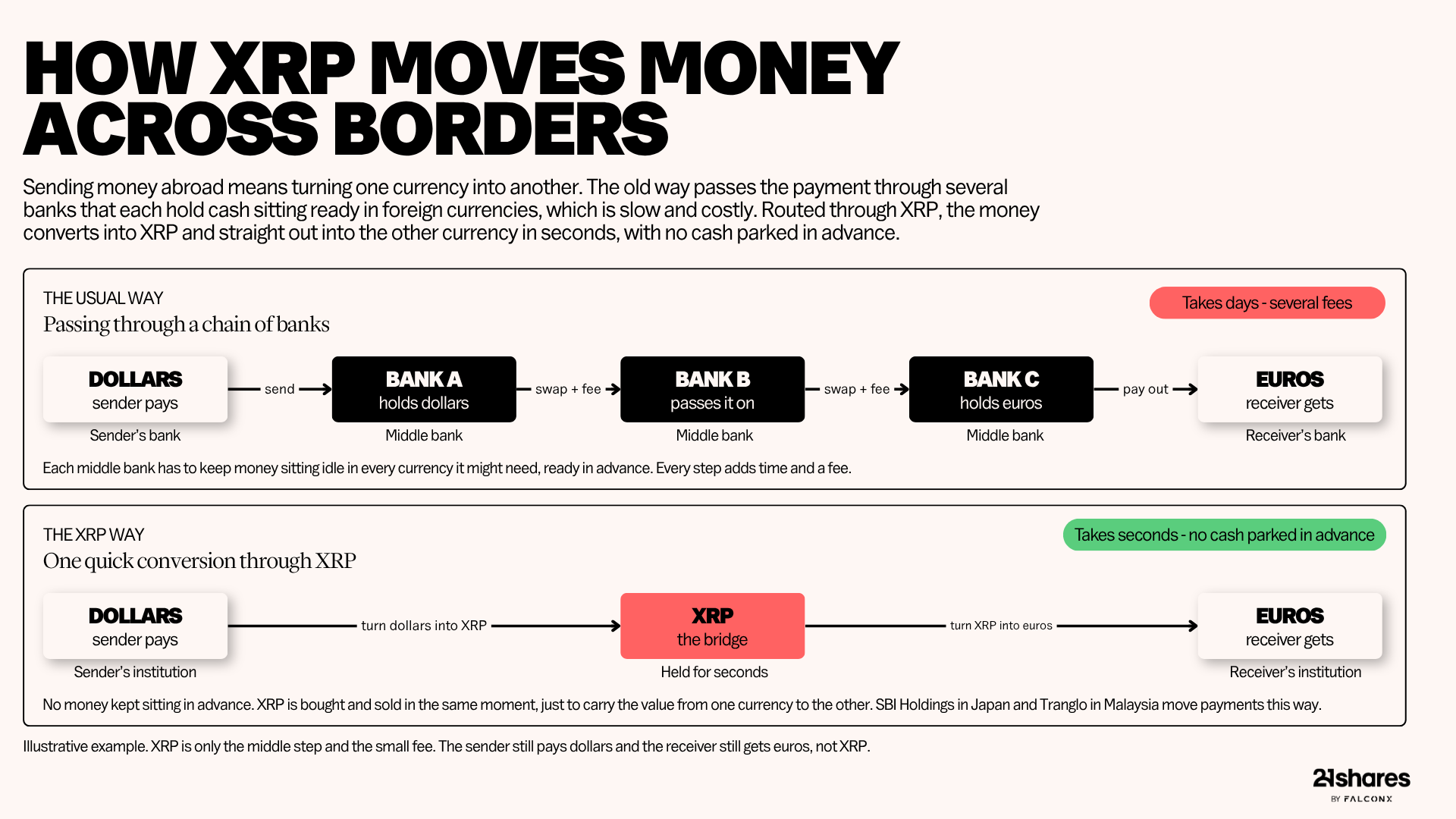
So what is XRP actually for? Its original and still primary role is as a bridge asset for payments, particularly cross-border ones. Instead of routing money through a chain of correspondent banks, a payment can convert from one currency into XRP and out into another in seconds. Financial institutions such as Japan's SBI Holdings and payment providers like Malaysia's Tranglo use the ledger for exactly this.
However, the XRP Ledger has since grown beyond payments. It hosts a native decentralized exchange, supports token issuance, and serves as crucial infrastructure for stablecoins and tokenized real-world assets: Ripple's RLUSD stablecoin reached around $1.6 billion, while tokenized assets represented on the XRPL stand at $4 billion, making it one of the largest networks for real-world assets. This mirrors a key structural trend across base-layer networks, where stablecoins and tokenization are modernizing the rails of legacy finance. XRP's role in all of this is narrow but unavoidable: the assets themselves do not trade in XRP, but every transaction on the ledger, whether a payment, a trade, or a token issuance, pays its fee in XRP, which is then burned.
Where Bitcoin was designed as a digital store of value sheltered from the broader financial system, XRP was designed as critical plumbing for the financial system itself. That distinction shapes everything about how the asset works and how investors should evaluate it.





.svg)



_logo.svg)

.svg.png)