

Hyperliquid's H1 2026 earnings tell two stories simultaneously. Total fees and user growth have never been stronger. Core protocol revenue, by contrast, is quietly declining.
Gross fees rose 31% to $419.3 million in H1 2026 from the same period in 2025. Average daily users nearly doubled. June trading volume hit $266.5 billion while H1 trading volume sits at $1.29 trillion. Yet the revenue Hyperliquid keeps from its own native markets fell 3.8% over the same period.
The following five charts explain why that divergence exists, what it means for Hyperliquid's competitive position, and how the market is pricing the outcome.
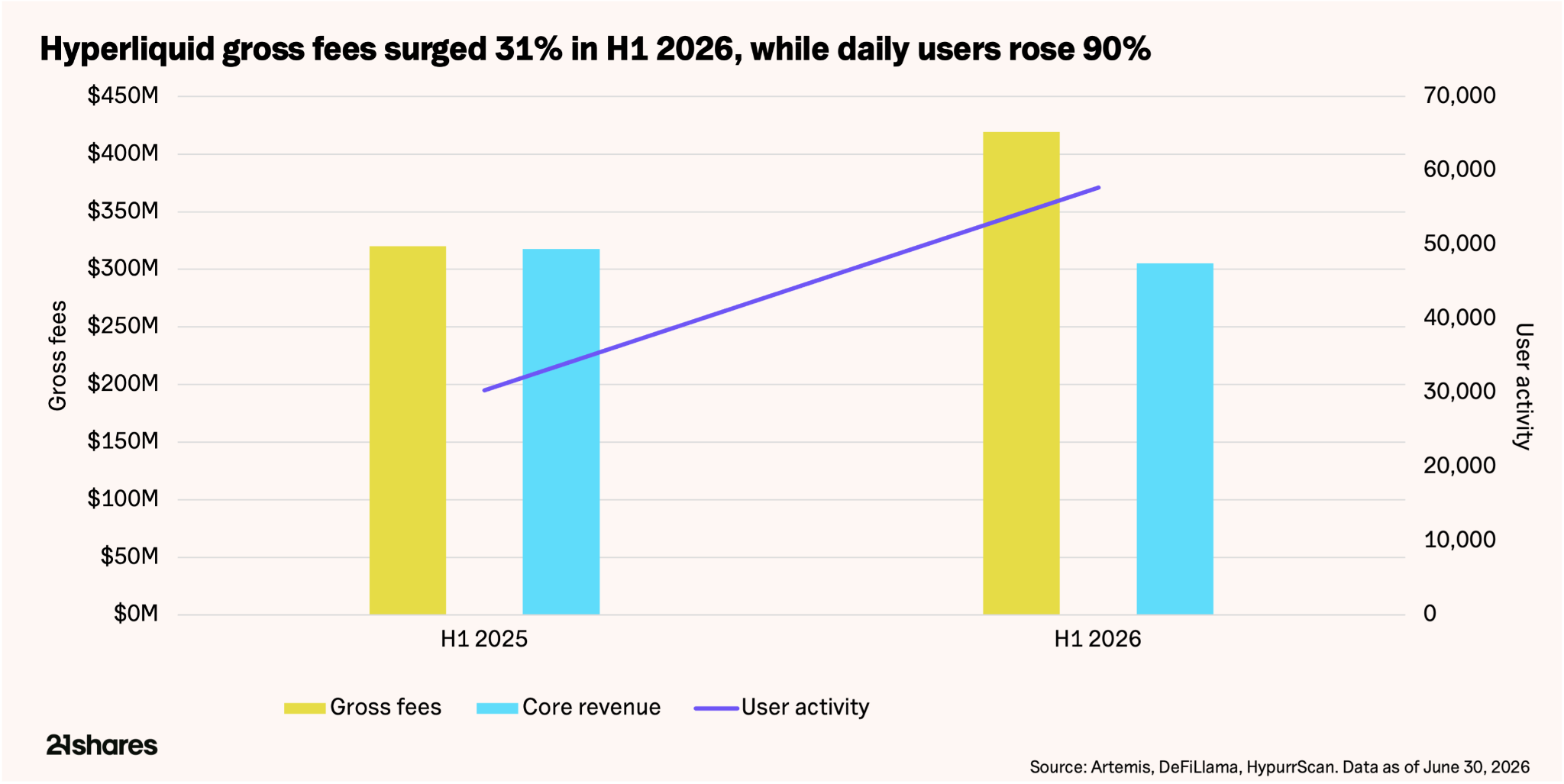
Gross fees surged 31% while average daily active users rose 90% in H1
Hyperliquid generated $419.3 million in gross fees in H1 2026, up from $320 million in H1 2025. But the revenue line that flows back into the platform's own treasury, its core protocol revenue, declined from $317.5 million to $305.3 million over the same period. The gap is explained by HIP-3 (Hyperliquid Improvement Proposal 3): an open framework allowing external businesses to launch their own markets on Hyperliquid's infrastructure, keeping 50% of resulting trading fees. As HIP-3 markets have grown, they've captured an ever-increasing percentage of total fees without flowing fully back to the protocol. Meanwhile, the user base tells a different story: average daily users rose 90% in H1, suggesting demand is not weakening but rather it's being served through a new channel.
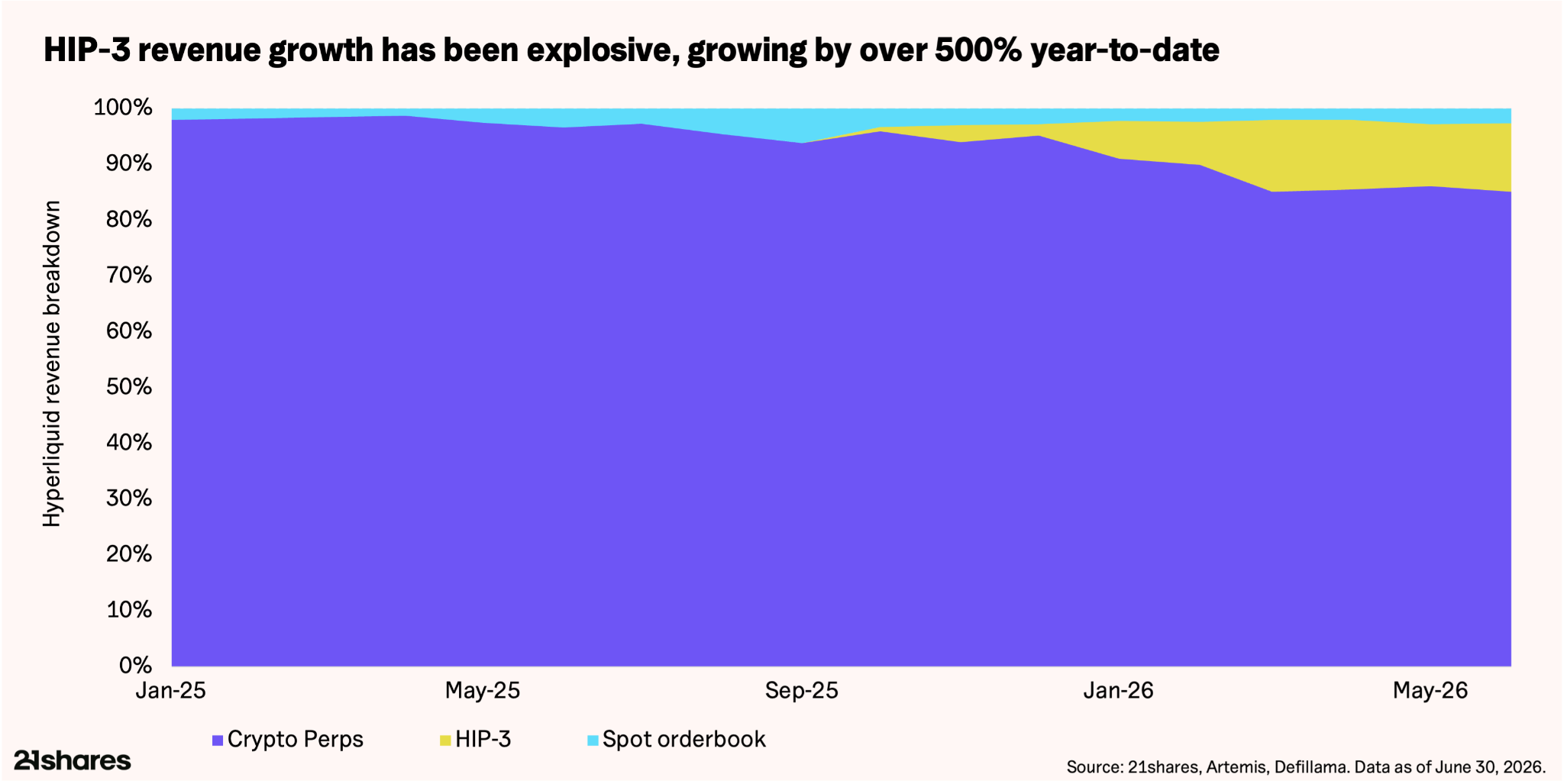
HIP-3 went from zero to 11% of revenue in less than a year
Before HIP-3, Hyperliquid's fee base was essentially a single product: crypto perpetuals. Today, crypto perpetuals still represent 82.7% of gross fees, but HIP-3 perps, which allow external builders to deploy markets tracking equities, commodities, and pre-initial public offering (IPO) assets, have grown from negligible to 11.2% of gross fees, a +10,000% year-to-date increase. Spot trading and HIP-1 (Hyperliquid's ticker auction mechanism) contribute the remaining 6.1%. Looking ahead, a USD Coin (USDC) reserve income partnership with Coinbase could add an estimated $135 to $160 million annually, roughly 18% of current core revenue, by directing approximately 90% of yield on $5.4 billion in USDC reserves toward HYPE buybacks. However, it should be noted that if usage of Hyperliquid falls, this number will fall as well. That income stream has not yet been confirmed onchain.
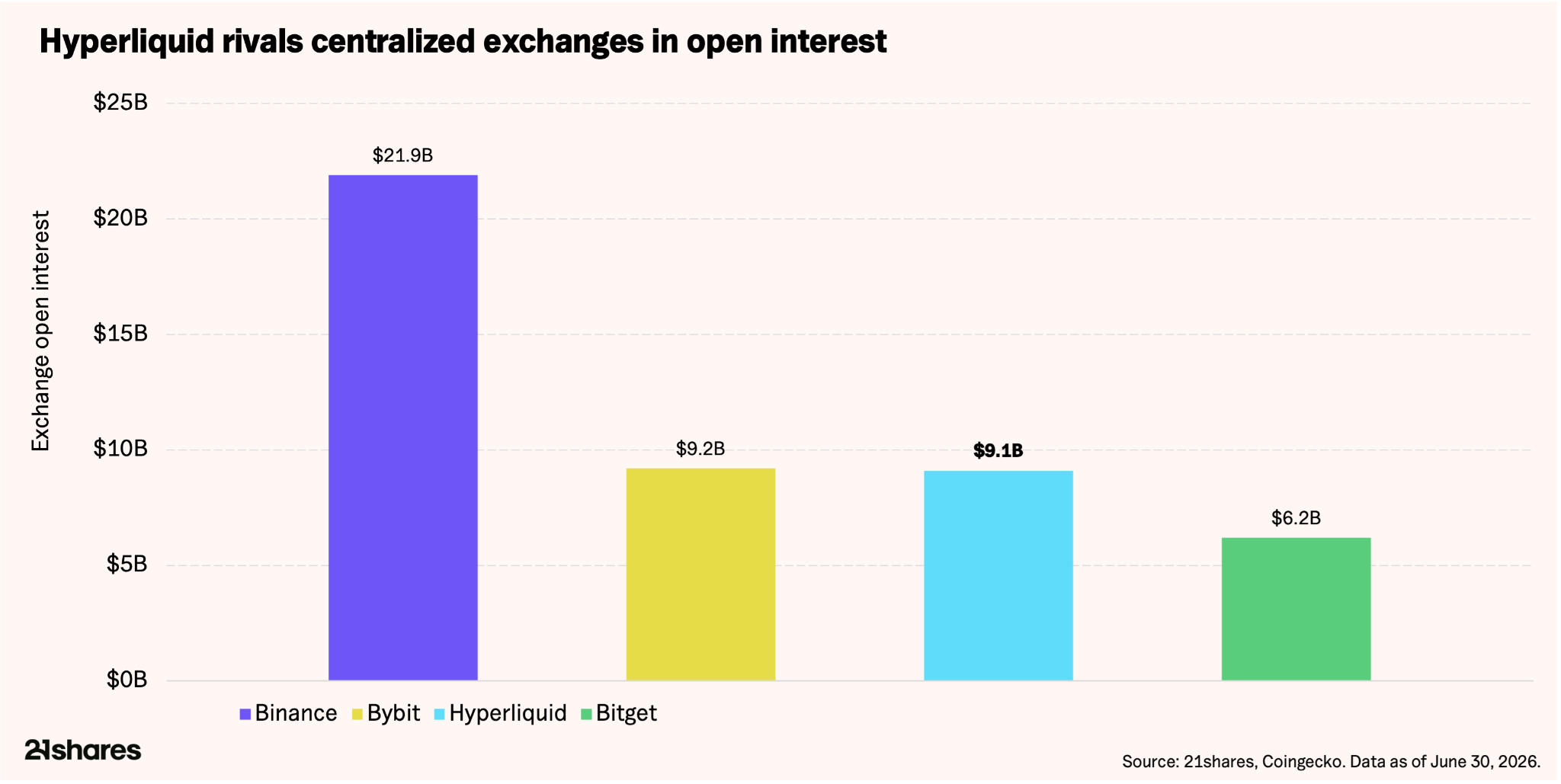
Rivalling Bybit at scale, Hyperliquid now holds 10% of all crypto perps open interest
Centralized exchanges still dominate the perpetuals market. Binance alone captures 14% of global open interest, but Hyperliquid's $9.1 billion in open interest represents 10.3% of the entire crypto perps market, including centralized venues. That position has grown 24.8% year-over-year, 25.5% year-to-date, and 27.9% quarter-over-quarter. The platform now sits alongside Bybit in scale. No other decentralized venue comes close.
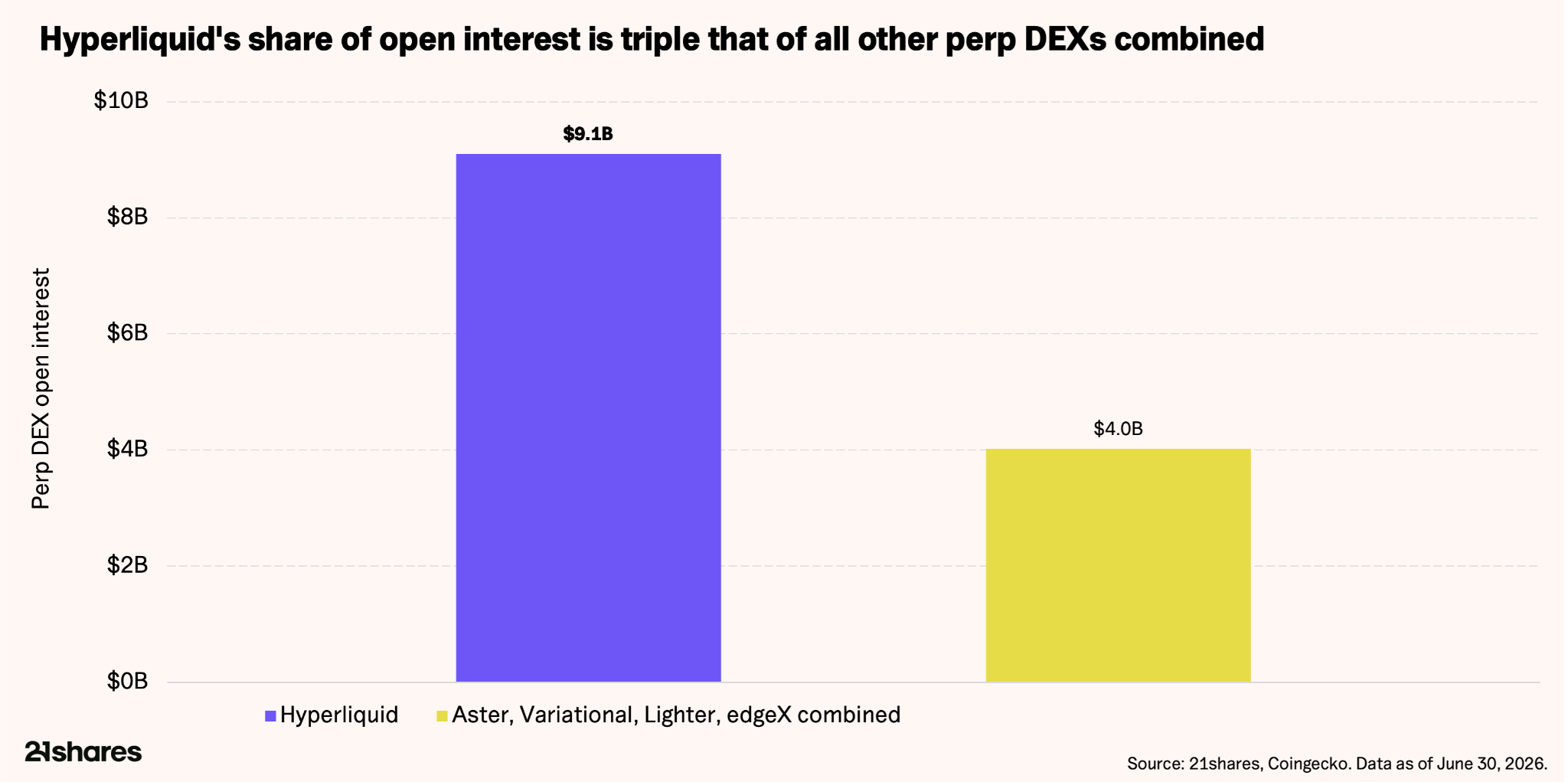
Within DeFi, Hyperliquid holds more open interest than the rest of the market combined
Among onchain derivatives venues, Hyperliquid's lead is structural. It holds 54.5% of all decentralized perps open interest, 5.5x more than Aster ($1.7 billion), Hyperliquid's nearest competitor, and more than the rest of the onchain market combined. However, one competitive moat is eroding: Aster now directs 99% of fees to buybacks alongside a matching burn, mirroring Hyperliquid's own token value accrual model. The more significant threat may come from outside decentralized finance (DeFi) entirely: the Chicago Mercantile Exchange (CME) launched 24/7 gold futures on July 27, doing roughly $60 million in notional volume on its opening weekend versus Hyperliquid's $16 million that same weekend. The CME is directly targeting the commodities and equities markets where Hyperliquid's HIP-3 growth is most concentrated.
At 23x issuance-adjusted P/E, HYPE is priced roughly in line with traditional stock exchange peers
Valuing Hyperliquid requires treating HYPE like an exchange rather than a typical crypto token. A price-to-earnings (P/E) ratio measures how much the market pays for each dollar of a company's earnings. Applied here, the P/E allows a direct comparison between HYPE and listed exchange stocks. Against a peer set of CME (18.7x), CBOE Global Markets (CBOE) (20.7x), Interactive Brokers (IBKR) (34.3x), and Coinbase (48.1x), the 24.5x average P/E places HYPE's issuance-adjusted 23x multiple slightly below that average.
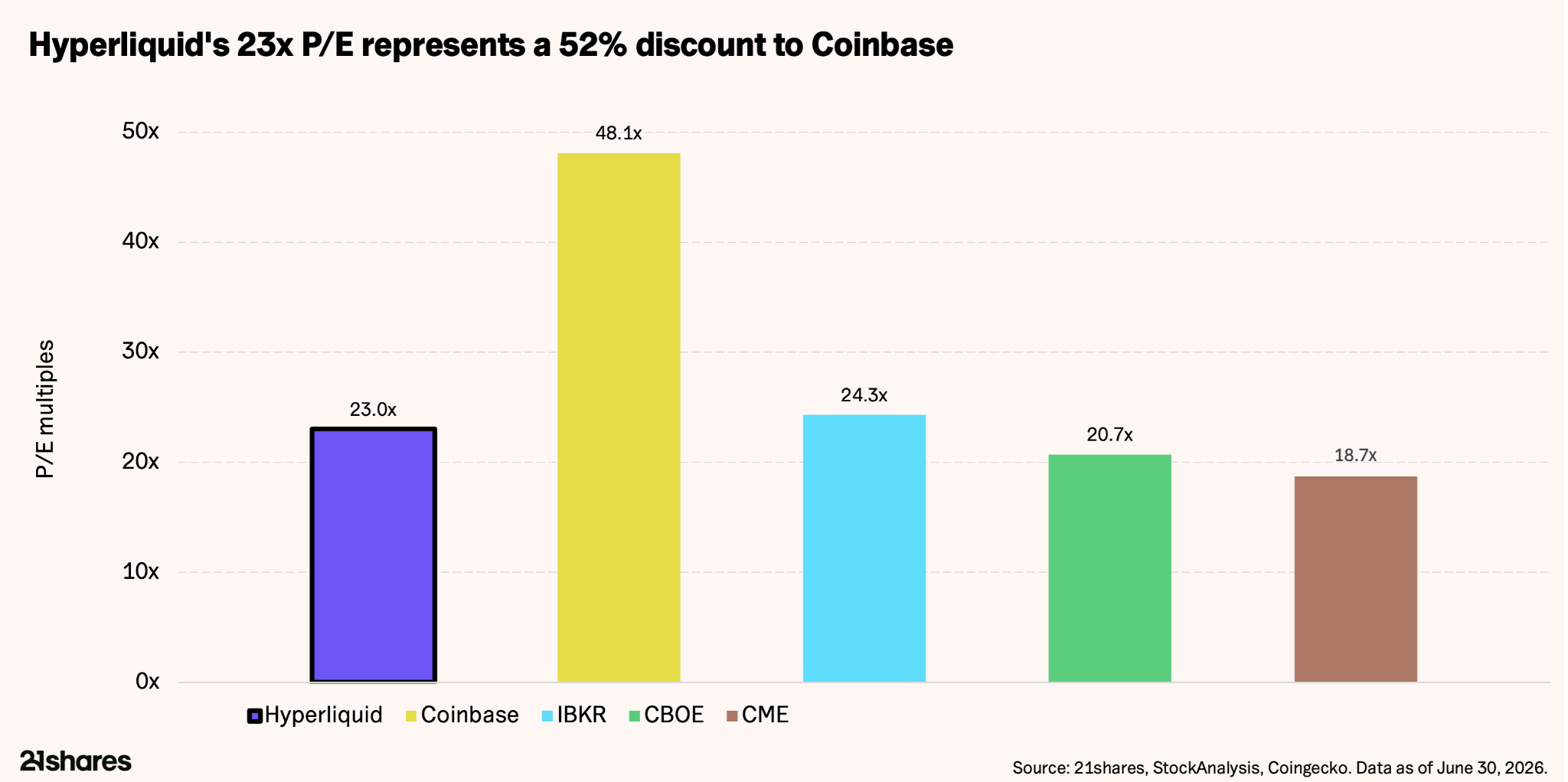
The raw P/E of 15.6x rises to 23x once approximately $309 million of annual token issuance is treated as a cost. The discounted cash flow (DCF) range (a valuation method that estimates what future earnings are worth in today's terms) is considerably wider: a bear scenario (25% required return, 13% near-term growth) implies $29/HYPE, while a bull scenario (15% required return, 27% growth) implies $120/HYPE versus the current approximately $58 spot price.
What the numbers add up to
Hyperliquid enters H2 2026 with its user base growing, its total fee pool expanding, and its open interest near all-time highs. But the revenue mix that underpins HYPE's value accrual is shifting.
While its core crypto perps business still drives over 80% of gross fees, revenue growth has been negative in 2026. Hyperliquid's newest growth engine, its HIP-3 markets tracking non-crypto real-world assets such as equities, oil, and gold, is real and accelerating. However, it carries two risks the original platform didn't:
- Single-builder concentration: Trade.xyz powers nearly all HIP-3 open interest and volume.
- Regulatory uncertainty: equities and pre-IPO markets remain in a legal grey zone, even as the Commodity Futures Trading Commission (CFTC) signals progress on crypto perps.
The USDC reserve income, if confirmed onchain, would add a volume-complementary revenue stream. If realized, the over $6 billion in USDC currently deposited on the platform could generate as much as $160 million in additional annual revenue, at current annualized figures of roughly $600 million, an increase of nearly 30%
HIP-4, Hyperliquid's framework for fully collateralized prediction markets and options-style contracts (requiring deployers to stake 500,000 HYPE) is a further revenue diversifier. It opens a new fee-generating product surface while locking up HYPE supply.
Deribit, the world's largest crypto options platform, generated an estimated $250 million in options revenue in 2024, while prediction market venues Kalshi and Polymarket together reached an estimated $4 billion-plus in annualized revenue for 2026. Hyperliquid is now positioned to compete for share in both.
At 23x issuance-adjusted P/E, the market is pricing in roughly fair value against traditional finance peers. Whether Hyperliquid can extend that valuation depends on its ability to defend and grow its position across both crypto and traditional market infrastructure, competing not just against onchain rivals, but against an incumbent financial system that is increasingly trading 24/7.
FAQ
What were Hyperliquid's earnings results for H1 2026?
Hyperliquid generated $419.3 million in gross fees in H1 2026, up 31% from $320 million in H1 2025, while average daily active users rose 90% over the same period (Artemis, DeFiLlama, HypurrScan. Data as of 30 June 2026). Core protocol revenue, the fee share that flows back to the platform's own treasury, declined slightly from $317.5 million to $305.3 million, as HIP-3 markets captured a growing share of total fees without returning them fully to the protocol.
What is HIP-3 and why does it matter for Hyperliquid's revenue?
HIP-3 (Hyperliquid Improvement Proposal 3) is an open framework allowing external businesses to launch their own markets on Hyperliquid's infrastructure, keeping 50% of the resulting trading fees. HIP-3 markets grew from negligible to 11.2% of gross fees in less than a year, a year-to-date increase of over 10,000% (21shares, Artemis, DeFiLlama. Data as of 30 June 2026). This explains why gross fees rose sharply while core protocol revenue declined: total activity is growing, but a larger share of it now flows to external builders rather than the protocol treasury.
How does Hyperliquid compare to centralized exchanges in the perpetuals market?
Hyperliquid holds $9.1 billion in open interest, representing 10.3% of the entire crypto perpetuals market including centralized venues, placing it alongside Bybit in scale (21shares, CoinGecko. Data as of 30 June 2026). Within decentralized finance (DeFi) specifically, Hyperliquid holds 54.5% of all onchain derivatives open interest — more than the rest of the onchain market combined. Binance remains the largest single venue with 14% of global open interest.
Is HYPE fairly valued at its current price?
At an issuance-adjusted price-to-earnings (P/E) ratio of 23x, HYPE trades slightly below the average P/E of its listed exchange peer group — which includes the Chicago Mercantile Exchange (CME) at 18.7x, CBOE Global Markets (CBOE) at 20.7x, Interactive Brokers (IBKR) at 34.3x, and Coinbase at 48.1x, averaging 24.5x (21shares, StockAnalysis, CoinGecko. Data as of 30 June 2026). A discounted cash flow (DCF) analysis produces a wide range: a bear scenario implies approximately $29 per HYPE and a bull scenario implies approximately $120, against a current spot price of approximately $58. This is a valuation framework, not a price target. HYPE's price is highly volatile and may fall significantly. Past performance is not a reliable indicator of future results.
What are the main risks facing Hyperliquid going into H2 2026?
Three risks stand out from the earnings analysis. First, HIP-3 revenue is heavily concentrated through a single builder — Trade.xyz powers nearly all HIP-3 open interest and volume. Second, HIP-3's equities and pre-initial public offering (IPO) markets operate in a regulatory grey zone, even as the Commodity Futures Trading Commission (CFTC) signals progress on crypto perpetuals rules. Third, the Chicago Mercantile Exchange (CME) launched 24/7 gold futures in July 2026, directly targeting the commodities and equities markets where Hyperliquid's HIP-3 growth is most concentrated (21shares. Data as of 30 June 2026).