Fear, uncertainty, and doubt: What is the data telling us?




Analysis by Eliezer Ndinga, Karim Abdelmawla, and Matt Mena
On February 5, Bitcoin dipped below $70,000 for the first time since November 2024. The recent market weakness reflects a shock-driven, cross-asset deleveraging event, not a breakdown in Bitcoin’s structural thesis.
A convergence of global rates volatility, policy shock, and geopolitical escalation triggered forced risk reduction across asset classes. Gold fell more than 1%, slipping below $4,900 per ounce, and silver dropped over 11%, falling to under $79 per ounce.
With traditional markets closed, digital assets absorbed disproportionate selling pressure due to their 24/7 liquidity, amplifying the visible drawdown. However, investor behavior reflected in spot flows, derivatives positioning, and exchange-traded funds, in addition to onchain metrics, is consistent with leverage reset rather than capitulation.
What triggered the sell-off?
Global bond market volatility and higher-for-longer uncertainty
US Treasury yields continued to rise, tightening domestic financial conditions and increasing the opportunity cost of holding non-yielding or liquidity-sensitive assets such as Bitcoin.
Separately, volatility in Japanese government bonds, particularly at the long end, alongside renewed speculation around yen intervention, added to global rate instability.
Together, rising US yields and stress in Japanese bond markets reinforced a higher-for-longer rate regime and contributed to cross-asset risk reduction, rather than reflecting a US-only rates shock.
Dollar strength following the Kevin Warsh nomination
The dollar strengthened in the aftermath of the Warsh nomination, growing by almost 2.6% since January 26, consistent with expectations of tighter monetary discipline.
While Bitcoin does not trade as a clean inverse to the dollar, dollar strength typically signals tighter global liquidity, which has historically weighed on risk assets, including Bitcoin.
Growth impulse firming
The US economy is running hotter than expected. Measuring business activity, the Institute for Supply Management Purchasing Managers’ Index (PMI) rose to 52.6, its highest level since 2022, pointing to stronger economic momentum.
Stronger growth data reduces the urgency for policy easing and reinforces expectations for higher-for-longer rates, further pressuring liquidity-sensitive assets.
Policy shock: Kevin Warsh's nomination as a dual shock
Markets interpreted Warsh’s nomination as signaling greater monetary discipline:
- Less balance sheet expansion
- Firmer dollar policy bias
- Higher real rates
Importantly, this functioned as a dual shock:
- It pressured risk-on assets through tighter liquidity expectations.
- It also weakened the inflation-hedge narrative underpinning gold and other stores of value.
This helps explain why both growth assets and traditional havens sold off simultaneously, consistent with margin-driven de-risking rather than asset-specific weakness.
Geopolitical escalation
Rising tensions around Iran, including US rhetoric and reports of explosions at Bandar Abbas port, intensified risk-off positioning.
Iranian leadership warned of a broader regional conflict, acting as the final catalyst for weekend selling.
Policy uncertainty and data visibility
January labor data will not be released due to the partial government shutdown, reducing near-term visibility into employment conditions. At the same time, lingering uncertainty around whether the government will remain funded in the coming weeks added another layer of policy risk.
Together, data delays and funding uncertainty reinforced cautious positioning even in the absence of a full shutdown.
How the sell-off manifested
Crypto as the primary shock absorber
With traditional markets closed over the weekend, digital assets became the primary venue for global risk expression.
Bitcoin failed to hold $84,000, broke below $80,000, and triggered a cascade of liquidations. Price reached a low of $72,500 before stabilizing in the $73,000 - $76,000 range.
Drawdown severity
From mid-last week to Sunday, Bitcoin declined over 15% over five days, one of its most severe short-term drawdowns in nearly two years.
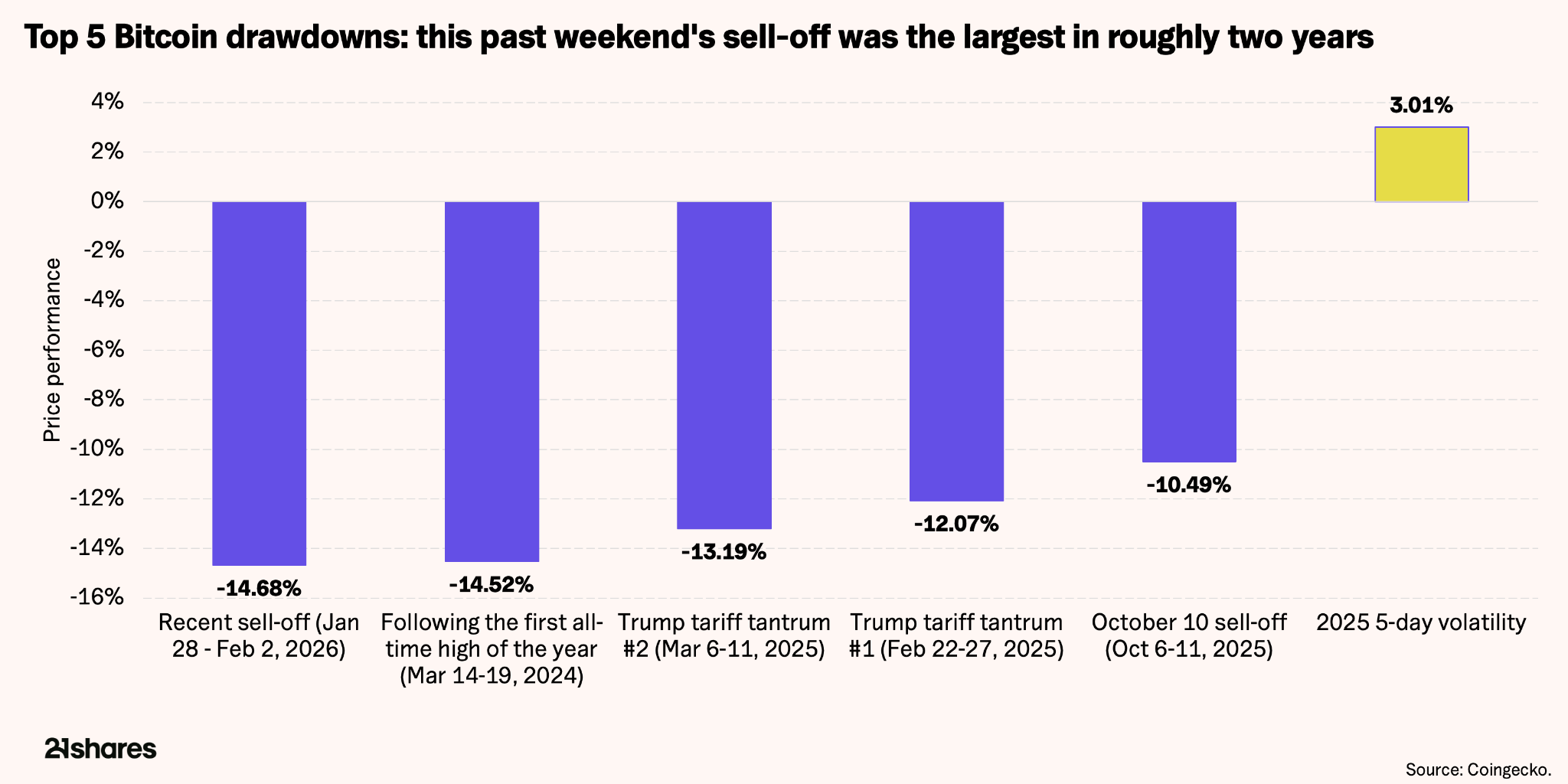
Statistically, this represents a ~2 standard-deviation move, with an estimated ~1% historical probability, underscoring the severity of the liquidity vacuum rather than fundamental stress.
Forced deleveraging
Derivatives liquidations totaled $3.7 billion over the weekend - with $2.6 billion on Friday alone, heavily concentrated in long positions ($2.4 billion vs. ~$150 million shorts). The scale of the move makes it the 10th-largest liquidation event on record, suggesting a mechanical unwind of leverage rather than discretionary selling.
Thin weekend liquidity amplified price moves, but was not the root cause.
Cross-asset margin dynamics
The sell-off was not crypto-specific:
- Silver collapsed more than 30% in a single session and is now ~35% below its January 29 high.
- Gold fell ~9% on January 30 and is down more than 20% from recent highs.
- High-growth equities and mega-cap tech also retraced sharply - with the MAG7 dropping by more than 6% from the January 30 until the February 5.
Taken together, CME margin hikes in precious metals forced leveraged positions to unwind, contributing to broader cross-asset deleveraging1.
Crypto market impact
Bitcoin declined by approximately $200 billion in market value. Total crypto market capitalization fell by ~12% to $2.62 trillion. These declines reflect the market’s role as a liquidity sink during the shock, not a deterioration in fundamentals.
What markets are signaling now
Spot volumes: heavy selling, not capitulation
From January 29 to February 2:
- Daily spot sell volume for Bitcoin increased ~45%, from ~$4.6 billion to ~$6.7 billion - a one standard deviation move.
- Spot buying rose in parallel to ~$6.4 billion.
- Sell/buy ratios remained contained at ~1.04 to 1.05×.
In prior capitulation regimes (March 2020, mid-2022), sell/buy ratios exceeded 1.10×, reflecting a collapse in demand. Thus, the current pattern indicates deleveraging, not panic-driven exit at the moment.
Derivatives positioning reset
Open interest declined by around 16% from ~$30 billion to ~$25 billion, confirming a leverage flush.Funding rates rebounded from -0.009 to -0.001, easing downside pressure.
Liquidation risk is now skewed to the upside:
- Approximately $2 billion in short liquidations clustered between $80,000-$86,000
- Relatively limited long liquidation exposure below $74,000
The key signal is whether open interest and funding rebuild, confirming stabilization rather than trend deterioration.
ETF flows
Bitcoin ETFs saw ~$1.3 billion in outflows on January 29 and 30. The sharpest Bitcoin drawdown (-8.7%) occurred over the weekend when ETFs were not trading. Flows turned +$450 million upon reopening on February 2, indicating ETFs reacted to volatility rather than drove it this time.
Fundamental signals
Stablecoin liquidity is holding up
Total stablecoin supply is down only ~2% since mid-January, at $306 billion, and market cap is down from a high of $311 billion.
Onchain transaction volume exceeded $10 trillion in January, indicating sustained operational activity.
Institutional momentum continues:
- Fidelity stablecoin launch
- Hong Kong’s first stablecoin issuer license
- UAE central bank approval of a USD-denominated stablecoin
Large investors remain resilient
Despite a ~25% price drawdown since November, the number of ≥1k BTC holders rose from 1,219 to 1,299 (+6.6%).
This suggests supply transfer to larger, price-insensitive holders, consistent with deleveraging rather than distribution.
Long-term investor cost basis remains stable
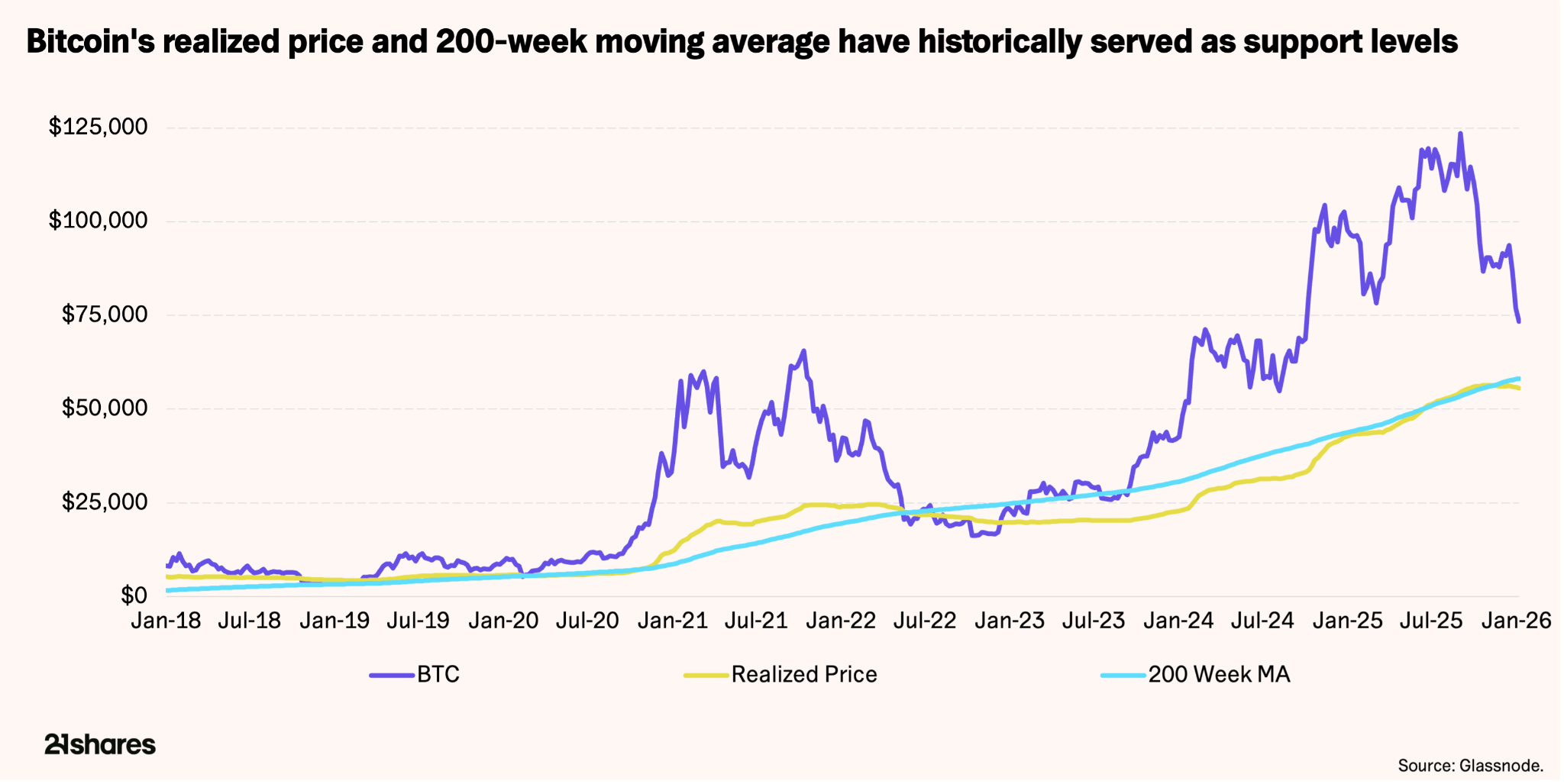
Despite a ~25% drawdown in spot price since November, Bitcoin’s realized cap (or aggregated cost basis) is down less than 1%.
In prior capitulation regimes (2018, March 2020, 2022), realized cap contracted by ~10–18%, reflecting broad long-term holder capitulation and cost-basis resets
In the current episode, realized losses are concentrated in short-duration wallets (<3 months), while 3-year+ cohorts remain largely patient with no meaningful repricing of their cost basis.
Thus, this divergence indicates a deleveraging event rather than a structural regime shift.
Projects with strong fundamentals continue to attract capital
Despite broad risk-off conditions, assets with clear revenue and product-market fit continue to outperform.
Canton Network and Hyperliquid are up ~30% Week on week - driven by strong fundamental metrics and product expansion -, and ParaFi’s $35 million allocation into JUP highlights capital rotating toward assets with tangible use and cash flows rather than exiting crypto indiscriminately.
Scenarios and technical levels
Bear case
- $72,000-74,000: Critical support zone (“Liberation Day” low and pre-Trump 2024 highs).
- $65,000 - $69,000: Prior cycle all-time high and structural retest zone.
- $56,000 - $58,000: Long-term cost basis and 200-day moving average convergence; historically separates corrective drawdowns from capitulation phases.
Bull case
- $80,000: Immediate resistance. Reclaiming this level signals stabilization.
- $85,000: Trend confirmation. A clean break with volume would suggest the panic-driven phase has ended.
The path forward depends on macro stabilization, leverage rebuilding, and technical follow-through -determining whether the market consolidates or extends the correction.
______
Footnotes:
- Reuters. (2026, February 2). Gold, silver extend fall as CME margin hikes compound sharp selloff. Reuters. https://www.reuters.com/world/india/gold-falls-15-firm-dollar-silver-recovers-over-three-week-low-2026-02-02/
This report has been prepared and issued by 21Shares AG for publication globally. All information used in the publication of this report has been compiled from publicly available sources that are believed to be reliable, however, we do not guarantee the accuracy or completeness of this report. Crypto asset trading involves a high degree of risk. The crypto asset market is new to many and unproven and may have the potential not to grow as expected.Currently, there is relatively small use of crypto assets in the retail and commercial marketplace in comparison to relatively large use by speculators, thus contributing to price volatility that could adversely affect an investment in crypto assets. In order to participate in the trading of crypto assets, you should be capable of evaluating the merits and risks of the investment and be able to bear the economic risk of losing your entire investment.Nothing herein does or should be considered as an offer to buy or sell or solicitation to buy or invest in crypto assets or derivatives. This report is provided for information and research purposes only and should not be construed or presented as an offer or solicitation for any investment. The information provided does not constitute a prospectus or any offering and does not contain or constitute an offer to sell or solicit an offer to invest in any jurisdiction. The crypto assets or derivatives and/or any services contained or referred to herein may not be suitable for you and it is recommended that you consult an independent advisor. Nothing herein constitutes investment, legal, accounting or tax advice, or a representation that any investment or strategy is suitable or appropriate to your individual circumstances or otherwise constitutes a personal recommendation. Neither 21Shares AG nor any of its affiliates accept liability for loss arising from the use of the material presented or discussed herein.Readers are cautioned that any forward-looking statements are not guarantees of future performance and involve risks and uncertainties and that actual results may differ materially from those in the forward-looking statements as a result of various factors.This report may contain or refer to material that is not directed to, or intended for distribution to or use by, any person or entity who is a citizen or resident of or located in any locality, state, country or other jurisdiction where such distribution, publication, availability or use would be contrary to law or regulation or which would subject 21Shares AG or any of its affiliates to any registration, affiliation, approval or licensing requirement within such jurisdiction.