

Bitcoin provides both potential for growth and diversification.
During periods of economic growth, Bitcoin often acts as a "growth asset," meaning its price tends to rise when there is more money moving through the global economy. However, it can also pivot toward a defensive role – acting like "digital gold" – during times of market stress or when traditional currencies lose their value. This can protect your portfolio from inflation.
A key to building a resilient portfolio is choosing assets that do not always move in the same direction. Understanding how different investments react to the same news is central to managing risk.
Our research shows that Bitcoin has historically exhibited lower average correlations to equities than most traditional assets, although correlations can rise temporarily.
Because its price is driven by different factors than the earnings of traditional companies, adding a small amount of bitcoin to your portfolio may help "smooth out" the ups and downs of your other investments. Over time, holding assets that do not always move in sync can lead to a more diversified and effective investment strategy.
Bitcoin in a traditional portfolio
In the past, bitcoin’s price hasn't usually moved in the same direction as stocks or bonds. However, this can change depending on what is happening in the global economy.
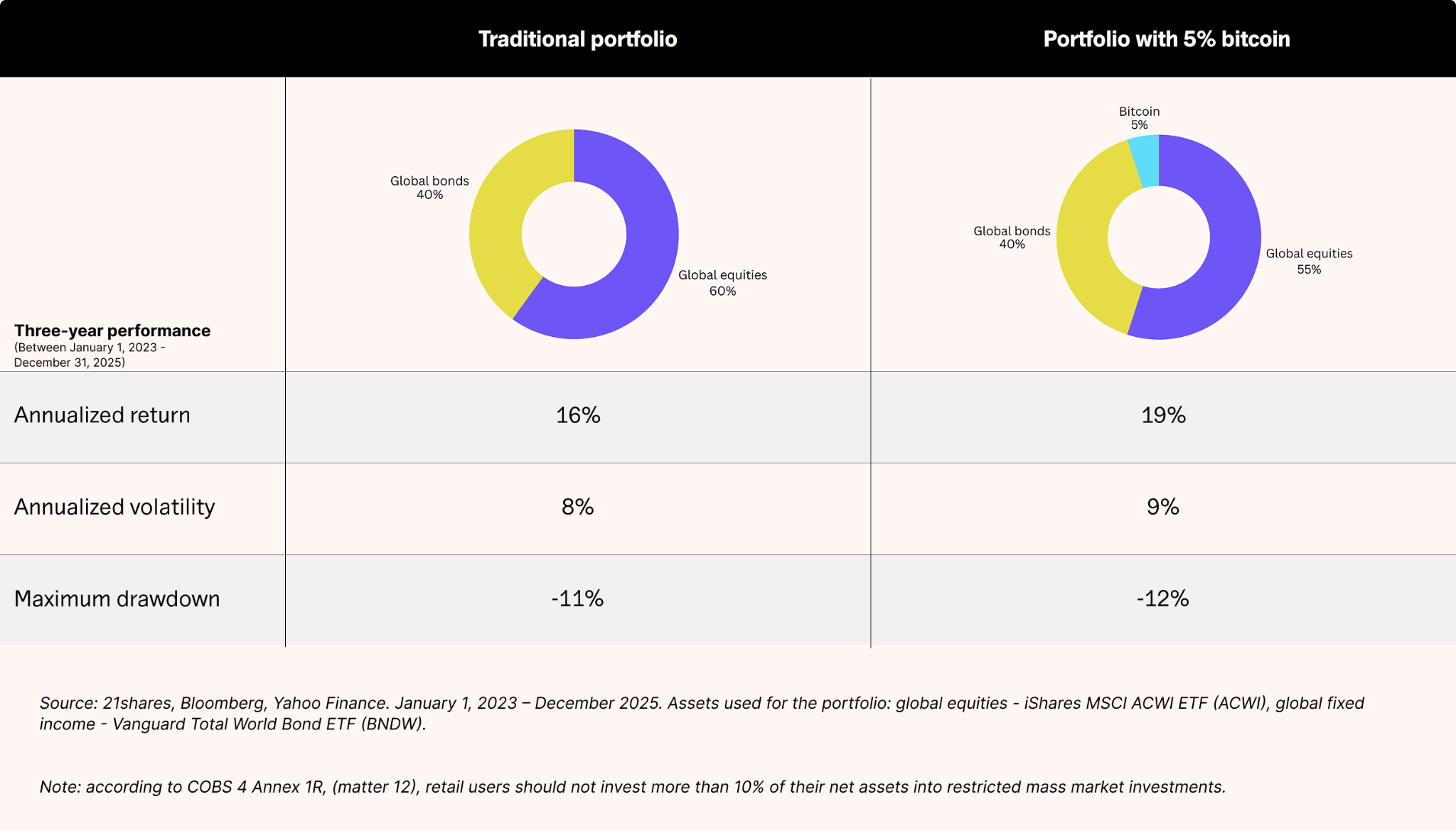
History has shown that, when sized appropriately, small allocations to bitcoin have improved portfolio efficiency. As illustrated in the chart below, a 5% bitcoin allocation delivered a 3 percentage point improvement in annualized returns with only a marginal increase in volatility and maximum drawdown over the three years from January 2023 to December 2025. The result is a meaningfully better return-to-risk profile, demonstrating that even a modest allocation can enhance risk-adjusted performance without disproportionately impacting downside.1
Bitcoin’s value in a portfolio lies in its differentiated return drivers and asymmetric upside potential – this is what we mean by diversification.
The table below compares a traditional portfolio – made of 60% stocks and 40% bonds – with a more modern portfolio that includes a small allocation of bitcoin. These examples are based on historical data from the last three years to illustrate how different strategies performed.
Interestingly, the portfolios that included bitcoin recovered faster from their largest price drops. During the market fall triggered by US tariffs in April 2025, the traditional portfolio took 22 days to return to its previous value. In contrast, the portfolios containing bitcoin recovered in just 17 days. This suggests that a small amount of bitcoin may help a portfolio bounce back more quickly during certain types of market stress.
Footnotes:
- 21shares, Bloomberg, Yahoo Finance. January 1, 2023 – December 31, 2025. Global equities: iShares MSCI ACWI ETF (ACWI); Global fixed income: Vanguard Total World Bond ETF (BNDW).