
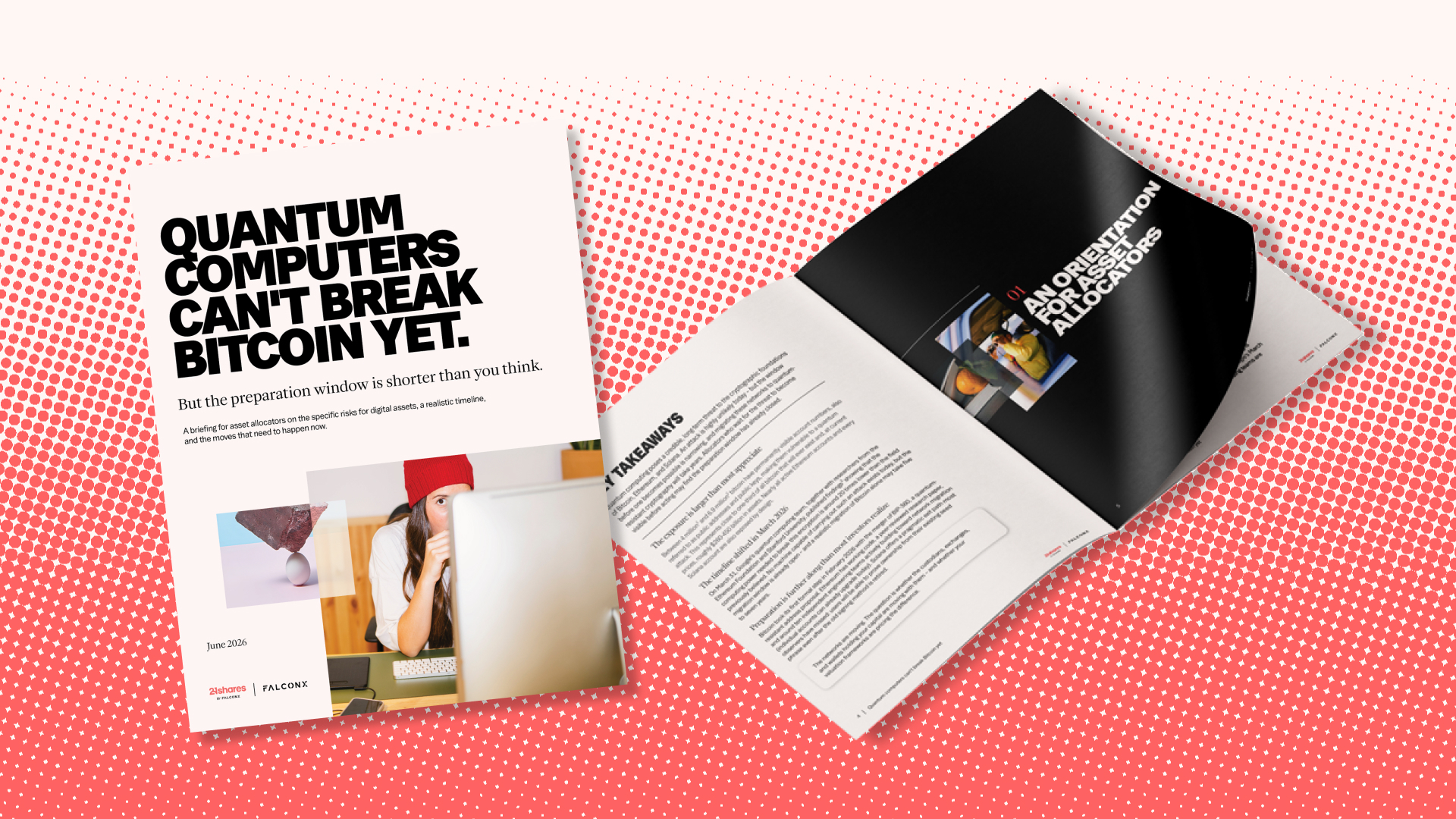
Quantum computing is not an existential threat to digital assets today – but the window to prepare before it becomes one is already open, and it will not stay open indefinitely. Formal proposals, working prototypes, and engineering breakthroughs have converged in the first half of 2026 across multiple independent teams, at a pace that would have been hard to imagine just twelve months ago: the response is no longer theoretical.
To help asset allocators navigate what this means in practice, 21shares researchers Karim AbdelMawla and Eliézer Ndinga – drawing on expertise from Project Eleven, Castle Island Ventures, Coinbase, Anza/Solana, and the Ethereum Foundation – have published Quantum computers can't break Bitcoin yet – but the preparation window is shorter than you think. Below are six things every allocator should know. Read the full report for the details behind each one.
1. The threat is to ownership, not the blockchain
Quantum computing does not threaten the blockchain’s transaction history – settled records stay intact. What’s threatened is the proof of ownership: the mechanism that ensures only you can authorize a transaction, the digital equivalent of a signature or PIN code. Past transactions would not change, but control over funds could be compromised if certain account information is visible. The report explains exactly where that visibility exists and where it does not.
2. Today's quantum computers cannot break Bitcoin – but the gap is narrowing
The computing power needed to break the protection on Bitcoin, Ethereum, and Solana is large, but recent research from Google3 – published jointly with the Ethereum Foundation and Stanford University – shows it is about 20 times less than previously estimated. No machine with this capability exists today, but the threshold moved closer not because anyone built a better machine, but because researchers found a more efficient approach – and that pattern of sudden improvement, rather than gradual hardware progress, is what makes the timeline hard to predict.
3. The real risk is a deadline that moves, not a fixed one
Expert timelines for a capable quantum computer range from the early 2030s to beyond 2040. The risk is not that a specific date arrives, but that breakthroughs compress those timelines faster than the ecosystem can respond.4 Google’s March 2026 research3 also showed that, on the type of hardware the leading teams are building, the protection on a bitcoin payment could theoretically be broken fast enough to interfere with a transaction before it settles. Practical defenses for this exist and could be deployed well before the hardware matures – but only if preparation starts now, not when the threat appears imminent. A realistic migration of Bitcoin alone may take five to seven years.
4. Risk concentrates where capital does – and one threat is already active
The biggest targets are not individual wallets but the systems where a small number of compromised keys could unlock large pools of capital – payment bridges between blockchains, shared treasury accounts, and network operators. These concentration points already carry risk today: bridges alone have lost close to $3 billion since 2022, without any quantum involvement.5 One quantum-related threat requires no future hardware: attackers can copy exposed account information today and decrypt it once quantum capability matures – a practice the US Federal Reserve has described as a “present and ongoing” risk.6 Google’s March 2026 research3 also identifies an attack where a single quantum computation could create a permanent weakness in parts of Ethereum’s infrastructure – a risk Bitcoin does not appear to share. The Ethereum Foundation's co-authorship of the research signals the issue is already being addressed.
5. Governments and big tech are already preparing – most blockchains are catching up
The US government requires all new national security systems to use quantum-resistant protection from January 2027.7 Google set a 2029 deadline for its own migration8 back in 2019. And Cloudflare,9 Apple,10 Signal,11 Microsoft,12 and AWS13 are already deploying upgraded protections. The blockchain ecosystem has not kept pace: 24 of the top 26 protocols still rely entirely on methods being phased out elsewhere.14 The replacement technology is standardized, tested, and available – the gap is in adoption, not invention. However, the fact that the organizations closest to the threat are now collaborating openly can be taken as a sign that the response is maturing.
6. The networks are beginning to move – understanding the timeline is key
Upgrading a blockchain is not like updating a phone app – there is no single company that can push a fix. Bitcoin took its first formal step in February 2026 with a new quantum-resistant address proposal.15 Ethereum has working code and around ten independent teams working toward network migration, with individual accounts able to upgrade today. Solana has a practical recovery path, so no user who acts in time will permanently lose access. Progress is real and measurable.
Past Bitcoin upgrades show that network-wide adoption takes years, even after proposals are approved.16 The networks that move earliest will carry lower transition risk and face fewer forced migrations under pressure. That readiness gap is not yet reflected in most valuation frameworks – this may be a relevant due diligence consideration for allocators.
The quantum threat is not a cliff edge – it is a multi-year, trackable migration, and the networks that move earliest will carry the lowest transition risk. Understanding where that readiness gap sits today is the due diligence advantage – and it is exactly what this report was written to provide.
______
Footnotes:
- Deloitte Netherlands, "Quantum computers and the Bitcoin blockchain," accessed 2025. https://www.deloitte.com/nl/en/services/consulting-risk/perspectives/quantum-computers-and-the-bitcoin-blockchain.html
- Project Eleven, "Bitcoin RISQ List," accessed 2025. https://www.projecteleven.com/bitcoin-risq-list
- Babbush, R., Zalcman, A., Gidney, C. et al., "Securing Elliptic Curve Cryptocurrencies against Quantum Vulnerabilities: Resource Estimates and Mitigations," Google Quantum AI, Ethereum Foundation & Stanford University, March 2026. https://quantumai.google/static/site-assets/downloads/cryptocurrency-whitepaper.pdf
- Nature Communications, "Quantum error correction breakthrough," accessed 2025. https://www.nature.com/articles/s41467-025-65836-3
- DefiLlama, "Hacks: Total Value Lost," accessed March 2026. https://defillama.com/hacks/total-value-lost
- Federal Reserve Board, FEDS Working Paper 2025-093, accessed 2025. https://www.federalreserve.gov/econres/feds/files/2025093pap.pdf
- NSA, "CNSA 2.0 FAQ," September 2022. https://media.defense.gov/2022/Sep/07/2003071836/-1/-1/0/CSI_CNSA_2.0_FAQ_.PDF
- Google, "Cryptography Migration Timeline," Google Blog, 2019. https://blog.google/innovation-and-ai/technology/safety-security/cryptography-migration-timeline/
- Cloudflare, "Post-Quantum Cryptography 2025," Cloudflare Blog, 2025. https://blog.cloudflare.com/pq-2025/
- Apple, "iMessage PQ3 Security," Apple Support, accessed 2025. https://support.apple.com/en-us/122756
- Signal, "PQXDH Specification," Signal Documentation, accessed 2025. https://signal.org/docs/specifications/pqxdh/
- Microsoft, "Post-Quantum Cryptography APIs Now Generally Available on Microsoft Platforms," Microsoft Security Blog, 2025. https://techcommunity.microsoft.com/blog/microsoft-security-blog/post-quantum-cryptography-apis-now-generally-available-on-microsoft-platforms/4469093
- AWS, "Post-Quantum Cryptography," Amazon Web Services, accessed 2025. https://aws.amazon.com/security/post-quantum-cryptography/
- Cambridge Judge Business School, "Why Quantum Matters Now for Blockchain," 2025. https://www.jbs.cam.ac.uk/2025/why-quantum-matters-now-for-blockchain/
- Bitcoin, "BIP-360," GitHub, accessed 2025. https://github.com/bitcoin/bips/blob/master/bip-0360.mediawiki
- Cointelegraph Magazine, "Nobody knows if quantum secure cryptography will even work," accessed 2026. https://cointelegraph-magazine.com/dirty-secret-quantum-signatures-no-one-knows/






.svg)