
.jpg)
By Matt Mena
At last month’s Bitcoin conference in Las Vegas, one topic dominated the conversation: the GENIUS Act. In his speech, Vice President J.D. Vance called on lawmakers to support the bill, officially titled the Guiding and Establishing National Innovation for US Stablecoins (GENIUS) Act. This bipartisan legislation is sparking debate in Congress, as it aims to establish the first federal framework for stablecoins.
As of early June 2025, the GENIUS Act, one of the most significant crypto bills to date, is steadily moving through the U.S. Senate. In May, it cleared a major hurdle with a 66–32 procedural vote, signaling strong bipartisan support. Lawmakers are now making final amendments, and the bill is widely expected to pass the full Senate later this month. If enacted, enforcement would likely begin in Q3 2026.
Let’s break down what the GENIUS Act is all about.
What is the GENIUS Act?
Stablecoins are a type of cryptocurrency designed to hold a steady value, typically pegged to a fiat currency like the U.S. dollar. The GENIUS Act sets clear rules for who can issue these stablecoins and how they must be backed (1:1 by cash or short-term Treasuries). It also lays out safeguards to protect both consumers and the broader financial system.
Importantly, the bill gives federal agencies, including the Office of the Comptroller of the Currency (OCC) and the Federal Reserve, authority to oversee major stablecoin issuers, while creating a structured path for compliant innovation. Under the proposed rules, practices like misleading marketing, unauthorized yield products, and foreign issuers dodging U.S. oversight would be banned.
The GENIUS Act could usher in a new era of crypto adoption by bringing legal clarity and legitimacy to dollar-backed stablecoins. Much like how ETFs opened the door for institutional Bitcoin investment, this legislation could unlock new applications for blockchain finance, and potentially onboard hundreds of millions of users in the process.
The importance of stablecoins in the crypto world
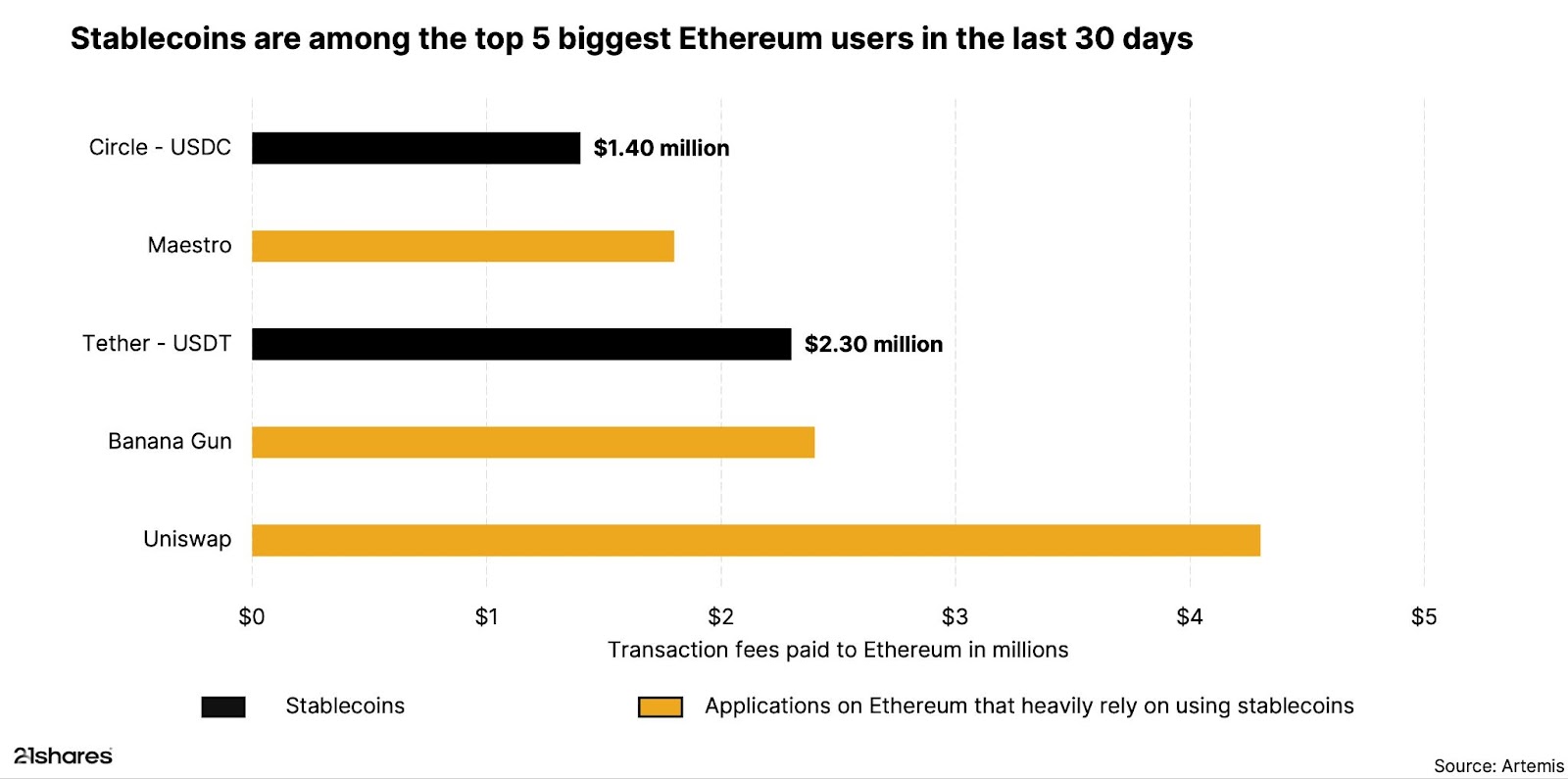
Stablecoins are already the most widely used product in crypto, serving as the backbone for payments, collateral, and trading throughout decentralized finance (DeFi). In the past month, two of the top five fee-consuming applications on Ethereum were stablecoins (see the figure below). Rounding out that list are Uniswap, Banana Gun, and Maestro, all of which are Ethereum-based apps that rely heavily on stablecoin activity.
If the GENIUS Act becomes law, stablecoins are likely to dominate fee usage not just on Ethereum but across major networks like Solana and emerging Bitcoin Layer 2s, signaling a fundamental shift in how value moves through blockchain ecosystems. This act isn’t just about regulatory clarity; it’s a structural unlock that could significantly accelerate stablecoin adoption and cement its role at the heart of the crypto economy.
Why the GENIUS Act matters to crypto ETF investors
In the past twelve months, stablecoin volumes have exceeded $7 trillion, while the total market cap has increased by over $100 billion, despite ongoing regulatory uncertainty. If that cloud is lifted and stablecoin issuance becomes federally licensed, it could open the floodgates to institutional investors, payment providers, and even sovereign entities. This would push the market closer to a multi-trillion-dollar scale. And as usage expands, some of that capital will inevitably flow into native tokens like Ether and Solana, which are essential for transacting on their respective networks.

For ETF investors, this is a promising signal. Greater stablecoin usage drives more transactions, increases demand for block space, and boosts protocol revenue, much of which flows back to native tokens. As a result, rising stablecoin activity can strengthen the long-term valuation case for assets like Ether, Solana, and even Bitcoin. In that sense, the GENIUS Act isn’t just about legitimizing stablecoins, it also reinforces the investment thesis for the blockchains that support them.





.svg)



_logo.svg)

.svg.png)